
Distribution Substation Market Outlook: Size, Share, Trends, Growth Analysis, Competitive Landscape & Forecast, 2026-2033

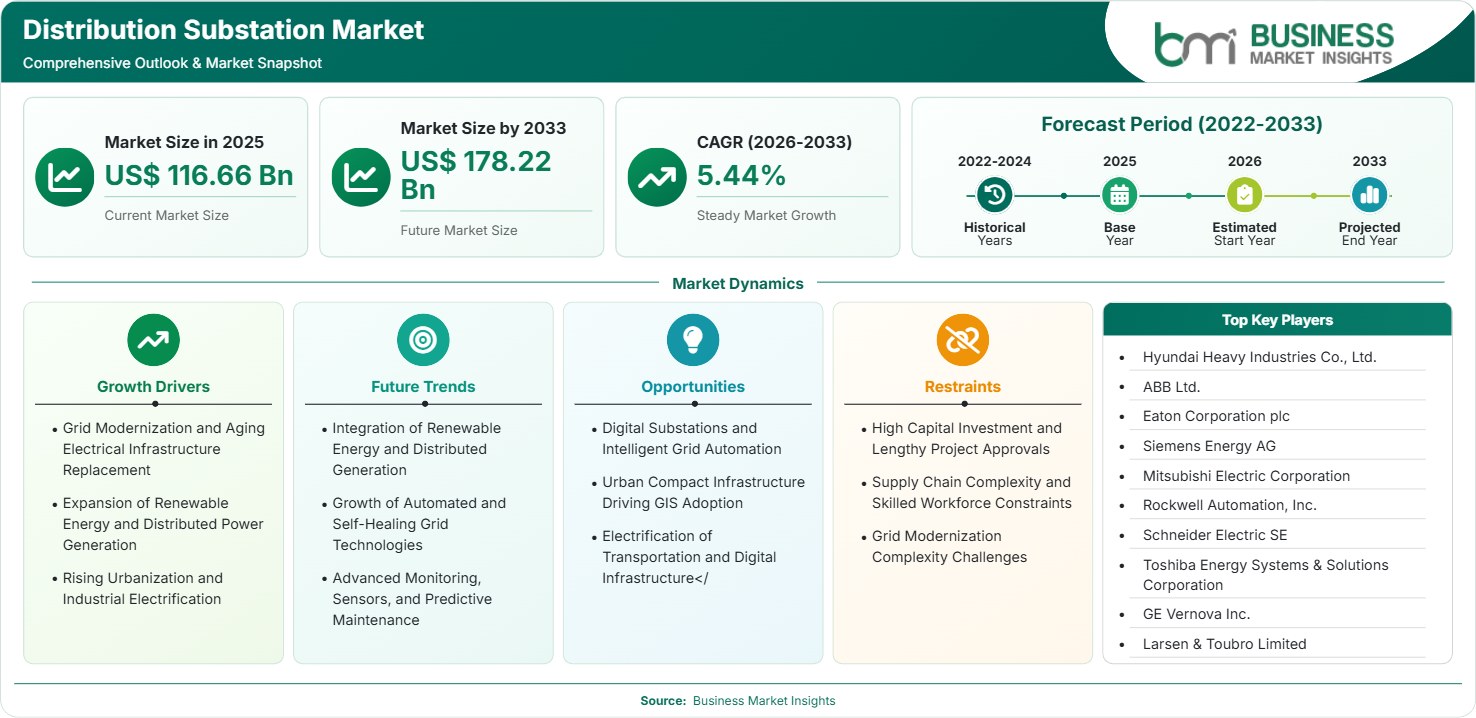
The Distribution Substation Market size was valued at US$ 116.66 Billion in 2025 and is projected to reach US$ 178.22 Billion by 2033, growing at a CAGR of 5.44% during 2026–2033. Rising grid modernization investments, renewable energy integration, urban electricity demand, and digital substation technologies are strengthening infrastructure resilience while creating long-term opportunities through smart distribution networks and advanced automation solutions.

Report Coverage
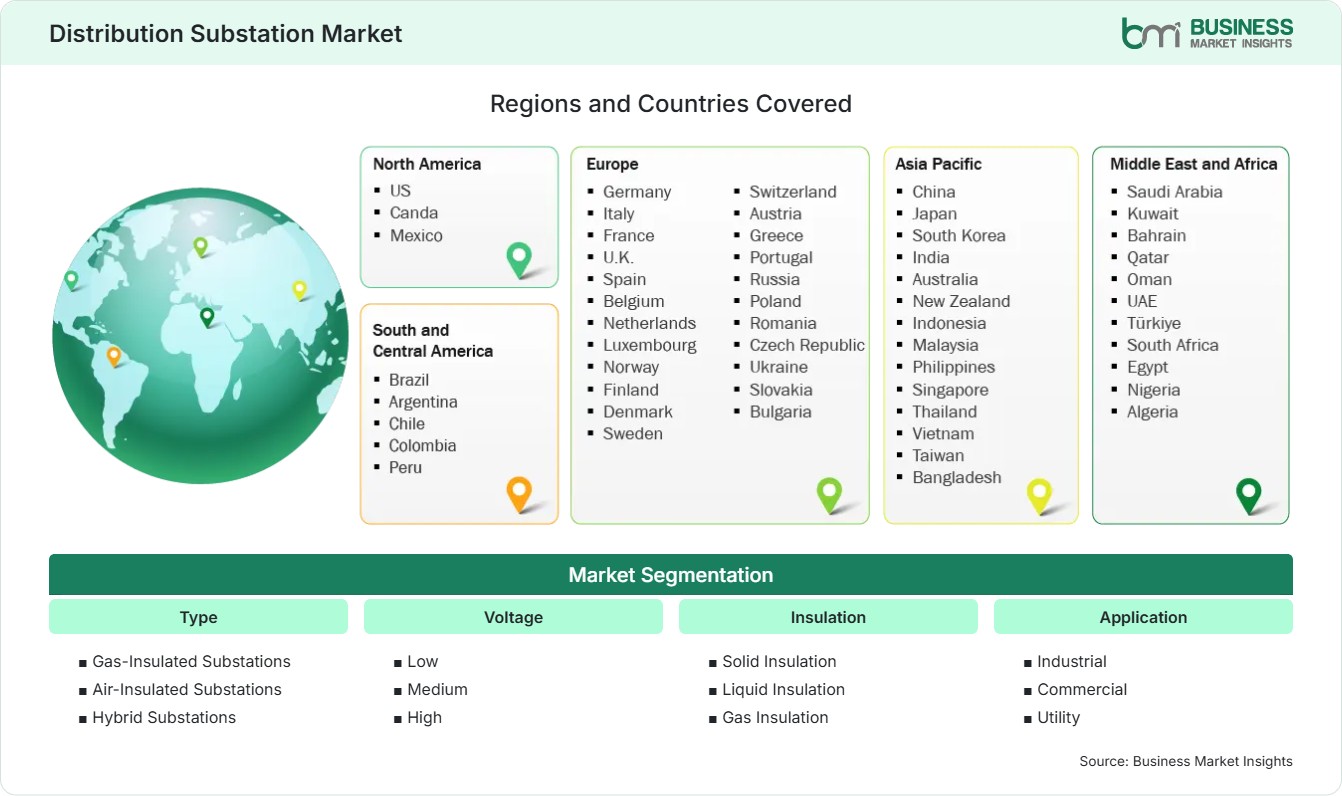
  • Type: Gas-Insulated Substations , Air-Insulated Substations , Hybrid Substations
  • Voltage: Low, Medium, High
  • Insulation: Solid Insulation, Liquid Insulation, Gas Insulation
  • Application: Industrial, Commercial, Utility
US$ 116.66 Bn Market size in 2025
US$ 178.22 Bn Market Size by 2033
5.44% CAGR, 2026 - 2033
2026-2033 Forecast Period

AI Overview

Distribution Substation Market Summary

  • North America Region: North America holds 32%–35% market share in 2025, expanding at a 4.8%–5.2% CAGR during 2026–2033, supported by aging grid replacement, utility digitalization, renewable integration, and federal infrastructure investments encouraging resilient electricity distribution systems and intelligent substation modernization initiatives. The U.S. remains the regional leader, supported by utility modernization projects, digital substations, renewable integration, and a projected CAGR of 4.9%–5.3% through 2033.
  • Fastest Growing Region: Asia Pacific accounts for 28%–31% market share in 2025 while advancing at a 6.5%–7.1% CAGR through 2033 due to accelerating urbanization, industrial expansion, renewable capacity additions, transmission upgrades, and increasing government investments supporting reliable electricity infrastructure.
  • Leading Segment: Air-Insulated Substations (AIS) represent 43%–46% market share in 2025 and are projected to grow at 4.9%–5.4% CAGR during 2026–2033 because of cost efficiency, proven operational reliability, simplified maintenance, and widespread deployment across utility distribution networks.
  • High Growth Segment: Gas-Insulated Substations (GIS) contribute 28%–31% market share in 2025 while recording a 6.7%–7.3% CAGR through 2033, driven by compact installation requirements, urban infrastructure expansion, environmental resilience, and increasing demand for high-performance grid equipment.
  • Key Market Opportunity: Digital substations integrating intelligent electronic devices, predictive maintenance platforms, and advanced monitoring technologies enable utilities to enhance grid reliability, reduce operating costs, improve asset utilization, and accelerate renewable energy integration.
  • Major Market Players: Hyundai Heavy Industries Co., Ltd., ABB Ltd., Eaton Corporation plc, Siemens Energy AG, Mitsubishi Electric Corporation, Rockwell Automation, Inc., Schneider Electric SE, Toshiba Energy Systems & Solutions Corporation, GE Vernova Inc., Larsen & Toubro Limited.
Strategic Insights

Distribution Substation Market: Strategic Insights

Distribution Substation Market Strategic Framework
FREE PDF
Request your free sample
Request free sample
Stakeholder View

Key Takeaways

  • Utility companies are increasingly transforming traditional distribution infrastructure into digitally connected ecosystems by integrating intelligent protection devices, advanced transformers, communication networks, and automated control systems that improve operational visibility and asset performance throughout the electricity value chain.
  • Strong investment potential exists within gas-insulated substations, high-voltage installations, and utility applications where compact designs, renewable energy connectivity, and higher operational reliability provide attractive long-term growth opportunities for manufacturers, EPC contractors, and technology suppliers.
  • Artificial intelligence, IoT-enabled sensors, cloud-based asset management, digital twins, and predictive maintenance software are reshaping substation operations by reducing unplanned outages, improving equipment lifespan, optimizing maintenance schedules, and enhancing overall grid efficiency.
  • Asia Pacific continues to present one of the most compelling investment environments due to rapid industrialization, expanding urban electricity demand, government-backed transmission expansion programs, and large-scale renewable energy deployment requiring modern distribution infrastructure.
  • Strategic partnerships between equipment manufacturers, utilities, engineering firms, and digital technology providers are accelerating innovation while mergers, acquisitions, and localized manufacturing investments strengthen competitive positioning and expand regional service capabilities.
  • Increasing emphasis on cybersecurity, climate resilience, and flexible grid architectures is encouraging utilities to adopt intelligent substation platforms capable of supporting distributed energy resources, electric vehicle charging infrastructure, and future electricity demand growth.
Geographic Outlook

Distribution Substation Market Regional Highlights

North America Distribution Substation Market

North America accounts for 32%–35% of the Distribution Substation Market share in 2025 and is projected to expand at a 4.8%–5.2% CAGR through 2033. Utility modernization programs, replacement of aging electrical infrastructure, renewable energy integration, and federal investment in resilient power networks continue supporting regional demand. Advanced automation, digital substations, and cybersecurity-enabled grid management remain strategic priorities for utilities across the United States and Canada, strengthening operational efficiency while improving distribution reliability and reducing outage risks.

  • Utilities are replacing aging transformers, switchgear, and protection systems with intelligent digital equipment to improve grid reliability and meet rising electricity demand.
  • Renewable energy integration requires flexible substations that can manage bidirectional power flows, driving adoption of automation, advanced monitoring, and predictive maintenance technologies.
  • Grid modernization investments continue to expand deployment of digital substations, communication-enabled relays, and remote asset management systems that improve resilience and reduce maintenance costs.
  • Growing electrification of transport, commercial buildings, and industry is increasing network loads, prompting utilities to expand substation capacity and enhance operational efficiency.

US Distribution Substation Market

The United States represents nearly 79%–82% of North American demand while advancing at a 4.9%–5.3% CAGR through 2033. Utility investments in smart grid deployment, renewable integration, wildfire resilience, and transmission modernization continue supporting sustained capital expenditure across distribution infrastructure. Strong federal funding programs and private utility investment accelerate digital transformation and intelligent substation implementation.

  • Large-scale renewable energy projects require upgraded substations equipped with intelligent monitoring systems, digital relays, and automated protection technologies capable of improving network stability and renewable integration efficiency.
  • Increasing electricity demand from electric vehicle charging infrastructure, hyperscale data centers, and manufacturing expansion is encouraging utilities to modernize aging distribution networks using advanced substation technologies.
  • Utilities continue adopting predictive asset management software, IoT-enabled monitoring devices, and cloud-connected operational platforms that reduce maintenance costs while improving system reliability and outage response performance.
  • Climate resilience initiatives encourage investment in hardened substations capable of operating under severe weather conditions while minimizing service interruptions and improving long-term grid reliability.

Europe Distribution Substation Market

Europe captures approximately 24%–27% market share during 2025 and is forecast to register a 4.7%–5.1% CAGR through 2033. Decarbonization strategies, renewable integration, cross-border electricity connectivity, and digital grid initiatives continue stimulating infrastructure upgrades. Germany remains the leading national market, while Eastern European countries exhibit stronger expansion supported by transmission modernization and increasing renewable electricity investments.

  • Germany leads the region through investments in intelligent substations, renewable integration, and industrial automation that support grid modernization and energy transition goals.
  • Poland is among the fastest-growing markets, driven by grid upgrades, renewable expansion, and modernization of aging transmission and distribution networks.
  • Utilities are increasingly adopting compact gas-insulated substations in urban areas where space is limited and reliability demands are high.
  • European utilities prioritize sustainable technologies, digital asset monitoring, and cybersecurity to enhance grid resilience and efficiency.
  • Smart grid and renewable energy regulations continue to boost demand for advanced transformers, intelligent switchgear, and digital protection systems across Europe.

Asia Pacific Distribution Substation Market

Asia Pacific contributes approximately 28%–31% market share in 2025 and is expected to achieve the fastest regional expansion with a 6.5%–7.1% CAGR through 2033. Rapid urbanization, industrial growth, renewable capacity expansion, and large-scale electrification projects continue stimulating sustained investment across distribution infrastructure. China dominates regional deployment, while India records one of the strongest growth trajectories supported by government-backed electricity expansion initiatives in Distribution Substation Market.

  • China leads regional investment through renewable integration, ultra-high-voltage transmission expansion, and smart grid deployment supporting rising electricity demand.
  • India is among the fastest-growing markets, driven by utility modernization, rural electrification, industrial growth, and renewable energy integration.
  • Japan and South Korea are increasing investments in compact gas-insulated substations, intelligent automation, and digital monitoring systems for reliable power infrastructure.
  • Southeast Asian countries are strengthening distribution networks to support manufacturing growth, urbanization, and increasing electricity consumption.
  • Clean energy and grid resilience policies are driving adoption of advanced transformers, intelligent switchgear, and digital substation technologies across the region.

Rest of World Distribution Substation Market

Rest of World represents approximately 13%–16% market share during 2025 while progressing at a 5.3%–5.8% CAGR through 2033. South & Central America continue expanding electricity infrastructure through renewable integration and urban network upgrades. Meanwhile, the Middle East & Africa increasingly invest in resilient distribution systems supporting industrial diversification, smart cities, and large-scale infrastructure development.

  • Brazil leads South & Central America through transmission expansion, renewable integration, and investment in modern electricity distribution infrastructure.
  • Saudi Arabia shows strong growth driven by smart city projects, industrial diversification, and power infrastructure modernization.
  • Gulf countries are increasingly deploying intelligent substations with automation, digital monitoring, and advanced protection technologies.
  • African utilities continue expanding transmission networks, rural electrification, and renewable connectivity with support from international funding institutions.
  • Rising private investment and public infrastructure spending are creating opportunities for advanced substation equipment, engineering, and digital technology providers.
Global Market Geography
FREE PDF
Request your free sample
Request free sample
Segment Analysis

Distribution Substation Market Segmentation

Type

The Type segment accounted for approximately 43%–46% of the overall market in 2025 and is anticipated to grow at a 5.2%–5.7% CAGR through 2033. Technology selection depends on available installation space, voltage requirements, maintenance costs, environmental conditions, and long-term operational efficiency. The Distribution Substation Market scope continues expanding as utilities increasingly adopt compact, digitally enabled, and environmentally resilient substation technologies.

  • Gas-Insulated Substations (GIS): GIS offers a compact footprint, high reliability, and low maintenance, making it ideal for urban areas, renewable projects, and space-constrained industrial sites.
  • Air-Insulated Substations (AIS): AIS remains widely used due to lower upfront costs, easier maintenance, and suitability for large installations with adequate land availability.
  • Hybrid Substations: Hybrid solutions combine GIS and AIS benefits, providing greater flexibility, efficiency, and space optimization for modern grid infrastructure.

Voltage

The Voltage segment represents approximately 36%–39% market share in 2025 and is forecast to expand at a 5.5%–6.0% CAGR through 2033. Increasing electricity demand, renewable integration, industrial electrification, and expanding urban infrastructure continue encouraging investment across multiple voltage classes supporting resilient and efficient distribution networks in Distribution Substation Market.

  • Low Voltage: Low-voltage substations support power distribution for residential, commercial, and small industrial facilities, ensuring reliable and cost-effective electricity delivery.
  • Medium Voltage: Medium-voltage substations dominate distribution networks by balancing efficiency, cost, flexibility, and reliable power supply across urban and industrial areas.
  • High Voltage: High-voltage substations enable long-distance power transmission, renewable energy integration, industrial connectivity, and improved grid stability.

Insulation

The Insulation segment accounted for approximately 30%–33% of total demand in 2025 and is expected to register a 5.6%–6.1% CAGR through 2033. The Distribution Substation Market trends continue material innovation, environmental performance, equipment durability, and safety requirements continue influencing insulation technology adoption across modern electricity distribution infrastructure.

  • Solid Insulation: Solid insulation provides reliable performance, low maintenance, and enhanced safety, making it increasingly popular in compact commercial and industrial distribution equipment.
  • Liquid Insulation: Liquid insulation remains widely used in transformers due to effective cooling, strong dielectric performance, and proven long-term reliability.
  • Gas Insulation: Gas insulation is gaining adoption because of its compact design, high dielectric strength, and suitability for urban and space-constrained power distribution systems.

Application

The Application segment represented approximately 45%–48% Distribution Substation Market share in 2025 and is projected to expand at a 5.7%–6.2% CAGR through 2033. Utilities, industrial facilities, and commercial infrastructure increasingly require intelligent substations supporting higher operational reliability, renewable integration, digital monitoring, and efficient electricity distribution aligned with evolving energy transition priorities.

  • Industrial: Industrial facilities deploy advanced substations to support automated manufacturing, mining, heavy industry, and other power-intensive operations requiring reliable electricity.
  • Commercial: Commercial users adopt intelligent distribution systems for data centers, healthcare facilities, retail complexes, educational institutions, and other critical infrastructure requiring consistent power supply.
  • Utility: Utilities remain the largest segment, investing in grid modernization, renewable integration, automation, and digital asset management to improve reliability and reduce operating costs.
Market Forces

Distribution Substation Market Dynamics

Grid Modernization and Aging Electrical Infrastructure Replacement

Utility companies in both developed and developing countries are investing in new substations since old substations have reached the end of their life cycle. The International Energy Agency (IEA) states that investment in the grid is increasing each year due to growing electricity demand and the integration of renewables into the power grid. The Distribution Substation Market growth is reinforced by infrastructure replacement programs supported through public funding, regulatory incentives, and utility capital expenditure. Digital monitoring platforms, predictive maintenance, and asset management software further optimize lifecycle performance while minimizing maintenance costs and enhancing electricity distribution reliability across increasingly complex power networks.

Expansion of Renewable Energy and Distributed Power Generation

The fast implementation of solar, wind, battery storage, and distributed generation sources has led to the architecture of changes in electricity infrastructure. Renewable energy generation leads to variability in electricity flows that need flexible substations which will be able to facilitate bidirectional flows of electricity and monitor them in real time. The utilities have been investing in protection systems, automation, and communication substations to preserve voltage stability and operational reliability. With the continued growth of renewable energy capacity worldwide, substations are becoming key elements connecting decentralized energy production facilities to transmission and distribution grids.

Rising Urbanization and Industrial Electrification

Urban population growth, industrial growth, and rising electricity consumption have driven investments in developing new-age electricity distribution systems. Factories, business districts, transportation systems, and intelligent cities need an electrical network that can ensure continuous operations. The government is working to expand access to electricity for consumers, while power utilities are adding substation capacity to manage the increased load from EVs, data centers, and digital industries. With industrial automation, electricity demand is growing across several industries. Smart substations with remote diagnostics and predictive maintenance solutions make network operation flexible and cost-efficient.

Key Market Opportunities

Digital Substations and Intelligent Grid Automation

Digital substations are among the most profitable investment options for the future, driven by utilities' shift from hardware-based to software-based electricity infrastructure. IEDs, cloud computing, IEC 61850 protocol, and predictive analytics enhance operational visibility and decrease maintenance costs. Investment in companies that provide for automation, cybersecurity, and digital asset management is becoming increasingly popular among investors. The Distribution Substation Market Forecasts indicate expanding deployment of intelligent infrastructure supporting renewable integration, real-time network optimization, and remote operations. These technologies improve asset utilization, minimize outages, and enhance electricity quality while supporting increasingly decentralized and digitally connected power systems across global utility networks.

Urban Compact Infrastructure Driving GIS Adoption

Rapid urban development continues increasing demand for compact gas-insulated substations where land availability remains limited. Metropolitan transportation systems, airports, industrial parks, commercial developments, and smart cities increasingly require high-capacity electrical infrastructure occupying minimal physical space. The gas-insulated substations ensure operational reliability while minimizing environmental exposure and maintenance needs. Companies that focus on environmentally friendly insulation technology, modularity, and monitoring technology have much to gain with the long-term expansion of the infrastructure. The ongoing urban renewal projects in the Asia Pacific region, Europe, and the Middle East also contribute to investment opportunities for compact substations.

Electrification of Transportation and Digital Infrastructure

Electrification projects continue to create new opportunities in electricity distribution systems. The charging of electric vehicles, hyperscale data centers, semiconductor fabrication facilities, and automation technology have contributed greatly to rising power demand. There is a need for utilities to build substations capable of handling increased power while maintaining stable power quality and resilience. Increased investments in batteries and renewable power generation also contribute to greater capital investment in medium- and high-voltage distribution systems. Companies offering engineering, automation, monitoring, and maintenance services stand to benefit immensely.

Market Restraints and Challenges

High Capital Investment and Lengthy Project Approvals

Factor: High upfront capital expenditure combined with land acquisition requirements, environmental assessments, permitting procedures, and lengthy procurement cycles. Impact: Utilities tend to postpone infrastructure development due to financial, regulatory and other related restrictions. Long project development periods increase expenses and slow infrastructure modernization, especially in developing countries that lack funding for development. Fluctuations in equipment prices and supply chains create additional difficulties for project development and lead to reduced procurement volumes during short-term periods.

Supply Chain Complexity and Skilled Workforce Constraints

Factor: Limited availability of critical components, skilled technical professionals, and specialized engineering capabilities alongside fluctuating raw material prices. Impact: Longer equipment delivery periods, rising production costs, and installation delays affect project implementation in the utility sector globally. Utilities, as well as engineering contractors, must spend more effort on developing their human capital, diversifying their suppliers, inventory planning, and managing projects digitally.

Company Analysis

Competitive Landscape

The competitive environment remains moderately consolidated as global electrical equipment manufacturers compete through product innovation, digitalization, EPC capabilities, and lifecycle services. The Distribution Substation Market analysis indicates that vendors are increasingly investing in intelligent substations, IEC 61850-compliant automation, SF6-alternative insulation technologies, cybersecurity, and predictive asset management platforms to strengthen their global market positions.

Company Name

Overview

Products and Services Relevant to this Market

Hyundai Heavy Industries Co., Ltd.

Integrated power infrastructure provides strong EPC capabilities across Asia and the Middle East.

GIS, transformers, switchgear, EPC services, grid modernization, and power system integration.

ABB Ltd.

Global leader in electrification and automation solutions for utilities and industries.

Digital substations, switchgear, transformers, protection relays, grid automation software, monitoring, and maintenance services.

Eaton Corporation plc

Provider of intelligent electrical infrastructure focused on power quality, safety, and efficiency.

Switchgear, protection devices, transformers, automation platforms, distribution equipment, and engineering services.

Siemens Energy AG

Supplier of transmission and distribution solutions supporting grid resilience and renewable integration.

GIS, AIS, digital grid technologies, transformers, automation systems, and asset management solutions.

Mitsubishi Electric Corporation

Manufacturer of advanced electrical equipment for industrial automation and utility modernization.

GIS, protection relays, SCADA integration, transformers, switchgear, monitoring systems, and intelligent control solutions.

Rockwell Automation, Inc.

Specializes in industrial automation and digital solutions that improve electrical infrastructure performance and efficiency.

Automation software, industrial control systems, digital monitoring, communication platforms, cybersecurity, and asset optimization solutions.

Schneider Electric SE

Global provider of energy management and automation technologies for utilities, buildings, and industries.

EcoStruxure platform, digital substations, medium-voltage equipment, switchgear, transformers, automation software, and grid management solutions.

Toshiba Energy Systems & Solutions Corporation

Delivers power transmission and distribution equipment with expertise in advanced electrical infrastructure.

Transformers, GIS, protection systems, automation technologies, EPC services, monitoring platforms, and utility engineering solutions.

GE Vernova Inc.

Supplies advanced grid technologies supporting utility modernization and renewable integration.

Digital substations, transformers, grid software, protection equipment, automation systems, and asset performance management solutions.

Larsen & Toubro Limited

Major engineering and infrastructure company executing transmission and distribution projects worldwide.

EPC services, substations, transformers, switchgear installation, grid modernization, automation integration, and maintenance services.

Trust & Transparency

Research Methodology

The market analysis combines proprietary research with secondary data from government agencies, company disclosures, regulatory filings, industry databases and expert interviews. Market estimates are validated through data triangulation, cross-market benchmarking and analyst review.

View Full Research Methodology

Questions Answered

Frequently Asked Questions

Which region is projected to provide the strongest long-term investment opportunities?

Asia Pacific offers the strongest long-term opportunities because of rapid industrialization, renewable energy expansion, urban infrastructure development, government grid modernization programs, and increasing electricity demand across emerging economies.

What technologies are reshaping the Distribution Substation Market Report?

Artificial intelligence, IoT sensors, digital twins, predictive maintenance software, IEC 61850 communication standards, cloud-based monitoring platforms, cybersecurity solutions, and intelligent electronic devices are transforming modern substation operations.

Which industries generate the highest demand for distribution substations?

Electric utilities remain the largest end users, followed by industrial manufacturing, commercial infrastructure, renewable energy projects, transportation systems, hyperscale data centers, and smart city developments requiring dependable electricity distribution.

Which substation type is expected to witness the strongest future demand?

Gas-insulated substations are expected to record the fastest expansion due to compact designs, minimal maintenance requirements, high operational reliability, and suitability for dense urban environments where installation space is limited.

What factors are primarily driving demand for Distribution Substation Market?

Demand is increasing because utilities are replacing aging electrical infrastructure, integrating renewable energy, expanding urban electricity networks, and adopting digital grid technologies that improve operational reliability, automation, and long-term asset performance.

Access the Full Distribution Substation Market Report

Get segment-level forecasts, regional estimates, competitive benchmarking, company profiles and downloadable Excel datasets.

Access the full Distribution Substation Market Report
350 pages PDF & Excel | 2026-08-27