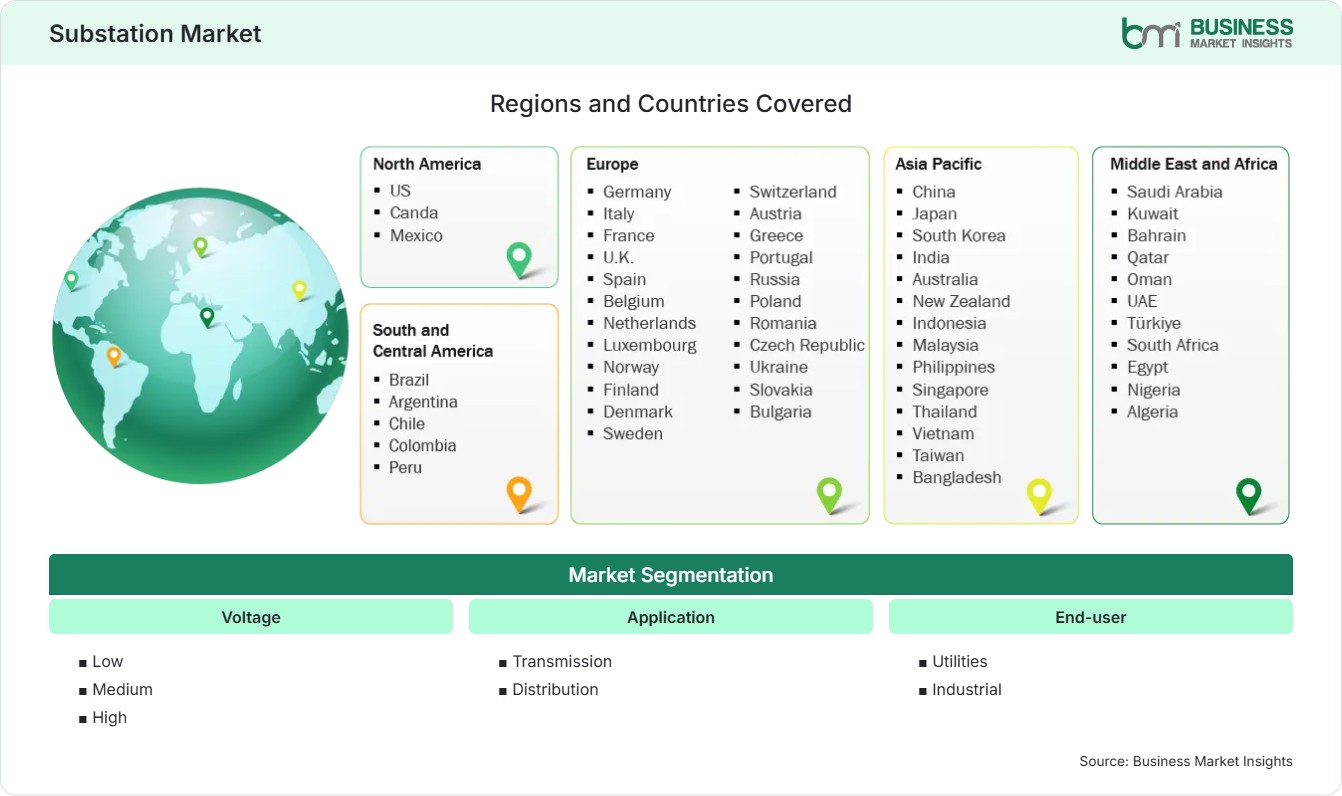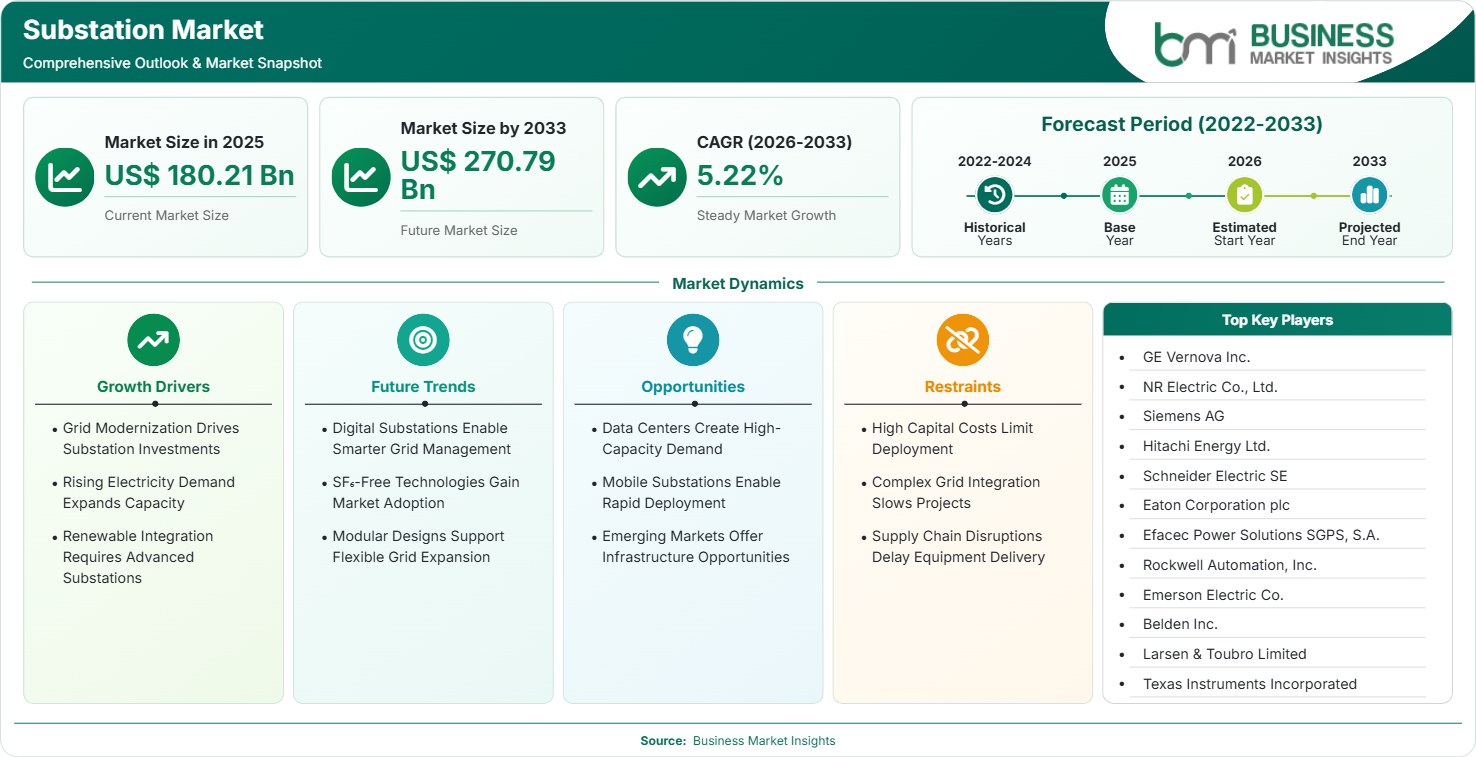
Substation Market Regional Highlights
North America Substation Market
North America represented a 25%–28% share in 2025 and is projected to advance at a 4.8%–5.2% CAGR through 2033. The region combines aging transmission assets with rapid data-center expansion, renewable interconnection, electrification, and resilience spending. Utilities are prioritizing automation, digital protection, transformer replacement, and capacity upgrades. The United States dominates regional procurement, while Canada contributes through transmission reinforcement and renewable integration. The regional Substation Market share reflects high equipment value per project, strict reliability requirements, and growing demand for compact, low-emission technologies.
- Utility replacement programs are shifting spending toward modern protection, automation, and transformer systems as operators seek higher reliability from aging transmission and distribution infrastructure.
- Data centers are creating concentrated electricity demand that requires dedicated substations, redundant feeds, advanced protection, and accelerated grid-connection programs around major technology corridors.
- Renewable interconnection is increasing demand for high-voltage substations capable of managing variable generation, reactive power, congestion, and long-distance transmission flows across interconnected systems.
- Environmental requirements are encouraging SF₆-free switchgear, while digital monitoring and remote operations improve maintenance planning and reduce operational exposure across critical substations.
US Substation Market
The United States accounted for an estimated 18%–21% of global demand in 2025 and is projected to grow at a 4.7%–5.1% CAGR through 2033. Utility modernization, hyperscale data centers, manufacturing reshoring, renewable projects, and transmission expansion are reshaping procurement priorities. Federal and state infrastructure initiatives support replacement of aging assets and increased resilience. The Substation Market growth in the country is increasingly influenced by connection queues, transformer availability, environmental compliance, and the need to deliver more capacity without proportionate increases in land use.
- Hyperscale data centers are increasing requirements for high-reliability substations, redundant electrical pathways, fast deployment, and automation capable of coordinating utility and behind-the-meter assets.
- Grid operators are upgrading substations around renewable corridors and large-load clusters, creating demand for high-voltage transformers, GIS, protection systems, and advanced communications.
- SF₆-free technology is moving closer to utility-scale adoption, with utilities evaluating clean-air and vacuum-based equipment alternatives to meet environmental goals.
- Infrastructure modernization programs continue supporting replacement of aging transformers, breakers, relays, and communications platforms across transmission and distribution networks.
Europe Substation Market
Europe held a 22%–25% Substation Market share in 2025 and is expected to register a 4.6%–5.0% CAGR through 2033. Germany, the United Kingdom, France, and Italy remain leading markets because renewable integration requires stronger transmission and distribution networks. Germany is particularly important for cross-border electricity flows, while France benefits from nuclear-generation investments and electrification programs. Spain and Italy provide high-growth opportunities, with modeled CAGRs of 5.2%–5.7% and 5.0%–5.5%, respectively, supported by renewable expansion and transmission reinforcement.
- Germany is prioritizing grid hubs capable of handling rising cross-border electricity exchange and large-scale renewable integration, increasing demand for compact GIS and voltage-control technologies.
- France provides opportunities for high-voltage modernization and lower-emission grid infrastructure as operators balance reliability requirements with decarbonization objectives.
- Southern European countries are benefitting from rapid solar deployment, increasing demand for substations, reactive-power compensation, and digital network-management solutions.
- European procurement increasingly incorporates greenhouse-gas performance alongside electrical specifications, encouraging deployment of SF₆-free switchgear technologies.
Asia Pacific Substation Market
Asia Pacific held a 32%–35% Substation Market share in 2025 and is forecast to expand at a 5.8%–6.2% CAGR through 2033, making it the fastest-growing regional market. China, India, Japan, South Korea, and Southeast Asia drive demand through industrialization, urbanization, renewable deployment, and transmission expansion. India is a leading high-growth market with a modeled CAGR of 6.3%–6.8%, while Southeast Asia is positioned around 6.0%–6.5%. Large renewable corridors, industrial projects, and rising electricity consumption continue supporting capacity additions.
- China remains a major demand center because extensive transmission systems, industrial electrification initiatives, and renewable integration projects require continuous reinforcement of power infrastructure.
- India combines renewable-energy evacuation requirements, manufacturing investment, urban demand growth, and modernization programs supporting transformer, switchgear, and automation procurement.
- Southeast Asia is expanding interconnected power systems and industrial corridors, creating opportunities for modular substations, digital protection systems, and transmission infrastructure.
- Japan and South Korea prioritize resilience, automation, compact equipment designs, and replacement of aging assets, supporting demand for higher-value digital substations.
Rest of World Substation Market
Rest of World accounted for a 15%–18% Substation Market share in 2025 and is expected to grow at a 4.7%–5.1% CAGR through 2033. South and Central America benefit from renewable-energy projects, mining operations, interconnection investments, and rising urban electricity demand. Brazil remains the leading regional market, while Chile and Colombia support strong project pipelines. In the Middle East and Africa, Saudi Arabia, the UAE, and South Africa are important demand centers. Saudi Arabia and the UAE exhibit modeled CAGRs of 5.7%–6.2% as infrastructure investment accelerates.
Latin American markets increasingly require substations for renewable projects and mining operations where long-distance transmission and high reliability remain central procurement requirements. In the Middle East and Africa, industrial diversification, desalination, urbanization, and electricity-access programs continue expanding infrastructure investment opportunities.
- Brazil's renewable-energy capacity and extensive transmission requirements create sustained opportunities for high-voltage substations and associated grid technologies.
- Saudi Arabia and the UAE continue investing in power infrastructure supporting industrial diversification, urban development, desalination projects, and digital-economy expansion.
- South Africa requires modernization of aging electrical infrastructure, creating opportunities for protection systems, automation platforms, and asset-monitoring technologies.
- Latin American renewable corridors require stronger transmission nodes, reactive-power management capabilities, and advanced control systems to improve network stability.