
Hydrogen Market Outlook: Size, Share, Trends, Growth Analysis, Competitive Landscape & Forecast, 2026-2033

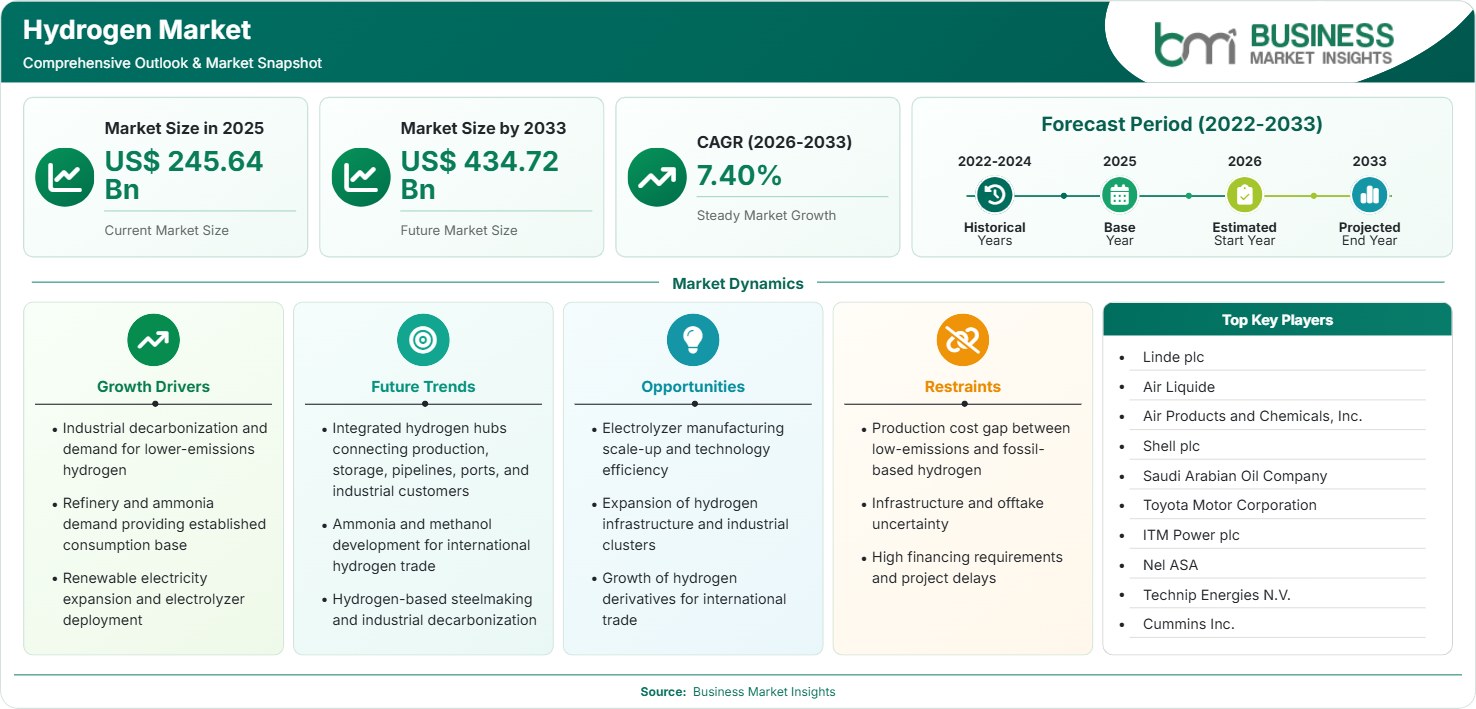
The Hydrogen Market size was valued at US$ 245.64 Billion in 2025 and is projected to reach US$ 434.72 Billion by 2033, growing at a CAGR of 7.40% during 2026–2033, supported by industrial decarbonization, refinery demand, ammonia production, renewable integration, clean-energy investment, and emerging hydrogen infrastructure.

Report Coverage
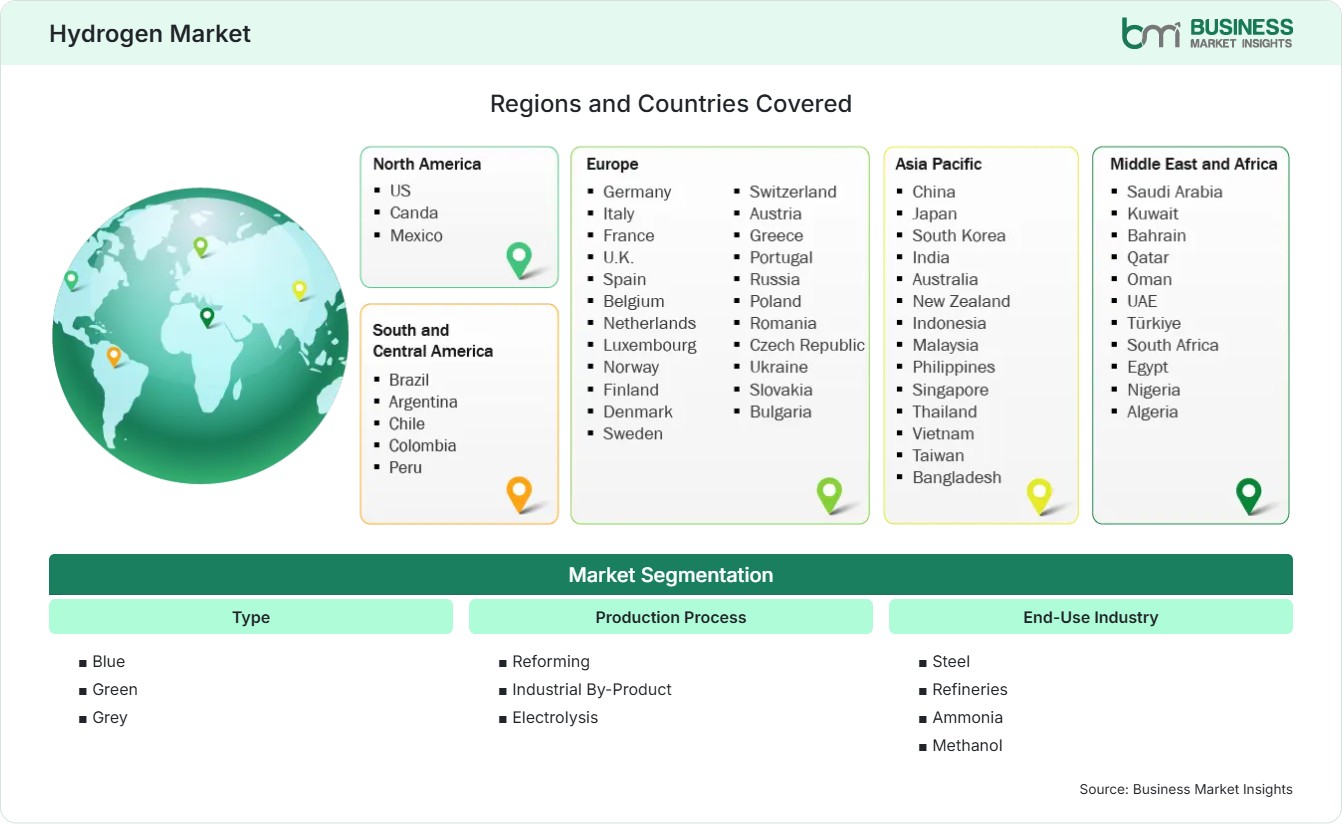
  • Type: Blue, Green, Grey
  • Production Process: Reforming, Industrial By-Product, Electrolysis
  • End-Use Industry: Steel, Refineries, Ammonia, Methanol
US$ 245.64 Bn Market size in 2025
US$ 434.72 Bn Market Size by 2033
7.40% CAGR, 2026 - 2033
2026-2033 Forecast Period

AI Overview

Hydrogen Market Summary

  • North America Region: North America holds a modeled 22%–26% share of the Hydrogen Market in 2025, with a 6.4%–7.1% CAGR through 2033, driven by refinery demand, industrial decarbonization, hydrogen hubs, natural-gas resources, carbon-management infrastructure, electrolyzers, and clean-energy investment. The US represents most regional demand, with refining, industrial gases, hydrogen hubs, clean-energy incentives, and infrastructure supporting a 6.9%–7.5% CAGR through 2033.
  • Fastest Growing Region: Asia Pacific holds a modeled 34%–38% share in 2025 and is projected to expand at an 8.2%–9.0% CAGR, supported by great industrial demand, electrolyzer manufacturing, renewable electricity, refining, ammonia, steel, mobility, energy security, and government-backed hydrogen programs.
  • Leading Segment: Refineries hold a modeled 28%–32% share in 2025 and are projected to grow at a 6.8%–7.4% CAGR, supported by established hydrogen consumption, hydroprocessing, desulfurization, fuel-quality requirements, refinery modernization, and substitution with lower-emissions hydrogen.
  • High Growth Segment: Green hydrogen holds a modeled 8%–12% share of the Hydrogen Market in 2025 and is projected to grow at a 12.5%–14.5% CAGR, supported by renewable electricity, electrolyzer deployment, industrial decarbonization, green ammonia, hydrogen-based steel, clean-fuel policies, and declining technology costs.
  • Key Market Opportunity: Integrated hydrogen hubs can connect renewable generation, electrolyzers, storage, pipelines, ports, ammonia plants, refineries, steel facilities, and contracted customers, improving utilization while reducing infrastructure duplication.
  • Major Market Players: Linde plc, Air Liquide, Air Products and Chemicals, Inc., Shell plc, Saudi Arabian Oil Company, Toyota Motor Corporation, ITM Power plc, Nel ASA, Technip Energies N.V., and Cummins Inc.
Strategic Insights

Hydrogen Market: Strategic Insights

Hydrogen Market Strategic Framework
FREE PDF
Request your free sample
Request free sample
Stakeholder View

Key Takeaways

  • The value chain is moving toward integrated ecosystems connecting producers, renewable developers, electrolyzer manufacturers, storage operators, pipeline companies, ports, engineering firms, and industrial customers. This structure can improve utilization and reduce duplicated infrastructure investment.
  • Refining and ammonia provide the strongest near-term demand foundation because hydrogen is already embedded in their processes. Steel, methanol, shipping, heavy vehicles, synthetic fuels, and selected power applications provide additional long-term upside.
  • Electrolyzer manufacturing is becoming increasingly scale-driven. Installed electrolysis capacity exceeded 4 GW in 2025, while more than 2.5 GW was under construction for operation in 2026, reinforcing demand for efficient equipment and project integration.
  • Asia Pacific provides the strongest regional investment case because China combines large hydrogen demand with extensive electrolyzer manufacturing, while Japan, South Korea, India, and Australia are developing complementary production and utilization ecosystems.
  • Investment is becoming more selective as developers prioritize projects with firm offtake, competitive electricity, infrastructure access, policy support, and credible financing. The IEA also reports substantial delays across announced low-emissions projects.
  • International trade is increasingly focused on hydrogen derivatives. Ammonia and methanol can use established maritime infrastructure, whereas pure hydrogen requires specialized transportation, compression, liquefaction, or reconversion systems.
Geographic Outlook

Hydrogen Market Regional Highlights

North America Hydrogen Market

North America holds a modeled 22%–26% share in 2025 and is projected to grow at a 6.4%–7.1% CAGR through 2033. Refining, petrochemicals, industrial gases, natural gas, renewable electricity, and carbon-management assets provide a strong industrial foundation. The Hydrogen Market share remains concentrated in the United States, while Canada contributes through hydropower, natural resources, and export-oriented projects. Regional Market growth increasingly depends on hydrogen hubs, long-term offtake agreements, and coordinated infrastructure development.

  • Gulf Coast infrastructure connects pipelines, storage, refineries, chemical plants, ports, and carbon-management assets, creating favorable conditions for large integrated hydrogen projects and industrial substitution.
  • Canada can leverage hydropower, natural gas, wind resources, and carbon-management infrastructure to develop lower-emissions hydrogen for domestic industrial users and potential export markets.
  • Developers increasingly evaluate electricity costs, incentive eligibility, permitting, customer commitments, construction schedules, and infrastructure readiness before approving capital-intensive hydrogen facilities.
  • Industrial clusters remain attractive because proximity between producers and consumers reduces transportation requirements and enables shared storage, compression, pipeline, and distribution infrastructure.

US Hydrogen Market

The United States represents a modeled 78%–84% share of North American activity and is projected to expand at a 6.9%–7.5% CAGR of the Hydrogen Market through 2033. The country benefits from extensive refining capacity, natural gas availability, renewable resources, engineering capabilities, industrial clusters, and hydrogen infrastructure. Gulf Coast projects remain strategically important because production can serve refineries, ammonia plants, chemical facilities, mobility applications, and emerging lower-carbon industrial uses through established infrastructure networks.

  • Gulf Coast clusters can integrate production, pipelines, storage, refining, ammonia, chemicals, renewable electricity, and carbon management, improving utilization and reducing transportation requirements.
  • Existing industrial consumption creates anchor demand, allowing producers to develop projects around customers already using hydrogen as a feedstock or processing input.
  • Policy incentives have improved project economics, although developers continue to assess regulatory conditions, financing costs, electricity sourcing, construction schedules, and long-term offtake commitments.

Europe Hydrogen Market

Europe holds a modeled 20%–24% share in 2025 and is projected to grow at a 6.2%–7.0% CAGR of the Hydrogen Market through 2033. Germany, the Netherlands, France, and Spain remain leading markets, while Denmark and Portugal provide renewable-resource opportunities. European development is closely connected with industrial decarbonization, renewable electricity, certification, cross-border infrastructure, and imported hydrogen derivatives. Germany offers strong steel, chemical, and refining demand, while Spain provides substantial renewable generation potential and port connectivity for hydrogen corridors.

  • Germany combines steel, chemicals, refining, mobility, and energy demand with industrial infrastructure, making it a critical destination for lower-emissions hydrogen development.
  • The Netherlands benefits from Rotterdam-area ports, industrial clusters, import infrastructure, storage potential, and pipeline connections with Germany and other European industrial centers.
  • Spain's solar and wind resources support large renewable hydrogen projects, while coastal industrial areas can connect production with ammonia, methanol, and maritime applications.
  • France is developing hydrogen across industrial, mobility, and energy applications while using its diverse electricity system to support lower-emissions production.

Asia Pacific Hydrogen Market

Asia Pacific holds a modeled 34%–38% share in 2025 and is projected to record an 8.2%–9.0% CAGR through 2033. China leads deployment and manufacturing, while Japan, South Korea, India, and Australia contribute through industrial demand, import strategies, renewable projects, mobility, and export development. China accounted for nearly three-quarters of new electrolysis installations during 2025, strengthening its equipment and project-development influence.

  • China combines extensive hydrogen demand with large electrolyzer manufacturing capacity, supporting rapid deployment while increasing competitive pressure among equipment manufacturers.
  • Japan is developing hydrogen and ammonia applications in power generation, transport, industry, and energy supply, supported by long-term energy-security priorities.
  • South Korea is expanding hydrogen mobility, fuel cells, power applications, industrial utilization, and supporting infrastructure through domestic and international partnerships.
  • India offers substantial potential because refining, fertilizers, steel, renewable energy, and national clean-hydrogen programs can create multiple large demand centers.
  • Australia can combine large solar and wind resources with hydrogen and ammonia production, particularly where projects connect directly with ports and Asian buyers.

Rest of World Hydrogen Market

The Rest of World models a 14% to 18% share by 2025 and is expected to grow at a CAGR of 7.2% to 8.4% through 2033. Hydropower, solar power, wind, ports, and exports have created an attractive environment for South and Central America, with Brazil and Chile leading the way. The other two markets worth considering in South and Central America, Colombia and Argentina, offer additional potential as infrastructure and policy frameworks develop. Financing conditions remain a critical determinant of project execution and long-term competitiveness.

The Middle East Hydrogen Market includes natural gas, solar energy, industry, and exports, whereas Africa offers large renewable resources but high financing costs and poor infrastructure. Saudi Arabia, the United Arab Emirates, and Oman are significant centers for projects, while South Africa, Egypt, Morocco, and Namibia offer new opportunities in renewable hydrogen and its derivatives.

  • Brazil's renewable electricity system and industrial base support potential hydrogen, ammonia, fertilizer, refining, and export projects linked with coastal infrastructure.
  • Chile combines exceptional solar and wind resources with mining demand and port access, supporting green hydrogen and ammonia opportunities for domestic and international markets.
  • Saudi Arabia combines natural gas, solar resources, industrial infrastructure, and export capabilities, creating conditions for large integrated hydrogen and ammonia projects.
  • The UAE is developing hydrogen-related projects around industrial and port ecosystems, supporting domestic applications and international hydrogen-derived fuel trade.
Global Market Geography
FREE PDF
Request your free sample
Request free sample
Segment Analysis

Hydrogen Market Segmentation

Type

The type category continues to be dominated by grey hydrogen, as existing production facilities serve industrial customers. However, blue hydrogen offers an option for emissions reduction where natural gas and carbon capture technology are available. On the other hand, green hydrogen is becoming strategically important. The scope of the Hydrogen Market includes not only production technology, but also renewable electricity generation, transportation, and industrial applications.

  • Blue: Blue hydrogen combines fossil-based feedstocks with carbon capture, supporting lower-emissions production where natural gas, carbon-management infrastructure, and suitable storage resources are available.
  • Green: Green hydrogen uses renewable electricity and electrolysis, supporting industrial decarbonization, green ammonia, sustainable fuels, and hydrogen-based steel as renewable power expands.
  • Grey: Grey hydrogen remains widely deployed because reforming technology is mature, scalable, and deeply integrated into refining, ammonia, methanol, and chemical production facilities.

Production Process

The production process sub-sector is still dominated by the mature reforming process, but electrolysis is gaining prominence as the availability of renewable electricity increases. Industrial by-product hydrogen provides additional capacity by recycling chemical and petrochemical processes. The choice of process is determined by the cost competitiveness of raw materials, the availability of electricity, carbon policies, load factors, and customer requirements for carbon intensity. Electrolysis provides the strongest technology growth opportunity through 2033.

  • Reforming (Without Carbon Capture): Established reforming provides large industrial volumes, particularly in refining and chemicals, but faces increasing emissions pressure from governments and corporate customers.
  • Industrial By-Product: Hydrogen recovered from existing industrial processes can improve resource efficiency and reduce incremental production requirements where purification and collection systems are available.
  • Electrolysis: Electrolysis converts electricity and water into hydrogen, with deployment accelerating as larger projects, renewable integration, and improved electrolyzer technology support industrial applications.

End-Use Industry

End-use demand is driven by refining and ammonia, given the importance of hydrogen in their production processes. Steel, methanol, mobility, shipping, power generation, and fuel cells offer further growth opportunities. Current industrial use provides the most reliable basis for demand, while new industry sectors require further technology development, infrastructure development, regulatory frameworks, and cost optimization. Such dynamics are key drivers of the hydrogen market trends across regional investment programs and industrial decarbonization strategies.

  • Steel: Hydrogen-based direct reduction can replace carbon-intensive reduction routes, creating great potential demand for low-emissions hydrogen among steelmakers pursuing lower-carbon production.
  • Refineries: Refineries use hydrogen for hydroprocessing and desulfurization, making them dependable customers for lower-emissions hydrogen and important early adopters of cleaner supply.
  • Ammonia: Ammonia production requires substantial hydrogen feedstock and provides opportunities for lower-emissions fertilizers, marine fuels, energy carriers, and international hydrogen trade.
  • Methanol: Methanol producers can integrate lower-emissions hydrogen with suitable carbon sources to develop cleaner chemical products and synthetic fuel pathways.
Market Forces

Hydrogen Market Dynamics

Key Market Drivers

Industrial decarbonization is expanding demand for cleaner hydrogen

Total global hydrogen production remains at about 100 Mt per year, while low-carbon hydrogen production is expected to reach around 1 Mt by 2025. Refined and industrial uses are prevalent, thus presenting the possibility of substitution with cleaner production methods. The Hydrogen Market currently has an advantage in selecting projects closer to existing customers, since existing demand will reduce the need for infrastructure and enhance utilization. Other applications, such as steel, are additional benefits but have a minor contribution. The IEA has reported that almost all demand for hydrogen still occurs in traditional industries and in refining. This structure provides producers with a practical starting point for decarbonization while enabling new applications to develop as technology, infrastructure, financing, and policy frameworks mature.

Renewable electricity is enabling larger electrolysis projects

The installed electrolysis capacity increased twofold, surpassing 4 GW in 2025, driven by major installations in China. Over 2.5 GW of capacity was under construction and slated for deployment in 2026. The cost of renewable power generation, electrolyzer usage, grid connection, and electrolyzer efficiency are among the factors that affect a project's economics. Larger-scale installations could be more efficient in engineering and procurement, while integration with renewable power generation could minimize the risk of electricity price fluctuations. In 2025, China accounted for about 75% of new installations, underscoring the need for economies of scale and experience with large-scale projects.

Energy security is broadening national hydrogen strategies

Hydrogen is becoming part of national energy-security strategies because domestic production can reduce exposure to imported fossil fuels and connect electricity generation to industrial feedstocks and transport fuels. Countries with abundant renewable energy can generate hydrogen or ammonia from their electricity for domestic use or export, while countries producing natural gas can produce blue hydrogen with carbon management facilities. For this reason, governments have begun backing projects despite the lack of cost equivalence between such hydrogen and traditional hydrogen. The certainty of long-term policy remains key, as developers should have assurances that incentive frameworks, carbon policies, and related measures will remain stable throughout project development and operation. This strategic role supports continued investment across production and infrastructure.

Key Market Opportunities

Integrated hydrogen hubs can strengthen project economics

Hydrogen integration hubs may incorporate renewable energy, electrolysis, storage, transport, ports, refineries, ammonia, steel, and multiple clients within an integrated ecosystem. Such an approach will enhance the utilization of the assets involved, minimize duplication of infrastructure investment, and ensure diversity in offtake risk. Hydrogen Market Forecasts foresee greater value from projects that link production to secure industrial offtake than from projects dependent on future demand that may never materialize. According to the IEA, many hydrogen pipeline infrastructure projects have yet to receive adequate investment. This presents opportunities for players in infrastructure development, engineering firms, storage operations, and investment, as well as storage operators and investors capable of structuring shared networks around high-density industrial demand and contracted customers.

Ammonia and methanol can accelerate international trade

The use of hydrogen derivatives provides a convenient means of international energy trade, as ammonia and methanol can rely on well-developed logistics chains. Export-focused production accounts for a considerable share of announced low-emission energy projects. The link is made between countries abundant in renewables and industrial countries where local production is less profitable. Ammonia is particularly useful as a fertilizer, a fuel in marine transportation, and an energy carrier, whereas methanol is used in chemical and maritime transport. Projects should have access to buyers, conversion plants, certification, logistics, and competitive financing. Projects that integrate production, conversion, and logistics can extract additional value while alleviating logistics-related problems for pure hydrogen. International standards and reliable certification will increasingly influence the competitiveness of cross-border projects.

Hydrogen-based steel can establish large new demand centers

Hydrogen-based direct reduction represents a major industrial opportunity because hydrogen can replace carbon-intensive reduction agents in steelmaking. Large steel facilities can provide concentrated demand suitable for dedicated production plants, pipelines, renewable generation, and storage systems. The possibilities are highest when there is synergy between iron ore feedstock, green energy, industrial facilities, and carbon regulations. The first pilot plants will help set performance standards for hydrogen use, facility efficiency, and steel quality. R&D efforts are yielding results in steel manufacturing and other sectors that have proven challenging to decarbonize, yet the deployment of the technology depends on hydrogen costs, steel premiums, infrastructure, and purchasing. These conditions create opportunities for integrated producers and industrial buyers able to coordinate supply and demand.

Market Restraints and Challenges

Production cost gap and slower low-emissions adoption

Factor: Low-emissions hydrogen generally remains more expensive than unabated fossil-based hydrogen because renewable electricity, electrolyzer capital, financing, infrastructure, and utilization costs remain substantial. Impact: Industrial consumers without strong carbon-price exposure or procurement mandates may postpone conversion, weakening project bankability and increasing dependence on subsidies. Cost reductions require larger manufacturing volumes, improved electrolyzer efficiency, higher utilization, lower-cost renewable electricity, cheaper financing, and stable demand policies. Developers must optimize the entire production system rather than focusing only on electrolyzer prices because engineering, construction, grid connections, storage, and supporting infrastructure can materially affect total project economics. This cost gap remains one of the central barriers to rapid industrial substitution.

Infrastructure and offtake uncertainty and delayed project execution

Factor: Hydrogen projects require coordinated investment across production, storage, pipelines, ports, conversion facilities, and customer equipment. Impact: delays in one component can postpone commercial operation of the complete project, increase financing costs, and weaken investor confidence. The IEA has identified substantial delays among announced low-emissions projects, with more than half of potential electrolyzer capacity in the 2030 pipeline facing schedule slippage. Developers therefore need stronger customer agreements, shared infrastructure, standardized certification, financing guarantees, and clear regulatory frameworks. Projects located near established industrial consumers can reduce some of these risks because existing demand provides an anchor for infrastructure investment and improves the probability of sustained asset utilization.

Company Analysis

Competitive Landscape

The Hydrogen Market analysis indicates that competition spans industrial gases, integrated energy, electrolyzers, fuel cells, engineering, mobility, infrastructure, and large-scale project development. Competitive differentiation increasingly depends on technology efficiency, project execution, customer relationships, infrastructure access, financing strength, geographic reach, and the ability to integrate multiple stages of the value chain.

Company Name

Overview

Products and Services relevant to this market

Linde plc

Global industrial gases and engineering company with extensive hydrogen production, distribution, and infrastructure capabilities.

Hydrogen production, liquefaction, storage, distribution, fueling infrastructure, engineering, and industrial gas solutions.

Air Liquide

Global industrial gases company with broad hydrogen production, distribution, mobility, and industrial application capabilities.

Hydrogen production, compression, liquefaction, distribution, fueling stations, engineering, and industrial hydrogen solutions.

Air Products and Chemicals, Inc.

Major gases and chemicals company with extensive hydrogen production, distribution, and project development capabilities.

Hydrogen production, pipelines, liquefaction, fueling, equipment, industrial supply, and integrated hydrogen infrastructure.

Shell plc

Integrated energy company developing hydrogen production, mobility, industrial supply, and renewable-energy-linked projects.

Hydrogen production, fueling infrastructure, renewable hydrogen, industrial supply, and energy-transition solutions.

Saudi Arabian Oil Company

Integrated energy company pursuing hydrogen and ammonia opportunities alongside established energy infrastructure.

Blue hydrogen, renewable hydrogen, ammonia, carbon management, industrial applications, and export projects.

Toyota Motor Corporation

Automotive technology company developing fuel-cell systems and hydrogen mobility applications.

Fuel-cell systems, hydrogen vehicles, commercial mobility solutions, and hydrogen ecosystem technologies.

ITM Power plc

Electrolyzer specialist focused on large-scale proton exchange membrane systems.

PEM electrolyzers, hydrogen production systems, engineering support, and project integration.

Nel ASA

Hydrogen technology company supplying electrolyzers and hydrogen fueling equipment.

Alkaline and PEM electrolyzers, hydrogen fueling stations, production systems, and services.

Technip Energies N.V.

Engineering and technology company supporting complex energy and industrial projects.

Hydrogen engineering, ammonia, renewable hydrogen integration, process technology, and project management.

Cummins Inc.

Power technology company developing electrolyzers, fuel cells, engines, and hydrogen systems.

Electrolyzers, fuel cells, hydrogen engines, power systems, mobility technologies, and integrated solutions.

Trust & Transparency

Research Methodology

The market analysis combines proprietary research with secondary data from government agencies, company disclosures, regulatory filings, industry databases and expert interviews. Market estimates are validated through data triangulation, cross-market benchmarking and analyst review.

View Full Research Methodology

Questions Answered

Frequently Asked Questions

What does a Hydrogen Market Report typically evaluate?

A comprehensive report evaluates production technologies, hydrogen types, end-use industries, regional development, competitive strategies, infrastructure, investment activity, policy factors, market dynamics, opportunities, restraints, and the outlook for established and emerging applications.

Why are firm offtake agreements important for hydrogen developers?

Firm offtake agreements demonstrate customer commitment and improve project bankability. Without contracted demand, developers face greater uncertainty around plant utilization, revenue stability, financing, infrastructure investment, and final investment decisions. Projects with established industrial customers can therefore have stronger commercial foundations.

What role can ammonia and methanol play in international hydrogen trade?

Ammonia and methanol can simplify international hydrogen trade because established maritime infrastructure already supports their production, storage, transportation, and handling. They can connect renewable-rich production regions with distant industrial customers without requiring every trade route to depend on pure hydrogen transportation systems.

Why is electrolyzer manufacturing becoming more competitive?

Electrolyzer manufacturing is becoming increasingly scale-driven as larger projects and stronger manufacturing capacity improve purchasing economics. The IEA reports that installed electrolysis capacity surpassed 4 GW in 2025, while more than 2.5 GW was under construction for operation in 2026.

How important are established industrial applications to future hydrogen demand?

Refining, ammonia, methanol, and other established applications remain the foundation because hydrogen is already embedded in their production processes. New uses such as steel, shipping, mobility, and synthetic fuels provide additional demand, but their contribution remains smaller and more dependent on infrastructure, policy support, technology maturity, and competitive economics.

Access the Full Hydrogen Market Report

Get segment-level forecasts, regional estimates, competitive benchmarking, company profiles and downloadable Excel datasets.

Access the full Hydrogen Market Report
350 pages PDF & Excel | 2026-08-31