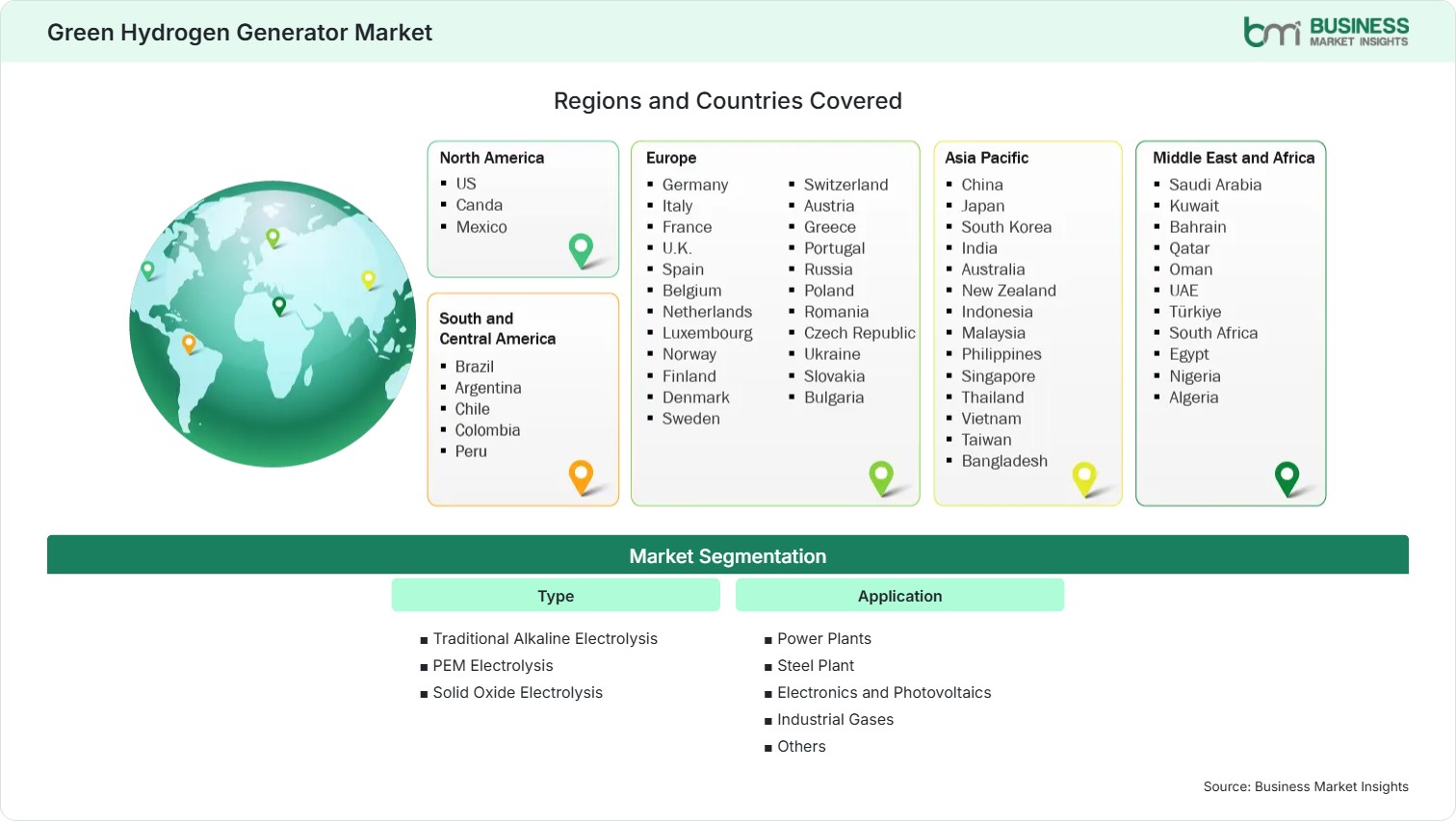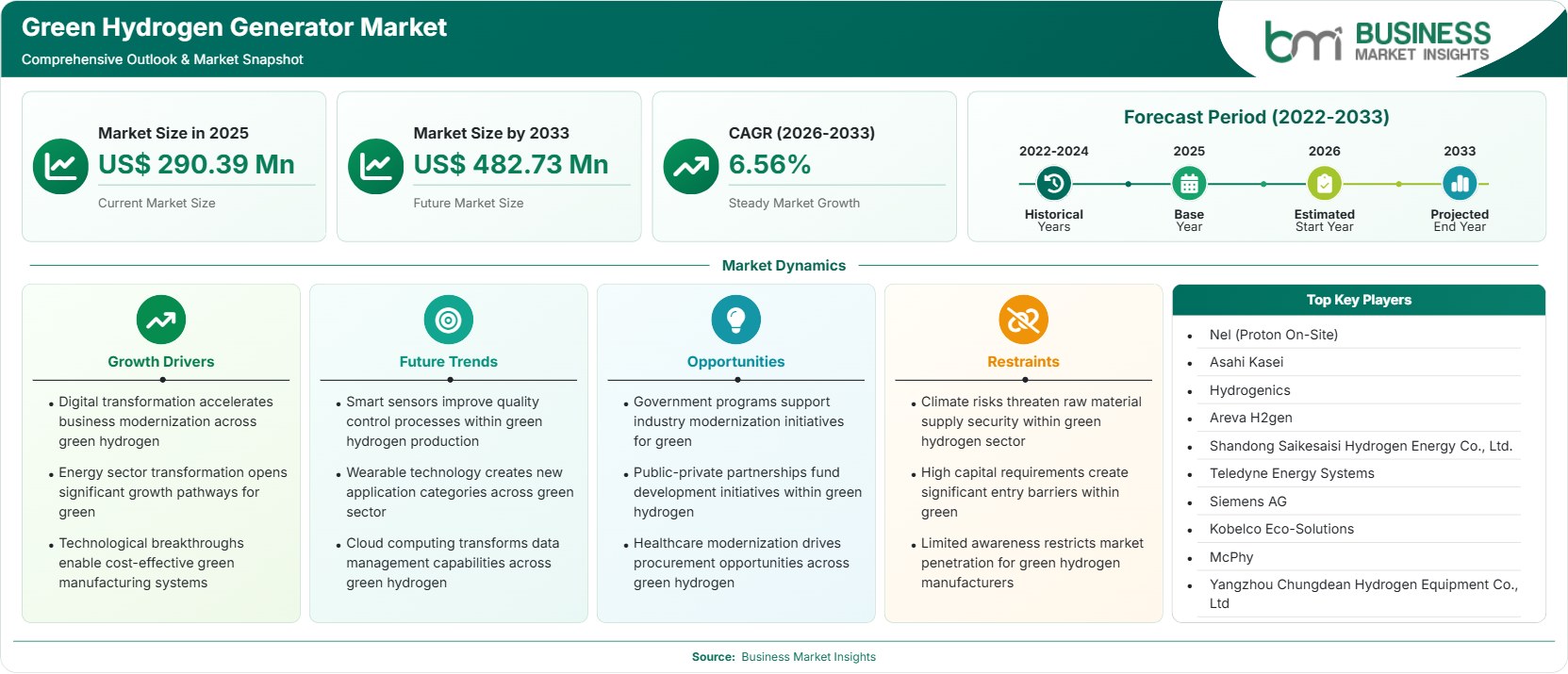
Green Hydrogen Generator Market Regional Highlights
North America Green Hydrogen Generator Market
North America accounted for 30%–33% of global revenue in 2025 and is anticipated to expand at a CAGR of 6.0%–6.8% during 2026–2033. The region benefits from large-scale renewable energy deployment, federal clean hydrogen incentives, expanding electrolyzer manufacturing capacity, and industrial decarbonization initiatives. Strong collaboration between utilities, engineering companies, and industrial gas producers continues to accelerate commercial hydrogen projects. The Green Hydrogen Generator Market share remains supported by increasing investments in green ammonia, sustainable aviation fuel, and heavy industrial applications.
- The U.S. Inflation Reduction Act and Department of Energy hydrogen initiatives are encouraging commercial deployment of electrolyzers, supporting domestic manufacturing, strengthening supply chains, and improving project economics for renewable hydrogen production across multiple industrial sectors.
- Industrial decarbonization across refining, ammonia, chemicals, and steel production continues creating sustained demand for large-capacity hydrogen generation systems, while utilities increasingly evaluate hydrogen as a long-duration energy storage solution supporting renewable electricity integration.
- Growing investment in offshore wind, utility-scale solar, and hydropower projects provides reliable renewable electricity for electrolyzer installations, improving hydrogen production economics and reducing lifecycle carbon emissions throughout industrial operations.
- Strategic partnerships between technology developers, engineering contractors, utilities, and industrial gas suppliers are accelerating commercialization, reducing deployment risks, and strengthening the regional hydrogen ecosystem for long-term market expansion.
- Increasing private equity investments and government-backed infrastructure funding continue supporting hydrogen hubs, pipeline development, storage facilities, and export capabilities, reinforcing North America's competitive position within the global hydrogen economy.
US Green Hydrogen Generator Market
The United States represents approximately 74%–78% of North American Green Hydrogen Generator Market revenue in 2025 and is projected to grow at a CAGR of 6.2%–7.0% through 2033. Federal incentives, extensive renewable resources, industrial demand, and expanding clean hydrogen infrastructure continue supporting commercial adoption. Investment across Gulf Coast industrial clusters, California, and Midwestern manufacturing hubs is accelerating deployment of renewable hydrogen production technologies for multiple end-use industries.
- Federal production tax credits and hydrogen hub funding are reducing investment risks while improving project bankability, encouraging utilities, industrial manufacturers, and technology providers to accelerate deployment of renewable hydrogen production facilities.
- Large industrial consumers continue replacing conventional hydrogen with renewable alternatives to comply with emissions reduction objectives, strengthening long-term demand for advanced electrolyzer technologies and integrated hydrogen production systems.
- Expansion of domestic electrolyzer manufacturing facilities improves equipment availability, shortens supply chains, supports localization strategies, and enhances competitiveness across the national hydrogen technology ecosystem.
- Increasing collaboration among research institutions, government agencies, and private technology developers accelerates commercialization of advanced electrolysis technologies while supporting innovation in efficiency, durability, and system integration.
Europe Green Hydrogen Generator Market
Europe captured 28%–31% of global Green Hydrogen Generator Market revenue in 2025 and is forecast to register a CAGR of 6.4%–7.2% during 2026–2033. Strong climate policies, carbon pricing mechanisms, renewable energy expansion, and hydrogen infrastructure investments continue supporting regional leadership. Germany remains the largest national market, while Spain and the Netherlands strengthen electrolyzer deployment. Poland demonstrates one of the fastest growth trajectories with an estimated CAGR of 7.4%–8.2% supported by industrial modernization and renewable investments.
- European Union hydrogen strategies and REPowerEU initiatives continue accelerating investment in electrolyzer manufacturing, renewable hydrogen production, and cross-border hydrogen transport infrastructure supporting industrial decarbonization objectives.
- Germany maintains regional leadership through extensive industrial demand, engineering expertise, and government funding supporting commercial hydrogen deployment across chemicals, steel manufacturing, and energy applications.
- Spain experiences rapid expansion because abundant solar resources, supportive regulatory frameworks, and export ambitions encourage development of utility-scale renewable hydrogen production facilities serving domestic and international markets.
- The Netherlands strengthens its hydrogen economy by integrating offshore wind generation, port infrastructure, and industrial clusters, enabling efficient production, storage, and distribution of renewable hydrogen across European supply chains.
- Poland records one of Europe's fastest growth rates as industrial modernization programs and renewable electricity investments increase adoption of electrolyzer technologies for manufacturing and energy applications.
Asia Pacific Green Hydrogen Generator Market
Asia Pacific represented 27%–30% of global revenue in 2025 and is expected to achieve the fastest expansion with a CAGR of 7.2%–8.0% during 2026–2033. Rapid industrialization, ambitious hydrogen roadmaps, expanding renewable power capacity, and strong manufacturing ecosystems support regional development. China leads overall deployment, while India records the highest growth with an estimated CAGR of 8.0%–8.8%, driven by national green hydrogen initiatives and industrial investment. The Green Hydrogen Generator Market growth is reinforced by accelerating demand across heavy industries.
- China maintains regional leadership through extensive electrolyzer manufacturing capabilities, supportive industrial policies, renewable energy deployment, and large-scale hydrogen demonstration projects supporting domestic demand.
- Japan continues emphasizing advanced electrolysis technologies, hydrogen mobility, and integrated energy systems while encouraging collaboration between technology providers, utilities, and industrial manufacturers.
- India emerges as the fastest-growing national market due to expanding renewable electricity capacity, supportive hydrogen missions, industrial decarbonization strategies, and significant investment commitments from public and private sectors.
- Australia strengthens its position as a future renewable hydrogen exporter by combining exceptional renewable energy resources with export-oriented infrastructure and international supply agreements.
- South Korea accelerates adoption through industrial innovation, fuel cell deployment, and government policies promoting hydrogen as a strategic component of long-term energy transition planning.
Rest of World Green Hydrogen Generator Market
Rest of World accounted for 10%–12% of global Green Hydrogen Generator Market revenue in 2025 and is projected to expand at a CAGR of 6.8%–7.6% during 2026–2033. South & Central America increasingly leverage abundant renewable resources for hydrogen production, while Middle East & Africa benefit from large-scale solar projects and export-oriented hydrogen strategies.
Brazil leads South & Central America through renewable electricity availability and industrial opportunities. Saudi Arabia remains the regional leader across the Middle East, while the United Arab Emirates demonstrates one of the strongest growth profiles with an estimated CAGR of 7.6%–8.4%, supported by large-scale hydrogen investment and export infrastructure.
- Brazil leverages hydropower and expanding solar capacity to strengthen renewable hydrogen production, supporting industrial decarbonization and creating opportunities for future export-oriented hydrogen projects.
- Saudi Arabia continues investing in world-scale hydrogen production facilities integrated with renewable energy resources, positioning itself as a major supplier within emerging international hydrogen trade networks.
- The United Arab Emirates accelerates hydrogen investments through strategic partnerships, renewable infrastructure expansion, and export-focused initiatives targeting European and Asian energy markets.
- South Africa explores renewable hydrogen opportunities supporting mining, heavy industry, and clean fuel production while benefiting from abundant renewable energy resources and international collaboration.
- Chile continues expanding renewable hydrogen development by combining exceptional solar and wind resources with supportive national strategies aimed at establishing long-term export competitiveness.