Market Summary
Executive Summary and Global Market Analysis
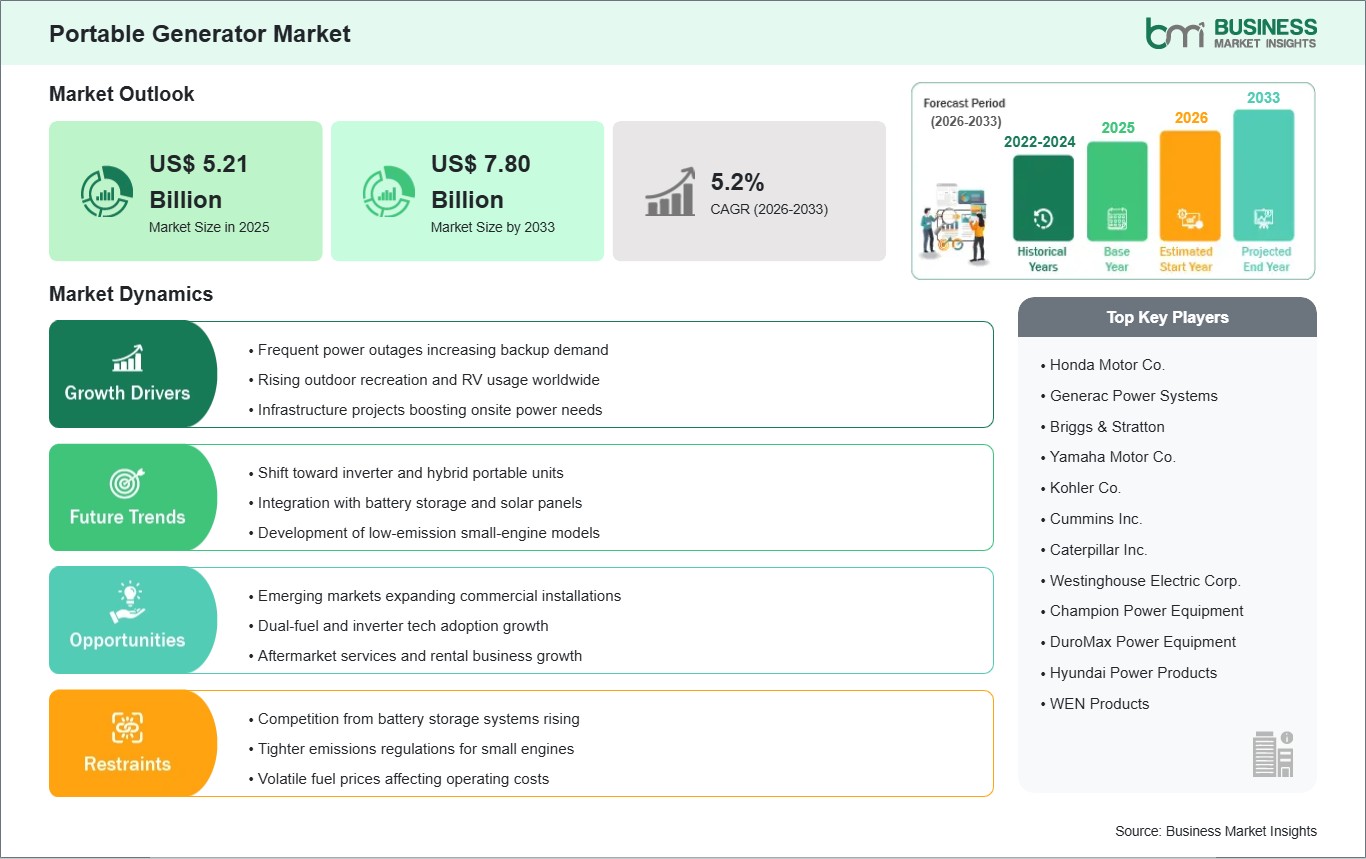
Portable generators are self-contained units that generate electricity. They provide temporary power in places without stable grid access or during outages. Their small size, easy transport, and flexible use make them perfect for home backup, outdoor activities, construction, and temporary business needs. The industry caters to users looking for reliable electricity without the need for permanent infrastructure. Changes in energy reliability demands have increased the interest in portable power solutions across various fields. Households are placing more importance on planning for outages, while businesses want equipment that can support essential operations during unexpected interruptions. The need for quick and flexible access to electricity continues to drive purchases in both developed and developing countries. Market segmentation shows a wide range of operational needs. Gasoline generators are commonly used for short-term and recreational purposes due to their ease of use. Diesel generators work well for longer operating times, while gaseous systems attract users looking for cleaner fuel options. Solar-integrated products are becoming popular for applications that need lower emissions and quieter operation. Product development now focuses more on efficiency, digital features, and fuel versatility. Manufacturers are launching improved control systems, remote monitoring tools, inverter-based designs, and hybrid energy setups. These improvements enhance the user experience while meeting growing expectations for energy management, portability, and environmental performance. Competition in the portable generator market revolves around product differences, technology use, and distribution. Market players are continuously improving performance aspects like runtime, noise levels, mobility, and reliability. Strategic investments in innovation and a diverse product lineup reflect a competitive landscape where customer preferences increasingly shift toward smart, flexible, and energy-efficient portable power solutions.
Segment Analysis
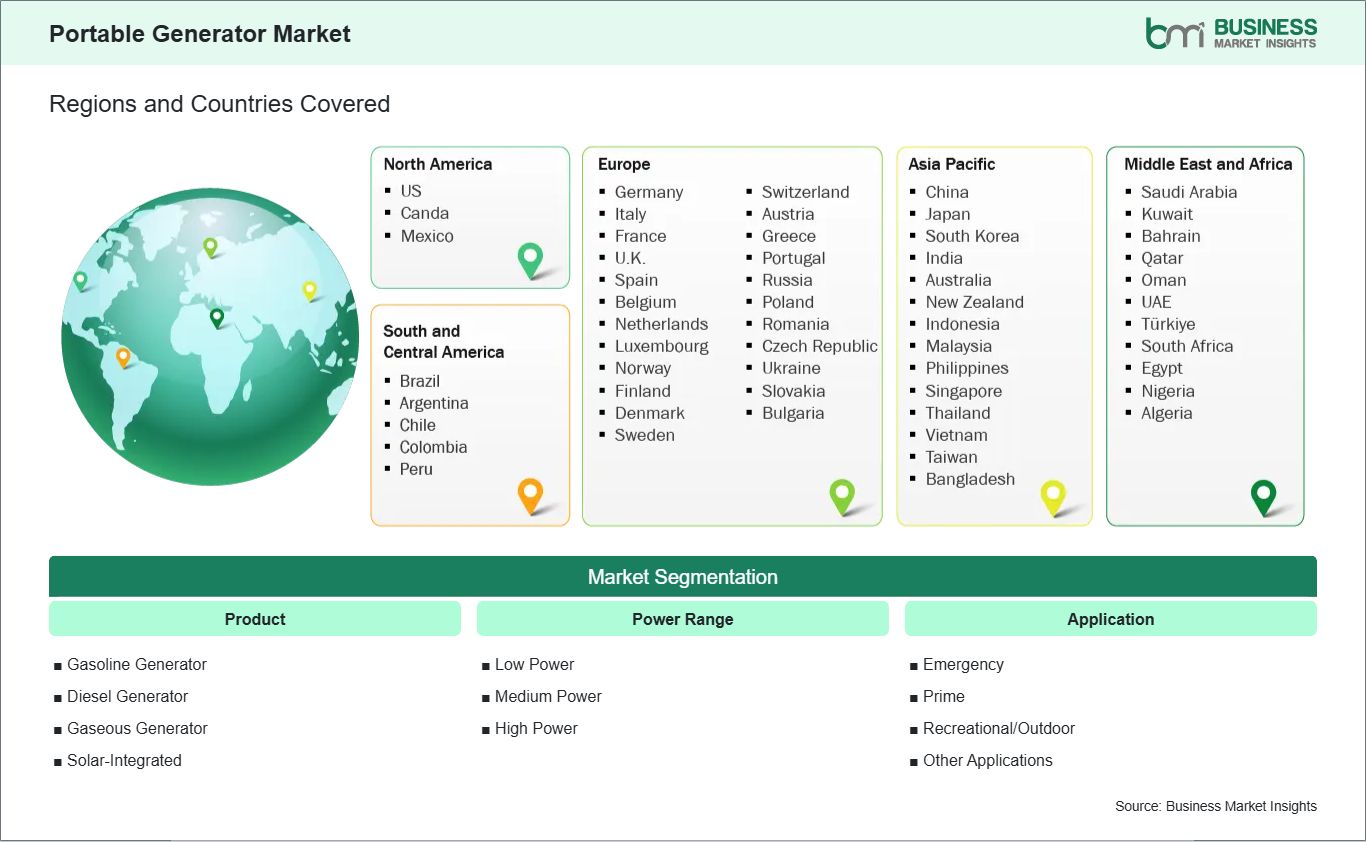
Portable Generator Market Segmentation
The market is structured around product categories, power output capacities, and application-specific operational requirements.
By Product
- Gasoline Generator - Favored for portable household and recreational electricity requirements.
- Diesel Generator - Supports prolonged operation under demanding power conditions.
- Gaseous Generator - Utilizes cleaner-burning fuels with enhanced environmental compatibility.
- Solar-Integrated - Combines renewable charging capabilities with backup power functionality.
By Power Range
- Low Power - Handles essential appliances and compact electronic equipment.
- Medium Power - Accommodates residential backup and commercial site operations.
- High Power - Addresses intensive temporary electricity requirements efficiently.
By Application
- Emergency - Provides immediate electricity during grid failures and outages.
- Prime - Supplies continuous power for off-grid environments.
- Recreational/Outdoor - Enables convenient energy access for leisure activities.
- Other Applications - Serves temporary industrial, agricultural, and construction needs.
Market Forces
Portable Generator Market Drivers and Opportunities
Rising Emphasis on Backup Power Reliability
Frequent electricity outages and increased preparedness have sparked interest in portable power equipment. Home users want reliable backup options that can support essential appliances. Meanwhile, businesses need temporary power solutions during service interruptions. These situations have led to a wider use of portable generators in different settings where consistent power is crucial. The effect goes beyond just emergency responses. More organizations are including portable power systems in their continuity plans to reduce downtime risks. This shift improves market relevance across various industries and highlights portable generators as valuable tools for maintaining operational stability during unexpected events.
Expansion of Hybrid and Solar-Integrated Generator Technologies
Interest in cleaner and more adaptable power systems is creating opportunities for innovative generator designs. Manufacturers are integrating battery storage, smart energy management software, and renewable charging capabilities into portable platforms. These developments support applications that need lower noise levels, improved efficiency, and less reliance on traditional fuels. Future opportunities are tied to the growing acceptance of hybrid energy systems in residential, recreational, and professional areas. Ongoing improvements in portable energy storage and solar technologies may expand application possibilities. As users look for more flexibility and sustainability, the next generation of portable power solutions is ready to open new paths for market growth.
Size and Share Analysis
Portable Generator Market Size and Share Analysis
The Portable Generator Market was valued at USD 5.21 billion in 2025 and is expected to reach USD 7.80 billion by 2033. This reflects a compound annual growth rate (CAGR) of 5.2% during the forecast period. The market growth shows a steady use of temporary power solutions in residential, commercial, and industrial areas. Demand trends still prefer equipment that offers flexibility and reliable access to electricity. Among product types, gasoline generators hold a strong position because they are widely available and easy to use. Diesel generators are often chosen for longer runtime needs, while gaseous options appeal to users looking for cleaner fuel choices. Solar-integrated systems are becoming more popular as technology improves. Emergency uses are a major area for generators since backup power is crucial during unexpected outages. Prime power uses continue to show steady demand in off-grid settings, while outdoor activities boost the market with a growing need for portable energy.
Report Coverage
Portable Generator Market Report Coverage and Deliverables
The "Portable Generator Market Size and Forecast (2022-2033)" report provides a detailed analysis of the market covering below areas:
- Market size and forecast at global, regional, and country levels for all market segments covered under the scope
- Market trends, as well as drivers, restraints, and opportunities
- The market analysis covering key trends, global and regional framework, major players, regulations, and recent developments
- Industry landscape and competition analysis covering market concentration, heat map analysis, prominent players, and recent developments for the market
- Detailed company profiles, including SWOT analysis
Geographic Insights
Portable Generator Market Geographic Insights
The Portable Generator market shows varied regional adoption influenced by energy security needs, infrastructure conditions, weather disruptions, and power requirements. Across the globe, users seek portable electricity solutions that provide flexibility, quick deployment, and reliable performance. Differences in economic activity, grid reliability, and buyer preferences shape purchasing trends in various countries and industries. North America has a strong market supported by awareness of emergency preparedness and backup power planning. Residential and commercial users often consider portable generators as part of their overall resilience plans. Product choices increasingly focus on better efficiency, digital monitoring features, and greater convenience. Asia Pacific presents a growing market where industrial activity, construction growth, and infrastructure development drive steady demand for temporary power solutions. Portable generators are used at remote project sites, commercial facilities, and homes. Companies continue to introduce products designed for different operating conditions and changing user expectations in the region. Europe has consistent market activity influenced by environmental concerns, energy transition goals, and regulatory policies. There is a growing interest in quieter and cleaner technologies, which promotes attention to innovative generator designs and hybrid systems. Meanwhile, emerging markets in the Middle East, Africa, and South and Central America provide opportunities related to infrastructure growth, electrification efforts, and the need for reliable mobile power systems.
Industry Activity
Recent Developments
Industry developments continue to emphasize product innovation, operational efficiency, and evolving portable power technologies.
- In June 2025: Anker SOLIX has launched the F3000 Portable Power Station, aimed at providing reliable backup power for households during short-term outages due to extreme weather. Key features include rapid recharging, scalable capacity, and compatibility with 120V generators, ensuring essential appliances can operate during disruptions. The product is available for sign-up at ankersolix.com.
- In April 2025: Ecoflow has launched the River 3 Plus, a 286 Wh portable power station for outdoor use. It can be expanded with additional modules to reach capacities of up to 858 Wh. A wireless charging version will be available in May.
Trust & Transparency
Research Methodology
The market analysis combines proprietary research with secondary data from government agencies, company disclosures, regulatory filings, industry databases and expert interviews. Market estimates are validated through data triangulation, cross-market benchmarking and analyst
review.
View Full Research Methodology
Key Sources Referred:
International Energy Agency (IEA)U.S. Energy Information Administration (EIA)International Electrotechnical Commission (IEC)Institute of Electrical and Electronics Engineers (IEEE)National Fire Protection Association (NFPA)American National Standards Institute (ANSI)European Committee for Electrotechnical Standardization (CENELEC)International Organization for Standardization (ISO)Gas Technology Institute (GTI)World Bank (ESMAP)Electric Power Research Institute (EPRI)U.S. Department of Energy (DOE)