Solar Generator Market Regional Highlights
North America Solar Generator Market
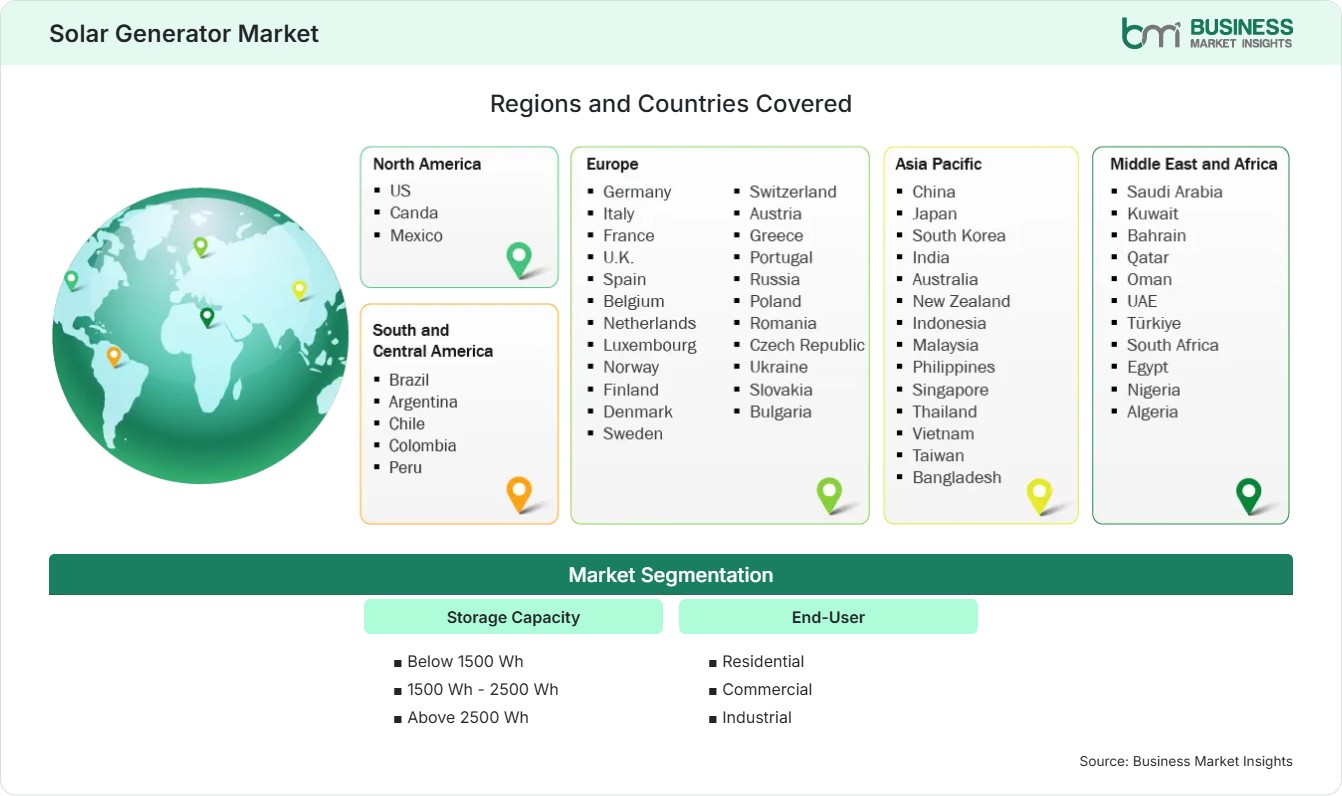
North America accounts for 34%–37% of global demand in 2025 and is expected to grow at a CAGR of 6.8%–7.4% through 2033. The region benefits from increasing weather-related outages, strong consumer awareness, and widespread adoption of distributed energy resources. The Solar Generator Market share in North America remains the largest globally due to high purchasing power and established renewable-energy ecosystems. Residential preparedness programs, outdoor recreation demand, and portable backup applications continue supporting sustained market expansion across the United States and Canada.
- Grid resilience spending across utilities and municipalities is encouraging households and businesses to adopt portable energy systems capable of supporting essential loads during outage events.
- Increasing wildfire, hurricane, and storm disruptions have elevated emergency preparedness investments, supporting stronger demand for battery-based backup alternatives than conventional fuel-powered generators.
- Recreational vehicle users, campers, and outdoor professionals increasingly prefer quiet, emission-free power solutions, strengthening portable energy equipment sales across multiple consumer categories.
- Product innovation focused on smart monitoring, faster charging, and expandable storage capacity continues improving user experience and replacement demand across mature customer segments.
US Solar Generator Market
The United States contributes 76%–80% of North American Solar Generator Market revenue and advances at a CAGR of 6.9%–7.5% through 2033. Strong adoption across residential, recreational, and emergency preparedness applications supports market development. Federal clean-energy incentives, distributed solar deployment, and increasing consumer interest in energy independence contribute to long-term demand. The country remains a leading innovation hub for battery storage systems, advanced inverters, and portable power technologies supporting multiple end-use categories.
- Severe weather events and grid reliability concerns continue influencing purchasing decisions, particularly across hurricane-prone, wildfire-prone, and storm-affected states.
- Expanding rooftop solar installations create favorable conditions for integrated portable storage solutions that enhance self-consumption and backup capabilities.
- E-commerce channels improve product accessibility while allowing manufacturers to reach consumers through direct-to-customer distribution models.
- Technology upgrades emphasizing LiFePO4 batteries, longer lifecycles, and faster charging capabilities support replacement demand and premium product adoption.
Europe Solar Generator Market
Europe represents 25%–28% of global Solar Generator Market revenue in 2025 and is projected to expand at 7.4%–8.2% CAGR through 2033. Energy security concerns, decarbonization objectives, and increasing distributed solar deployment support market momentum. Germany leads regional demand with growth near 7.3%–8.0%, while Eastern European markets exhibit stronger expansion at 8.5%–9.3%. Regulatory emphasis on renewable energy integration and residential energy resilience continues strengthening adoption across households and small commercial users.
- Energy price volatility has encouraged consumers to evaluate renewable-powered backup systems capable of reducing reliance on grid electricity.
- Portable power stations are increasingly deployed in recreational, residential, and small-business applications requiring flexible energy access.
- Government support for renewable technologies and battery storage investments strengthens market penetration across major European economies.
- Manufacturers increasingly target integrated home-energy ecosystems combining solar generation, storage, and digital energy management capabilities.
Asia Pacific Solar Generator Market
Asia Pacific holds 26%–29% share in 2025 and records the fastest expansion at 9.2%–10.1% CAGR. China remains the leading market due to manufacturing scale and renewable-energy investments, while India and Southeast Asian countries exhibit accelerated adoption. Rapid urbanization, increasing electricity demand, and growing awareness of clean-energy solutions are shaping regional Solar Generator Market share. The presence of major battery and component manufacturers further supports cost competitiveness and innovation across product categories.
- Manufacturing concentration enables economies of scale, supporting affordability and wider consumer accessibility across residential and commercial markets.
- Government electrification initiatives encourage deployment of distributed energy technologies in remote and underserved locations.
- Rising outdoor recreation, tourism activities, and mobile work applications create additional demand for portable energy systems.
- Growing rooftop solar adoption strengthens opportunities for integrated backup solutions supporting self-consumption and energy resilience.
- Commercial users increasingly deploy portable systems for temporary worksites, telecommunications infrastructure, and emergency response operations.
Rest of World Solar Generator Market
Rest of World accounts for 10%–13% of global demand in 2025 and is projected to grow at 8.1%–9.0% CAGR through 2033. South and Central America benefit from distributed energy investments and electrification initiatives. The Middle East and Africa are supported by off-grid energy requirements and renewable development programs. Brazil leads regional demand with 8.0%–8.8% growth, while selected African markets advance at 9.0%–10.0% due to expanding access-to-energy initiatives and resilience-focused infrastructure investments.
- Remote communities increasingly adopt portable solar-powered systems where conventional grid access remains limited or unreliable.
- Mining, agriculture, and field operations create demand for mobile energy solutions capable of operating in challenging environments.
- Renewable-energy deployment programs encourage distributed generation and storage adoption across underserved regions.
- Humanitarian projects and disaster-response activities utilize portable energy systems to support critical services and communications.