
Solar Tracker Market Outlook: Size, Share, Trends, Growth Analysis, Competitive Landscape & Forecast, 2026-2033

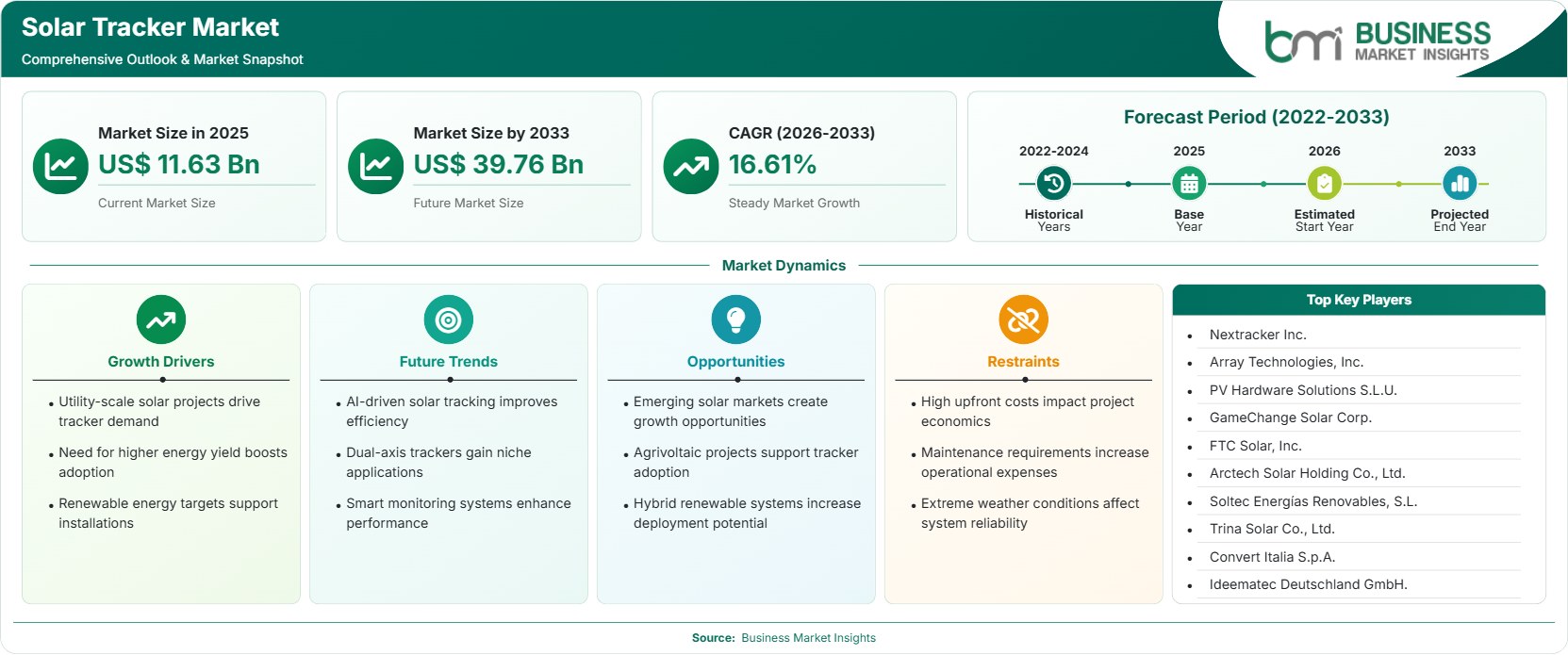
The Solar Tracker Market size was valued at US$ 11.63 Billion in 2025 and is projected to reach US$ 39.76 Billion by 2033, growing at a CAGR of 16.61% during 2026–2033. Rising utility-scale solar deployment, bifacial module adoption, grid decarbonization targets, digital monitoring systems, and expanding renewable energy investments are creating substantial growth opportunities across developed and emerging economies.

Report Coverage
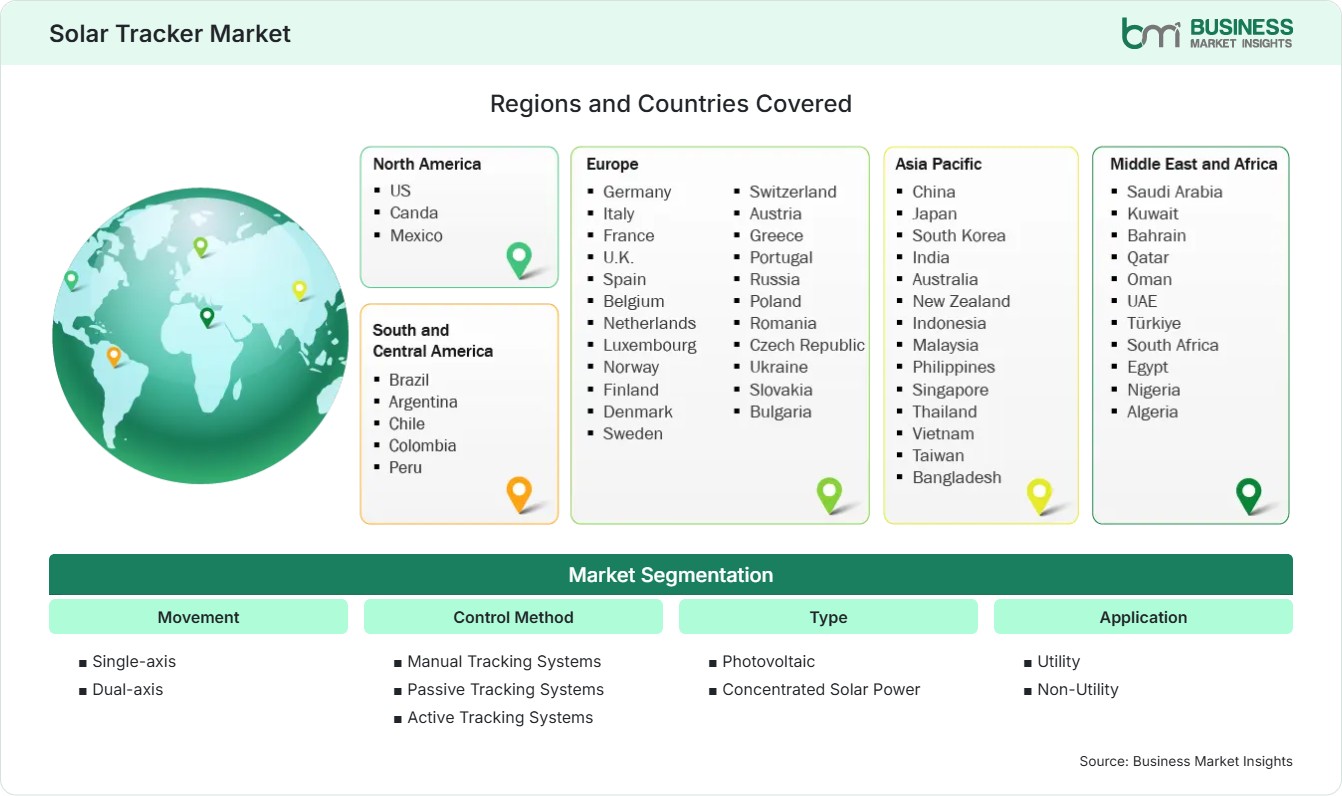
  • Movement: Single-axis, Dual-axis
  • Control Method: Manual Tracking Systems, Passive Tracking Systems, Active Tracking Systems
  • Type: Photovoltaic, Concentrated Solar Power
  • Application: Utility, Non-Utility
US$ 11.63 Bn Market size in 2025
US$ 39.76 Bn Market Size by 2033
16.61% CAGR, 2026 - 2033
2026-2033 Forecast Period

AI Overview

Solar Tracker Market Summary

  • North America Region: North America holds market share of 35%–38% in 2025, growing with a CAGR of 15%–17% during 2026–2033, supported by utility-scale solar investments, domestic manufacturing incentives, tracker software innovation, grid modernization efforts, land optimization strategies, renewable procurement growth, energy security priorities, project financing availability, transmission investments, and increasing bifacial module deployment. The U.S. leads regional demand through large utility projects and tax incentives, expanding at 15%–17% CAGR.
  • Fastest Growing Region: Asia Pacific holds market share of 27%–30% in 2025, growing with a CAGR of 18%–20% during 2026–2033, driven by solar capacity additions, manufacturing expansion, competitive EPC ecosystems, land-use efficiency requirements, renewable targets, transmission buildouts, foreign investment inflows, energy transition policies, industrial decarbonization initiatives, and large-scale procurement programs.
  • Leading Segment: Utility applications account for 70%–73% share in 2025 and expand at 16%–18% CAGR, supported by gigawatt-scale solar parks, improved project economics, rising electricity demand, utility procurement programs, financing accessibility, land productivity gains, performance optimization, renewable integration mandates, and long-term power purchase agreements.
  • High Growth Segment: Dual-axis trackers maintain 18%–21% share in 2025 while advancing at 18%–21% CAGR, benefiting from enhanced energy yield, growing deployment in high-irradiance regions, technological reliability improvements, precision tracking capabilities, advanced controls, premium power generation requirements, and increasing performance-focused installations.
  • Key Market Opportunity: Growing integration of artificial intelligence, predictive maintenance, terrain-adaptive tracker designs, and bifacial photovoltaic systems enables higher energy output, lower lifetime operating costs, stronger investment returns, and broader deployment potential.
  • Major Market Players: Nextracker Inc., Array Technologies, Inc., PV Hardware Solutions S.L.U., GameChange Solar Corp., FTC Solar, Inc., Arctech Solar Holding Co., Ltd., Soltec Energías Renovables, S.L., Trina Solar Co., Ltd., Convert Italia S.p.A., and Ideematec Deutschland GmbH.
Strategic Insights

Solar Tracker Market: Strategic Insights

Solar Tracker Market Strategic Framework
FREE PDF
Request your free sample
Request free sample
Stakeholder View

Key Takeaways

  • The value chain increasingly integrates steel suppliers, tracker manufacturers, software providers, EPC contractors, and utility developers, creating a more vertically coordinated ecosystem focused on performance optimization and cost efficiency.
  • Utility-scale installations present the strongest upside due to expanding solar parks, procurement programs, and power-purchase agreements that prioritize high energy yield and competitive levelized electricity costs.
  • Intelligent control platforms, AI-assisted positioning, wind-response algorithms, and predictive maintenance tools are becoming major innovation priorities, improving tracker productivity and reducing operating risks.
  • India, Saudi Arabia, and Brazil offer compelling investment potential due to large solar capacity targets, favorable irradiation levels, expanding infrastructure, and increasing participation from international investors.
  • Industry consolidation remains active as manufacturers pursue acquisitions, partnerships, and manufacturing expansions to strengthen regional presence, supply-chain resilience, and product differentiation.
  • Demand for bifacial photovoltaic systems continues reshaping product development strategies because tracker-equipped systems generate additional energy yield without proportional increases in land requirements.
Geographic Outlook

Solar Tracker Market Regional Highlights

North America Solar Tracker Market

North America accounts for approximately 35%–38% Solar Tracker Market share in 2025 and advances at a 15%–17% CAGR during 2026–2033. The region benefits from large utility-scale solar projects, supportive incentives, domestic manufacturing initiatives, and advanced energy infrastructure. Developers increasingly deploy trackers to maximize production from bifacial modules and improve project returns. The United States dominates regional installations, while Canada contributes through growing renewable procurement and decarbonization programs. Technology adoption remains strong across public utilities, independent power producers, and infrastructure investors.

  • Utility-scale solar development pipelines continue expanding due to federal incentives, renewable standards, and corporate clean-energy procurement programs.
  • Domestic manufacturing investments strengthen supply resilience while helping developers satisfy local-content requirements and reduce procurement risks.
  • AI-based monitoring and predictive maintenance systems improve performance visibility, enhancing operational efficiency and asset management outcomes.
  • Growing deployment of bifacial panels increases tracker demand because energy gains improve project economics across large installations.
  • Grid modernization and transmission expansion support additional renewable integration and sustained project development activity.

US Solar Tracker Market

The United States represents around 78%–82% of North American demand in 2025 and grows at a 15%–17% CAGR through 2033. Utility-scale solar remains the primary growth engine, supported by tax incentives, domestic manufacturing investments, and strong developer activity. Advanced tracking systems are increasingly adopted for maximizing output from bifacial modules. Competitive concentration among major suppliers supports continuous innovation in software, wind mitigation technologies, and lifecycle service capabilities. Large-scale renewable commitments continue reinforcing long-term equipment demand.

  • Federal energy-transition policies and utility procurement programs sustain robust project pipelines and recurring equipment demand.
  • Smart tracking software adoption improves generation performance while reducing maintenance requirements and operational inefficiencies.
  • Higher use of domestic manufacturing capacity strengthens supply predictability and supports investment confidence.
  • Independent power producers continue prioritizing productivity-focused technologies that maximize electricity output and long-term returns.

Europe Solar Tracker Market

Europe holds 21%–24% share in 2025 and expands at a 14%–16% CAGR during 2026–2033. Energy security priorities, decarbonization goals, and expanding solar installations support continued adoption. Southern European markets lead deployment due to favorable irradiation conditions. Spain remains the leading country, while Italy demonstrates high-growth potential supported by agrivoltaic initiatives and renewable investments. Developers increasingly combine advanced tracking systems with large photovoltaic projects to enhance energy production and optimize land utilization across the region.

  • Spain leads regional deployment, supported by mature project ecosystems and strong utility-scale development activity.
  • Italy records one of the strongest growth trajectories through agrivoltaic and renewable infrastructure investments.
  • Corporate renewable procurement expands demand for higher-efficiency solar installations and advanced tracking solutions.
  • Land-constrained markets increasingly adopt technology that maximizes productivity per hectare of installed capacity.
  • Grid integration improvements continue supporting accelerated renewable deployment across multiple countries.

Asia Pacific Solar Tracker Market

Asia Pacific captures 27%–30% share in 2025 and represents the fastest-growing region with 18%–20% CAGR during 2026–2033. Rapid solar capacity additions, expanding manufacturing capabilities, and government-backed renewable targets drive deployment. China and India lead installations, while Southeast Asian markets demonstrate growing momentum. Developers increasingly select tracking solutions to boost energy yield and improve project economics. Strong investment inflows, renewable procurement policies, and industrial decarbonization initiatives continue expanding addressable opportunities for suppliers throughout the region.

  • India demonstrates among the strongest growth rates due to ambitious renewable capacity targets and utility-scale developments.
  • China remains a leading installation market supported by manufacturing scale and solar infrastructure investments.
  • Southeast Asian economies are increasing renewable procurement to strengthen long-term energy security.
  • Competitive manufacturing ecosystems support cost optimization and technology accessibility across regional projects.
  • Industrial decarbonization programs drive additional demand for utility-scale renewable generation assets.

Rest of World Solar Tracker Market

The Rest of World region accounts for 14%–17% share in 2025 and advances at a 17%–19% CAGR through 2033. South and Central America benefit from expanding renewable investments, particularly in Brazil and Chile. Meanwhile, Middle East and Africa markets gain momentum from large-scale solar strategies, exceptional solar resources, and energy diversification initiatives. Saudi Arabia emerges as a major growth center, while regional project economics continue improving through declining solar generation costs and increased international financing participation.

  • Brazil remains the leading Latin American market, supported by utility-scale project development and renewable investment programs.
  • Chile benefits from strong solar resources, attracting developers seeking competitive power generation economics.
  • Saudi Arabia demonstrates rapid expansion through large renewable-energy deployment goals and strategic infrastructure investment.
  • United Arab Emirates strengthens demand through utility-scale procurement and broader energy-transition objectives.
  • International financing participation supports development of large projects across emerging renewable-energy markets.
Global Market Geography
FREE PDF
Request your free sample
Request free sample
Segment Analysis

Solar Tracker Market Segmentation

Movement

Movement represented a critical technology category where single-axis configurations held approximately 75%–78% share in 2025, while the overall segment expands at 16%–18% CAGR. The Solar Tracker Market scope within movement technologies continues broadening as developers evaluate yield improvements, land productivity, reliability, and project economics across varying irradiation and geographic conditions.

  • Single-axis: Widely adopted for utility-scale projects due to favorable cost-performance balance, compatibility with bifacial modules, operational simplicity, and strong energy-output enhancements across large photovoltaic installations.
  • Dual-axis: Gains traction in high-irradiance projects and specialized installations requiring precise sun-following capability to maximize generation efficiency and energy yield.

Control Method

Control systems remain central to operational performance, accounting for roughly 30%–33% of value creation across tracker deployments in 2025 with 17%–19% CAGR. Automation, digital monitoring, and predictive analytics increasingly influence procurement decisions as asset owners pursue performance optimization and lifecycle cost reductions.

  • Manual Tracking Systems: Selected primarily for small-scale projects and budget-sensitive applications where simplicity and low installation complexity remain priorities.
  • Passive Tracking Systems: Utilize environmental mechanisms to adjust positioning, offering reduced power consumption and simplified operational requirements.
  • Active Tracking Systems: Integrate sensors, motors, and software platforms to deliver accurate positioning, higher energy output, and advanced monitoring functionality.

Type

Type-based adoption increasingly reflects project objectives and technology selection criteria. This category maintained around 92%–94% share for photovoltaic systems in 2025 and progresses at 16%–18% CAGR. Solar Tracker Market trends indicate sustained preference for photovoltaic deployment because of cost competitiveness and extensive scalability.

  • Photovoltaic (PV): Dominates deployment due to broad applicability, declining module costs, extensive utility-scale adoption, and compatibility with intelligent tracking technologies.
  • Concentrated Solar Power (CSP): Serves niche high-irradiance applications requiring precise solar concentration and specialized thermal-energy production capabilities.

Application

Application remains the largest segment, with utility installations capturing 70%–73% share in 2025 and growing at 16%–18% CAGR. Expanding project pipelines, renewable-energy procurement, and infrastructure investments continue strengthening deployment prospects across global markets.

  • Utility: Benefits from large project sizes, financing accessibility, renewable mandates, and strong focus on optimizing electricity generation performance.
  • Non-Utility: Includes commercial, industrial, institutional, and distributed installations seeking enhanced productivity and improved long-term energy economics.
Market Forces

Solar Tracker Market Dynamics

Key Market Drivers

Utility-scale solar capacity expansion worldwide

According to the International Energy Agency, solar photovoltaic additions continue representing the largest source of new renewable capacity globally, encouraging greater use of tracking systems to maximize electricity generation. Utility developers increasingly favor trackers because energy-yield improvements often outweigh incremental capital expenditures across large projects. Solar Tracker Market growth has been linked to the deployment pipelines of gigawatt scale in North America, Asia-Pacific, and the Middle East region. The increasing renewable energy procurement by companies, decarbonization goals, and utilities' investment plans have added to the strength of the deployment pipeline. Increasing demand for electricity and lowering carbon intensity have supported solar investments for productivity gains.

Rising adoption of bifacial photovoltaic modules

Bifacial modules have provided a strong case for trackers as panels can collect sunlight that is being reflected off several surfaces. It is common to see better energy production from these systems compared to their fixed-tilt counterparts. Developers are incorporating smarter tracking technology to boost the performance of bifacial panels. Solar Tracker Market trends are shifting to favor energy efficiency instead of only focusing on reducing costs in equipment. Terrain-adjustable design, control, and optimization software from the manufacturers are some of the ways in which they have responded. Investor concerns on levelized cost of electricity are also contributing to the trend.

Digitalization and intelligent asset management

Digital monitoring solutions, predictive maintenance tools, and AI-enabled controls are transforming how operators manage solar assets. The current tracking systems make use of sensors and analytics which increase the precision of positioning, decrease downtime, and aid in efficient maintenance planning. The asset owners find the visibility of the real-time performance useful because it helps optimize the operations of the utility-scale facilities. Software improvements are also helping minimize the effects of weather risks and increase reliability. Competitiveness in the industry is thus expanding from structural engineering to digital performance management.

Key Market Opportunities

Expansion of solar projects across emerging economies

Developing nations are investing in capacity expansion for renewables in order to ensure energy security, decrease their reliance on fossil fuels, and develop their economies. India, Saudi Arabia, Brazil, and a number of other nations in Africa are developing their utility-scale solar projects. Solar Tracker Market Forecasts will be advantageous since software vendors increasingly tend to focus on solutions that guarantee high energy production and financial gains. International development financing, sovereign renewables programs, and participation of the private sector will still finance further implementation. Equipment vendors able to engage in local production and cost savings will find plenty of room for growth.

Integration of AI-enabled performance optimization

Artificial intelligence applications offer meaningful opportunities to improve positioning decisions, maintenance scheduling, weather responsiveness, and asset productivity. Advanced analytics are being embedded by tracking companies in their systems, as a result of which more insight and better performance management can be achieved. There is an increasing need for utilities and independent power producers to have more information on generation efficiencies, thus creating a market for intelligent monitoring technologies. With the increasing size of portfolios, there comes increased value in having automated asset management capability.

Agrivoltaics and multi-use land deployment models

Agrivoltaic projects are gaining consideration as governments and developers seek dual-use land strategies that combine agricultural activity with renewable-energy generation. Flexible tracker systems make it possible to design crop-compatible projects, sunshine management, and productivity improvement solutions that differentiate them from traditional solar farms. The regulation-backed programs in many countries are becoming increasingly supportive of such projects. The limitation on the availability of land due to high population density makes the multi-purpose approach even more appealing. For the manufacturers with flexible product lines, this is an emerging market.

Market Restraints and Challenges

High initial investment requirements

Factor: Tracker-equipped installations typically require higher upfront capital expenditure than fixed-tilt systems because of additional mechanical components, control systems, and installation complexity.

Impact: However, project economics could be difficult when there is limited financing in the market, low irradiation, and fierce competition on pricing. Even though the lifetime energy benefit may have made projects worthwhile, some investors keep choosing cheaper projects. The small project owners may encounter more difficulties accessing financing needed to deploy advanced technology. Under such circumstances, adoption of solar power will be difficult in certain geographical regions due to the advantages that come with it.

Supply-chain volatility and material cost exposure

Factor: Tracker manufacturing relies significantly on steel, motors, electronics, and logistics networks that remain vulnerable to pricing fluctuations and trade disruptions.

Impact: Cost risk might influence how projects get budgeted, negotiated through contracts, and delivered. Regional sources of raw materials and production processes are becoming popular among producers in order to avoid cost risk, but the effect of this uncertainty persists in purchasing decisions. International demand for infrastructure, geopolitical changes, and transport issues might occasionally impact profit margins at any point within the supply chain.

Company Analysis

Competitive Landscape

Solar Tracker Market analysis highlights competition centered on technology innovation, software integration, manufacturing scale, and global project execution capabilities.

Company Name

Overview

Products and Services relevant to this market

Nextracker Inc.

Global leader focused on utility-scale solar tracking technologies, digital optimization platforms, and large project deployments.

Single-axis trackers, smart controls, monitoring software, wind mitigation systems, and project performance optimization solutions.

Array Technologies, Inc.

Major supplier serving utility-scale solar developers across multiple international markets.

Tracker systems, structural components, control technologies, and lifecycle support services.

PV Hardware Solutions S.L.U.

Spain-based specialist with strong global utility-scale tracker deployment experience.

Solar tracking systems, controllers, structural solutions, and engineering support services.

GameChange Solar Corp.

Provider of cost-competitive tracking platforms for large renewable-energy projects.

Single-axis trackers, fixed structures, software integration, and project services.

FTC Solar, Inc.

Technology-focused company emphasizing tracker performance and deployment efficiency.

Voyager trackers, digital controls, project design support, and installation solutions.

Arctech Solar Holding Co., Ltd.

Prominent international supplier with expanding presence across emerging markets.

Tracking systems, racking products, intelligent controls, and engineering services.

Soltec Energías Renovables, S.L.

Renewable infrastructure company recognized for advanced solar tracking technologies.

Solar trackers, monitoring platforms, engineering services, and project optimization tools.

Trina Solar Co., Ltd.

Integrated solar-energy company with expanding smart tracking capabilities.

Tracker systems, photovoltaic modules, digital energy solutions, and project services.

Convert Italia S.p.A.

European participant specializing in solar tracking and engineering innovation.

Utility-scale tracking technologies, structural systems, and project support capabilities.

Ideematec Deutschland GmbH

Specialist manufacturer emphasizing precision tracking solutions for demanding environments.

Single-axis and dual-axis trackers, engineering solutions, and customized deployment services.

Trust & Transparency

Research Methodology

The market analysis combines proprietary research with secondary data from government agencies, company disclosures, regulatory filings, industry databases and expert interviews. Market estimates are validated through data triangulation, cross-market benchmarking and analyst review.

View Full Research Methodology

Questions Answered

Frequently Asked Questions

What insights does this Solar Tracker Market Report provide?

The Solar Tracker Market Report evaluates market structure, regional patterns, technology developments, competitive positioning, segment performance, investment opportunities, and emerging industry dynamics through 2033.

Which end-use category generates the highest demand?

Utility-scale solar projects account for the majority of global installations because large developers prioritize energy optimization, favorable project economics, and long-term electricity generation performance.

How does software improve tracker performance?

Modern software platforms enhance positioning accuracy, monitor system health, support predictive maintenance, optimize generation profiles, and reduce downtime through real-time operational visibility.

What makes dual-axis systems attractive despite higher costs?

Dual-axis systems can deliver higher energy capture through more precise solar positioning, making them attractive for high-irradiance environments and projects prioritizing maximum electricity generation.

What factors most influence tracker adoption decisions?

Project size, irradiation levels, financing availability, energy-yield targets, bifacial module usage, and land utilization requirements are typically the most important considerations influencing tracker deployment decisions.

Access the Full Solar Tracker Market Report

Get segment-level forecasts, regional estimates, competitive benchmarking, company profiles and downloadable Excel datasets.

Access the full Solar Tracker Market Report
350 pages PDF & Excel | 2026-08-28