
Solar Components Recycling Market Outlook: Size, Share, Trends, Growth Analysis, Competitive Landscape & Forecast, 2026-2033

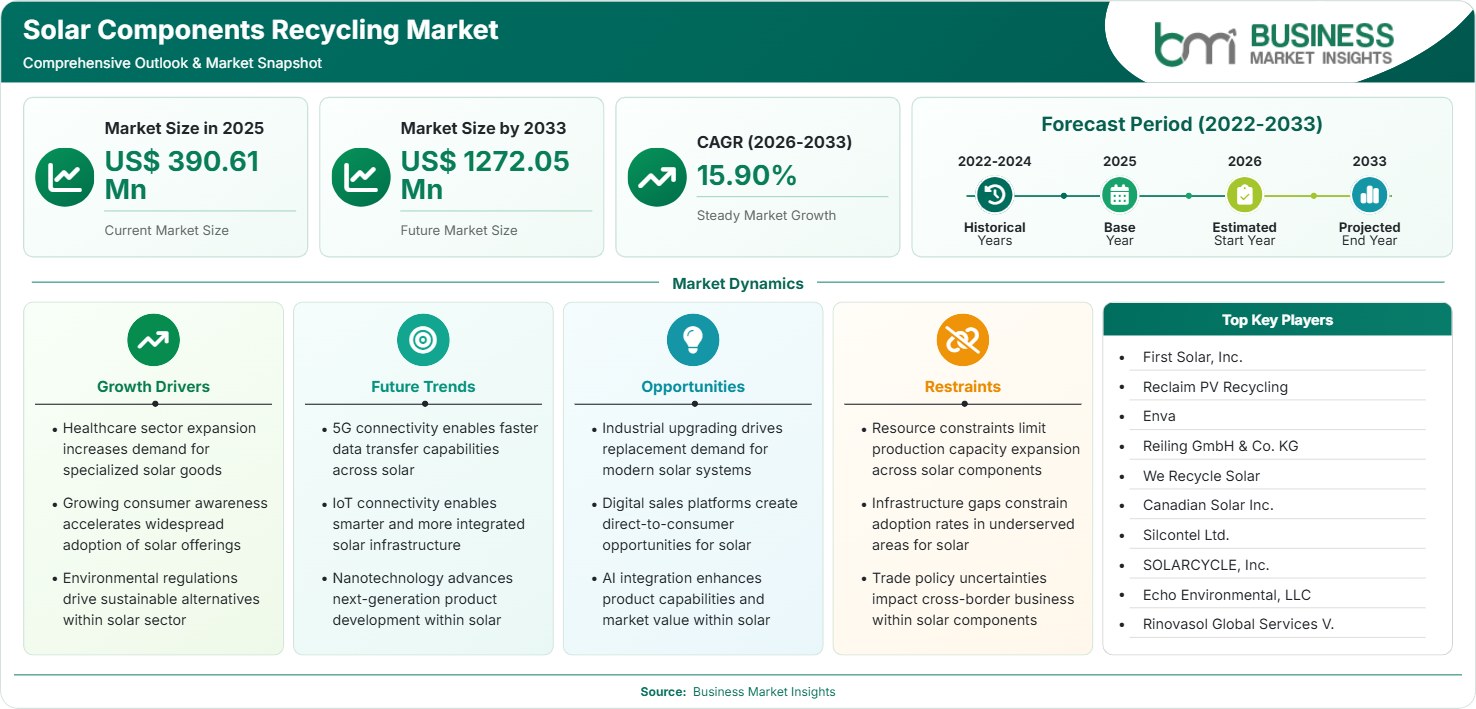
The Solar Components Recycling Market size was valued at US$ 390.61 Million in 2025 and is projected to reach US$ 1272.05 Million by 2033, growing at a CAGR of 15.90% during 2026–2033, driven by rising photovoltaic waste, circular-economy mandates, material recovery innovation, repowering activity, and demand for secondary raw materials.

Report Coverage
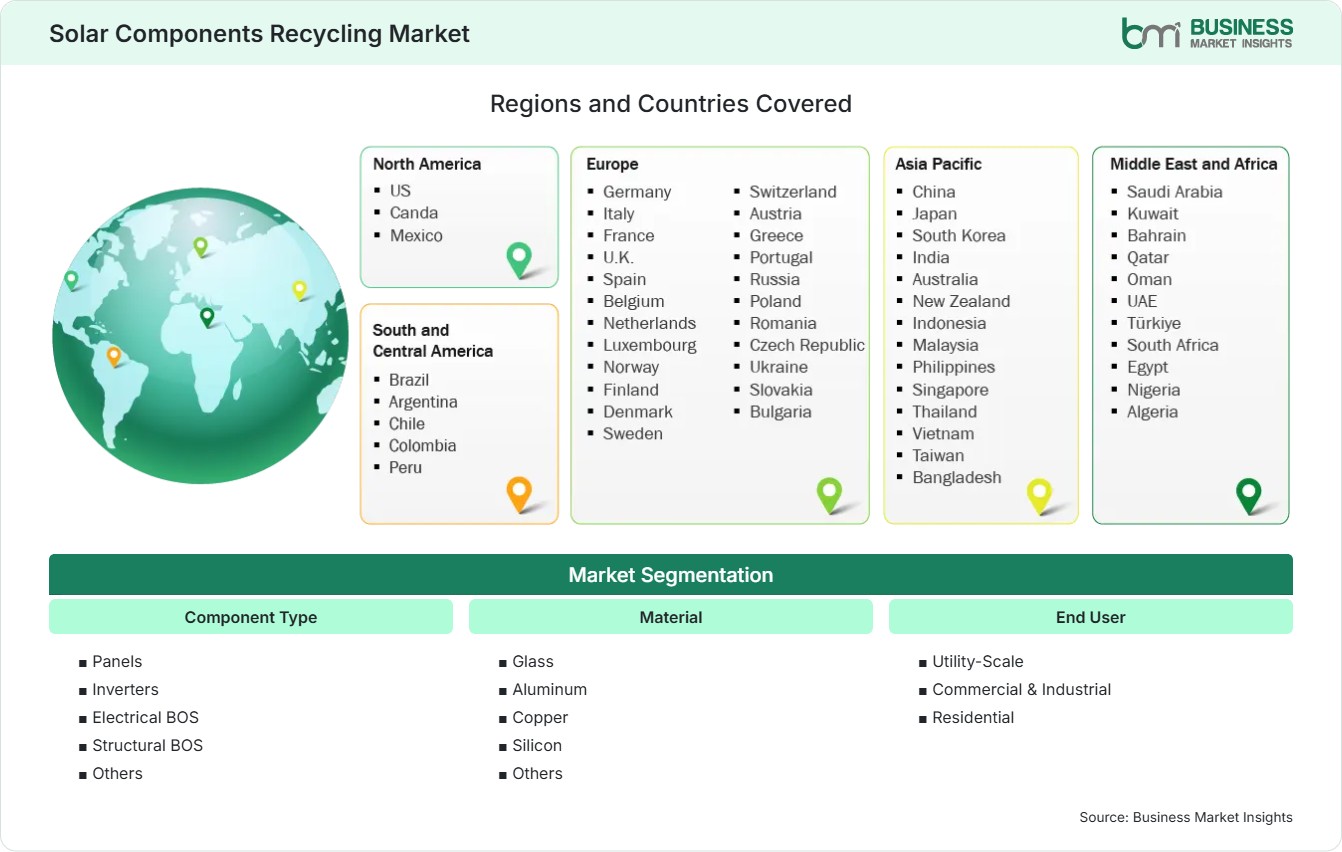
  • Component Type: Panels, Inverters, Electrical BOS, Structural BOS, Others
  • Material: Glass, Aluminum, Copper, Silicon, Others
  • End User: Utility-Scale, Commercial & Industrial, Residential
US$ 390.61 Mn Market size in 2025
US$ 1272.05 Mn Market Size by 2033
15.90% CAGR, 2026 - 2033
2026-2033 Forecast Period

AI Overview

Solar Components Recycling Market Summary

  • North America Region: North America holds a 10%–13% share in 2025, with a 13%–16% CAGR during 2026–2033, supported by utility-scale repowering, domestic recycling infrastructure, extended producer responsibility initiatives, material recovery investments, and growing demand for traceable circular supply chains. The US market is estimated to expand at a 13%–16% CAGR from 2026–2033, supported by utility-scale decommissioning, domestic manufacturing incentives, and recycling infrastructure investments.
  • Fastest Growing Region: Asia Pacific accounts for a 14%–18% share in 2025 and is advancing at a 18%–22% CAGR during 2026–2033, driven by enormous photovoltaic deployment, expanding manufacturing capacity, rising end-of-life volumes, circular economy policies, and investments in regional recycling networks.
  • Leading Segment: Panels represent a 78%–83% share in 2025 and are expanding at a 14%–17% CAGR during 2026–2033, supported by large installed bases, module replacement cycles, glass recovery, aluminum extraction, repowering, and increasingly sophisticated automated dismantling technologies.
  • High Growth Segment: Utility-Scale represents a 52%–57% share in 2025 and is growing at a 17%–20% CAGR during 2026–2033, driven by large project decommissioning, repowering, insurance replacements, centralized collection, bulk logistics, and contractual recycling obligations.
  • Key Market Opportunity: Investment in automated separation, high-purity silicon recovery, silver extraction, digital material traceability, and integrated repowering services can improve recycler economics while creating secondary-material supply opportunities.
  • Major Market Players: First Solar, Inc.; Reclaim PV Recycling; Enva; Reiling GmbH & Co. KG; We Recycle Solar; Canadian Solar Inc.; Silcontel Ltd.; SOLARCYCLE, Inc.; Echo Environmental, LLC; Rinovasol Global Services V.; The Retrofit Companies, Inc.; PVRE Cycle / Resource Recycling; Meyer Burger Technology AG.
Strategic Insights

Solar Components Recycling Market: Strategic Insights

Solar Components Recycling Market Strategic Framework
FREE PDF
Request your free sample
Request free sample
Stakeholder View

Key Takeaways

  • Market structure insight: The value chain is evolving from fragmented collection and disposal toward integrated networks connecting manufacturers, EPC contractors, asset owners, insurers, logistics providers, recyclers, refiners, and secondary-material buyers. Companies capable of coordinating these activities can secure stronger feedstock access and improve recovery economics.
  • Growth opportunity insight: Utility-scale projects offer the strongest near-term volume opportunity because centralized sites generate large module batches and simplify collection logistics. Commercial and industrial installations provide a second growth avenue as rooftop assets undergo modernization, insurance replacement, and performance-driven upgrades.
  • Innovation trend: Recycling technology is progressing from bulk material recovery toward selective separation and higher-purity outputs. Silicon, copper, silver, and aluminum recovery can improve value capture, while automated dismantling and digital tracking can reduce labor requirements and improve chain-of-custody transparency.
  • Regional opportunity: Asia Pacific presents a compelling investment case because high photovoltaic manufacturing concentration coincides with rapid installation growth. India, China, Japan, South Korea, and Australia are positioned to develop regional processing capacity as recycling requirements become more formalized.
  • Investment / M&A trend: Capital is increasingly directed toward specialized recycling plants, technology partnerships, and integrated repowering services. Reiling's formation of Convitrum GmbH in 2026 illustrates how established recyclers are extending into plant engineering to address rising international demand for PV recycling infrastructure.
  • Strategic insight: Long-term competitiveness will depend on feedstock contracts and recovery yield rather than processing capacity alone. Operators that secure predictable module flows and sell consistent secondary raw materials to industrial buyers can build more resilient margins.
Geographic Outlook

Solar Components Recycling Market Regional Highlights

North America Solar Components Recycling Market

North America holds a 10%–13% Solar Components Recycling Market share in 2025 and is projected to grow at a 13%–16% CAGR during 2026–2033. The region benefits from utility-scale repowering, aging installations, domestic manufacturing expansion, and rising attention to end-of-life management. The United States remains the principal demand center, while Canada is developing recycling capabilities alongside expanding photovoltaic deployment. Policy fragmentation remains a constraint, but centralized utility projects create favorable logistics for high-volume collection and processing. Growing interest in domestic material recovery further strengthens investment potential for advanced recycling infrastructure and integrated reverse-logistics networks.

  • Utility-scale repowering is increasing feedstock visibility as older installations are upgraded with higher-efficiency modules, creating concentrated opportunities for recyclers offering dismantling, transport, sorting, and material recovery.
  • Domestic solar manufacturing expansion strengthens circular supply-chain opportunities by encouraging recovery of aluminum, glass, copper, silicon, and other materials for potential reintegration into regional industrial production.
  • Insurance-driven replacement of damaged modules creates an additional feedstock stream, particularly after severe weather events, while specialized recyclers can capture value through rapid collection and compliant processing.
  • Regional policy differences require flexible operating models, encouraging companies to combine recycling contracts, logistics partnerships, manufacturer programs, and asset-owner agreements to maintain consistent module volumes.

US Solar Components Recycling Market

The US accounts for an estimated 8%–11% of the total 2025 revenue base and is advancing at a 13%–16% CAGR during 2026–2033. Solar Components Recycling Market demand is supported by large photovoltaic fleets, domestic manufacturing incentives, utility-scale repowering, and growing attention to circular supply chains. California, Texas, Arizona, and other high-installation states provide substantial feedstock potential. The market is also benefiting from investments in domestic solar manufacturing, which can create stronger commercial links between module producers, recyclers, and downstream material users seeking traceable secondary inputs.

  • Utility-scale projects provide concentrated collection economics, allowing recyclers to reduce per-module transportation costs and deploy specialized dismantling equipment across large batches of decommissioned or damaged modules.
  • Domestic manufacturing expansion is strengthening interest in closed-loop material strategies, particularly for aluminum, glass, copper, and silicon that can potentially support regional industrial supply chains.
  • Solar asset owners increasingly evaluate recycling during project planning, encouraging long-term agreements that connect decommissioning, logistics, material recovery, compliance reporting, and responsible downstream management.

Europe Solar Components Recycling Market

Europe represents a 38%–42% Solar Components Recycling Market share in 2025 and is projected to expand at a 12%–15% CAGR through 2033. The region remains the leading established recycling ecosystem because of mature collection infrastructure, WEEE obligations, producer responsibility mechanisms, and strong circular-economy policy. Germany, France, Italy, and the Netherlands are leading countries, while Germany is estimated at a 11%–14% CAGR and France at a 13%–16% CAGR. Investment increasingly targets automated recovery, higher material purity, and integrated repowering services that connect recycling with photovoltaic asset modernization.

  • Germany benefits from established PV recycling capabilities and regulatory compliance infrastructure, with specialized operators recovering glass, aluminum, silicon, copper, and other materials for industrial applications.
  • France combines substantial photovoltaic deployment with circular-economy priorities, creating opportunities for recycling companies offering national collection coverage and higher-value material recovery technologies.
  • Italy's large installed photovoltaic base creates long-term decommissioning potential, while project modernization and repowering can accelerate module replacement and generate concentrated recycling volumes.
  • The Netherlands functions as an important European solar logistics hub, supporting opportunities for reverse logistics, cross-border collection, consolidation, and compliant treatment of photovoltaic modules.

Asia Pacific Solar Components Recycling Market

Asia Pacific captures a 14%–18% Solar Components Recycling Market share in 2025 and is projected to grow at an 18%–22% CAGR through 2033, making it the fastest-growing regional opportunity. China, Japan, India, South Korea, and Australia lead deployment and manufacturing activity. China remains the largest installed-base opportunity, while India is positioned for rapid recycling infrastructure expansion. Japan and Australia offer attractive opportunities because of mature solar adoption and growing end-of-life management needs, while South Korea combines manufacturing expertise with circular-economy technology development.

  • China provides the largest long-term feedstock opportunity because of extensive photovoltaic manufacturing and deployment, creating strong potential for large-scale automated recycling and material recovery facilities.
  • India is developing rapidly as a solar manufacturing and deployment center, creating opportunities for regional recycling infrastructure that can serve domestic module production and future end-of-life volumes.
  • Japan's mature photovoltaic fleet supports demand for specialized recycling, reuse assessment, repowering, and material recovery services as older rooftop and utility installations approach replacement cycles.
  • Australia presents strong recycling potential because of high solar adoption, although dispersed installations and logistics costs create a need for regional collection hubs and efficient transportation models.

Rest of World Solar Components Recycling Market

South and Central America account for a 4%–6% share in 2025 and are projected to grow at a 16%–20% CAGR. Brazil and Chile lead regional deployment, while Brazil offers the strongest recycling opportunity because of its extensive solar expansion. Central American markets remain smaller but increasingly relevant as distributed photovoltaic adoption expands. The region's recycling ecosystem is still developing, creating opportunities for specialized logistics providers, regional processing hubs, and partnerships between developers, equipment suppliers, and recyclers.

The Middle East and Africa represent a 3%–5% share in 2025 and are projected to expand at a 18%–22% CAGR. Saudi Arabia, the United Arab Emirates, South Africa, and Morocco are leading the Solar Components Recycling Market, while Saudi Arabia and the UAE offer high-growth opportunities linked to large-scale solar projects. The combination of utility-scale development, harsh operating conditions, and project modernization creates future demand for centralized recycling infrastructure and recovery services.

  • Brazil's expanding solar fleet creates a long-term feedstock pipeline, while regional recyclers can benefit from centralized processing facilities serving concentrated utility and commercial project clusters.
  • Chile's strong utility-scale solar development supports future repowering and end-of-life opportunities, particularly for recyclers capable of operating across remote project locations.
  • Saudi Arabia and the UAE offer high-growth potential as large renewable projects mature, creating demand for planned decommissioning, logistics, and responsible material recovery services.
  • South Africa provides an emerging opportunity through commercial, industrial, and utility-scale installations, although recycling economics will depend on collection density and regional processing infrastructure.
Global Market Geography
FREE PDF
Request your free sample
Request free sample
Segment Analysis

Solar Components Recycling Market Segmentation

Component Type

Component Type segmentation is led by Panels, which represent a 78%–83% Solar Components Recycling Market share in 2025 and are projected to expand at a 14%–17% CAGR during 2026–2033. The segment benefits from module replacement, repowering, damaged inventory, and material recovery requirements. Increasing automation improves processing economics and enables higher-value separation of glass, aluminum, silicon, copper, and other embedded materials.

  • Panels: Dominant feedstock because installed modules generate the largest recoverable material stream, while aging assets, repowering, storm damage, and technology upgrades accelerate collection and recycling requirements.
  • Inverters: Replacement cycles and electronic component complexity create demand for specialized dismantling, component recovery, metals separation, and compliant handling as photovoltaic systems undergo modernization.
  • Electrical BOS: Cables, connectors, junction boxes, and electrical equipment offer recoverable copper and other materials, with recycling demand increasing alongside large project decommissioning and system upgrades.
  • Structural BOS: Aluminum and steel mounting structures create valuable secondary-material streams, while utility-scale dismantling projects enable efficient collection, sorting, and bulk processing.
  • Others: Auxiliary components create smaller but diverse recovery opportunities, requiring specialized collection practices and downstream processing partnerships to maximize material value.

Material

By Material segmentation is shaped by Glass, Aluminum, Copper, Silicon, and Others, with Glass representing an estimated 48%–53% share of the Solar Components Recycling Market in 2025 and a 13%–16% CAGR during 2026–2033. Material recovery economics increasingly depend on separation quality, purity, transportation distance, and downstream buyer demand. Higher-value silicon and copper recovery can improve recycler margins when advanced processing technologies are commercially viable.

  • Glass: Largest material stream by mass, with strong recovery potential for smelting and industrial applications when contamination is controlled and transportation distances remain economically manageable.
  • Aluminum: Valuable secondary metal recovered from module frames and mounting systems, benefiting from established recycling infrastructure and strong industrial demand for recycled aluminum inputs.
  • Copper: Recovered from wiring, ribbons, cables, and electrical components, offering attractive material value that supports investment in improved dismantling and separation technologies.
  • Silicon: Strategic recovery target because high-purity processing can potentially return valuable semiconductor material to industrial supply chains, although extraction economics remain technology-dependent.
  • Others: Plastics, silver, lead, and specialty materials require targeted treatment, creating opportunities for advanced separation processes and partnerships with specialized downstream refiners.

End User

By end-user segmentation, Utility-Scale installations lead, representing a 52%–57% share of the Solar Components Recycling Market in 2025 and expanding at a 17%–20% CAGR during 2026–2033. Large project volumes improve collection efficiency and support dedicated recycling contracts. Commercial & Industrial installations offer steady replacement demand, while Residential recycling remains more fragmented because of dispersed collection points and higher logistics complexity.

  • Utility-Scale: Large centralized installations generate substantial module volumes during repowering and decommissioning, supporting efficient logistics, dedicated recycling contracts, automated processing, and higher recovery yields.
  • Commercial & Industrial: Rooftop and distributed projects create recurring replacement opportunities as businesses modernize energy systems, upgrade modules, and pursue improved efficiency or storage integration.
  • Residential: Fragmented rooftop assets create collection challenges, but growing household solar adoption supports future recycling demand through retailer programs, local collection networks, and producer responsibility schemes.
Market Forces

Solar Components Recycling Market Dynamics

Key Market Drivers

Rising Photovoltaic Installations and Future End-of-Life Volumes

Rapid photovoltaic deployment is creating a structural feedstock pipeline for future recycling. The International Energy Agency continues to identify solar PV as a central driver of renewable electricity expansion, while the International Energy Agency Photovoltaic Power Systems Program highlights end-of-life management as an increasingly important component of PV sustainability. Solar Components Recycling Market growth depends not just on current waste production but also on total installed capacity. Long-term planning for decommissioning, repowering, and materials recovery is becoming an important trend in the solar panel recycling market. The recycling activities of First Solar provide an example of such lifecycle management by manufacturers, and its reported ability to recover over 90% at its India location is a case in point.

Regulatory Pressure and Circular Economy Requirements

European WEEE requirements and producer responsibility frameworks are strengthening formal collection and treatment systems for photovoltaic modules. These rules will thus incentivize both manufacturers and asset owners to develop end-of-life pathways that are traceable and will not depend on any informal channels for disposal. As a result, the European recycling network will develop itself based on certified collection and processing of the recycled materials. At the same time, similar policy debates have already begun in other high-deployment countries to reduce reliance on landfills and improve the efficiency of material use. In this respect, the regulatory push will be especially valuable in relation to such materials as glass, aluminum, silicon, and copper, since their recovery will help achieve the goals of the circular economy.

Advances in High-Value Material Recovery Technologies

Recycling economics are improving as processors move beyond basic shredding toward selective dismantling, delamination, and targeted recovery. Glass remains the dominant material by volume, but higher-value outputs such as aluminum, copper, silicon, and silver can materially improve revenue potential. Higher processing capability will also reduce contamination and enhance the usability of the recycled materials, thus improving their competitiveness compared to virgin materials. This is exemplified by the use of an advanced recycling process by First Solar Company as well as Reiling's emphasis on the recycling of glass, aluminum, copper, silicon, and silver. Technology development is critical, given that technological change will necessitate changes in equipment, sorting, and the recovery process.

Key Market Opportunities

Integrated Repowering and Recycling-as-a-Service Models

Repowering creates an opportunity to combine asset modernization with recycling, transforming end-of-life management from a standalone waste service into an integrated project activity. Reiling's 2026 repowering-as-a-service offering with partners illustrates this model by connecting module replacement, recycling, and broader project modernization. Solar Components Recycling Market Forecasts increasingly point toward service models that integrate dismantling, transportation, reuse assessment, recycling, and material recovery. These kinds of platforms can be useful for improving project economics through cost savings in coordination and greater predictability in the flow of inputs. The greatest chance of success would be for utility-scale projects where centralization facilitates the use of specific machines as well as the possibility of entering into long-term agreements.

High-Purity Silicon and Precious Material Recovery

Recovering higher-value materials represents an attractive investment frontier because conventional bulk recycling can leave substantial economic value unrealized. Silicon, silver, copper, and high-quality aluminum require specialized separation and refining pathways, but successful recovery can improve revenue per module. High-purity output producers through scalable processes would be able to distinguish themselves from low-value players who handle raw materials. A collaborative relationship with semiconductor, metals, glass and manufacturing sectors could help in securing downstream demand for their inputs. This would be especially applicable in situations where there are efforts being made to achieve supply chain stability without reliance on imported raw materials. In the long run, digital tagging and sorting of module content will improve efficiencies even more.

Digital Traceability and Circular Solar Supply Chains

Emerging Solar Components Recycling Market trends, including digital product passports, asset databases, and material traceability systems, can strengthen the connection among manufacturers, project owners, recyclers, and downstream material buyers. The record of the traceable module could include information on the manufacturer, type of technology, installation date, repair and maintenance history, and its end-of-life route, which would help make informed decisions about reusing vs recycling. In the case of recyclers, correct information on the materials that are used in the modules would help to cut down uncertainty during the sorting process and make an appropriate choice of the process to be used. Asset owners would be able to facilitate reporting and demonstrate the proper disposal of the waste.

Market Restraints and Challenges

Factor: High Collection and Transportation Costs

Factor: Photovoltaic modules are widely distributed across residential rooftops, commercial buildings, remote utility projects, and rural installations, making collection and transportation expensive relative to the value of recovered materials.

Impact: Logistics can reduce recyclers' margins, especially when processing plants are geographically concentrated, and module quantities are insufficient to fill a truckload. This problem is even more serious in the case of residential systems since there is a scattering of points where the modules are collected and low individual quantities of the modules. Utility-scale projects reduce the constraints through volume concentration and planning for the decommissioning process.

Factor: Low Recovery Economics for Conventional Processing

Factor: Standard mechanical recycling can recover large quantities of glass and metals, but may generate limited economic value when high-purity materials are difficult to separate or downstream prices weaken.

Impact: Inefficient output streams with low economic value may limit investments in modern equipment and push the recyclers towards disposal or sub-standard recovery processes where there are no strict regulations. The problem becomes more complex with modifications of the modules, which leads to new needs for processing. Improved separation might help capture the full value but requires capital expenditures, know-how, and stable feedstock volumes. Thus, recyclers should develop a portfolio strategy with diverse revenue sources, including the sale of materials, collection charges, producer agreements, repowering services, and technology alliances.

Company Analysis

Competitive Landscape

Solar Components Recycling Market analysis indicates a competitive structure combining integrated module manufacturers, specialized recyclers, waste-management companies, material recovery specialists, and emerging technology providers. Competitive differentiation increasingly depends on processing yield, geographic collection coverage, compliance capabilities, downstream material partnerships, and the ability to integrate recycling with repowering.

Company Name

Overview

Products and Services relevant to this market

First Solar, Inc.

Integrated solar manufacturer with a long-standing lifecycle management strategy and dedicated photovoltaic recycling infrastructure across multiple regions.

End-of-life module collection, recycling, material recovery, recycling technology, and manufacturer-supported lifecycle management programs.

Reclaim PV Recycling

Australian specialist focused on photovoltaic module recycling and recovery services, addressing the country's expanding installed solar base.

PV module recycling, collection, processing, material recovery, and end-of-life management services for solar assets.

Enva

UK-based environmental services provider operating across waste management and resource recovery with capabilities applicable to renewable-energy equipment streams.

Collection, waste treatment, resource recovery, compliance support, and recycling services relevant to photovoltaic equipment.

Reiling GmbH & Co. KG

German recycling group with specialized photovoltaic processing capabilities and an expanding international technology and service ecosystem.

PV module recycling, collection, dismantling, logistics, repowering services, material recovery, and recycling plant engineering.

We Recycle Solar

US-focused solar recycling specialist supporting responsible handling of decommissioned and damaged photovoltaic modules.

Solar panel recycling, collection, logistics coordination, reuse assessment, and material recovery services.

Canadian Solar Inc.

Major solar manufacturer and energy solutions provider with an expanding North American manufacturing footprint and lifecycle considerations.

Solar modules, energy solutions, project services, recycling partnerships, and end-of-life management within photovoltaic supply chains.

Silcontel Ltd.

Israel-based specialist associated with silicon and photovoltaic technology expertise, relevant to advanced material recovery opportunities.

Silicon-related processing expertise, technology solutions, and capabilities applicable to photovoltaic material recovery.

SOLARCYCLE, Inc.

US clean-technology company focused on creating circular supply chains for solar modules and recovered materials.

Solar panel recycling, material recovery, collection services, refurbishment, and circular-material supply solutions.

Echo Environmental, LLC

US environmental services company supporting renewable-energy asset recovery and responsible end-of-life management.

Solar panel recycling, electronic waste processing, logistics, material recovery, and compliant waste management.

Rinovasol Global Services V.

Netherlands-based specialist focused on photovoltaic module reuse, repair, and recycling within European circular solar supply chains.

PV reuse assessment, repair, recycling, logistics, and circular lifecycle services for photovoltaic modules.

The Retrofit Companies, Inc.

US environmental services provider with expertise in electronics recycling and renewable-energy equipment recovery.

Solar panel recycling, electronic waste management, collection, processing, material recovery, and compliance services.

PVRE Cycle / Resource Recycling

Belgium-oriented photovoltaic recycling specialist addressing end-of-life module recovery and circular material management.

PV module collection, recycling, dismantling, material recovery, and resource circulation services.

Meyer Burger Technology AG

Swiss photovoltaic technology company with advanced module expertise and a strategic interest in sustainable solar manufacturing.

High-efficiency PV technology, module manufacturing, lifecycle strategies, material efficiency, and sustainability-oriented solar solutions.

Trust & Transparency

Research Methodology

The market analysis combines proprietary research with secondary data from government agencies, company disclosures, regulatory filings, industry databases and expert interviews. Market estimates are validated through data triangulation, cross-market benchmarking and analyst review.

View Full Research Methodology

Questions Answered

Frequently Asked Questions

What differentiates successful recycling companies?

The Solar Components Recycling Market Report highlights that successful operators typically combine reliable feedstock access, efficient logistics, high recovery yields, regulatory compliance, downstream material buyers, and technology flexibility. Long-term contracts with manufacturers, developers, insurers, and asset owners can provide greater resilience than relying solely on spot waste volumes.

Why is traceability becoming important for recyclers?

Traceability can document module origin, composition, ownership, treatment route, and recovered materials. This information supports regulatory compliance, improves sorting decisions, strengthens chain-of-custody reporting, and helps manufacturers and asset owners demonstrate responsible lifecycle management.

How does repowering influence Solar Components Recycling Market?

Repowering can bring forward module replacement before physical end-of-life. As asset owners upgrade older systems with higher-efficiency modules, recyclers receive concentrated volumes from utility-scale sites, improving collection economics and creating opportunities for integrated dismantling and recycling contracts.

Which recovered material has the strongest strategic value?

Glass offers the largest volume opportunity, while silicon, copper, aluminum, and silver can provide greater value per unit when recovery and purification technologies are economically viable. The strongest strategy combines high-volume glass recovery with selective extraction of higher-value materials.

What is driving the shift toward circular photovoltaic recycling?

The shift is being driven by increasing end-of-life volumes, producer responsibility requirements, resource-security concerns, and demand for secondary raw materials. Recycling is moving beyond waste compliance toward recovery of materials that can potentially re-enter industrial supply chains.

Access the Full Solar Components Recycling Market Report

Get segment-level forecasts, regional estimates, competitive benchmarking, company profiles and downloadable Excel datasets.

Access the full Solar Components Recycling Market Report
350 pages PDF & Excel | 2026-08-17
Similar Research

Related Market Reports