
Solar Carport Market Outlook: Size, Share, Trends, Growth Analysis, Competitive Landscape & Forecast, 2026-2033

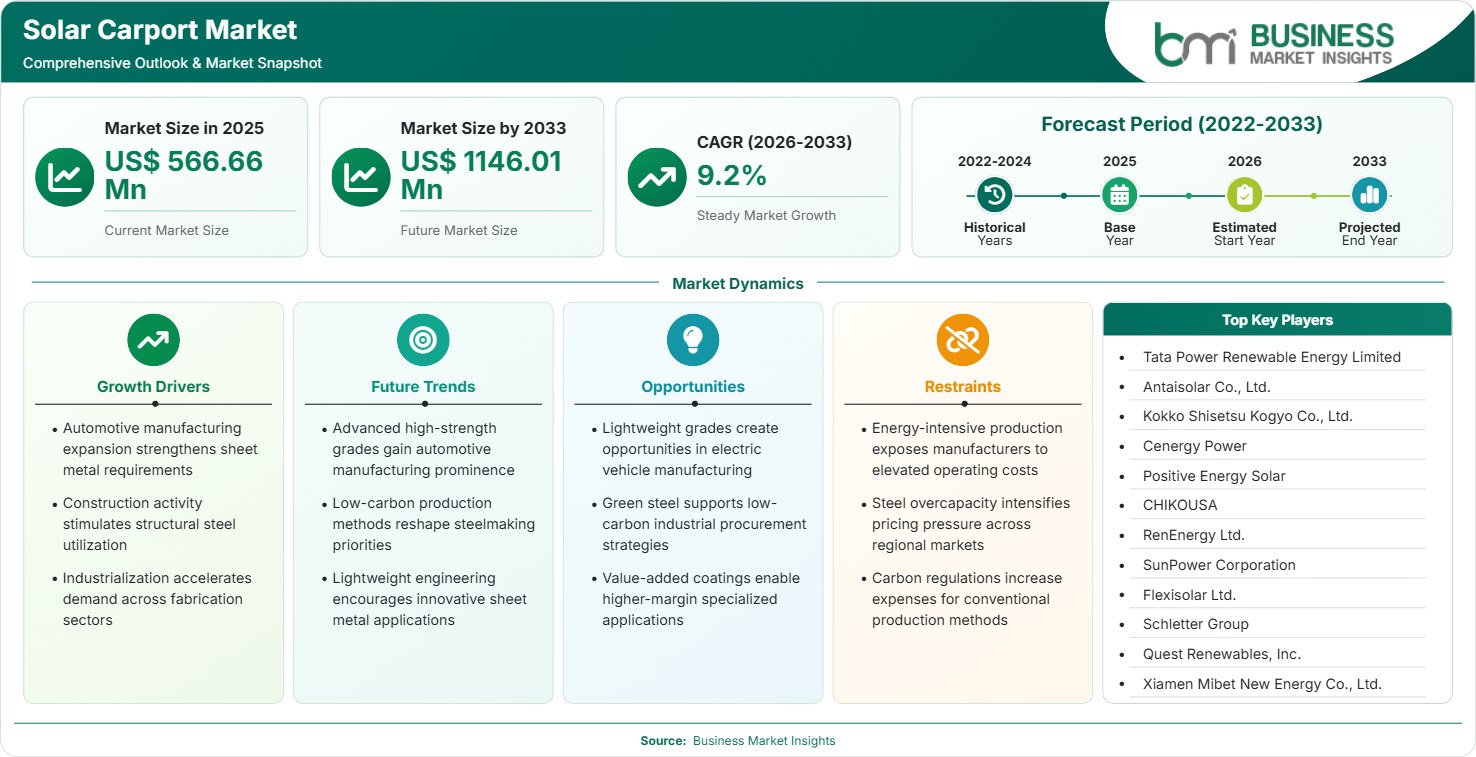
The Solar Carport Market size was valued at US$ 566.66 Million in 2025 and is projected to reach US$ 1146.01 Million by 2033, growing at a CAGR of 9.20% during 2026–2033, driven by EV charging integration, parking-space optimization, decarbonization mandates, distributed solar adoption, and commercial renewable-energy investments.

Report Coverage
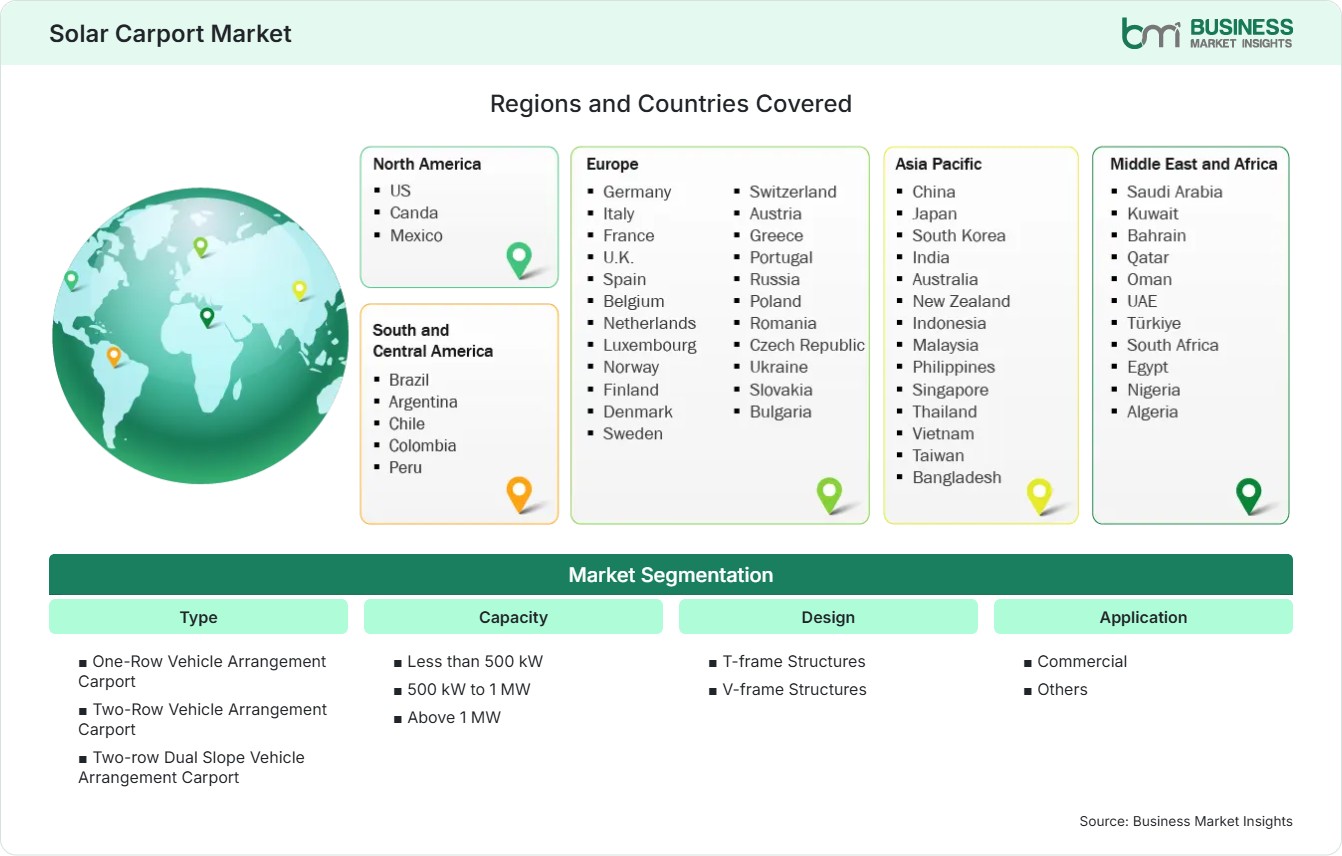
  • Type: One-Row Vehicle Arrangement Carport, Two-Row Vehicle Arrangement Carport, Two-row Dual Slope Vehicle Arrangement Carport
  • Capacity: Less than 500 kW, 500 kW to 1 MW, Above 1 MW
  • Design: T-frame Structures, V-frame Structures
  • Application: Commercial, Others
US$ 566.66 Mn Market size in 2025
US$ 1146.01 Mn Market Size by 2033
9.2% CAGR, 2026 - 2033
2026-2033 Forecast Period

AI Overview

Solar Carport Market Summary

  • North America Region: North America holds a 11%–14% share in 2025, growing with a 8.6%–9.5% CAGR during 2026–2033, influenced by commercial EV charging, corporate decarbonization, parking infrastructure modernization, favorable financing, and renewable-energy procurement. The U.S. market benefits from large commercial parking portfolios, EV infrastructure investment, and demand for resilient distributed generation, supporting approximately 8.7%–9.6% CAGR through 2033.
  • Fastest Growing Region: Asia Pacific holds a 31%–35% share in 2025, growing with a 10.0%–11.2% CAGR during 2026–2033, supported by expanding solar deployment, industrial parking, EV adoption, manufacturing investment, urban land constraints, distributed-generation policies, and increasingly integrated commercial energy infrastructure.
  • Leading Segment: T-frame Structures holds a 49%–53% share in 2025, growing with a 8.7%–9.5% CAGR during 2026–2033, supported by structural simplicity, efficient vehicle access, scalable engineering, standardized fabrication, broad commercial suitability, and established developer familiarity across large parking installations.
  • High Growth Segment: Above 1 MW holds a 13%–17% share in 2025, growing with a 10.4%–11.4% CAGR during 2026–2033, supported by corporate campuses, airports, logistics hubs, manufacturing facilities, large parking assets, EV charging demand, power-purchase agreements, and economies of scale.
  • Key Market Opportunity: Parking assets can become distributed energy infrastructure as EV charging, battery storage, smart controls, and solar generation converge, enabling commercial owners to monetize unused surface areas while improving energy resilience.
  • Major Market Players: Tata Power Renewable Energy Limited, Antaisolar Co., Ltd., Kokko Shisetsu Kogyo Co., Ltd., Cenergy Power, Positive Energy Solar, CHIKOUSA, RenEnergy Ltd., SunPower Corporation, Flexisolar Ltd., Schletter Group, Quest Renewables, Inc., Xiamen Mibet New Energy Co., Ltd., EvoEnergy, KDC Solar LLC, and Enova.
Strategic Insights

Solar Carport Market: Strategic Insights

Solar Carport Market Strategic Framework
FREE PDF
Request your free sample
Request free sample
Stakeholder View

Key Takeaways

  • Supply-chain structure: The value chain is increasingly integrated across structural engineering, steel and aluminum fabrication, PV modules, inverters, EPC services, electrical equipment, EV charging, monitoring, and asset management. Suppliers capable of coordinating these interfaces can capture greater project value.
  • Growth opportunity: Large commercial parking portfolios provide the strongest expansion pathway because one project can combine electricity generation, vehicle shading, EV charging, and corporate sustainability objectives without competing directly with agricultural or undeveloped land.
  • Innovation trend: Lightweight structures, modular trusses, bifacial modules, optimized drainage, prefabricated electrical systems, digital structural modeling, and ground-assembled components are reducing installation complexity while improving project consistency.
  • Regional opportunity: India offers an attractive combination of rapid solar deployment, industrial expansion, EV adoption, and large commercial facilities. IEA data indicate almost 50 GW of solar PV additions in 2025, reinforcing the broader infrastructure ecosystem.
  • Investment and M&A: Capital is moving toward integrated renewable infrastructure providers rather than standalone mounting suppliers. Strategic value increasingly depends on engineering capability, EPC execution, financing access, long-term maintenance, and the ability to integrate charging and storage.
  • Commercial strategy: Developers should prioritize standardized designs for repeatable parking configurations while maintaining engineering flexibility for snow, wind, drainage, fire access, accessibility, and local permitting requirements.
Geographic Outlook

Solar Carport Market Regional Highlights

North America Solar Carport Market

North America represented a 11%–14% Solar Carport Market share in 2025, with a 8.6%–9.5% CAGR during 2026–2033. The demand centers around commercial parking, logistics, universities, healthcare campuses, and fleet depots. Higher electricity rates and corporate renewable energy goals drive investment in such projects. In addition, EV charging adds to the financial viability of such projects as it creates on-site electricity loads. There are well-established EPC providers, financiers, structure manufacturers, and distributed energy solution providers in the value chain of the region. Most of the demand arises from the United States commercial projects, with Canada and Mexico offering additional opportunities for growth.

  • When roof space is limited or unsuitable for further installation of photovoltaic systems, commercial parking operators are becoming more inclined to consider canopy systems as well.
  • The depots for electric vehicles offer better economic advantages since solar power generation can be directly combined with charging vehicles during the day, which reduces the demand on the grid and enhances the use of renewable energy.
  • The scope of corporate sustainability commitments is extending procurement from the generation of electricity to include the various kinds of infrastructure that is visible, such as that which supports employee parking, customer facilities, and branded environmental initiatives.
  • Because of modular engineering, construction times can be shortened and disturbance in busy parking areas reduced, which in turn improves the feasibility of projects for hospitals, campuses, retailers, and logistics facilities.

US Solar Carport Market

The U.S. accounted for approximately 75%–80% of North American Solar Carport Market demand in 2025, equivalent to about 8.3%–11.2% of global demand, and is projected to record an 8.7%–9.6% CAGR during 2026–2033. Commercial real estate, fleet electrification, educational institutions, airports, and city parking facilities are key customer segments. The impact of federal and state clean energy policies, corporate power purchase agreements, utility-led programs, and the need for resilience-driven distributed generation is helping to build out pipelines of projects. Regional differences still matter, however, as permitting, interconnection, electricity rates, and incentives vary widely by state.

  • California, New York, Massachusetts, New Jersey, and selected western states provide attractive conditions where high electricity prices and clean-energy policies improve distributed-generation economics.
  • Fleet electrification is expanding demand for large canopies at logistics facilities, municipal depots, delivery hubs, and corporate campuses where charging loads align with solar production.
  • Structural suppliers increasingly differentiate through engineering, prefabrication, installation safety, wind and snow performance, and reduced parking disruption rather than basic steel fabrication alone.

Europe Solar Carport Market

Europe represented a 43%–47% Solar Carport Market share in 2025, with a 8.8%–9.7% CAGR during 2026–2033, retaining a leading position because of renewable-energy targets, constrained urban land, high electricity costs, and strong commercial PV adoption. Germany, France, Spain, Italy, and the United Kingdom lead as major sources of demand. Germany and Spain have deep solar deployments, whereas France has immense potential for solar parking due to policies that favor solar energy for large parking lots.

  • Germany remains a leading country, with approximately 8.8%–9.6% CAGR, supported by substantial PV deployment, commercial electricity demand, and corporate renewable procurement.
  • France is a high-growth opportunity at approximately 10.0%–11.2% CAGR, supported by parking-solar policy direction and increasing interest in dual-use commercial infrastructure.
  • Spain offers approximately 9.5%–10.6% CAGR, benefiting from strong solar irradiation, commercial PV economics, industrial development, and increasing electrification of transport.
  • The United Kingdom is positioned for approximately 9.2%–10.3% CAGR, supported by commercial solar adoption, EV infrastructure, fleet electrification, and demand for low-carbon commercial estates.

Asia Pacific Solar Carport Market

Asia Pacific captured a 31%–35% share in 2025 and is projected to achieve a 10.0%–11.2% CAGR during the Solar Carport Market Forecasts, making it the fastest-growing major region. The drivers of demand in China, Japan, India, South Korea, and Australia are varied. The solar industry in China is a highly dominant regionally, while India has both quick installation of solar PV and industrial development. Japan has strict restrictions on land availability and therefore requires parking lot-integrated solar power generation. According to IEA statistics, 50 GW of solar PV was installed in India in 2025.

  • China provides approximately 10.0%–11.0% CAGR, supported by manufacturing scale, commercial energy demand, EV adoption, and continued expansion of distributed photovoltaic infrastructure.
  • India represents approximately 11.0%–12.2% CAGR, driven by rapid renewable deployment, industrial parks, airports, shopping facilities, EV charging, and corporate decarbonization.
  • Japan offers approximately 9.7%–10.8% CAGR, with limited land availability encouraging integration of PV generation into parking and other built environments.
  • Australia is positioned for approximately 9.5%–10.7% CAGR, supported by high solar irradiation, commercial electricity costs, distributed generation, and increasing EV adoption.

Rest of World Solar Carport Market

Rest of World represented a 8%–11% Solar Carport Market share in 2025, with a 9.0%–10.2% CAGR during 2026–2033. Strong solar resources and increasing commercial procurement of renewable energy make the South and Central American regions attractive, particularly Brazil. Mexico is another country that has potential for distributed commercial use. In the Middle East and Africa, development is occurring through larger commercial projects, airports, logistics centers, and renewable energy projects. Saudi Arabia and the UAE are particularly attractive markets for development, due to the solar irradiation levels and significant infrastructure investments.

Projects in South and Central America have adopted more parking canopies where energy pricing and economics allow on-site power generation. The Brazilian solar power growth has created an existing ecosystem for EPCs, panels, inverters, and commercial energy services. Middle Eastern projects prefer strong structures designed to withstand heat, dust, winds, and strong sunlight.

  • Brazil is positioned for approximately 9.5%–10.5% CAGR, supported by distributed solar adoption, commercial electricity economics, and large retail and industrial parking areas.
  • Saudi Arabia offers approximately 11.0%–12.0% CAGR, supported by rapidly expanding solar deployment and major infrastructure development.
  • The UAE is positioned for approximately 10.2%–11.3% CAGR, with strong commercial sustainability programs and high-value parking infrastructure.
  • Mexico provides approximately 9.2%–10.3% CAGR, supported by industrial facilities, automotive manufacturing, logistics, and distributed renewable-energy demand.
Global Market Geography
FREE PDF
Request your free sample
Request free sample
Segment Analysis

Solar Carport Market Segmentation

Type

The Type segment is led by Two-Row Vehicle Arrangement Carport configurations, supported by efficient parking coverage and repeatable structural layouts. The segment represents approximately 45%–49% share in 2025 and records an estimated 8.8%–9.6% CAGR during 2026–2033. Solar Carport Market trends favor configurations balancing vehicle access, structural economy, drainage, and photovoltaic surface utilization across commercial parking assets.

  • One-Row Vehicle Arrangement Carport: Suitable for smaller parking layouts and distributed commercial sites, this configuration offers straightforward installation, flexible orientation, and lower structural complexity where parking density limits larger canopy formats.
  • Two-Row Vehicle Arrangement Carport: Provides efficient coverage across paired parking spaces, improving material utilization and photovoltaic density while supporting commercial facilities seeking scalable generation and consistent parking circulation.
  • Two-row Dual Slope Vehicle Arrangement Carport: Dual-slope geometry supports opposing parking orientations and balanced photovoltaic exposure, making it suitable for larger facilities requiring efficient land utilization, drainage, and architectural consistency.

Capacity

Capacity segmentation is led by 500 kW to 1 MW, representing approximately 40%–44% Solar Carport Market share in 2025 and achieving an estimated 9.0%–9.8% CAGR during 2026–2033. The range suits commercial campuses, retail facilities, industrial sites, and fleet depots requiring meaningful onsite generation without the engineering complexity of very large systems.

  • Less than 500 kW: Targets smaller commercial parking assets where electricity savings, straightforward interconnection, and manageable construction requirements support adoption across retail, offices, schools, and small industrial properties.
  • 500 kW to 1 MW: Combines substantial generation with manageable project execution, making it attractive for commercial campuses, warehouses, healthcare facilities, and medium-sized industrial parking portfolios.
  • Above 1 MW: Enables high-capacity generation across airports, manufacturing plants, logistics hubs, and large campuses, with economies of scale supporting stronger engineering and procurement optimization.

Design

The Design segment is dominated by T-frame Structures, accounting for approximately 49%–53% Solar Carport Market share in 2025 and achieving an estimated 8.7%–9.5% CAGR during 2026–2033. Standardized geometry, structural familiarity, vehicle access, and efficient fabrication support widespread commercial deployment, while V-frame systems address projects requiring alternative spans and specialized parking layouts.

  • T-frame Structures: Offer standardized structural geometry, efficient fabrication, accessible engineering, and broad compatibility with commercial parking arrangements, supporting repeatable deployment across multiple project sizes.
  • V-frame Structures: Provide alternative structural geometry for selected parking configurations, helping developers address site constraints, architectural requirements, drainage considerations, and module-orientation objectives.

Application

Commercial applications dominate because organizations can combine electricity generation, vehicle protection, EV charging, sustainability reporting, and parking optimization. Commercial demand represented approximately 88%–92% Solar Carport Market share in 2025, with an estimated 9.0%–9.8% CAGR during 2026–2033. The [Market Title] scope increasingly extends toward integrated energy infrastructure rather than standalone parking shade.

  • Commercial: Includes retail centers, offices, industrial facilities, logistics sites, airports, hospitals, universities, and corporate campuses where large parking footprints create attractive opportunities for renewable generation and charging infrastructure.
Market Forces

Solar Carport Market Dynamics

Key Market Drivers

Expansion of Commercial Solar and Distributed Generation

The global deployment of photovoltaics provides the basic context for the demand side of parking integration. According to the IEA-PVPS, PV capacity will reach around 3 TW in 2025, with 698 GW added. With such deployment, the range of options for modules, engineering skills, inverter technology, and financing for canopy PV projects widens. Business owners look for additional generation when the roof's PV potential is not enough. Solar Carport Market trends also favor the deployment of larger commercial facilities since costs of structural acquisition, electrical planning, and EPC can be spread out through higher capacity.

EV Charging Integration Creates New Electricity Demand

The emergence of electric vehicles changes the economic nature of the role of parking infrastructure by turning parking spots into energy-consuming locations. Direct supply of solar canopies can help meet the daytime charging needs, thus decreasing reliance on grid electricity and increasing usage of onsite power generation. The need to charge cars becomes an integral part of parking needs for commercial fleets, offices, malls, airports, and logistics centers. It makes sense to invest in a joint venture rather than only in solar power generation. The combination of canopy generation, charging equipment, smart energy management, and storage also increases the potential revenue captured by EPCs and energy-service companies offering bundled infrastructure.

Land Optimization and Corporate Decarbonization

Parking canopies enable the production of renewable energy without using any new undeveloped land, providing an added strategic benefit in urban commercial settings. Corporations can use their existing parking structures to procure renewable energy, implement their carbon reduction programs, and provide information about their sustainability efforts while keeping the parking function intact. Such a system works well, especially in countries like Europe and Japan, where the availability of land is a problem. Solar Carport Market growth is consequently linked not only to electricity economics but also to corporate climate commitments, building modernization, fleet electrification, and increasing pressure to reduce operational emissions.

Key Market Opportunities

Integrated Solar, Storage, and EV Charging Platforms

The most promising opportunity appears to be the combination of PV canopies with battery systems, chargers, energy management software, and grid services. They enable optimization of solar self-consumption, scheduling of charging operations, reduction of demand charges, and backup for certain commercial loads. The developers have an opportunity not only to sell structural systems but also to earn revenue from software, maintenance, monitoring, and energy services. Parking projects with large portfolios are especially lucrative due to the same or similar layouts, which allow for the use of common engineering across many sites. The biggest opportunity will be for suppliers that can integrate all these structural, electrical, and digital components into a single business case.

Large Fleet Depots and Logistics Parking

Electrification of delivery vehicles, buses, service fleets, and corporate vehicles is creating large concentrated charging loads. Solar carports can generate electricity over the fleet's parking area, reducing land use for renewable generation and protecting vehicles from the elements. The logistics centers have a particular appeal because the vehicles are likely to be parked during daytime hours, thereby matching charging demand with solar electricity generation. The projects can utilize contracts for power supply, if required. It is an opportunity most suitable for engineering firms with expertise in large-scale installations and the integration of high-power chargers.

Parking Policy and Urban Infrastructure Transformation

The parking rules have the potential to convert extensive surface areas into sites for renewable energy projects. France is one country where policies have taken shape regarding the installation of solar panels in parking facilities that qualify for such installations, and other places are looking to do similar things. This makes sure there is an investment channel that is not dependent on voluntary initiatives by companies. Parking areas, transit facilities, airports, shopping centers, and government facilities can all serve as renewable energy sources while still being used for transport. There is room for differentiation among suppliers in designing systems for fire access, drainage, accessibility, weight-bearing, and other considerations.

Market Restraints and Challenges

High Structural and Installation Costs

Factor: Solar carports require steel or aluminum structures, foundations, drainage systems, elevated electrical work, engineering studies, and specialized installation compared with conventional ground-mounted or rooftop PV. Parking operations can also require phased construction and traffic management.

Impact: High upfront investment may result in a long payback period and deter small business investors, especially in regions where electricity is cheap or finance costs are high. The greatest effect will be seen on projects that have complex parking layouts, poor soil conditions, difficult access to construction, and costly grid connections. Structural cost can be avoided by implementing modularization, standardization, optimization of the foundation system, phase implementation, and integration of the procurement process.

Permitting, Grid Interconnection, and Site Constraints

Factor: Projects can require multiple approvals covering structural safety, electrical systems, fire access, stormwater management, accessibility, parking operations, and utility interconnection. Existing underground services can complicate foundation placement, while grid capacity may constrain larger installations. Impact: Development schedules may be prolonged, leading to increased development costs, as well as uncertainty regarding construction planning and financing. Such considerations become critical when development occurs in an urban area with extensive car parking and underground utilities, which reduce the ability to control construction. Today, many developers are dealing with the problem by conducting early geotechnical assessments, utility mapping, preliminary interconnection studies, digital modeling of the site, and uniform permit documentation.

Company Analysis

Competitive Landscape

The Solar Carport Market analysis indicates a fragmented competitive environment combining integrated renewable-energy companies, specialized structural suppliers, solar EPC providers, and engineering-focused canopy manufacturers. Competition increasingly centers on structural efficiency, installation speed, engineering support, durability, project financing, EV charging integration, and geographic coverage.

Company Name

Overview

Products and Services relevant to this market

Tata Power Renewable Energy Limited

Indian renewable-energy company with extensive solar development, EPC, and commercial energy capabilities and established large-scale canopy experience.

Solar carport EPC, photovoltaic systems, engineering, project development, operations, maintenance, and integrated renewable-energy solutions.

Antaisolar Co., Ltd.

Chinese PV mounting specialist providing distributed, rooftop, ground-mounted, and carport structures across international markets.

Solar carport mounting systems, structural engineering, rooftop solutions, ground mounting, digital design, and localized technical support.

Kokko Shisetsu Kogyo Co., Ltd.

Japanese specialist focused on photovoltaic structures and renewable-energy infrastructure adapted to demanding site conditions.

Solar carport structures, PV mounting systems, engineering, fabrication, and site-specific structural solutions.

Cenergy Power

U.S. solar-energy provider serving commercial customers with renewable generation and project implementation capabilities.

Commercial solar systems, carport PV installations, project development, engineering, and energy solutions.

Positive Energy Solar

U.S. solar company providing renewable-energy solutions for residential and commercial customers.

Solar PV systems, commercial installations, energy solutions, and supporting project services for canopy applications.

CHIKOUSA

Solar mounting provider offering structural solutions designed for diverse photovoltaic installation environments.

Solar carport mounting structures, PV support systems, engineering, installation support, and structural components.

RenEnergy Ltd.

U.K.-based renewable-energy specialist delivering solar and energy infrastructure solutions for commercial customers.

Solar PV, carport installations, battery storage, EV charging, design, installation, monitoring, and energy services.

SunPower Corporation

Established solar technology and services company with commercial solar expertise and distributed-energy capabilities.

Commercial PV systems, solar engineering, project development, energy services, and integrated distributed-generation solutions.

Flexisolar Ltd.

U.K. specialist focused on solar carport structures and photovoltaic canopy applications for commercial sites.

Solar panel carports, canopy structures, project design, engineering, installation support, and commercial PV solutions.

Schletter Group

Global mounting-system manufacturer with extensive expertise in engineered photovoltaic support structures.

Solar carports, mounting systems, structural components, engineering services, and large commercial PV infrastructure.

Quest Renewables, Inc.

U.S. specialist focused specifically on solar canopy systems with modular designs and integrated engineering services.

Long-span carports, double-cantilever systems, parking-garage canopies, feasibility studies, EPC, construction, and commissioning.

Xiamen Mibet New Energy Co., Ltd.

Chinese solar mounting manufacturer serving international photovoltaic markets with engineered support systems.

Solar carport structures, ground mounting, rooftop systems, engineering, manufacturing, and customized PV support solutions.

EvoEnergy

U.K. renewable-energy provider with commercial solar expertise and capabilities spanning project development and installation.

Commercial solar PV, solar carports, battery storage, EV charging, energy management, and maintenance services.

KDC Solar LLC

U.S. renewable-energy developer specializing in commercial and institutional solar infrastructure.

Solar development, project finance, commercial PV, carport installations, engineering coordination, and long-term energy services.

Enova

UAE-based energy-services company serving regional customers through clean-energy and efficiency solutions.

Solar PV, distributed renewable systems, commercial energy solutions, project development, and supporting energy services.

Trust & Transparency

Research Methodology

The market analysis combines proprietary research with secondary data from government agencies, company disclosures, regulatory filings, industry databases and expert interviews. Market estimates are validated through data triangulation, cross-market benchmarking and analyst review.

View Full Research Methodology

Questions Answered

Frequently Asked Questions

What business model can improve solar carport project economics?

Projects can combine multiple revenue and savings streams, including onsite electricity consumption, EV charging, renewable-energy procurement, power-purchase agreements, parking modernization, and energy-management services. For large portfolios, standardized designs and centralized procurement can reduce engineering and installation costs. Long-term operations and maintenance contracts can also create recurring revenue for project developers and service providers. __________________________________________________________________________________________

Why is structural engineering important in solar carport projects?

Structural engineering determines foundation requirements, wind and snow resistance, drainage, module loading, vehicle clearance, corrosion protection, and long-term durability. Site-specific conditions can materially affect project cost. Proper engineering also reduces construction risk and supports permitting by demonstrating that the canopy can safely withstand local environmental and operational loads. __________________________________________________________________________________________

Can solar carports support EV fleet charging?

Yes. Solar carports can provide electricity directly to EV chargers, while battery storage and energy-management software can balance charging demand. Fleet depots are especially suitable because vehicles may remain parked during daytime solar production. System sizing should consider charger power, parking duration, grid capacity, solar generation profiles, and future fleet electrification plans. __________________________________________________________________________________________

Which commercial properties are best suited for solar carports?

Large retailers, manufacturing facilities, airports, hospitals, universities, logistics centers, office campuses, and fleet depots are particularly suitable. The strongest projects generally combine substantial parking availability with high daytime electricity consumption, EV charging requirements, or corporate renewable-energy targets. Properties with long operating hours can achieve higher onsite utilization of generated electricity. __________________________________________________________________________________________

What makes a solar carport different from a rooftop solar system?

The Solar Carport Market Report highlights that a solar carport uses parking structures as the mounting platform, allowing electricity generation without consuming additional rooftop capacity. It can also provide vehicle shade, integrate EV chargers, and support battery storage. This makes it particularly useful for commercial sites where roof space is limited, structurally unsuitable, or already committed to other building functions. __________________________________________________________________________________________

Access the Full Solar Carport Market Report

Get segment-level forecasts, regional estimates, competitive benchmarking, company profiles and downloadable Excel datasets.

Access the full Solar Carport Market Report
350 pages PDF & Excel | 2026-09-15
Similar Research

Related Market Reports