
Solar Pump Market Outlook: Size, Share, Trends, Growth Analysis, Competitive Landscape & Forecast, 2026-2033

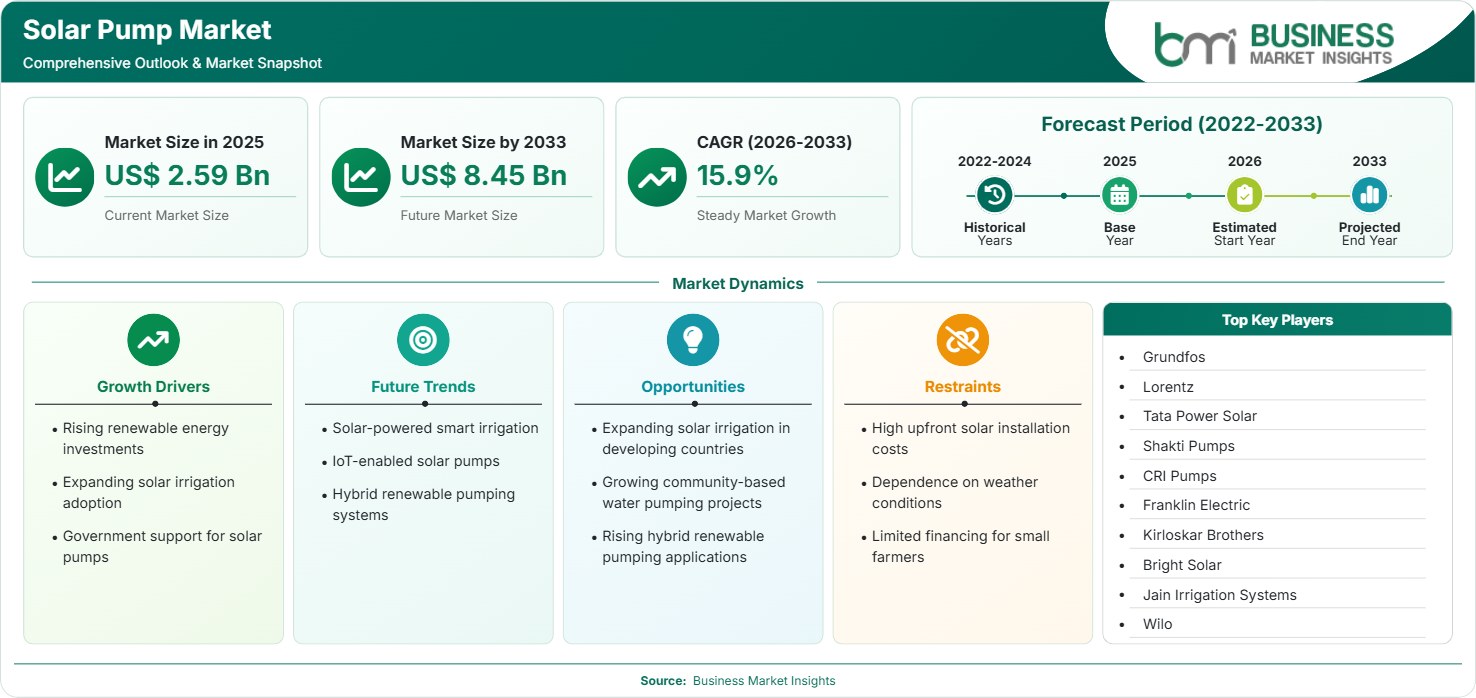
The Solar Pump Market size was valued at US$ 2.59 Billion in 2025 and is projected to reach US$ 8.45 Billion by 2033, growing at a CAGR of 15.9% from 2026 to 2033. Rising renewable energy investments, expanding solar irrigation adoption, government support for clean water access, rural electrification initiatives, and hybrid renewable pumping applications are driving market expansion.

Report Coverage
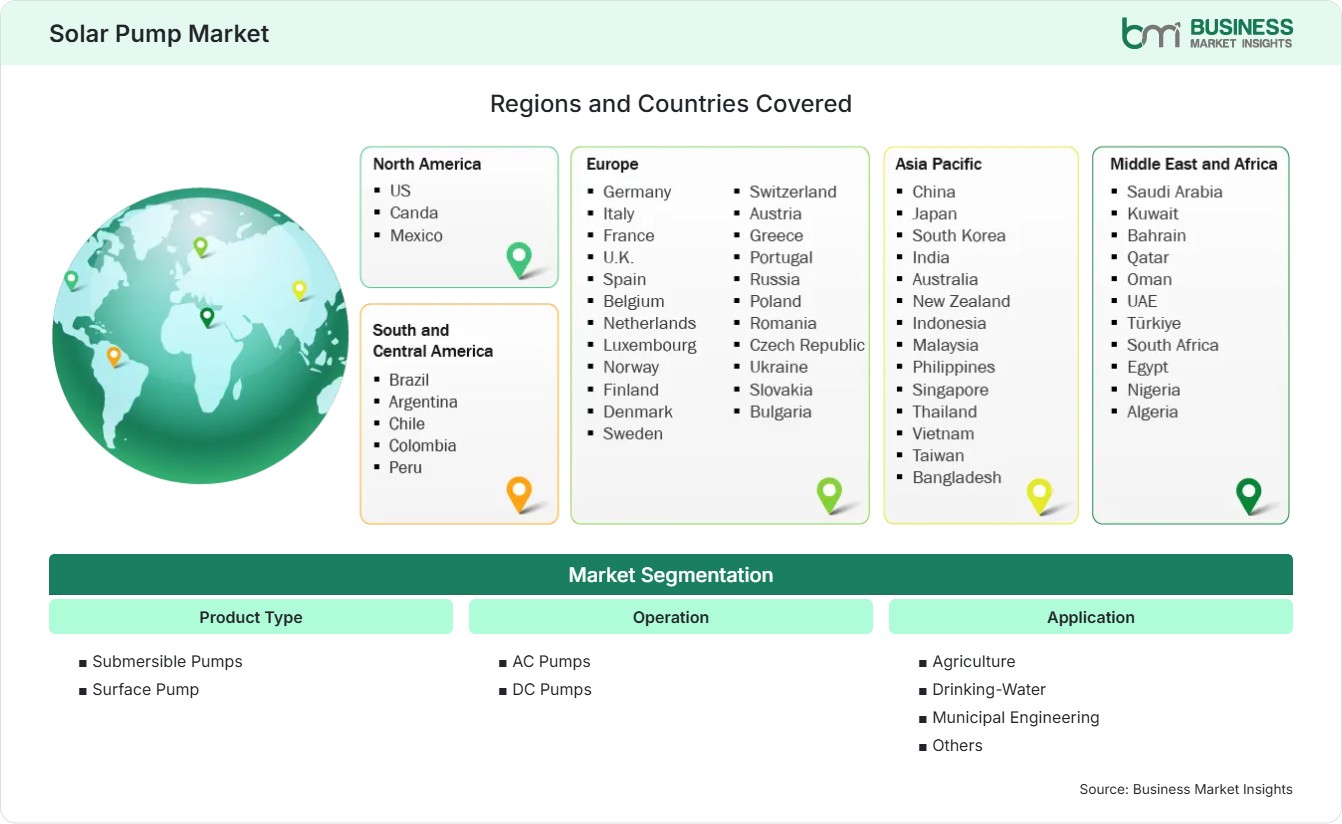
  • Product Type: Submersible Pumps, Surface Pump
  • Operation: AC Pumps, DC Pumps
  • Application: Agriculture, Drinking-Water, Municipal Engineering, Others
US$ 2.59 Bn Market size in 2025
US$ 8.45 Bn Market Size by 2033
15.9% CAGR, 2026 - 2033
2026-2033 Forecast Period

01 AI Overview

Solar Pump Market Summary

  • North America Region: North America holds a market share of 24%–27% in 2025 and is projected to grow at a CAGR of 14.8%–15.5% during 2026–2033. Growth is supported by renewable energy adoption, agricultural modernization, sustainable water management, and government incentives. The US market is expanding at a CAGR of 15.0%–15.7% due to increasing solar-powered irrigation deployment, rural water applications, and clean energy investments.
  • Fastest Growing Region: Asia Pacific accounts for 39%–42% market share in 2025 and is expected to grow at a CAGR of 16.5%–17.3% during 2026–2033. Growth is driven by agricultural demand, rural water requirements, government solar programs, and increasing adoption of decentralized renewable pumping solutions.
  • Leading Segment: Submersible Pumps represent 58%–61% market share in 2025 and are projected to grow at a CAGR of 15.7%–16.4% during 2026–2033. Strong adoption is supported by efficient deep-water extraction, agricultural irrigation requirements, and suitability for remote locations.
  • High Growth Segment: DC Pumps account for 52%–55% share in 2025 and are estimated to grow at a CAGR of 16.2%–17.0% through 2026–2033. Growth is supported by higher energy efficiency, compatibility with photovoltaic systems, and demand for off-grid water pumping.
  • Key Market Opportunity: Solar irrigation expansion, community water pumping projects, and hybrid renewable pumping systems are creating opportunities for manufacturers developing efficient, reliable, and cost-effective solar-powered water solutions.
  • Major Market Players: Grundfos, Lorentz, Tata Power Solar, Shakti Pumps, CRI Pumps, Franklin Electric, Kirloskar Brothers, Bright Solar, Jain Irrigation Systems, Wilo.
02 Strategic Insights

Solar Pump Market: Strategic Insights

solar-pump-market-market-strategic-framework
FREE PDF
Request your free sample
Request free sample
03 Stakeholder View

Key Takeaways

  • The market ecosystem includes solar module suppliers, pump manufacturers, system integrators, agricultural stakeholders, government agencies, and renewable energy service providers. Integration capability and after-sales support are becoming important competitive factors.
  • Agriculture remains the primary growth opportunity as farmers increasingly adopt solar-powered irrigation systems to reduce operating expenses and improve water accessibility in remote regions.
  • Technology innovation is focused on high-efficiency motors, smart controllers, remote monitoring platforms, improved photovoltaic integration, and hybrid renewable pumping solutions.
  • Asia Pacific provides strong investment potential due to agricultural dependence, government-backed solar initiatives, rural water requirements, and increasing renewable energy adoption.
  • Companies are expanding through strategic partnerships, government contracts, financing programs, and local distribution networks to improve market penetration.
  • Future competitiveness will depend on reducing installation costs, improving energy conversion efficiency, and developing solutions suitable for varied geographic and climatic conditions.
04 Geographic Outlook

Solar Pump Market Regional Highlights

North America Solar Pump Market

North America accounted for a 24%–27% share of the Solar Pump Market in 2025 and is projected to grow at a CAGR of 14.8%–15.5% during 2026–2033. The region benefits from renewable energy adoption, sustainable agriculture practices, and increasing demand for efficient water management systems. The United States remains the leading contributor due to agricultural modernization, clean energy investments, and increasing deployment of solar-powered irrigation solutions.

  • The United States drives regional adoption through agricultural solarization programs, renewable energy incentives, and demand for sustainable irrigation technologies.
  • Canada is expanding solar pump deployment through rural water management initiatives, renewable energy projects, and agricultural efficiency improvements.
  • Farmers are adopting solar pumping systems to reduce fuel dependency, lower operating expenses, and improve irrigation reliability.
  • Government incentives and sustainability targets are encouraging investments in renewable-powered water infrastructure across rural areas.

US Solar Pump Market

The US represented a 21%–24% share of the Solar Pump Market in 2025 and is expected to grow at a CAGR of 15.0%–15.7% through 2026–2033. Demand is supported by renewable energy integration, agricultural sustainability initiatives, and increasing adoption of off-grid water pumping systems. Solar pumps are gaining importance in farms, remote communities, and water conservation projects.

  • Agricultural users are increasingly adopting solar irrigation systems to improve energy efficiency and reduce dependence on conventional power sources.
  • Rural water projects are utilizing solar pumps for reliable water access and decentralized infrastructure development.
  • Renewable energy incentives are supporting investment in solar-powered agricultural and municipal applications.
  • Advanced monitoring systems are improving operational efficiency and maintenance management for solar pumping installations.

Europe Solar Pump Market

Europe held a 21%–24% share of the Solar Pump Market in 2025 and is forecast to grow at a CAGR of 15.2%–15.9% from 2026–2033. The region benefits from renewable energy policies, climate targets, and increasing interest in sustainable agricultural practices. Germany, Italy, Spain, France, and the Netherlands represent key markets due to clean energy adoption and efficient farming initiatives.

  • Germany supports market growth through renewable energy investments, sustainable agriculture programs, and advanced water management solutions.
  • Italy is expanding adoption through agricultural modernization, solar energy integration, and irrigation efficiency improvements.
  • Spain demonstrates strong demand due to solar availability, agricultural activity, and increasing use of renewable-powered pumping.
  • France and the Netherlands are adopting solar pumping technologies through sustainable farming and resource conservation initiatives.

Asia Pacific Solar Pump Market

Asia Pacific captured a 39%–42% share of the Solar Pump Market in 2025 and is expected to achieve a CAGR of 16.5%–17.3% during 2026–2033. The region represents the fastest-growing market due to agricultural dependence, rising renewable energy investments, government subsidy programs, and rural water requirements. China, India, Southeast Asia, and Australia are major contributors to regional expansion.

  • India is expanding solar pump adoption through agricultural solarization programs, irrigation requirements, and government-backed renewable energy initiatives.
  • China is supporting market growth through renewable infrastructure investments, agricultural modernization, and large-scale solar deployment.
  • Southeast Asian countries are adopting solar pumping solutions for farming, rural development, and decentralized water supply applications.
  • Australia is increasing adoption through remote agricultural operations, water conservation needs, and renewable energy integration.

Rest of World Solar Pump Market

Rest of World represented a 8%–11% share of the Solar Pump Market in 2025 and is projected to grow at a CAGR of 15.5%–16.2% during 2026–2033. South America and the Middle East & Africa are experiencing increased adoption due to water scarcity concerns, agricultural expansion, and renewable energy initiatives. Brazil, South Africa, Saudi Arabia, and UAE represent emerging opportunities.

South American countries are adopting solar pumps to improve agricultural productivity, while Middle Eastern and African regions are investing in renewable-powered water access solutions for rural communities and irrigation applications.

  • Brazil is expanding solar pump usage through agricultural demand, renewable energy adoption, and rural irrigation development.
  • South Africa is increasing deployment through water access projects, farming applications, and renewable infrastructure investments.
  • Saudi Arabia is adopting solar pumping systems to support sustainable agriculture and water management initiatives.
  • The United Arab Emirates is implementing solar-powered water solutions through sustainability programs and infrastructure modernization projects.
global-market-geography
FREE PDF
Request your free sample
Request free sample
05 Segment Analysis

Solar Pump Market Segmentation

Product Type

Product Type segmentation includes Submersible Pumps and Surface Pump. Submersible Pumps represented the leading segment in 2025 due to their suitability for deep-water extraction, agricultural irrigation, and remote water supply applications. Surface Pump systems are gaining adoption for shallow water sources and smaller-scale applications requiring easier installation. The segment is projected to grow at a CAGR of 15.7%–16.4% from 2026–2033, supported by increasing agricultural mechanization, renewable energy adoption, and decentralized water infrastructure development.

  • Submersible Pumps: Submersible pumps are widely adopted for agricultural irrigation and rural water projects due to efficient operation, deep-water access, and reliable performance in remote locations.
  • Surface Pump: Surface pumps support applications requiring shallow water extraction, easier maintenance, and cost-effective solar-powered water pumping solutions across farms and small communities.

Operation

Operation segmentation covers AC Pumps and DC Pumps, with DC Pumps maintaining a leading position due to direct compatibility with photovoltaic systems, higher efficiency, and suitability for off-grid applications. AC Pumps continue supporting larger installations requiring integration with existing electrical infrastructure. The segment is expected to achieve a CAGR of 16.2%–17.0% during 2026–2033, driven by technological improvements, energy efficiency requirements, and expansion of decentralized renewable pumping systems.

  • AC Pumps: AC pumps are used in larger systems requiring stable power supply, integration with existing grids, and higher-capacity water pumping operations.
  • DC Pumps: DC pumps are gaining demand through direct solar compatibility, improved efficiency, lower energy losses, and suitability for remote agricultural and community water applications.

Application

Application segmentation includes Agriculture, Drinking-Water, Municipal Engineering, and Others. Agriculture represents the dominant application segment due to extensive irrigation requirements, rising focus on sustainable farming, and efforts to reduce diesel-powered pumping dependence. Drinking-water and municipal applications are expanding through rural infrastructure development and clean water initiatives. The segment is expected to register a CAGR of 15.6%–16.3% from 2026–2033, supported by renewable energy investments and increasing water accessibility programs.

  • Agriculture: Agriculture applications drive adoption through solar irrigation requirements, reduced operational costs, improved energy independence, and increasing sustainable farming practices.
  • Drinking-Water: Drinking-water projects utilize solar pumps for decentralized water supply, rural communities, and areas requiring reliable renewable-powered water access systems.
  • Municipal Engineering: Municipal applications include public water systems, infrastructure projects, and community-level pumping solutions supporting sustainable urban and rural water management.
06 Market Forces

Solar Pump Market Dynamics

Key Market Drivers

Rising Renewable Energy Investments

Growing global investments in renewable energy infrastructure are facilitating the use of solar-powered pumps in different agricultural, water management, and rural development contexts. There is a need by governments, private sectors, and communities to invest in renewable energy technology to decrease dependence on fossil fuels. The Solar Pump Market growth is driven by reducing costs of solar components, increasing use of photovoltaics, and emphasis on decentralized power solutions. There is an evident trend towards the use of efficient controllers, high-performance motors, and combined power solutions that make the system more reliable. Environmental policies and commitment to renewable energy drive consumers to move from diesel pumps to solar ones.

Expanding Solar Irrigation Adoption

The agricultural industries are progressively opting for the installation of solar pumps for improved production, lower costs of energy consumption, and sustainable farming activities. The solar pump market trends indicate Farmers in regions with high solar availability are implementing solar pumps to access reliable water sources while reducing dependence on grid electricity and fuel-based systems. The growth of precision agriculture and efficient irrigation systems has led to a rise in the demand for solar water pumps. Manufacturers have been working on creating innovative products that are efficient, have remote monitoring facilities, and are optimized for different farming environments. The increasing trend of agricultural modernization and the realization of the advantages of renewable energy-based irrigation is helping fuel this trend.

Government Support for Solar Pumps

The government programs that focus on renewable energy use and sustainable agriculture create good opportunities for the introduction of solar pumps. The provision of subsidies, financing programs, rural electrification projects, and other measures for developing clean energy are creating better access possibilities for the farmers and communities. Investments by the government into the water management infrastructure make the use of solar energy more attractive in the regions where there is limited access to electricity. Governments are also encouraging the use of renewable energy solutions to cut down the energy expenses for agriculture. All these measures contribute to the growth of the solar pumps market.

Key Market Opportunities

Expanding Solar Irrigation in Developing Countries

Developing countries offer significant opportunities for solar pump makers due to the large agricultural population, rising irrigation demand, and inadequate electrical infrastructure. Solar pumps could be used to benefit farmers through provision of inexpensive and sustainable means of pumping water. There are government-sponsored agricultural and renewable energy programs that are advocating their use in rural areas. The companies providing inexpensive, durable and maintainable equipment could take advantage of this market opportunity. Growth of smallholder farming and increased emphasis on food security are other factors contributing to these opportunities.

Growing Community-Based Water Pumping Projects

Community-based water pumping projects are creating opportunities for solar pump providers by addressing water accessibility challenges in rural and underserved regions. Shared pumping systems can provide reliable water access for multiple households, agricultural communities, and public facilities. Development agencies and governments are looking more into decentralized renewable energy sources as means to strengthen water infrastructure. Manufacturers who provide scalable systems, remote monitoring, and easy maintenance can profit from such projects. The increased focus on sustainable rural development and climate change-resistant infrastructure has increased demand for community-based solar water pumps. Such applications expand market opportunities beyond individual agricultural users.

Rising Hybrid Renewable Pumping Applications

Hybrid pumping systems that use solar power alongside another renewable power source or a backup power source are now being explored for situations requiring continuous water pumping. Hybrid systems offer improved reliability through overcoming solar limitations and operating in low-light conditions. Agricultural sites, municipalities, and off-grid infrastructure developers are now considering hybrid systems to ensure energy security. This emerging opportunity will certainly become beneficial to control system vendors. Increased demand for reliable water infrastructure and the integration of renewable energy sources will definitely result in wider use of hybrid pumping technologies, which will positively affect Solar Pump Market forecasts.

Market Restraints and Challenges

High Upfront Solar Installation Costs

Factor: Solar pumping systems require significant initial investment for photovoltaic panels, pumps, controllers, installation, and supporting equipment.

Impact: High upfront costs can restrict adoption among small-scale farmers, rural communities, and price-sensitive customers despite long-term operating savings. Financing limitations and limited awareness of lifecycle benefits can slow deployment in developing regions. Manufacturers and governments are addressing this challenge through subsidies, financing programs, and lower-cost system designs. However, initial capital requirements remain a key barrier compared with conventional pumping solutions. Reducing installation expenses and improving access to financial support will remain important for broader market penetration.

Dependence on Weather Conditions

Factor: Solar pumps rely on sunlight availability, making performance dependent on seasonal variations, weather patterns, and geographic conditions.

Impact: Reduced solar radiation during cloudy periods or unfavorable weather can affect pumping capacity and operational consistency. Users requiring continuous water supply may need backup systems, energy storage, or hybrid configurations, increasing overall system complexity and costs. Manufacturers are developing efficient controllers, improved energy management technologies, and hybrid solutions to overcome reliability concerns. However, weather dependency remains a significant consideration for agricultural and municipal users evaluating solar-powered pumping systems, particularly in regions with variable climatic conditions.

07 Company Analysis

Competitive Landscape

The Solar Pump Market analysis highlights increasing competition among renewable energy solution providers, pump manufacturers, irrigation technology companies, and water infrastructure specialists. Leading players are focusing on efficient pump designs, photovoltaic integration, smart monitoring systems, and expanded distribution networks. Companies are strengthening their market position through partnerships, government projects, and customized solutions for agricultural, municipal, and rural water applications.

Company Name

Overview

Products and Services relevant to this market

Grundfos

Global pump technology company providing advanced water and energy-efficient solutions.

Solar-powered pumps, water supply systems, renewable pumping solutions, and smart controllers.

Lorentz

Renewable water pumping specialist focused on solar-powered water solutions.

Solar pumps, photovoltaic pumping systems, controllers, and irrigation solutions.

Tata Power Solar

Renewable energy company providing solar technologies and energy solutions.

Solar water pumps, solar irrigation systems, photovoltaic solutions, and installation services.

Shakti Pumps

Pump manufacturer specializing in energy-efficient and solar pumping systems.

Solar pumps, submersible pumps, controllers, irrigation systems, and water solutions.

CRI Pumps

Pump technology company serving agricultural, residential, and industrial applications.

Solar pumps, water pumping systems, submersible pumps, and irrigation solutions.

Franklin Electric

Water and energy systems company offering pumping technologies globally.

Solar pumping systems, motors, controls, water transfer solutions, and components.

Kirloskar Brothers

Engineering company providing fluid management and pumping solutions.

Solar pumps, agricultural pumping systems, water management equipment, and pump technologies.

Bright Solar

Renewable energy company focused on solar-powered water pumping applications.

Solar water pumps, irrigation solutions, photovoltaic systems, and rural water solutions.

Jain Irrigation Systems

Agricultural technology company providing irrigation and renewable solutions.

Solar pumps, irrigation systems, water management solutions, and agricultural technologies.

Wilo

Pump manufacturer offering efficient water management technologies worldwide.

Solar pumping solutions, high-efficiency pumps, water systems, and smart controls.

08 Industry Activity

Recent Developments

August 2025

Crompton Greaves Consumer Electricals expanded its solar pumping business after receiving approval for supplying 1,884 off-grid solar photovoltaic water pumping systems under Maharashtra’s solar agriculture pump initiative, including remote monitoring capabilities.

June 2025

Crompton Greaves Consumer Electricals secured its largest-ever solar water pump order worth over ₹101 crore from Maharashtra Energy Development Agency (MEDA) for supplying, installing, and commissioning 4,500 off-grid solar photovoltaic water pumping systems under the PM-KUSUM scheme.

May 2025

JNTech Renewable Energy completed a large-scale photovoltaic water pumping and irrigation project in Yunnan, China, strengthening its position in solar-powered irrigation solutions for large agricultural applications.

April 2025

Crompton Greaves Consumer Electricals — received an order from Maharashtra Energy Development Agency for 433 solar water pumping systems, expanding its renewable energy-powered irrigation solutions portfolio.

10 Trust & Transparency

Research Methodology

The market analysis combines proprietary research with secondary data from government agencies, company disclosures, regulatory filings, industry databases and expert interviews. Market estimates are validated through data triangulation, cross-market benchmarking and analyst review.

View Full Research Methodology

11 Questions Answered

Frequently Asked Questions

What does the Solar Pump Market Report analyze?

The report evaluates market size, product segments, applications, regional opportunities, competitive strategies, technology developments, and factors influencing industry growth.

How are governments supporting solar pump deployment?

Governments are supporting deployment through subsidies, renewable energy programs, agricultural modernization initiatives, and rural water infrastructure projects that improve accessibility and affordability.

Why are DC pumps gaining popularity?

DC pumps are gaining demand because they directly integrate with solar photovoltaic systems, offer improved energy efficiency, and support off-grid applications in remote locations.

Which product type dominates the Solar Pump Market share?

Submersible Pumps represent the leading product type due to their suitability for deep-water extraction, agricultural irrigation, and remote water supply applications.

What is driving solar pump adoption globally?

Solar pump adoption is increasing due to renewable energy investments, agricultural irrigation demand, government support programs, rural water requirements, and efforts to reduce dependence on conventional fuel-powered pumping systems.

Access the Full Solar Pump Market Report

Get segment-level forecasts, regional estimates, competitive benchmarking, company profiles and downloadable Excel datasets.

Access the full Solar Pump Market Report
350 pages PDF & Excel | 2026-07-31