
Smart Solar Market Outlook: Size, Share, Trends, Growth Analysis, Competitive Landscape & Forecast, 2026-2033

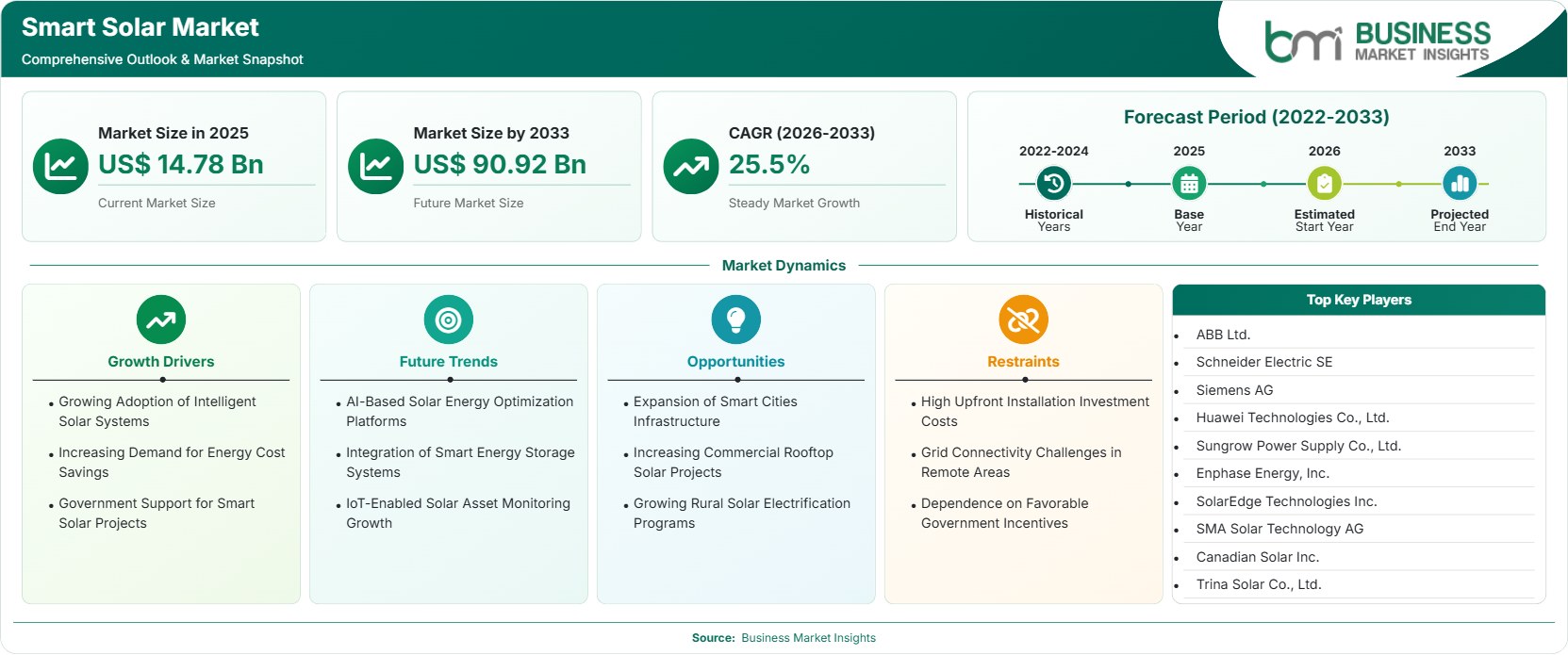
The Smart Solar Market size was valued at US$ 14.78 billion in 2025 and is projected to reach US$ 90.92 billion by 2033, growing at a CAGR of 25.5% from 2026 to 2033. Market expansion is driven by increasing adoption of intelligent solar energy systems, rising investments in smart grid infrastructure, supportive government renewable energy initiatives, growing demand for energy cost optimization, and rapid deployment of digital energy management technologies.

Report Coverage
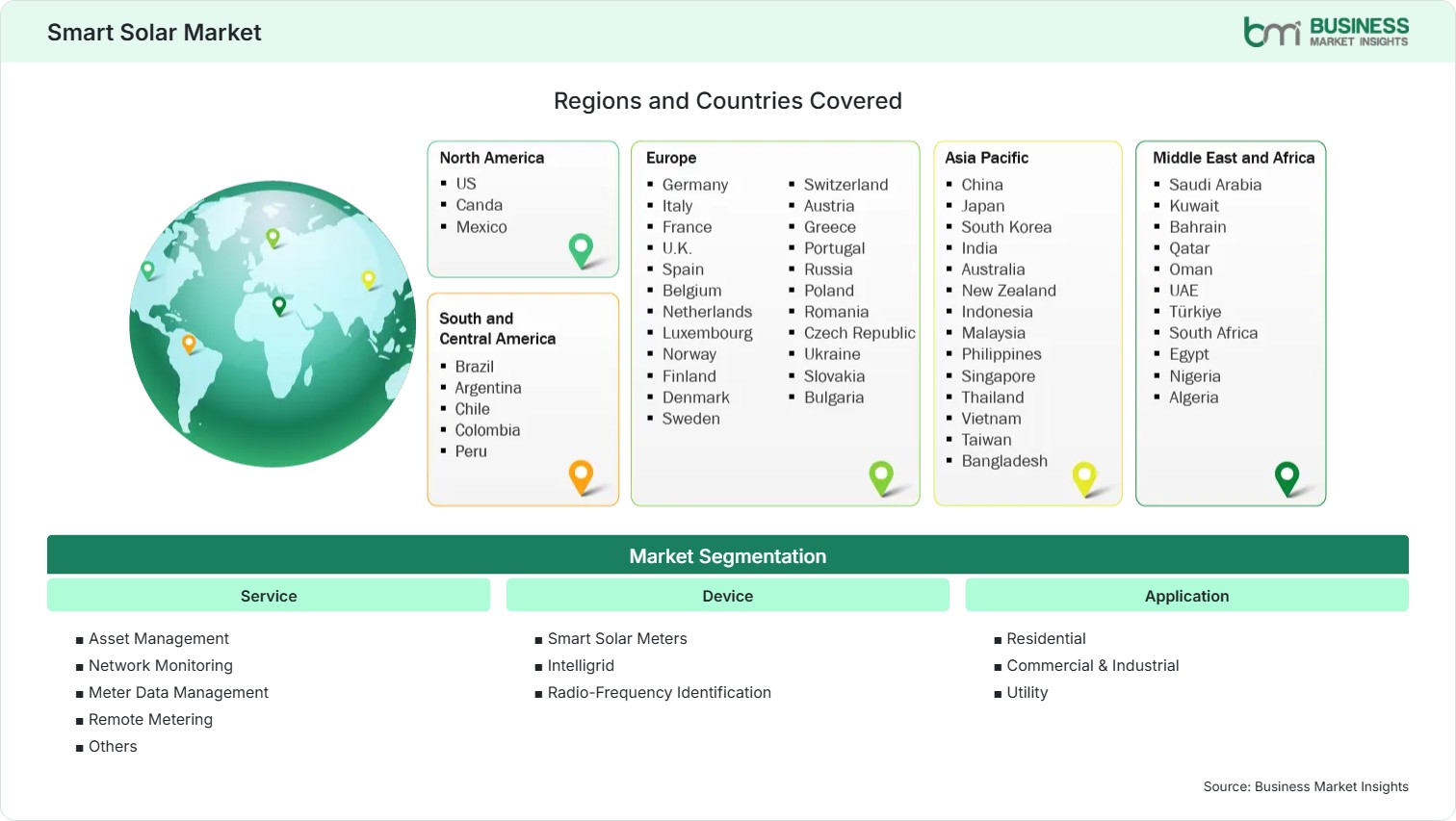
  • Service: Asset Management, Network Monitoring, Meter Data Management, Remote Metering, Others
  • Device: Smart Solar Meters, Intelligrid, Radio-Frequency Identification
  • Application: Residential, Commercial & Industrial, Utility
US$ 14.78 Bn Market size in 2025
US$ 90.92 Bn Market Size by 2033
25.5% CAGR, 2026 - 2033
2026-2033 Forecast Period

AI Overview

Smart Solar Market Summary

  • North America Region: North America accounted for 29%–32% share in 2025 and is projected to grow at a CAGR of 24.8%–25.4% from 2026–2033. Growth is supported by smart grid modernization, distributed solar generation, advanced energy management systems, and favorable renewable energy policies. The US market is expected to register a CAGR of 24.9%–25.5% during the forecast period, driven by commercial solar investments and digital utility infrastructure.
  • Fastest Growing Region: Asia Pacific held 37%–41% share in 2025 and is anticipated to expand at a CAGR of 26.3%–27.0% from 2026–2033. Rapid urbanization, government renewable energy targets, smart city initiatives, and large-scale solar deployment are accelerating market growth across China, India, Japan, South Korea, and Southeast Asia.
  • Leading Segment: Commercial & Industrial represented 41%–45% share in 2025 and is projected to grow at a CAGR of 25.3%–25.9% from 2026–2033. Businesses are increasingly adopting smart solar technologies to reduce electricity costs, improve operational efficiency, and achieve sustainability goals.
  • High Growth Segment: Network Monitoring accounted for 22%–26% share in 2025 and is expected to grow at a CAGR of 26.5%–27.2% from 2026–2033, supported by increasing deployment of digital grid management systems, remote diagnostics, and real-time solar performance analytics.
  • Key Market Opportunity: Smart city development, commercial rooftop solar expansion, rural electrification projects, AI-enabled energy management, and digital grid integration are creating significant growth opportunities across the smart solar ecosystem.
  • Major Market Players: ABB Ltd., Schneider Electric SE, Siemens AG, Huawei Technologies Co., Ltd., Sungrow Power Supply Co., Ltd., Enphase Energy, Inc., SolarEdge Technologies Inc., SMA Solar Technology AG, Canadian Solar Inc., and Trina Solar Co., Ltd.
Strategic Insights

Smart Solar Market: Strategic Insights

Smart Solar Market Strategic Framework
FREE PDF
Request your free sample
Request free sample
Stakeholder View

Key Takeaways

  • The market ecosystem includes solar equipment manufacturers, energy management solution providers, smart grid technology companies, utilities, software developers, and renewable energy service providers.
  • Commercial and industrial applications represent significant revenue opportunities due to rising investments in energy efficiency, sustainability initiatives, and distributed power generation.
  • Innovation is focused on AI-powered analytics, IoT-enabled monitoring, predictive maintenance, cloud-based energy management, and automated grid optimization technologies.
  • Asia Pacific offers the strongest long-term investment potential due to large-scale renewable energy deployment, smart city expansion, and government-backed solar initiatives.
  • Leading companies are strengthening competitive positions through digital platform development, strategic partnerships, product innovation, and integrated renewable energy solutions.
  • Future competitiveness will depend on intelligent monitoring capabilities, cybersecurity, interoperability with smart grids, advanced analytics, and scalable energy management platforms.
Geographic Outlook

Smart Solar Market Regional Highlights

North America Smart Solar Market

North America accounted for 29%–32% share in 2025 and is projected to grow at a CAGR of 24.8%–25.4% from 2026–2033. The region benefits from increasing distributed solar installations, smart grid modernization, advanced energy management systems, and strong regulatory support for renewable energy. The United States remains the largest smart solar market due to growing investments in commercial solar projects, digital energy infrastructure, and utility-scale renewable power generation.

  • The United States is expanding smart solar deployment through grid modernization and commercial renewable energy investments.
  • Utilities are implementing intelligent monitoring platforms to improve electricity reliability and renewable integration.
  • Commercial facilities are increasingly adopting smart solar systems to reduce operating costs and improve energy efficiency.
  • Battery energy storage integration is strengthening demand for advanced smart solar management technologies.

US Smart Solar Market

The US represented 26%–29% share in 2025 and is expected to grow at a CAGR of 24.9%–25.5% from 2026–2033. Market growth is driven by federal renewable energy incentives, rising commercial rooftop installations, digital grid expansion, and increasing adoption of AI-enabled energy management systems. Businesses and utilities continue to invest in intelligent solar technologies to improve operational efficiency and long-term sustainability.

  • Commercial enterprises are investing in smart solar platforms to optimize electricity consumption.
  • Utilities are expanding digital grid infrastructure to support distributed renewable energy resources.
  • Advanced monitoring technologies are improving solar asset performance and predictive maintenance capabilities.
  • Growing battery storage adoption is supporting intelligent solar energy management across multiple applications.

Europe Smart Solar Market

Europe accounted for 23%–26% share in 2025 and is projected to grow at a CAGR of 24.7%–25.3% from 2026–2033. The region is supported by ambitious decarbonization targets, renewable energy expansion, smart grid modernization, and widespread adoption of digital energy management solutions. Germany, the United Kingdom, France, Italy, and the Netherlands continue to lead regional growth through large-scale solar deployment, intelligent grid infrastructure, and increasing investments in distributed energy resources.

  • Germany is strengthening market demand through large-scale rooftop solar installations and smart energy management initiatives.
  • The United Kingdom is expanding smart solar adoption through grid modernization and commercial renewable energy projects.
  • France is increasing investments in intelligent renewable infrastructure and digital electricity monitoring.
  • Italy is promoting smart solar technologies through distributed generation and energy efficiency initiatives.
  • The Netherlands is supporting market growth through smart grid integration and advanced renewable energy management systems.

Asia Pacific Smart Solar Market

Asia Pacific represented 37%–41% share in 2025 and is expected to register a CAGR of 26.3%–27.0% from 2026–2033, making it the fastest-growing regional market. Rapid urbanization, expanding electricity demand, government renewable energy policies, and smart city initiatives are accelerating adoption across China, India, Japan, South Korea, and Southeast Asia. Continuous investments in utility-scale solar projects and digital energy infrastructure are further strengthening regional growth.

  • China is expanding intelligent solar deployment through large-scale renewable energy investments and smart grid development.
  • India is accelerating adoption through government-backed solar programs and rural electrification initiatives.
  • Japan is increasing demand through advanced energy management technologies and distributed solar installations.
  • South Korea is investing in smart energy infrastructure to improve renewable power integration.
  • Southeast Asian countries are expanding digital solar projects to meet rising electricity demand and sustainability objectives.

Rest of World Smart Solar Market

Rest of World accounted for 7%–10% share in 2025 and is projected to grow at a CAGR of 25.0%–25.7% from 2026–2033. Latin America, the Middle East, and Africa are witnessing increasing adoption of smart solar technologies due to renewable energy investments, expanding electricity access programs, and infrastructure modernization. Governments and private developers are focusing on intelligent solar systems to improve grid stability and reduce dependence on conventional power generation.

Middle Eastern countries are investing heavily in utility-scale smart solar projects, while Latin America is expanding commercial and industrial renewable energy installations. African markets are benefiting from rural electrification programs supported by off-grid and hybrid smart solar solutions.

  • Brazil is increasing commercial and utility-scale smart solar installations to improve renewable energy generation.
  • Mexico is expanding distributed solar adoption through industrial and commercial investments.
  • Gulf countries are investing in intelligent solar infrastructure as part of national energy diversification strategies.
  • South Africa is deploying smart solar systems to improve electricity reliability and rural power access.
  • Emerging economies are creating long-term growth opportunities through smart infrastructure development and renewable energy expansion.
Global Market Geography
FREE PDF
Request your free sample
Request free sample
Segment Analysis

Smart Solar Market Segmentation

Service

Service segmentation includes asset management, network monitoring, meter data management, remote metering, and other digital support services. The segment accounted for 100% share in 2025 and is projected to grow at a CAGR of 25.5% from 2026–2033. Increasing deployment of connected solar infrastructure, cloud-based monitoring platforms, predictive maintenance technologies, and digital asset optimization solutions is driving strong demand across utility, commercial, and residential sectors.

  • Asset Management: Asset management services help maximize solar system performance through predictive maintenance, operational analytics, lifecycle optimization, and performance monitoring.
  • Network Monitoring: Network monitoring represents the fastest-growing service due to increasing adoption of real-time grid visibility, fault detection, remote diagnostics, and intelligent energy management solutions.
  • Meter Data Management: Meter data management supports accurate energy measurement, billing optimization, consumption analytics, and efficient integration with smart grid platforms.
  • Remote Metering: Remote metering enables automated energy monitoring, operational efficiency, and reduced maintenance costs through wireless communication technologies.
  • Others: Other services include predictive analytics, software integration, technical consulting, cybersecurity solutions, and digital performance optimization services.

Device

Device segmentation includes smart solar meters, Intelligrid systems, and radio-frequency identification (RFID) technologies. The segment accounted for 100% share in 2025 and is projected to grow at a CAGR of 25.5% from 2026–2033. Rising investments in intelligent energy infrastructure, automated monitoring, and digital grid connectivity are supporting widespread deployment of advanced smart solar devices.

  • Smart Solar Meters: Smart solar meters dominate the device segment by enabling real-time energy monitoring, consumption analysis, remote communication, and efficient billing management.
  • Intelligrid: Intelligrid technologies support intelligent grid management, renewable energy integration, automated load balancing, and advanced electricity distribution optimization.
  • Radio-Frequency Identification (RFID): RFID solutions improve solar asset tracking, equipment identification, maintenance management, and inventory monitoring across large-scale solar installations.

Application

Application segmentation includes residential, commercial & industrial, and utility sectors. The segment accounted for 100% share in 2025 and is projected to grow at a CAGR of 25.5% from 2026–2033. Rising renewable energy adoption, favorable government policies, increasing electricity costs, and digital energy management are accelerating smart solar deployment across all application areas. The integration of IoT-enabled monitoring, battery storage, and intelligent energy optimization systems is further supporting market expansion.

  • Residential: Residential applications are expanding due to increasing rooftop solar adoption, smart home integration, energy independence initiatives, and growing consumer awareness regarding electricity cost savings.
  • Commercial & Industrial: Commercial & industrial applications dominate the market owing to high electricity consumption, sustainability goals, operational cost optimization, and increasing investments in distributed renewable energy systems.
  • Utility: Utility applications are witnessing strong growth through large-scale smart solar farms, grid modernization projects, renewable energy integration, and advanced digital monitoring technologies.
Market Forces

Smart Solar Market Dynamics

Key Market Drivers

Growing Adoption of Intelligent Solar Systems

The increasing adoption of intelligent solar systems is driving substantial growth in the Smart Solar Market. Consumers, businesses, and utilities are integrating advanced monitoring platforms, automated controls, IoT connectivity, and cloud-based analytics into solar installations to improve energy generation efficiency and operational reliability. Intelligent systems enable real-time performance monitoring, predictive maintenance, and rapid fault detection, reducing operational costs while maximizing energy output. Growing deployment of digital renewable energy infrastructure and rising demand for optimized solar asset management are accelerating market expansion across residential, commercial, and utility-scale applications.

Increasing Demand for Energy Cost Savings

Increased electricity generation costs and the need for operational efficiency have made smart solar technologies more attractive to companies and individuals. Smart energy management systems ensure effective use of electricity, better utilization of solar electricity, and decreased reliance on traditional grid-based electricity sources. Advanced monitoring systems are now widely used by commercial firms to reduce costs and boost their sustainability profile. The Smart Solar Market trends indicate a shift towards technologies that offer long-term cost savings and better energy visibility.

Government Support for Smart Solar Projects

Government initiatives promoting renewable energy adoption are significantly supporting Smart Solar Market growth. The financial incentives, tax advantages, net metering rules, renewable energy mandates, and smart grid investments are driving the global installation of intelligent solar energy solutions. Government investments in the digital electrical grid and decarbonization initiatives are boosting the adoption of modern solar power control and monitoring systems. Such an enabling regulatory environment is facilitating the adoption of intelligent solar technology while contributing to long-term clean energy transition goals.

Key Market Opportunities

Expansion of Smart Cities Infrastructure

The growth of smart city infrastructure brings many opportunities for smart solar solution providers. The urban development initiatives involve intelligent energy systems, smart electrical grids, smart infrastructure, and renewable energy systems to enhance efficiency. Smart solar solutions help achieve efficient energy production and smart grid integration in modern cities. Growing investments in smart buildings and smart cities are likely to drive high demand for intelligent solar solutions in developed and developing countries alike.

Increasing Commercial Rooftop Solar Projects

The fast growth of rooftop solar energy facilities provides significant potential for smart solar technologies. Companies install rooftop systems to reduce electricity costs, enhance energy resilience, and meet environmental sustainability goals. With the help of smart monitoring systems, it becomes possible to analyze performance in real time, conduct preventive maintenance, and optimize energy production. It is anticipated that with an ever-growing worldwide use of renewable energy, the demand for smart solar technologies will grow significantly.

Growing Rural Solar Electrification Programs

With ongoing efforts to develop rural electrification projects, there is a greater scope for the smart use of solar power technology, especially in areas where conventional electricity sources are not readily available. Intelligent solar power systems with remote monitoring features have been promoted by governments and development agencies to increase efficiency. Remote monitoring lowers maintenance costs and improves the efficiency of operational systems. Investment in renewable energy infrastructure in rural areas is expected to fuel future growth in emerging markets.

Market Restraints and Challenges

High Upfront Installation Investment Costs

Factor: Smart solar systems require significant initial investments in photovoltaic modules, intelligent monitoring equipment, communication infrastructure, software platforms, and energy management technologies. Impact: High capital requirements can delay project implementation, particularly among residential consumers and small businesses with limited financial resources. Although operational savings are substantial over time, initial investment costs remain a barrier to wider market adoption.

Grid Connectivity Challenges in Remote Areas

Factor: Many rural and remote regions continue to face inadequate grid infrastructure, limited communication networks, and insufficient digital connectivity required for advanced smart solar system integration. Impact: Grid connectivity limitations can reduce monitoring effectiveness, delay renewable energy integration, and increase deployment complexity. Infrastructure improvements and digital network expansion will be essential to support broader adoption of intelligent solar technologies in underserved regions.

Company Analysis

Competitive Landscape

The Smart Solar Market analysis is highly competitive, with major players including global energy technology firms, solar equipment providers, and digital energy management solution providers specializing in intelligent monitoring, integration, and automation. Businesses are looking to invest in AI-driven energy management solutions, IoT-based monitoring solutions, advanced inverters, cloud analytics, and smart grid integration to build their competitive edge. Strategic collaborations, innovative products, growth in renewable energy infrastructure, and software solutions continue to be core elements of the competitive landscape in this rapidly growing industry.

Company Name

Overview

Products and Services relevant to this market

ABB Ltd.

Global electrification and automation company serving energy and industrial sectors.

Smart solar monitoring systems, energy management solutions, grid automation, and power distribution technologies.

Schneider Electric SE

Energy management and industrial automation company with digital infrastructure expertise.

Smart solar energy management, digital grid solutions, monitoring software, and automation platforms.

Siemens AG

Technology company specializing in electrification, digitalization, and smart infrastructure.

Smart grid technologies, solar monitoring systems, energy analytics, and automation solutions.

Huawei Technologies Co., Ltd.

Technology company providing digital power and renewable energy solutions.

Smart PV solutions, intelligent inverters, energy storage integration, and cloud-based solar management platforms.

Sungrow Power Supply Co., Ltd.

Renewable energy company focused on solar power conversion technologies.

Smart inverters, energy management systems, monitoring platforms, and battery storage solutions.

Enphase Energy, Inc.

Solar technology company specializing in distributed energy systems.

Microinverters, smart energy management platforms, monitoring software, and residential energy storage systems.

SolarEdge Technologies Inc.

Smart energy technology provider serving residential, commercial, and utility sectors.

Power optimizers, smart inverters, solar monitoring platforms, and intelligent energy management solutions.

SMA Solar Technology AG

Solar technology company specializing in photovoltaic system solutions.

Smart inverters, monitoring software, energy management systems, and grid integration technologies.

Canadian Solar Inc.

Global solar technology company offering integrated renewable energy solutions.

Solar modules, battery storage systems, smart energy solutions, and utility-scale solar technologies.

Trina Solar Co., Ltd.

Integrated photovoltaic manufacturer and smart energy solution provider.

Solar modules, intelligent tracking systems, smart solar platforms, and energy storage solutions.

Industry Activity

Recent Developments

July 2026

Huawei Technologies Co., Ltd. launched the latest Grid-Forming Strategy for future power systems at The Smarter E 2026. Company has a strategic focus on grid-forming, integrated solutions that reinforce grid stability to support high renewable penetration in Europe.

June 2026

Enphase Energy, Inc. announced to showcase a range of current and new products for the European market. This will include AI-powered charging optimization, green solar charging from the home’s solar system, and an integrated MID-certified meter.

November 2025

Schneider Electric SE announced the availability of its One Digital Grid Platform, a unified, artificial intelligence (AI)-enabled software platform designed to help utilities modernize faster, strengthen grid resilience and reduce energy costs.

August 2024

SolarEdge Technologies announced the availability of its Power Control System (PCS) Busbar Current Management solution in the U.S., enabling larger commercial solar installations while improving smart energy management and reducing infrastructure constraints

Trust & Transparency

Research Methodology

The market analysis combines proprietary research with secondary data from government agencies, company disclosures, regulatory filings, industry databases and expert interviews. Market estimates are validated through data triangulation, cross-market benchmarking and analyst review.

View Full Research Methodology

Questions Answered

Frequently Asked Questions

What does the Smart Solar Market Report cover?

The Market Report covers market size, regional analysis, segmentation, competitive landscape, industry trends, growth drivers, opportunities, restraints, recent developments, and market forecasts through 2033.

How are manufacturers advancing smart solar technologies?

Companies are integrating artificial intelligence, IoT connectivity, cloud-based analytics, advanced inverters, battery energy storage systems, and digital monitoring platforms to improve system efficiency and operational performance.

Why is network monitoring becoming increasingly important in smart solar systems?

Network monitoring enables real-time performance tracking, fault detection, predictive maintenance, remote diagnostics, and optimized energy management, improving system reliability and maximizing solar energy generation.

Which application segment dominates the market?

Commercial & Industrial applications hold the largest smart solar market share due to increasing investments in rooftop solar installations, energy efficiency initiatives, operational cost reduction, and corporate sustainability objectives.

What factors are driving the Smart Solar Market growth?

The market is driven by increasing adoption of intelligent solar systems, rising demand for energy cost savings, supportive government renewable energy policies, smart grid expansion, and growing investments in digital energy management technologies.

Access the Full Smart Solar Market Report

Get segment-level forecasts, regional estimates, competitive benchmarking, company profiles and downloadable Excel datasets.

Access the full Smart Solar Market Report
350 pages PDF & Excel | 2026-07-29