
Solar PV Market Outlook: Size, Share, Trends, Growth Analysis, Competitive Landscape & Forecast, 2026–2033

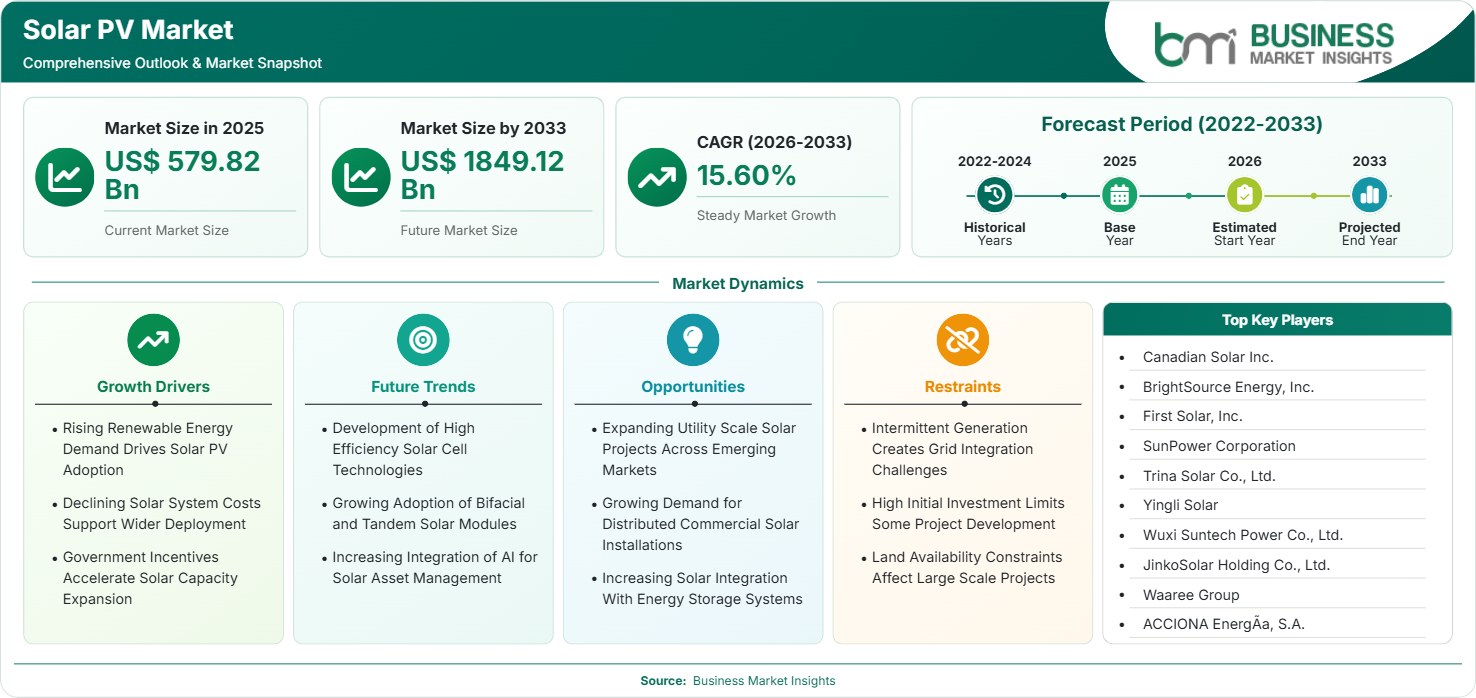
The Solar PV Market size was valued at US$ 579.82 Billion in 2025 and is projected to reach US$ 1849.12 Billion by 2033, growing at a CAGR of 15.60% during 2026–2033, driven by renewable electricity expansion, declining technology costs, energy security priorities, and opportunities in distributed generation, storage integration, and emerging markets.

Report Coverage
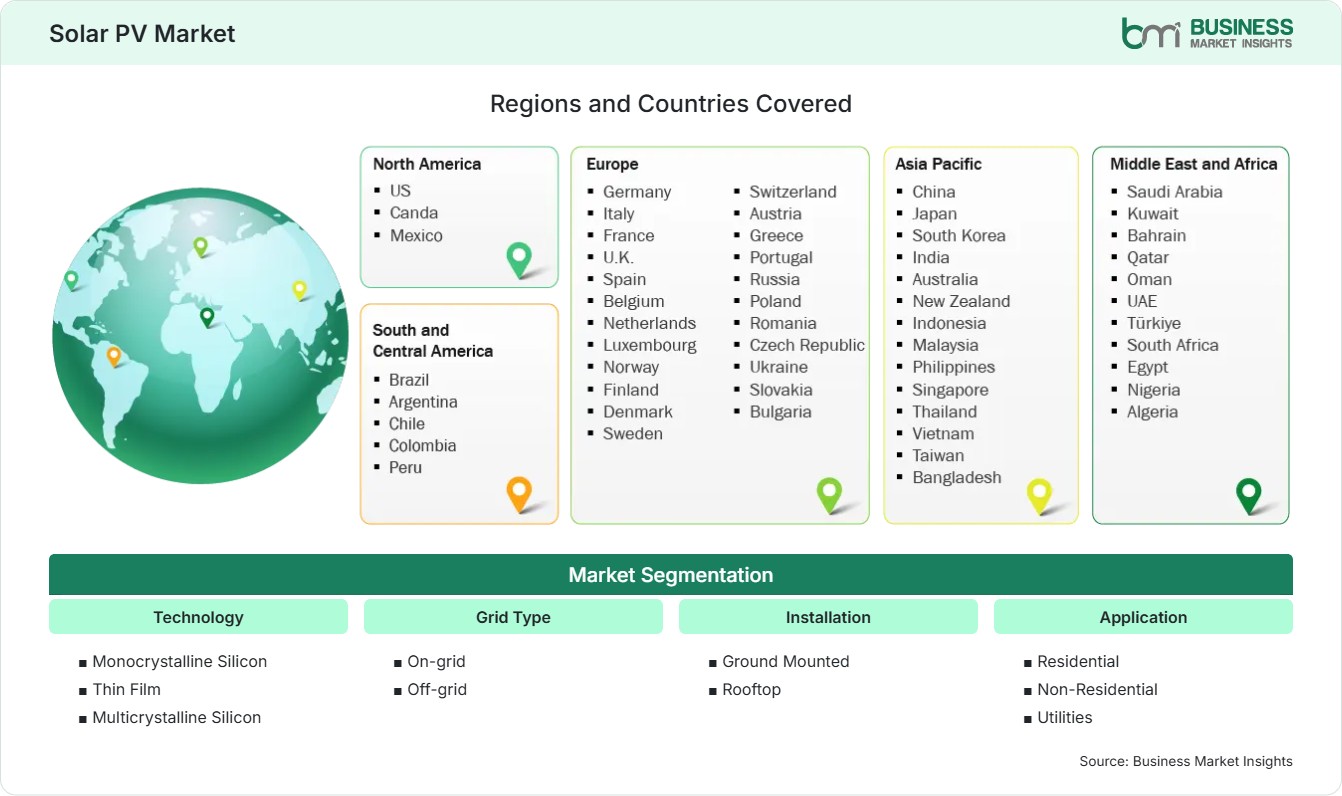
  • Technology: Monocrystalline Silicon, Thin Film, Multicrystalline Silicon
  • Grid Type: On-grid, Off-grid
  • Installation: Ground Mounted, Rooftop
  • Application: Residential, Non-Residential, Utilities
US$ 579.82 Bn Market size in 2025
US$ 1849.12 Bn Market Size by 2033
15.60% CAGR, 2026 - 2033
2026-2033 Forecast Period

AI Overview

Solar PV Market Summary

  • North America Region: North America holds a 16%–19% share in 2025 and is projected to grow at a 13.8%–15.1% CAGR during 2026–2033. Policy support, utility procurement, distributed generation, and energy storage integration drive deployment, while grid modernization creates opportunities for flexible solar infrastructure and localized electricity generation.
  • Fastest Growing Region: Asia Pacific holds a 48%–52% share in 2025 and is projected to grow at a 17.2%–18.8% CAGR during 2026–2033. Expanding electricity demand, manufacturing capacity, supportive policies, and utility-scale development accelerate installations, creating opportunities for distributed systems, storage integration, and grid-connected renewable infrastructure.
  • Leading Segment: Monocrystalline Silicon holds a 58%–62% share in 2025 and is projected to grow at a 16.4%–17.9% CAGR. High conversion efficiency, improving manufacturing processes, broad application suitability, and demand for maximum power output support continued technology adoption.
  • High Growth Segment: Utilities holds a 42%–46% share in 2025 and is projected to grow at a 17.8%–19.5% CAGR. Large-scale procurement, renewable capacity targets, land availability, grid integration, and storage development support utility projects and continued investment in centralized solar generation.
  • Key Market Opportunity: Combining photovoltaic generation with energy storage, digital controls, flexible grids, and distributed systems can improve renewable utilization while creating investment opportunities across equipment, project development, operations, and grid services.
  • Major Market Players: Canadian Solar Inc., BrightSource Energy, Inc., First Solar, Inc., SunPower Corporation, Trina Solar Co., Ltd., Yingli Solar, Wuxi Suntech Power Co., Ltd., JinkoSolar Holding Co., Ltd., Waaree Group, and ACCIONA Energía, S.A.
Strategic Insights

Solar PV Market: Strategic Insights

Solar PV Market Strategic Framework
FREE PDF
Request your free sample
Request free sample
Stakeholder View

Key Takeaways

  • Supply chains are evolving from module-centered procurement toward integrated ecosystems involving manufacturers, developers, installers, financiers, grid operators, storage providers, and digital energy-management specialists.
  • Utility-scale installations offer substantial expansion potential because large projects can add generation capacity rapidly, while distributed systems provide complementary opportunities where land, grid access, or consumption patterns favor localized generation.
  • Technology development is increasingly focused on higher module efficiency, improved durability, advanced inverters, intelligent monitoring, and systems designed to operate effectively alongside energy storage.
  • Asia Pacific presents the strongest regional investment case because expanding electricity consumption, manufacturing capabilities, policy support, and large renewable development pipelines support broad deployment across multiple applications.
  • Investment is increasingly moving toward integrated renewable portfolios that combine generation assets with storage, transmission upgrades, digital optimization, and long-term power procurement structures.
  • Grid readiness is becoming a strategic differentiator, as project value increasingly depends on interconnection availability, curtailment risk, storage requirements, transmission capacity, and the ability to deliver electricity when needed.
Geographic Outlook

Solar PV Market Regional Highlights

North America Solar PV Market

North America holds a 16%–19% share in 2025 and is expected to grow at a 13.8%–15.1% CAGR during 2026–2033. Utility procurement, distributed installations, energy storage, and grid modernization support regional expansion. The Solar PV Market share reflects established project development capabilities and expanding clean electricity demand.

  • Utility-scale development remains central as power producers and large electricity consumers pursue long-term renewable procurement, supported by improving project economics and expanding interest in integrated storage systems.
  • Rooftop adoption is supported by electricity cost management, distributed generation requirements, and customer interest in greater energy independence across residential and commercial properties.
  • Grid constraints are encouraging investment in storage, advanced inverters, and transmission infrastructure capable of accommodating larger volumes of variable renewable generation.
  • Manufacturing and supply-chain investment can strengthen regional equipment availability while reducing exposure to concentrated international sourcing and logistics disruptions.

US Solar PV Market

The US accounts for a 74%–78% share of the North American market in 2025 and is projected to expand at a 14.1%–15.5% CAGR through 2033. Strong utility procurement, corporate renewable purchasing, distributed generation, and storage integration support development. The country's expanding project pipeline is increasingly influenced by interconnection availability and grid modernization requirements.

  • Large electricity consumers continue to support renewable procurement through long-term agreements, strengthening demand for projects capable of delivering predictable generation and competitive electricity pricing.
  • Storage integration is gaining importance where developers seek to improve generation flexibility and reduce exposure to periods of grid congestion or renewable curtailment.
  • Distributed installations provide opportunities across households, businesses, and public facilities seeking localized generation and greater control over electricity consumption.

Europe Solar PV Market

Europe represents a 20%–23% share in 2025 and is projected to grow at a 14.6%–16.0% CAGR during 2026–2033. Germany remains a leading market, while Spain offers stronger expansion potential. Germany is projected to grow at a 14.8%–16.2% CAGR, while Spain could expand at a 16.3%–18.0% CAGR. Energy security, decarbonization policies, distributed installations, and electricity-price considerations continue influencing regional development.

  • Germany benefits from extensive rooftop deployment, commercial installations, and continuing investment in renewable generation supported by established market infrastructure.
  • Spain offers favorable solar resources and opportunities for large-scale development, hybrid projects, and expanding renewable capacity linked to broader energy transition objectives.
  • Storage deployment is becoming increasingly important as renewable penetration rises and electricity systems require greater flexibility to manage generation variability.
  • Commercial and industrial consumers are expanding interest in on-site generation to manage energy costs and improve long-term electricity supply resilience.

Asia Pacific Solar PV Market

Asia Pacific holds a 48%–52% share in 2025 and is expected to grow at a 17.2%–18.8% CAGR through 2033. China leads deployment and manufacturing, while India offers higher expansion potential. China is projected to grow at a 17.0%–18.5% CAGR, while India could advance at an 18.4%–20.1% CAGR. The Solar PV Market growth is supported by electricity demand, renewable targets, industrial expansion, and large-scale infrastructure development.

  • China remains central to global deployment and manufacturing, supported by extensive domestic demand, established supply chains, and continued investment in renewable capacity.
  • India offers substantial opportunities through utility projects, distributed installations, agricultural applications, and expanding electricity demand across urban and industrial areas.
  • Japan, South Korea, and Australia continue investing in solar systems alongside storage and grid technologies that improve renewable integration.
  • Southeast Asian markets are expanding renewable procurement, creating opportunities for developers, equipment suppliers, and financiers supporting growing electricity infrastructure.

Rest of World Solar PV Market

Rest of World accounts for a 9%–12% share in 2025 and is projected to grow at a 15.4%–17.0% CAGR through 2033. South and Central America benefits from favorable resources and competitive project economics, while the Middle East is expanding large-scale renewable development. Brazil is projected to grow at a 16.0%–17.6% CAGR, while Saudi Arabia could advance at a 17.2%–19.0% CAGR.

South and Central America continues developing utility and distributed projects. Middle Eastern markets are combining large land availability with renewable investment strategies and expanding electricity infrastructure.

  • Brazil supports growth through distributed generation and utility development, benefiting from strong solar resources and expanding demand across residential and commercial consumers.
  • Saudi Arabia and neighboring markets are developing large renewable projects as energy systems diversify and domestic electricity requirements continue expanding.
  • African markets offer long-term opportunities for decentralized systems where conventional grid expansion remains costly or difficult to implement.
  • Project financing, transmission infrastructure, and regulatory stability remain important factors influencing deployment across developing renewable energy markets.
Global Market Geography
FREE PDF
Request your free sample
Request free sample
Segment Analysis

Solar PV Market Segmentation

Technology

Monocrystalline Silicon holds a 58%–62% share in 2025 and is projected to grow at a 16.4%–17.9% CAGR during 2026–2033. Higher efficiency and strong suitability across rooftop and utility installations support adoption. The Solar PV Market scope increasingly favors technologies that maximize power generation within available land and installation areas while improving long-term system performance.

  • Monocrystalline Silicon: High efficiency and strong power density support widespread use across utility, commercial, and residential projects where available installation space influences technology selection.
  • Thin Film: Thin-film technology supports selected applications requiring flexibility, performance under particular environmental conditions, or alternative manufacturing approaches beyond conventional crystalline silicon modules.
  • Multicrystalline Silicon: Multicrystalline technology remains relevant in cost-sensitive applications, although efficiency competition continues encouraging greater adoption of higher-performance module technologies.

Grid Type

On-grid systems account for a 78%–82% share in 2025 and are projected to grow at a 15.8%–17.2% CAGR during 2026–2033. Grid-connected installations benefit from established electricity infrastructure and large-scale procurement. The Solar PV Market share increasingly reflects the importance of transmission access, interconnection capacity, smart controls, and storage solutions supporting reliable renewable electricity integration.

  • On-grid: Grid-connected systems dominate because they can supply electricity directly to consumers or utility networks while supporting large-scale renewable capacity expansion.
  • Off-grid: Off-grid installations serve remote communities, agricultural operations, telecommunications sites, and other locations where conventional electricity infrastructure remains limited or unavailable.

Installation

Ground Mounted systems hold a 63%–67% share in 2025 and are projected to grow at a 16.6%–18.2% CAGR during 2026–2033. Large utility and commercial projects support their leading position. The Solar PV Market trends favor installations combining generation with storage and advanced monitoring to improve asset utilization, operational visibility, and long-term electricity output.

  • Ground Mounted: Large-scale installations benefit from flexible project design, centralized operations, and the ability to deploy significant generation capacity across suitable land areas.
  • Rooftop: Rooftop systems enable localized electricity generation and can reduce dependence on centralized supply while utilizing existing building infrastructure.

Application

Utilities account for a 42%–46% share in 2025 and are projected to grow at a 17.8%–19.5% CAGR during 2026–2033. Renewable capacity targets and large-scale procurement support expansion. Growing integration with storage and transmission infrastructure strengthens the role of centralized projects within evolving electricity systems.

  • Residential: Household installations support localized generation, electricity cost management, and greater interest in combining rooftop systems with battery storage technologies.
  • Non-Residential: Commercial, industrial, and institutional users adopt systems to manage electricity costs, support sustainability commitments, and improve long-term energy planning.
  • Utilities: Large-scale projects provide substantial generation capacity and support renewable procurement strategies, particularly where grid infrastructure and land availability enable development.
Market Forces

Solar PV Market Dynamics

Key Market Drivers

Expanding Renewable Electricity Requirements

Increased electricity demand and movement towards a more sustainable power supply system have increased the importance of the use of solar energy for power production. Both governments and electricity users are looking to increase renewable power generation to decrease their dependency on fuel, which may be prone to fluctuations. The development of the Solar PV market is also based on the scalability of this source of power generation, which can be implemented both in distributed and centralized systems of various sizes. Solar projects can be constructed in phases as well, which makes it possible for additional capacities to correlate with demand and infrastructure. Such an approach is especially beneficial for both mature electricity markets and developing countries, where there is a need for additional generation capacity.

Improving Technology Performance and System Economics

Further advances in the efficiency of modules, production, engineering, and operation are making the photovoltaic installations more economically appealing. Better technology can result in increased energy production per square meter of the installation area, while more efficient technologies and building methods can help to build installations in a more effective way. The Solar PV Market trends show the shift to the development of more energy-dense installations with more advanced control capabilities and increased operational transparency. Such trends help to apply solar technologies in regions with various land availability and consumption needs. Technology advancements also encourage the substitution and upgrade of existing systems.

Growing Need for Energy Supply Diversification

In addition, energy security concerns have motivated countries, corporations, and utilities to consider options for diversified electricity production. Solar PV systems would enable local electricity production capability and decrease reliance on energy imports, especially if such systems are supported by battery backup and flexible grid infrastructure. In turn, the Solar PV Market is positively impacted by the fact that the solar PV technology can cater to the needs of centralized and decentralized electricity production due to the modularity of projects. Corporations are also assessing on-site electricity generation as one of the elements of their energy management strategy. With the rise in electricity consumption being tied to the growth in industries, digital networks, and transport systems, the potential use of renewable energy sources is likely to grow.

Key Market Opportunities

Integration of Solar Generation with Energy Storage

Integration of photovoltaic systems with batteries allows for optimization of generation flexibility and adds value to renewable energy production. Battery technology makes it possible to shift the generated electricity to times when there is more demand or less solar generation, leading to higher utilization of systems. Companies may progress from developing standalone generation systems to offering integrated energy solutions that combine generation, storage, control, and forecasting. The Solar PV Market Forecast is becoming increasingly linked to the integrated project approach. The other opportunity area involves businesses interested in gaining control of their electricity consumption. More storage usage will enable greater flexibility in renewables while generating additional revenues in both equipment and services.

Expansion of Distributed Energy Systems

Distributed solar has opportunities in places where there is a need for power generation in proximity to the power consumer and the need for less dependency on centralized sources. Businesses, households, government establishments, agricultural farms, and far-flung installations can have customized solutions according to their needs. There will be a need for installation services, monitoring systems, financing mechanisms, storage systems, and energy management systems. Distributed solar can also lead to lower transmission needs if power generation is near the point of consumption. More opportunities would be created by increased access to finance and installation frameworks. The concept is especially applicable in market environments where expansion costs associated with the grid, power reliability issues, or consumption trends favor renewable energy production.

Development of Emerging Renewable Energy Markets

Opportunities are abundant in emerging countries as the infrastructure for power generation increases and more power is required. Projects involving solar energy can help with city development, industry growth, rural electrification, and an increase in the need for electricity for commercial use. There are opportunities available in everything from providing the equipment to developing the project and operating it. In markets where there are good solar energy resources available, projects can be utility-scale, while in markets where grid coverage is poor, a distributed or off-grid system would make sense. Success is contingent on stable regulation, access to financing, development of the transmission infrastructure, and competent project delivery. This places a premium on players who can offer comprehensive services beyond mere equipment.

Market Restraints and Challenges

Grid Integration and Interconnection Constraints

Factor: The rapid installation of renewable sources may outstrip the transmission capacity in place and cause congestion in an electric grid built on centralized generation technologies. Effect: The delays in project development, project curtailment, and increased costs of connection could result in lower projected returns and decreased deployment pace. For developers, it is becoming essential to consider their ability to connect to the grid prior to making investment decisions, while utility companies will have to develop transmission, energy storage, and management systems. Unpredictable solar generation adds to the necessity of better forecasting. Solving these problems will require collaboration in the planning process among developers, grid operators, regulators, and those who invest in infrastructure.

Land, Permitting, and Supply-Chain Challenges

Factor: Large installations require suitable land, regulatory approvals, equipment availability, and efficient logistics across multiple project stages. Impact: Delays or cost increases can affect project schedules and investment returns. Land-use concerns may create local opposition, particularly where projects compete with agriculture, conservation, or other development priorities. Supply-chain disruptions can also affect equipment procurement and construction planning. Developers must therefore strengthen site assessment, supplier relationships, and permitting strategies. Successful project execution increasingly depends on managing these non-technology factors alongside engineering and electricity-market considerations.

Company Analysis

Competitive Landscape

The Solar PV Market analysis is characterized by competition across module manufacturing, project development, renewable energy services, and integrated power solutions. Competitive positioning depends on technology performance, manufacturing scale, project execution, geographic reach, supply-chain management, financing capabilities, and the ability to support generation assets throughout their operational life cycle.

Company Name

Overview

Products and Services relevant to this market

Canadian Solar Inc.

Global solar and energy solutions company with activities spanning module production, project development, storage, and renewable energy services.

Solar modules, photovoltaic systems, energy storage solutions, project development, engineering, procurement, construction, and renewable asset services.

BrightSource Energy, Inc.

Renewable energy technology company focused on large-scale solar power development and advanced solar energy generation systems.

Solar energy technologies, utility-scale project development, engineering capabilities, power generation solutions, and renewable infrastructure services.

First Solar, Inc.

Major solar technology company specializing in photovoltaic module manufacturing and large-scale renewable energy solutions.

Thin-film photovoltaic modules, utility-scale solar technology, project support, recycling services, and renewable energy generation solutions.

SunPower Corporation

Solar energy company with experience in distributed solar systems and energy solutions for customer-focused applications.

Residential and commercial solar systems, photovoltaic panels, energy services, installation solutions, monitoring, and distributed generation technologies.

Trina Solar Co., Ltd.

Global photovoltaic manufacturer and solar technology provider serving utility, commercial, and distributed energy markets.

Solar modules, photovoltaic systems, energy storage solutions, tracking technologies, and integrated solar project services.

Yingli Solar

Photovoltaic manufacturer supplying solar modules and related products to utility, commercial, and distributed energy markets.

Solar photovoltaic modules, renewable generation products, solar system components, and solutions supporting diverse installation requirements.

Wuxi Suntech Power Co., Ltd.

Solar module manufacturer supplying photovoltaic products for global utility, commercial, industrial, and residential applications.

Photovoltaic modules, solar power products, system components, and equipment supporting distributed and utility-scale solar installations.

JinkoSolar Holding Co., Ltd.

Global photovoltaic manufacturer with extensive module production and renewable technology capabilities.

High-efficiency solar modules, photovoltaic products, energy storage solutions, and technologies supporting residential, commercial, and utility applications.

Waaree Group

Indian renewable energy and technology group with activities across solar manufacturing, project development, and energy solutions.

Solar modules, photovoltaic products, engineering and installation services, renewable projects, and integrated solar energy solutions.

ACCIONA Energía, S.A.

Renewable energy company developing and operating diversified clean power assets across international electricity markets.

Solar power projects, renewable electricity generation, asset development, operations, maintenance, and integrated clean energy services.

Trust & Transparency

Research Methodology

The market analysis combines proprietary research with secondary data from government agencies, company disclosures, regulatory filings, industry databases and expert interviews. Market estimates are validated through data triangulation, cross-market benchmarking and analyst review.

View Full Research Methodology

Questions Answered

Frequently Asked Questions

What does the Solar PV Market Report cover?

The report covers technology, grid type, installation, application, regional opportunities, market dynamics, investment potential, competitive positioning, infrastructure requirements, and factors influencing future photovoltaic deployment.

What is the main challenge facing future deployment?

Grid infrastructure and interconnection capacity are major challenges because generation projects require sufficient transmission access and system flexibility to deliver electricity reliably.

How does energy storage affect solar development?

Storage improves flexibility by allowing electricity generated during sunny periods to be used later, supporting demand management, reducing curtailment exposure, and improving renewable integration.

Why are utility applications growing rapidly?

Large-scale renewable procurement, national capacity targets, expanding electricity demand, and the ability to deploy significant generation capacity through centralized projects are supporting stronger utility-scale development.

Which technology leads the market?

Monocrystalline silicon leads because its high efficiency and strong power output make it suitable for utility, commercial, and residential installations where available space and long-term generation performance are important.

Access the Full Solar PV Market Report

Get segment-level forecasts, regional estimates, competitive benchmarking, company profiles and downloadable Excel datasets.

Access the full Solar PV Market Report
350 pages PDF & Excel | 2026-09-04