Market Summary
Executive Summary and Global Market Analysis
Solar panel recycling involves collecting, dismantling, recovering materials, and reprocessing used photovoltaic modules. The industry aims to extract valuable materials like glass, aluminum, Silicon, and metals for reuse in manufacturing. As solar capacity grows worldwide, managing retired and damaged panels has become crucial for sustainable energy systems.
Market growth is driven by the increasing number of aging photovoltaic assets, changing waste management practices, and a greater focus on resource efficiency. Utilities, developers, and manufacturers are integrating recycling options into project planning to lessen disposal issues and improve material recovery. Sustainability goals are pushing stakeholders to create structured end-of-life management plans.
Recycling methods vary based on processing techniques and panel types. Mechanical processes are popular for their ease of use and ability to separate materials. Crystalline silicon panels make up a large portion of recycling efforts since they form the biggest installed photovoltaic base globally. The shelf-life of panels also affects recovery needs; earlier-loss modules often enter recycling due to manufacturing defects or operational failures.
New technology is changing the industry. Thermal, laser, and hybrid recovery methods are improving material quality and making it easier to extract valuable components. Efforts are focusing on maintaining material quality, cutting treatment costs, and boosting the market potential of recovered resources. Automation and improved separation technologies are also enhancing efficiency and consistency in recovery.
The competitive landscape features investment in recycling infrastructure, innovative processes, and strategic alliances across the solar industry. Market players are concentrating on scalable recovery systems that can manage larger panel amounts while adhering to environmental standards. As circular economy goals become more important, companies are integrating recycling into renewable energy systems.
Segment Analysis
Solar Panel Recycling Market Segmentation
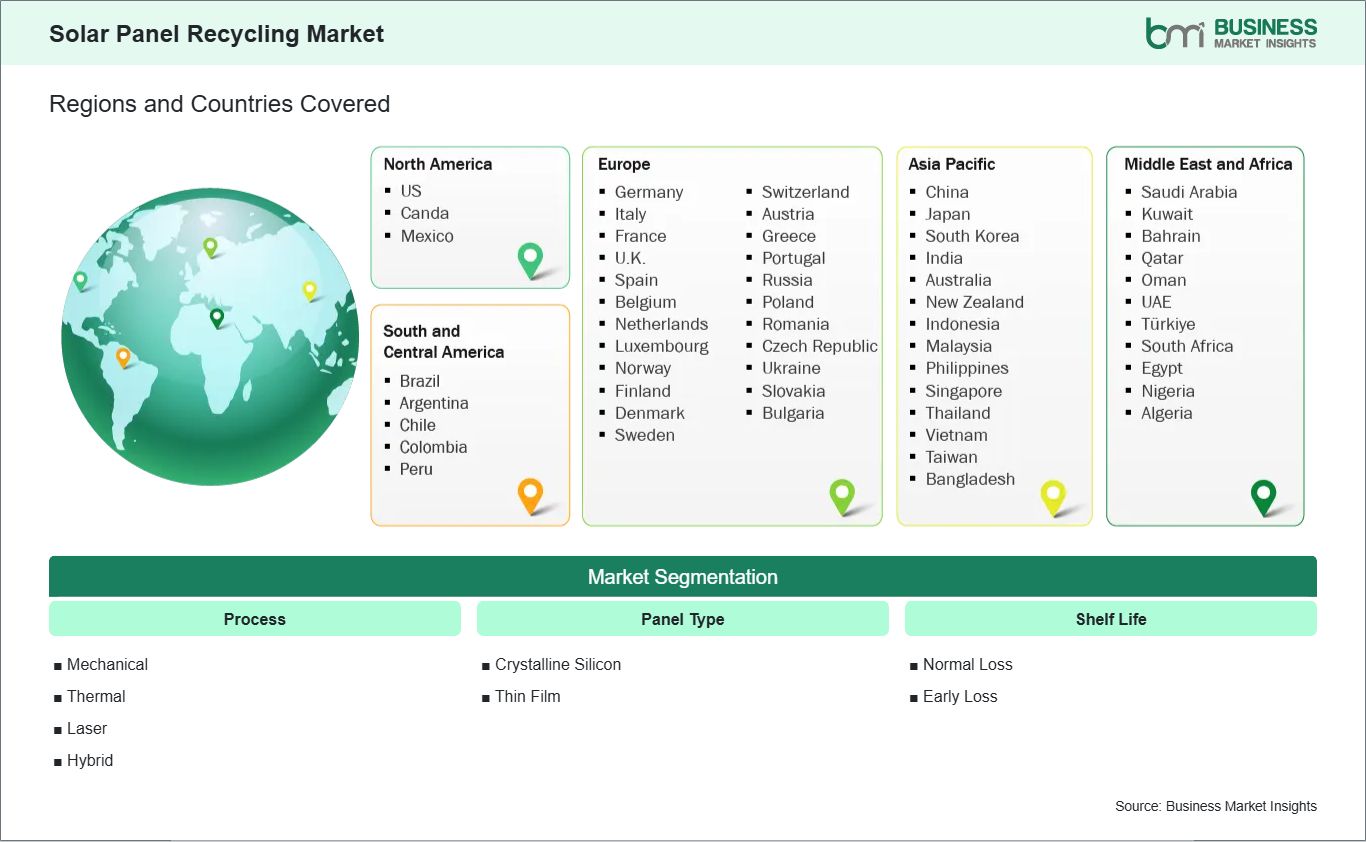
The market is segmented based on process, panel type, and shelf life characteristics.
By Process
- Mechanical - this method is widely used for separating materials with established workflows.
- Thermal - this process allows for improved recovery through controlled delamination procedures.
- Laser - this approach supports precise material extraction with minimal damage to components.
- Hybrid - this combines several recovery methods to improve resource efficiency
By Panel Type
- Crystalline Silicon - this type dominates recycling streams due to its extensive use history.
- Thin Film - this requires specialized treatment because of its unique material compositions.
By Shelf Life
- Normal Loss - this refers to modules that have reached their planned operational retirement
- Early Loss - this includes damaged, defective, or prematurely decommissioned panels
Market Forces
Solar Panel Recycling Market Drivers and Opportunities
Expansion of End-of-Life Photovoltaic Infrastructure
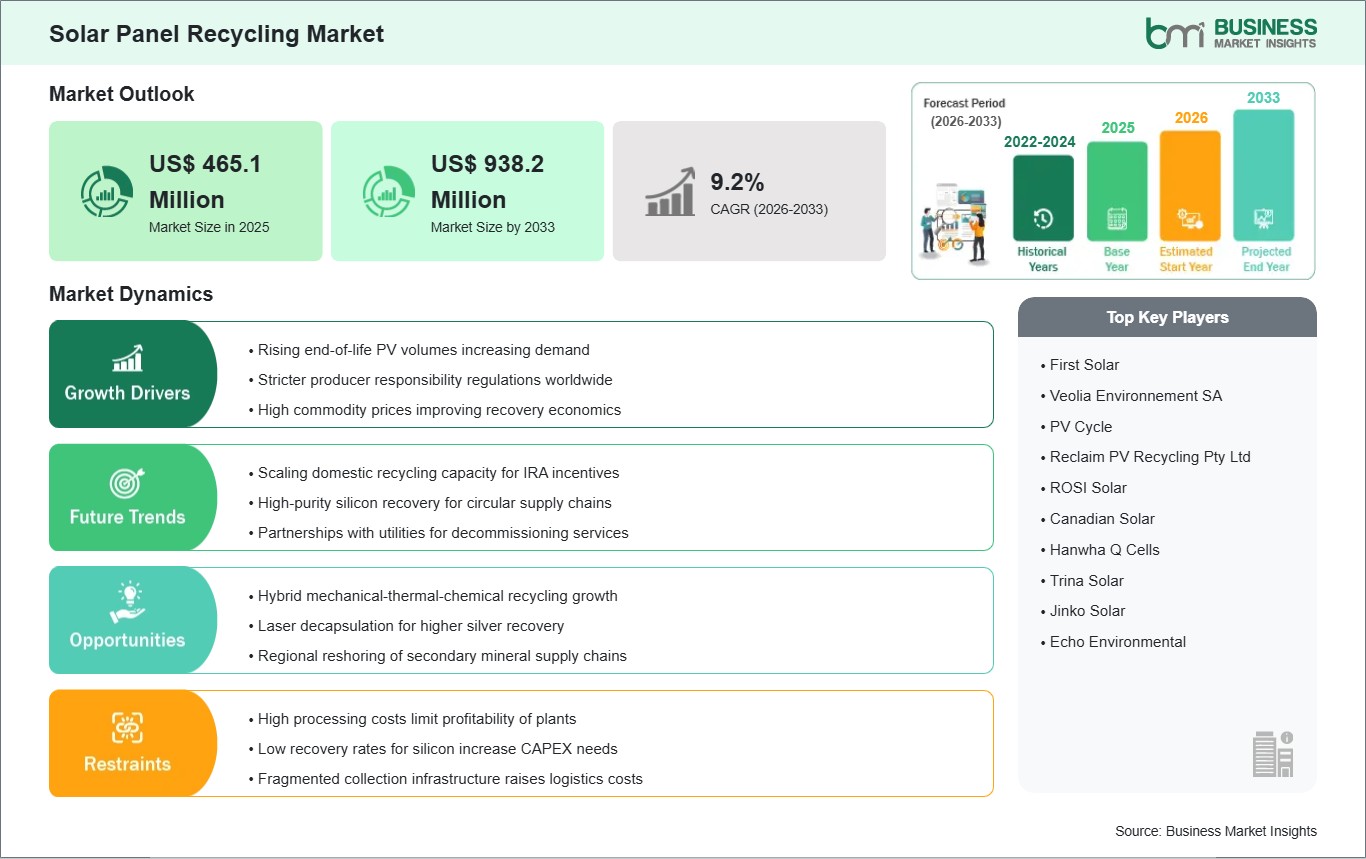
The growing number of photovoltaic installations has led to more panels nearing the end of their life. Asset owners need organized recovery solutions to handle material disposal responsibly and meet environmental standards. As a result, recycling facilities are seeing increased use as stakeholders look for sustainable options instead of sending materials to landfills. This rising demand drives investments in collection networks, processing facilities, and new recovery technologies. As renewable energy portfolios develop, recycling services play a more important role in project lifecycles. This change reinforces the industry's contribution to resource conservation and long-term sustainability goals in energy markets.
Advancement of High-Recovery Recycling Technologies
Innovation in material recovery technologies is creating chances to improve recycling costs and material quality. New thermal, laser, and hybrid processes allow for better extraction from photovoltaic modules while cutting down processing inefficiencies. These developments support more use cases across utility-scale and distributed solar installations.
Future opportunities include closed-loop manufacturing systems where recovered materials are put back into new photovoltaic products. Improved recovery capabilities can attract more industrial involvement and enhance supply chain strength. As technology gets better, recycling operations may take a larger share of value from end-of-life solar assets.
Size and Share Analysis
Solar Panel Recycling Market Size and Share Analysis
The solar panel recycling market is expected to reach US$ 0.93 billion by 2033, up from US$ 0.46 billion in 2025. The market is projected to grow at a rate of 9.2% from 2026 to 2033.
This growth reflects the increasing adoption of circular resource management in the renewable energy sector and the rising need for proper handling of panels at the end of their life. Mechanical recycling remains strong due to existing infrastructure and familiarity with operations. Crystalline silicon panels make up the largest recycling volumes, thanks to their significant installed base and common use in residential, commercial, and utility-scale projects. Utility-scale solar installations are a major source of recycling demand as large photovoltaic systems move into replacement cycles. Commercial and distributed energy systems also aid in material recovery, promoting market growth across various application settings.
Report Coverage
Solar Panel Recycling Market Report Coverage and Deliverables
The "Solar Panel Recycling Market Size and Forecast (2022-2033)" report provides a detailed analysis of the market covering below areas:
- The market size and forecast at global, regional, and country levels for all market segments covered under the scope
- The market trends, as well as drivers, restraints, and opportunities
- The market analysis covering key trends, global and regional framework, major players, regulations, and recent developments
- Industry landscape and competition analysis covering market concentration, heat map analysis, prominent players, and recent developments for the market
- Detailed company profiles, including SWOT analysis
Geographic Insights
Solar Panel Recycling Market Geographic Insights
The Solar Panel Recycling market shows different patterns of regional adoption based on the history of photovoltaic deployment, waste management practices, resource recovery goals, and the maturity of infrastructure. Stakeholders around the world are increasingly looking at end-of-life management needs along with plans to expand renewable energy. This focus highlights the need for recycling within overall sustainability and circular economy strategies.
North America shows strong industry involvement, driven by innovation and commercial recycling efforts. Project developers, utilities, and material recovery specialists are forming partnerships to improve resource recovery efficiency. Increased regulatory focus on waste reduction and sourcing materials locally also supports industry growth in the region.
Asia Pacific benefits from widespread solar deployment and increasing investments in renewable energy. Several countries are investigating scalable recycling systems to manage future panel retirements while keeping valuable materials. The region's strong manufacturing base also raises interest in recovering components that can enhance industrial supply chains and ensure resource security.
Europe has a structured approach to managing electronic and photovoltaic waste through established environmental policies. Recycling efforts are increasingly focusing on material traceability and resource circularity. Emerging markets in the Middle East, Africa, and South and Central America are slowly integrating recycling into renewable energy plans, creating long-term opportunities for infrastructure growth and specialized recovery services.
Industry Activity
Recent Developments
The solar panel recycling market is evaluated by gathering qualitative and quantitative data post primary and secondary research, which includes important corporate publications, association data, and databases. Recent developments and news in the market include:
- In April 2026, ROSI secured over US$ 22 million through a Series B round and public support to boost solar panel recycling infrastructure across Europe. The funding will help establish a new industrial facility in Spain and improve material recovery capacity for regional photovoltaic waste.
- In January 2026, SOLARCYCLE began operations at its solar panel recycling facility in Cedartown, Georgia. This marks a big increase in North American recycling capacity. The site processes thousands of photovoltaic modules each week and is designed for further expansion throughout 2026 to enhance end-of-life solar panel material recovery systems.
Trust & Transparency
Research Methodology
The market analysis combines proprietary research with secondary data from government agencies, company disclosures, regulatory filings, industry databases and expert interviews. Market estimates are validated through data triangulation, cross-market benchmarking and analyst
review.
View Full Research Methodology
Key Sources Referred:
International Renewable Energy Agency (IRENA)International Energy Agency (IEA)Solar Energy Industries Association (SEIA)International Electrotechnical Commission (IEC)Company WebsitesCompany Annual ReportsCompany Investor Presentations