Solar Floating Panel Market Regional Highlights
North America Solar Floating Panel Market
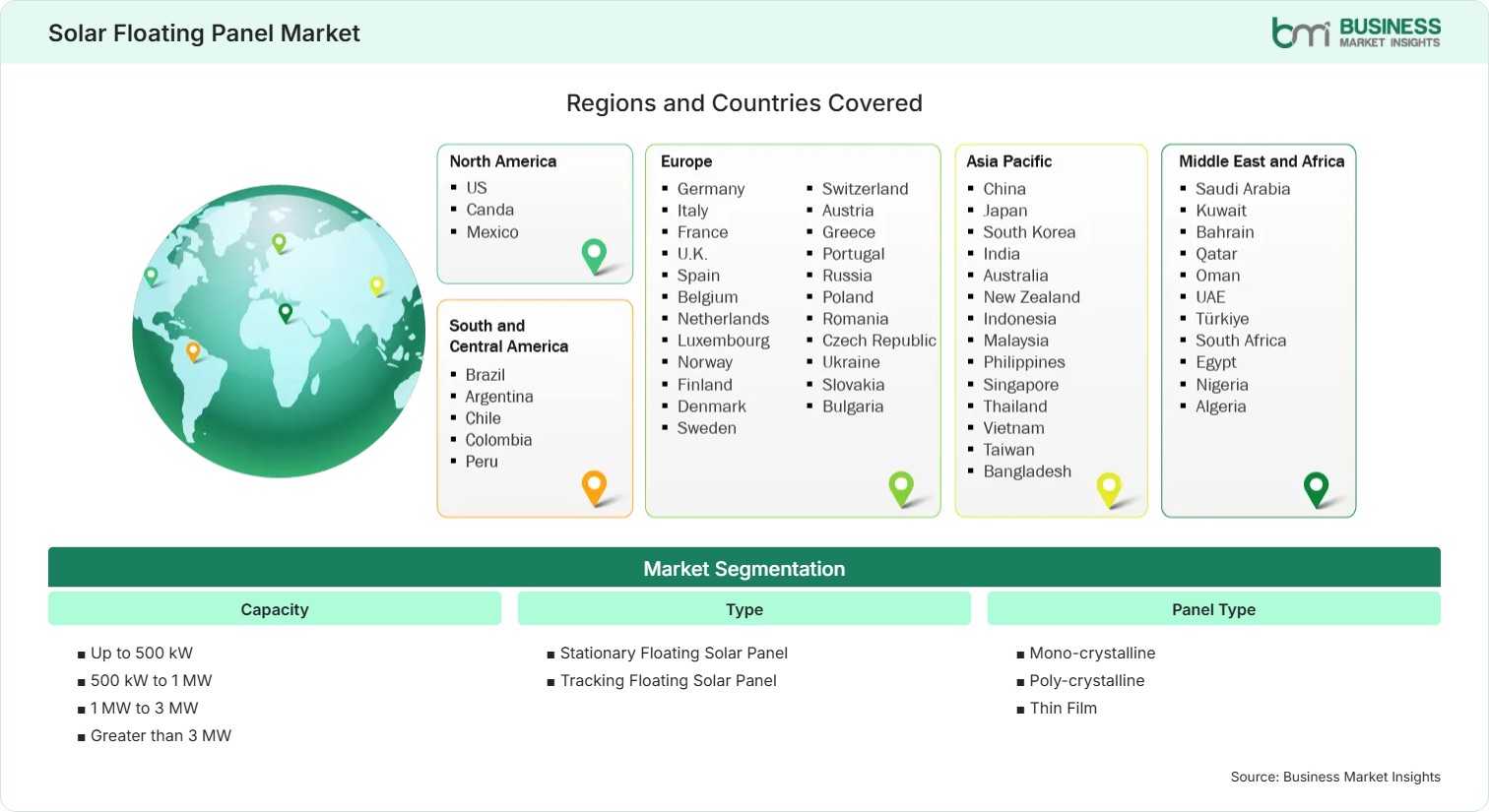
North America accounts for 18%–21% of the Solar Floating Panel Market share in 2025, while expanding at a CAGR of 25.2%–26.3% during 2026–2033. Rising renewable energy targets, increasing deployment across reservoirs, and modernization of transmission infrastructure continue to support regional expansion. Utilities are prioritizing floating photovoltaic projects to optimize land utilization while improving electricity generation efficiency and water resource management.
- Federal and state clean energy incentives continue encouraging investment in utility-scale floating photovoltaic installations across reservoirs, wastewater treatment facilities, and industrial water bodies, improving renewable electricity generation capacity.
- Utility companies increasingly integrate floating solar with battery energy storage systems to strengthen grid flexibility, improve renewable energy utilization, and reduce dependence on fossil fuel-based electricity generation.
- Engineering firms continue developing advanced anchoring technologies and corrosion-resistant floating platforms to improve long-term project durability under varying environmental conditions.
- Collaboration between utilities, technology providers, and research institutions accelerates the commercialization of high-efficiency floating photovoltaic systems capable of supporting long-duration clean energy deployment.
- Continued investment in renewable infrastructure and transmission modernization supports sustained Solar Floating Panel Market growth throughout North America.
US Solar Floating Panel Market
The United States is the largest national market in North America, accounting for 15%–17% of global revenue in 2025 and growing at a CAGR of 25.5%–26.6% through 2026–2033. The growing deployment of reservoir-based photovoltaic systems, supportive federal clean energy programs, and increasing corporate renewable energy procurement continue to strengthen market development.
- Public utilities increasingly evaluate floating solar installations on reservoirs to complement conventional renewable generation while reducing water evaporation and improving asset utilization.
- Investment in advanced inverter technologies, digital monitoring platforms, and predictive maintenance supports improved operational efficiency across utility-scale projects.
- State-level renewable portfolio standards continue to encourage the deployment of innovative photovoltaic technologies integrated with battery storage and smart grid infrastructure.
- EPC contractors increasingly collaborate with technology providers to optimize project design, installation efficiency, and lifecycle performance for floating photovoltaic assets.
Europe Solar Floating Panel Market
Europe contributes 22%–25% of global revenue in 2025 while recording a CAGR of 26.0%–27.1% through 2026–2033. Decarbonization targets, increasing investments in renewable energy, and the limited availability of suitable land encourage the deployment of floating photovoltaic projects. The Netherlands and France remain leading adopters, while Spain shows comparatively rapid expansion in utility-scale renewable development.
- The Netherlands maintains leadership through widespread deployment on inland reservoirs and water management infrastructure supporting renewable electricity generation.
- Spain records stronger projected growth with a CAGR of 27.4%–28.5%, driven by increasing solar investments and expanding renewable energy procurement programs.
- France continues investing in hybrid renewable projects integrating floating photovoltaic systems with hydropower assets and battery storage technologies.
- European engineering companies emphasize recyclable floating materials and sustainable project design to improve environmental performance throughout system lifecycles.
- Regulatory support for carbon neutrality and renewable electricity generation continues to accelerate commercial project development across the region.
Asia Pacific Solar Floating Panel Market
Asia Pacific accounts for 47%–50% of the global market in 2025 and records the fastest CAGR of 29.2%–30.4% during 2026–2033. Rapid electricity demand, land scarcity, supportive government policies, and abundant reservoir infrastructure continue driving large-scale project deployment. China remains the largest regional contributor, while India demonstrates the strongest growth momentum.
- China leads global floating photovoltaic deployment through utility-scale renewable projects supported by strong domestic manufacturing capabilities and government clean energy initiatives.
- India records the fastest regional growth with a CAGR of 30.2%–31.4%, encouraged by renewable energy expansion, reservoir utilization, and ambitious national solar capacity targets.
- Japan and South Korea continue deploying floating photovoltaic systems to overcome land constraints while improving renewable electricity generation efficiency.
- Southeast Asian countries increasingly adopt floating solar technology across hydropower reservoirs and irrigation infrastructure to strengthen energy security.
- Strong manufacturing ecosystems for photovoltaic modules and floating platforms reinforce regional competitiveness and project scalability.
Rest of World Solar Floating Panel Market
The Rest of World region collectively represents 9%–12% of global revenue in 2025 while expanding at a CAGR of 27.0%–28.2% during 2026–2033.
South & Central America continue benefiting from hydropower infrastructure suitable for hybrid renewable integration, while the Middle East & Africa increasingly deploy floating photovoltaic projects to diversify electricity generation and improve water resource utilization.
- Brazil remains the leading South & Central American market, while Chile records faster expansion with a CAGR of 28.1%–29.2% supported by renewable infrastructure investments.
- The United Arab Emirates leads regional deployment, whereas Saudi Arabia demonstrates stronger growth with a CAGR of 28.4%–29.6% through utility-scale clean energy initiatives.
- Mining companies increasingly utilize floating photovoltaic systems on industrial water reservoirs to reduce operational emissions and improve renewable energy adoption.
- International development agencies continue supporting financing mechanisms for renewable infrastructure projects across emerging economies.
- Growing investment in hybrid renewable power plants strengthens long-term opportunities for floating photovoltaic technology across developing regions.