Battery Recycling Market Regional Highlights
North America Battery Recycling
North America accounts for approximately 24%–27% of global revenue in 2025 and is projected to register a 13.0%–14.0% CAGR during 2026–2033. Regional expansion is supported by EV manufacturing investments, federal incentives, battery-material security initiatives, and increasing processing capacity. Battery Recycling Market share in the region benefits from strong automotive partnerships and rising battery manufacturing scrap availability. Collection infrastructure improvements and investments in hydrometallurgical recovery are enhancing material yields while reducing dependence on imported critical minerals across industrial supply chains.
- U.S. and Canadian recyclers are expanding integrated collection and processing networks, improving recovery rates for lithium, nickel, cobalt, and copper feedstocks.
- Gigafactory development supports growing manufacturing scrap volumes, creating predictable feedstock streams and improving recycling facility utilization rates.
- Government funding programs encourage domestic critical mineral recovery and strengthen circular-economy investments across battery value chains.
- Direct recycling research attracts capital due to potential reductions in processing costs and energy requirements.
US Battery Recycling
The United States represents roughly 72%–76% of North American revenue in 2025 and advances at a 13.5%–14.5% CAGR through 2033. Strong electric vehicle investment, battery manufacturing growth, and localized supply-chain strategies support market expansion. Public and private capital continue flowing toward commercial-scale processing facilities. The presence of technology innovators, automakers, and battery manufacturers strengthens collection ecosystems and accelerates commercialization of advanced recycling approaches designed to produce battery-grade recovered materials for domestic reuse.
- DOE-supported projects continue encouraging capacity expansion and development of next-generation recovery technologies.
- Partnerships between recyclers and vehicle manufacturers improve feedstock access and create long-term material supply agreements.
- Growth in stationary energy storage deployments expands future end-of-life battery volumes and recycling opportunities.
- State-level sustainability initiatives promote battery collection and responsible disposal programs.
Europe Battery Recycling
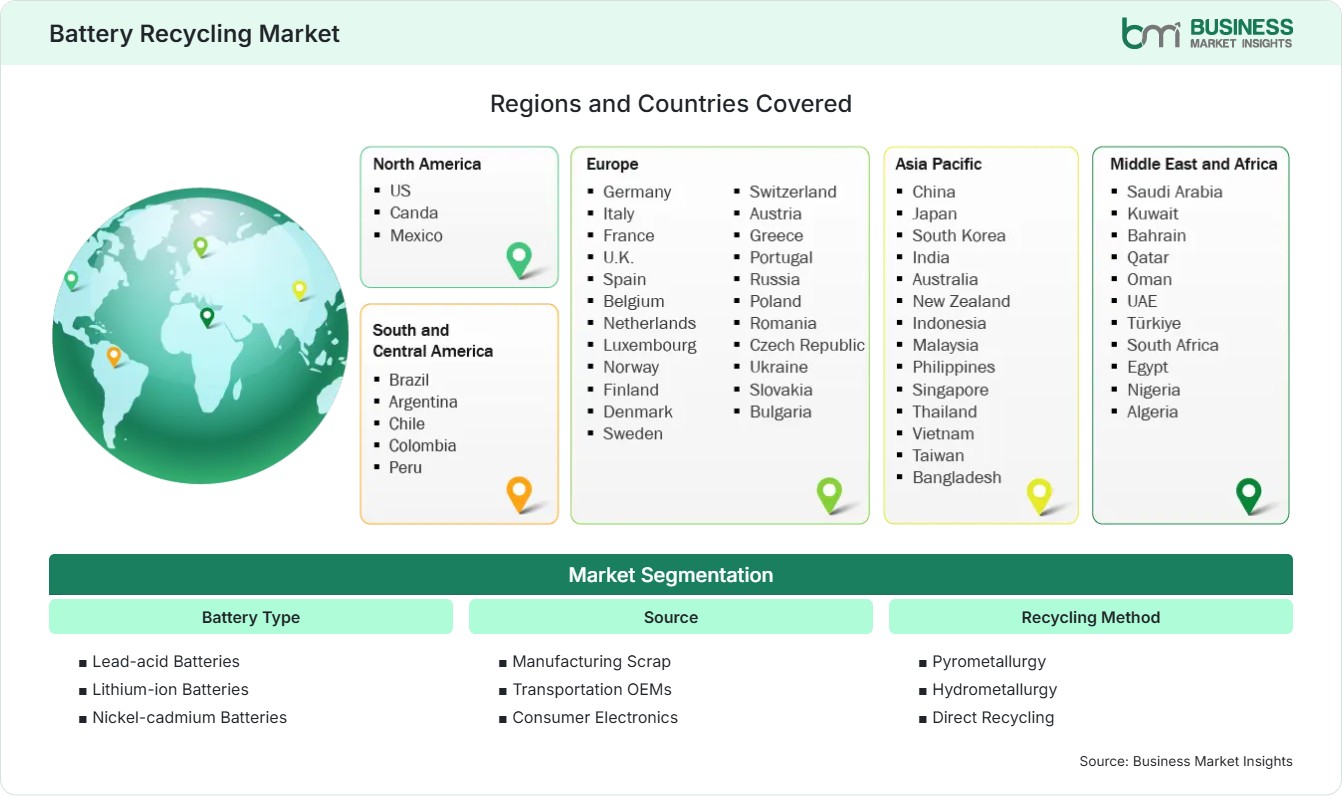
Europe holds approximately 25%–28% of global revenue in 2025 and records a 13.5%–14.5% CAGR during 2026–2033. Regulatory leadership, battery passport requirements, and recycled-content mandates strengthen adoption. Germany leads regional revenues, while Poland and Hungary emerge as high-growth processing locations with anticipated growth above regional averages. Strong automotive manufacturing capacity, environmental targets, and investments in battery circularity continue supporting deployment of advanced recycling infrastructure. Battery Recycling Market share remains reinforced by policy-driven demand and expanding gigafactory ecosystems.
- EU Battery Regulation strengthens long-term demand for recycled content and traceable material recovery systems.
- Germany remains the leading country due to industrial scale and established automotive production networks.
- Poland demonstrates elevated growth potential through battery manufacturing expansion and logistics advantages.
- Increasing investment in hydrometallurgical facilities improves recovery efficiency and economic viability.
- Automotive OEM sustainability commitments support long-term recycled material procurement strategies.
Asia Pacific Battery Recycling
Asia Pacific accounts for 38%–42% of global revenue in 2025 and achieves the fastest regional expansion at 15.5%–16.5% CAGR through 2033. China leads the regional landscape, while India represents one of the fastest-growing national markets. Extensive battery manufacturing capacity, favorable industrial ecosystems, and growing electric mobility adoption sustain leadership. Large-scale processing operations and government-supported recycling frameworks continue strengthening regional competitiveness. Battery Recycling Market growth is strongly linked to battery production concentration and integrated critical-material recovery infrastructure across key economies.
- China dominates processing capabilities due to established battery manufacturing and recycling networks.
- India benefits from expanding EV adoption and implementation of battery waste management frameworks.
- Japan and South Korea support technology innovation and high recovery-efficiency operations.
- Regional companies invest significantly in cathode material regeneration and direct recycling solutions.
- Manufacturing scrap remains an important feedstock source alongside growing end-of-life battery volumes.
Rest of World Battery Recycling
The Rest of World region accounts for approximately 8%–11% of Battery Recycling Market revenue in 2025 and is expected to grow at a 12.5%–13.5% CAGR through 2033. South and Central America benefit from mineral resources and emerging collection programs.
Middle East and Africa markets remain at earlier development stages but attract investment due to critical mineral availability and industrial diversification goals. Brazil leads regional revenues, while the United Arab Emirates demonstrates notable growth potential through sustainability-focused infrastructure development and circular economy initiatives.
- Brazil leads adoption through industrial recycling networks and growing sustainability investments.
- Gulf economies increasingly explore battery-material recovery to support industrial diversification strategies.
- Collection infrastructure development remains a priority across several emerging markets.
- International partnerships accelerate technical knowledge transfer and facility deployment.
- Resource security concerns encourage governments to evaluate domestic recycling capabilities.