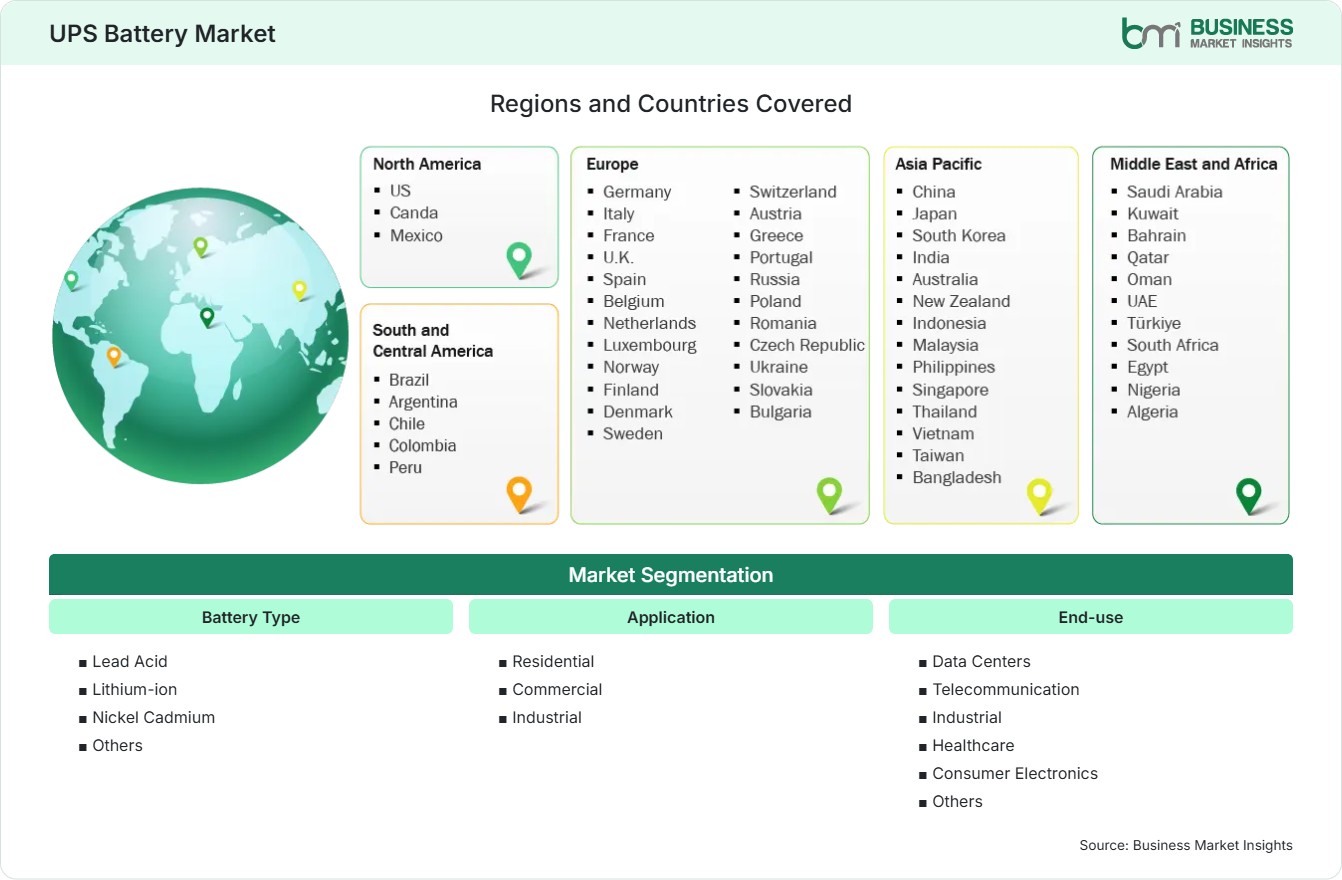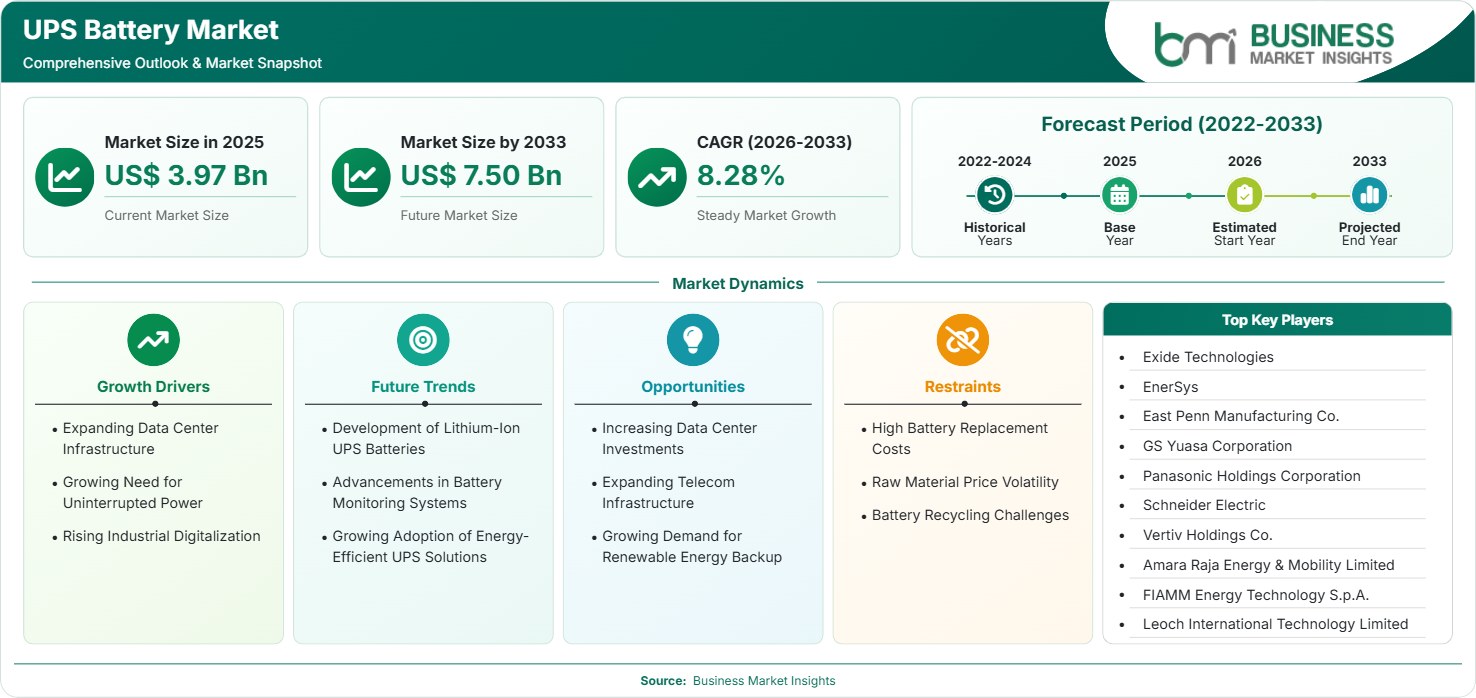
UPS Battery Market Regional Highlights
North America UPS Battery Market
North America held a 25%–28% of UPS Battery Market share in 2025 and is modeled to expand at a 7.5%–8.2% CAGR during 2026–2033. The region benefits from hyperscale computing, AI infrastructure, telecom modernization, industrial automation, and aging backup assets requiring replacement. Data-center operators increasingly prioritize compact battery architectures, monitoring, and resilience as grid interconnection becomes more challenging.
- AI-oriented data-center construction is increasing requirements for high-rate discharge capability, intelligent battery monitoring, thermal management, and power-quality resilience across new critical-power installations.
- Replacement demand remains strategically important because installed backup systems require scheduled battery renewal, creating recurring revenue opportunities for manufacturers, service providers, distributors, and specialized maintenance companies.
- Grid constraints are encouraging data-center operators to consider batteries as flexible energy assets alongside UPS functions, creating opportunities for demand response, peak management, and behind-the-meter storage.
- North American suppliers benefit from established service networks, established recycling channels, and sophisticated procurement standards emphasizing total ownership cost, reliability, cybersecurity, and lifecycle support.
US UPS Battery Market
The US represented approximately 20%–23% of the global UPS Battery Market in 2025 and is modeled to grow at a 7.4%–8.1% CAGR through 2033. Demand is concentrated around hyperscale data centers, colocation facilities, healthcare infrastructure, telecommunications, and industrial operations. This environment supports sustained battery procurement and technology upgrades.
- AI computing is increasing power-density requirements and making battery response characteristics, monitoring, and thermal performance more important during UPS specification and facility design.
- Data-center developers increasingly evaluate batteries as part of broader energy strategies, linking backup systems with onsite generation, storage, microgrids, and grid-interactive controls.
- Domestic manufacturing investments are strengthening supply resilience, while localized production can reduce exposure to international transportation disruptions and improve response times for critical infrastructure projects.
Europe UPS Battery Market
Europe held a 20%–23% of UPS Battery Market share in 2025 and is modeled to grow at a 7.2%–8.0% CAGR through 2033. Germany, the United Kingdom, France, and the Netherlands remain important deployment centers, while Spain and Nordic markets offer higher-growth opportunities linked to renewable generation and data-center development. Battery regulation is strengthening lifecycle transparency and recycling requirements, supporting investments in traceability and circularity.
- Germany and the United Kingdom provide mature demand environments where replacement programs, data-center expansion, industrial automation, and telecommunications reliability support recurring battery requirements.
- Nordic markets offer higher-growth potential because data-center development increasingly intersects with renewable electricity availability, creating opportunities for integrated UPS and energy-storage architectures.
- European regulation is encouraging manufacturers to strengthen battery documentation, lifecycle monitoring, material recovery, repairability, and recycling processes across commercial and industrial deployments.
- France, the Netherlands, and Spain provide additional opportunities through digital infrastructure investment, renewable-energy integration, and modernization of critical facilities requiring resilient power.
Asia Pacific UPS Battery Market
Asia Pacific accounted for 36%–39% of UPS Battery Market share in 2025 and is modeled to expand at a 9.0%–10.0% CAGR during 2026–2033, making it the fastest-growing regional market. Public market evidence also places Asia Pacific as the leading regional market, reflecting strong industrialization and data-center development. China, Japan, South Korea, and India lead regional demand, while Southeast Asia offers higher-growth opportunities as cloud infrastructure and digital services expand.
- China benefits from extensive manufacturing capacity, telecommunications deployment, cloud infrastructure, and industrial automation, supporting both conventional lead-acid and advanced lithium-ion backup requirements.
- India combines rapid data-center development, telecommunications expansion, industrial investment, and localized battery manufacturing, creating an increasingly attractive market for domestic and international suppliers.
- Japan remains technologically mature, with established demand for industrial batteries and strong adoption of high-reliability power systems across critical infrastructure and manufacturing.
- Southeast Asian economies provide higher-growth opportunities as data-center operators, cloud providers, and digital-service companies expand regional infrastructure and require dependable backup power.
Rest of World UPS Battery Market
Rest of World UPS Battery Market represented approximately 13%–17% of global demand in 2025, with a modeled 7.0%–8.0% CAGR through 2033. South and Central America benefit from telecom expansion, industrial modernization, and renewable-energy development. Brazil and Mexico represent leading demand centers, while Chile and Colombia offer attractive growth opportunities linked to digital infrastructure and distributed energy investment. Demand remains more price-sensitive than in mature markets, supporting continued adoption of established lead-acid architectures alongside selective lithium-ion deployment.
- Brazil and Mexico combine telecommunications, industrial facilities, and expanding digital infrastructure, creating sustained replacement and new-installation opportunities for established battery technologies.
- Chile and Colombia offer attractive growth niches where renewable generation, mining operations, telecommunications, and distributed power requirements support resilient backup infrastructure.
- Saudi Arabia and the United Arab Emirates provide high-value opportunities through hyperscale data centers, smart infrastructure, industrial diversification, and large-scale digital transformation initiatives.
- South Africa remains an important market where grid reliability concerns increase the value of backup systems and encourage customers to evaluate batteries alongside broader energy-storage architectures.