
Graphene Battery Market Outlook: Size, Share, Trends, Growth Analysis, Competitive Landscape & Forecast, 2026-2033

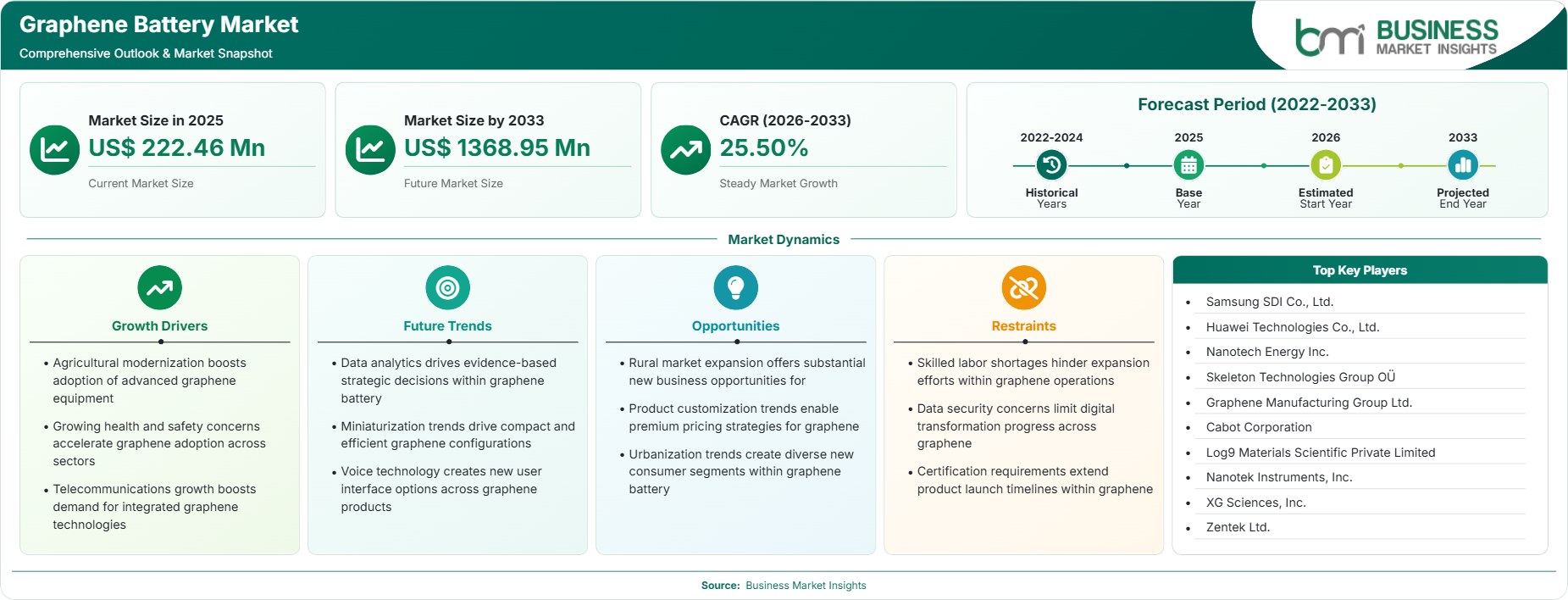
The Graphene Battery Market size was valued at US$ 222.46 Million in 2025 and is projected to reach US$ 1368.95 Million by 2033, growing at a CAGR of 25.50% during 2026–2033. Key drivers include rapid EV adoption, fast-charging requirements, advanced energy storage needs, and increasing graphene material innovation. Opportunities stem from aerospace electrification, grid storage modernization, and next-generation consumer electronics applications.

Report Coverage
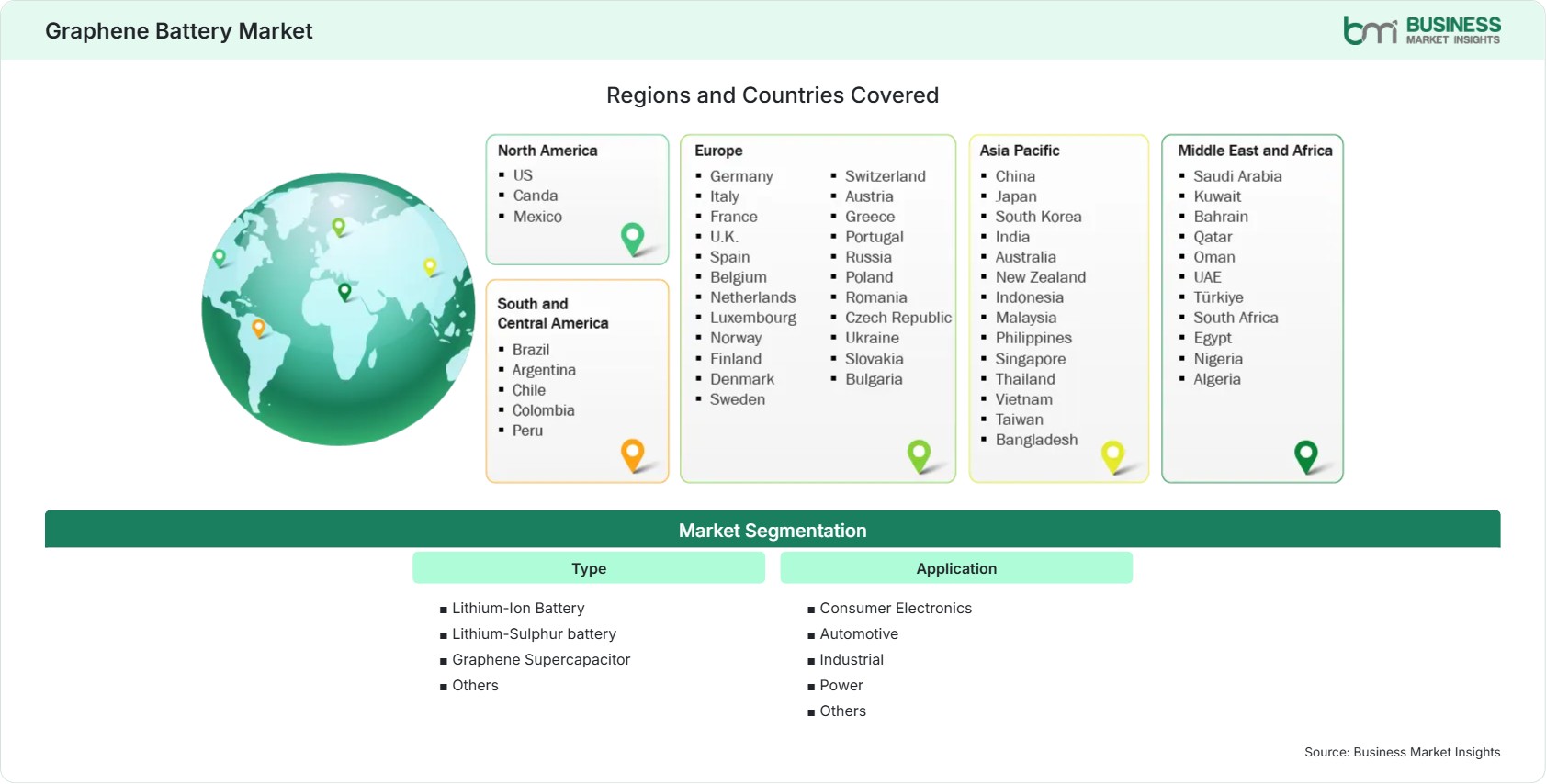
  • Type: Lithium-Ion Battery, Lithium-Sulphur battery, Graphene Supercapacitor, Others
  • Application: Consumer Electronics, Automotive, Industrial, Power, Others
US$ 222.46 Mn Market size in 2025
US$ 1368.95 Mn Market Size by 2033
25.50% CAGR, 2026 - 2033
2026-2033 Forecast Period

AI Overview

Graphene Battery Market Summary

  • North America Region: North America holds a market share of 34%–37% in 2025, expanding at 23%–26% CAGR during 2026–2033. Growth is driven by energy storage investment, EV battery innovation, manufacturing incentives, advanced materials commercialization, research collaboration, electrification expansion, sustainable mobility initiatives, and high-performance battery development. The U.S. dominates regional demand through advanced battery research, EV deployment, and manufacturing investments, growing at approximately 24%–27% CAGR.
  • Fastest Growing Region: Asia Pacific accounts for 28%–31% share in 2025 and advances at 27%–30% CAGR during 2026–2033. Growth benefits from EV manufacturing expansion, battery supply chain localization, electronics production leadership, government incentives, renewable integration, industrial development, advanced materials investment, and large-scale energy storage deployment.
  • Leading Segment: Consumer Electronics represents a 31%–34% share in 2025 and grows at 24%–27% CAGR during 2026–2033. Adoption is supported by compact device requirements, heat management advantages, rapid charging demand, battery life improvements, wearable technology expansion, premium product innovation, and portable energy storage applications.
  • High Growth Segment: Automotive holds 25%–28% share in 2025 and expands at 28%–31% CAGR during 2026–2033. Rising electric mobility, charging speed expectations, energy density improvements, lightweight battery needs, emissions reduction targets, vehicle electrification policies, and advanced battery platform investments accelerate adoption.
  • Key Market Opportunity: Commercialization of graphene-enhanced batteries for electric vehicles and grid-scale storage creates opportunities through longer lifecycle performance, fast charging capability, improved thermal stability, renewable integration support, and manufacturing scale expansion.
  • Major Market Players: Samsung SDI Co., Ltd.; Huawei Technologies Co., Ltd.; Nanotech Energy Inc.; Skeleton Technologies Group OÜ; Graphene Manufacturing Group Ltd.; Cabot Corporation; Log9 Materials Scientific Private Limited; Nanotek Instruments, Inc.; XG Sciences, Inc.; Zentek Ltd.
Strategic Insights

Graphene Battery Market: Strategic Insights

Graphene Battery Market Strategic Framework
FREE PDF
Request your free sample
Request free sample
Stakeholder View

Key Takeaways

  • The value chain is becoming increasingly integrated, with graphene material producers collaborating directly with cell manufacturers and application developers to accelerate commercial deployment.
  • Automotive electrification and high-performance consumer electronics offer the strongest revenue upside due to demand for fast charging and improved thermal stability.
  • Innovation is moving beyond graphene additives toward graphene-enabled architectures, hybrid electrodes, and supercapacitor technologies designed for high-power applications.
  • Asia Pacific presents the most compelling expansion opportunity because it combines battery manufacturing scale, policy incentives, and electronics production leadership.
  • Venture funding, strategic alliances, and technology licensing agreements are becoming preferred commercialization routes for emerging battery innovators.
  • Grid modernization initiatives and renewable energy integration needs are opening long-term opportunities for advanced stationary storage systems.
Geographic Outlook

Graphene Battery Market Regional Highlights

North America Graphene Battery Market

North America accounted for 34%–37% of global revenue in 2025 and is expected to advance at 23%–26% CAGR through 2033. Robust battery innovation ecosystems, government manufacturing incentives, and EV investments support commercialization. The region benefits from strong university research networks and advanced material development capabilities. The Graphene Battery Market share remains highest in North America due to active investment by energy storage companies and technology developers.

  • Federal clean-energy programs encourage advanced battery manufacturing and domestic material sourcing initiatives.
  • Electric vehicle charging performance requirements accelerate adoption of graphene-enhanced technologies.
  • Technology partnerships between material suppliers and battery developers strengthen commercialization pathways.
  • Stationary storage deployment for renewable integration creates additional demand opportunities.

US Graphene Battery Market

The United States represents 74%–78% of North American demand and is projected to expand at 24%–27% CAGR. Strong venture funding, defense-related technology development, and EV battery research activities support growth. Commercialization efforts increasingly target high-performance mobility applications, grid storage, and premium electronics. Manufacturing incentives continue improving domestic advanced battery production competitiveness.

  • National laboratory research programs support graphene material innovation and battery performance enhancement.
  • Growing EV deployment strengthens demand for fast-charging energy storage solutions.
  • Advanced manufacturing investments improve pilot-scale and commercial-scale production capabilities.
  • Aerospace and defense applications contribute specialized high-value demand.

Europe Graphene Battery Market

Europe holds 24-27% market share and achieves a 24-27% CAGR during 2025. Demand in Europe is fueled by battery localization policies, decarbonization objectives, and funding for electric transportation systems. Germany emerges as the leading market, while the Nordic countries and the United Kingdom present huge growth potential due to extensive research activities.

  • EU battery regulations encourage innovation in sustainable, efficient energy storage technologies.
  • Germany leads industrial deployment through automotive and advanced manufacturing sectors.
  • United Kingdom research institutions support commercialization of graphene-enabled technologies.
  • Nordic countries attract clean-energy storage investments and pilot projects.

Asia Pacific Graphene Battery Market

Asia Pacific accounts for the highest share, at 28% to 31%, and experiences the highest growth, at 27% to 30%. China has the largest production capacity and supply chain integration capabilities in the region, while India and Southeast Asia show strong growth potential. The presence of electronics manufacturing centers, EV development, and investment in battery production drives the region's leadership. The region contributes significantly to global Graphene Battery Market growth through scale advantages.

  • China dominates battery manufacturing and graphene material development activities.
  • India experiences rapid momentum through mobility electrification and domestic innovation programs.
  • South Korea and Japan continue investing in advanced cell performance technologies.
  • Consumer electronics production drives consistent demand across regional markets.

Rest of World Graphene Battery Market

Rest of World holds a share of 8% to 11% and shows a growth of 22% to 25% CAGR. The regions of South and Central America benefit from investments in renewable energy and storage technologies. The markets in the Middle East and Africa are being boosted by grid upgrades, smart city development, and industrial diversification plans. Brazil and the UAE represent leading opportunities, while Saudi Arabia demonstrates notable growth potential.

  • Renewable energy deployment increases demand for advanced storage technologies.
  • Industrial diversification strategies encourage technology adoption across key economies.
  • Smart infrastructure development supports energy storage investment.
  • Mining and resource sectors seek durable high-performance battery solutions.
Global Market Geography
FREE PDF
Request your free sample
Request free sample
Segment Analysis

Graphene Battery Market Segmentation

Type

Type was considered the technical basis of the technology’s application in industries. Lithium-ion batteries accounted for 46%-49% in 2025, while advanced graphene batteries expand commercialization potential. It is forecast that the market segment will grow at a 24%-27% CAGR as improved performance, charging capability, and longevity continue to attract investment. The Graphene Battery Market scope expands as manufacturers evaluate multiple chemistry pathways.

  • Lithium-Ion Battery: Most commercialized category, leveraging graphene additives to enhance energy density, charging performance, thermal stability, and cycle durability across transportation, portable electronics, and stationary storage applications.
  • Lithium-Sulphur battery: Gains attention due to theoretical energy density advantages and potential weight reduction benefits, particularly for aerospace, mobility, and long-duration storage applications.
  • Graphene Supercapacitor: Addresses ultra-fast charging and high-power applications requiring rapid energy delivery, excellent cycle life, and operational reliability in industrial and transportation environments.

Application

Application demand drivers come from consumer electronics, which account for 31% to 34% market share in 2025, while the automotive segment is the fastest-growing category, with a 28% to 31% CAGR. End-user demands are now more focused on fast charging, heat resistance, small size, and durability. The Graphene Battery Market trends suggest that applications have broadened from electronics to transportation and industrial energy storage.

  • Consumer Electronics: Smartphones, wearables, laptops, and connected devices require compact, efficient power systems supporting enhanced user experience and faster charging capabilities.
  • Automotive: Electric vehicles and hybrid platforms increasingly evaluate graphene-enhanced technologies to improve range, charging efficiency, thermal performance, and operational safety.
  • Industrial: Industrial robotics, automation systems, and material handling equipment benefit from durability, power delivery performance, and extended operational cycles.
  • Power: Renewable integration and stationary storage projects utilize advanced batteries to support grid stability, energy optimization, and resilience requirements.
Market Forces

Graphene Battery Market Dynamics

Key Market Drivers

Electric Vehicle Electrification Momentum

Adoption rates of electric vehicles (EVs) around the world continue to rise as many governments introduce stringent emissions-reducing policies and car manufacturers develop more types of EVs. In recent years, the International Energy Agency has confirmed an upward trend in global sales and installations of electric vehicles. There are clear benefits to graphene-enhanced batteries, including fast charging, superior heat dissipation, high energy efficiency, and increased longevity. These qualities are increasingly necessary for contemporary modes of transportation, thereby generating significant business opportunities and investments and supporting the large-scale deployment of next-generation electric mobility technologies worldwide.

Rising Demand for Fast-Charging Consumer Devices

Premium electronics companies are now emphasizing charging speed, battery life, and thermally efficient batteries to satisfy changing consumer demands. With graphene, conductivity improves, enabling fast energy transfer without generating heat during intense charging and use. This ensures improved performance and increases battery life. With modern phones and other electronic devices featuring high-performance capabilities and functionalities, the need for batteries that deliver this performance without compromising reliability, operating duration, or user experience

Advancements in Graphene Material Science

Research institutions, universities, and commercial developers are making significant progress in improving the quality, consistency, and scalability of producing graphene materials. Advanced manufacturing processes have helped reduce costs and address technical issues encountered when incorporating graphene into batteries. The advancements have enabled graphene to be incorporated into various battery chemistries, improving their commercial feasibility. Investment in research on nanomaterials is driving innovation, thereby ensuring the commercial success of batteries with high power density, thermal management properties, fast charging capability, efficient heat dissipation, and longer operational lifecycles for diverse applications.

Key Market Opportunities

Grid-Scale Renewable Energy Storage

The growing adoption of renewable energy sources such as solar and wind is increasing the demand for advanced energy storage systems that offer rapid response times, high efficiency, and long operating lifespans. Graphene-based battery and storage technologies have gained prominence as viable alternatives to address the intermittency of renewable energy generation and improve overall grid stability and resilience. With the rapid growth in renewable energy installations worldwide, utilities, grid companies, and infrastructure investors are beginning to consider more advanced storage systems, thereby opening new growth avenues and improving Graphene Battery Market forecasts for stationary energy storage applications.

Aerospace and Advanced Mobility Applications

Efforts to make airplanes more efficient in electricity use, unmanned aerial vehicles (UAVs), electric vertical takeoff and landing aircraft (eVTOLs), and advanced mobility platforms will require an energy storage solution that is lightweight and delivers optimal performance. Graphene-enabled batteries have been identified as a viable solution because of their ability to reduce weight, enable fast charging, improve energy efficiency, and extend battery lifespan. The above benefits are extremely important in aerospace applications. Investment in aerospace innovations and advanced mobility platforms has led to increased demand, creating significant growth opportunities for premium graphene battery technology providers.

Localized Battery Manufacturing Expansion

Governments around the world are increasingly promoting domestic battery manufacturing through incentives, tax breaks, grants, and strategic industrial policies that strengthen local value chains. This creates ample room for companies developing graphene technology to supply their advanced materials, thereby improving battery performance and efficiency. By creating a platform to support new local manufacturing value chains, companies in the graphene industry can build lasting collaborations with battery companies, automobile manufacturers, industrial equipment suppliers, and energy storage developers. Localization efforts also improve supply chain resilience, reduce dependence on imports, accelerate innovation, and foster sustainable growth across multiple end-use sectors.

Market Restraints and Challenges

High Graphene Material Costs Limiting Commercial Scalability

Factor: The production of high-purity graphene suitable for advanced battery applications remains considerably more expensive than conventional battery materials, owing to complex manufacturing processes, quality-control requirements, and limited large-scale production capacity. Impact: Elevated material costs continue to present a significant barrier to commercialization, particularly in cost-sensitive sectors such as consumer electronics and electric mobility. Manufacturers must carefully evaluate whether the performance advantages offered by graphene batteries justify the additional expense, especially in highly competitive markets. While ongoing process improvements are helping reduce production costs, achieving cost-effective scalability remains essential for widespread adoption and long-term market competitiveness.

Lack of Industry Standards Creating Adoption and Qualification Challenges

Factor: Industry standards governing graphene battery performance, testing protocols, manufacturing practices, and quality benchmarks remain relatively underdeveloped compared to established battery technologies. Impact: The absence of widely accepted standards creates uncertainty for buyers regarding long-term reliability, product consistency, and system compatibility. Variations in graphene quality and production methods across suppliers further complicate procurement and evaluation processes. As a result, qualification cycles may be extended, particularly in regulated industries and large-scale procurement environments, slowing market adoption and delaying broader commercialization of graphene-based battery technologies.

Company Analysis

Competitive Landscape

The competitive environment is characterized by technology innovation, strategic partnerships, and commercialization initiatives. Ongoing Graphene Battery Market analysis indicates a combination of established battery companies and specialized graphene developers shaping industry evolution.

Company Name

Overview

Products and Services relevant to this market

Samsung SDI Co., Ltd.

Global battery manufacturer investing in advanced materials and high-performance energy storage technologies.

Lithium-ion cells, battery systems, graphene-related battery research and development.

Huawei Technologies Co., Ltd.

Technology leader exploring graphene-enabled battery performance enhancements.

Fast-charging battery technologies, consumer device energy solutions, materials research.

Nanotech Energy Inc.

U.S.-based specialist focused on graphene-enhanced energy storage innovation.

Graphene batteries, supercapacitors, non-flammable battery technologies.

Skeleton Technologies Group OÜ

Leading ultracapacitor developer utilizing curved graphene technologies.

Graphene ultracapacitors, industrial storage solutions, transportation applications.

Graphene Manufacturing Group Ltd.

Commercializing graphene aluminum-ion battery technologies.

Graphene production, battery development, energy storage solutions.

Cabot Corporation

Advanced materials supplier supporting battery industry requirements.

Conductive additives, carbon materials, battery performance materials.

Log9 Materials Scientific Private Limited

Indian clean-tech company developing graphene-enabled storage technologies.

Advanced batteries, aluminum-air systems, energy storage platforms.

Nanotek Instruments, Inc.

Nanomaterial innovator serving energy storage and industrial sectors.

Graphene materials, battery components, nanotechnology solutions.

XG Sciences, Inc.

Graphene materials company targeting performance enhancement markets.

Graphene nanoplatelets, battery additives, specialty materials.

Zentek Ltd.

Advanced graphene technology developer with diversified applications.

Graphene materials, energy storage research, technology commercialization.

Trust & Transparency

Research Methodology

The market analysis combines proprietary research with secondary data from government agencies, company disclosures, regulatory filings, industry databases and expert interviews. Market estimates are validated through data triangulation, cross-market benchmarking and analyst review.

View Full Research Methodology

Questions Answered

Frequently Asked Questions

What is the biggest commercialization challenge?

Production economics remain a major challenge. Large-scale manufacturing must achieve cost competitiveness while maintaining consistent graphene quality and battery performance standards.

How does this Graphene Battery Market Report help investors?

The report identifies leading growth segments, technology trends, commercialization opportunities, competitive positioning, and regional investment prospects to support strategic decision-making.

Which region is expected to expand the fastest?

Asia Pacific is projected to record the highest growth rate due to dominant battery manufacturing capacity, electronics production leadership, and supportive electrification policies.

What differentiates graphene batteries from conventional lithium-ion batteries?

Graphene improves conductivity, heat dissipation, charging speed, and cycle life. These advantages can enhance energy storage efficiency and operational reliability across multiple applications.

Which application area offers the strongest long-term demand potential?

Automotive applications present the strongest long-term opportunity due to rapid EV adoption, charging infrastructure expansion, and demand for safer high-performance batteries with improved thermal characteristics.

Access the Full Graphene Battery Market Report

Get segment-level forecasts, regional estimates, competitive benchmarking, company profiles and downloadable Excel datasets.

Access the full Graphene Battery Market Report
350 pages PDF & Excel | 2026-08-31