
Portable Battery Market Outlook: Size, Share, Trends, Growth Analysis, Competitive Landscape & Forecast, 2026-2033

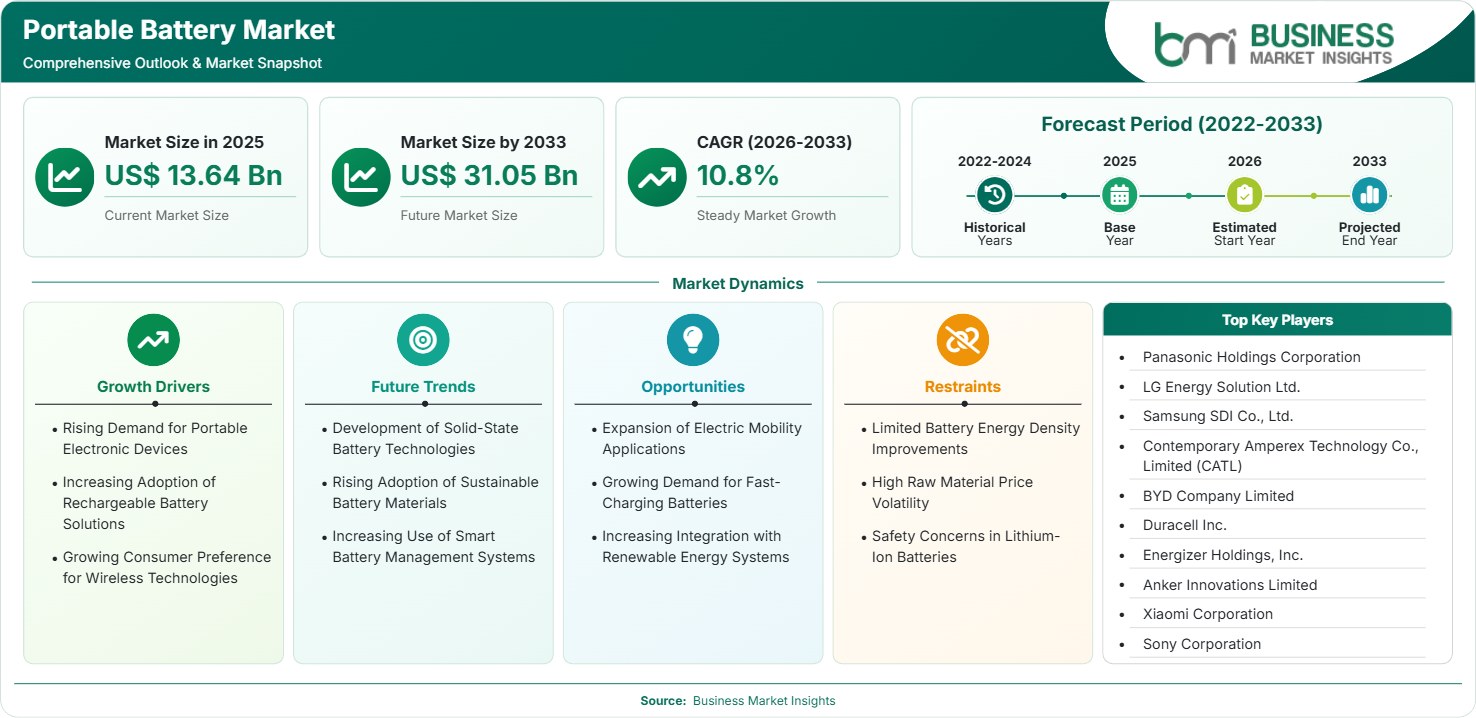
The Portable Battery Market size was valued at US$ 13.64 Billion in 2025 and is projected to reach US$ 31.05 Billion by 2033, growing at a CAGR of 10.8% during 2026–2033. Rising adoption of portable consumer electronics, increasing demand for rechargeable energy storage solutions, and expanding wireless device ecosystems are driving market growth, while fast-charging technologies and renewable energy integration continue creating significant long-term opportunities.

Report Coverage
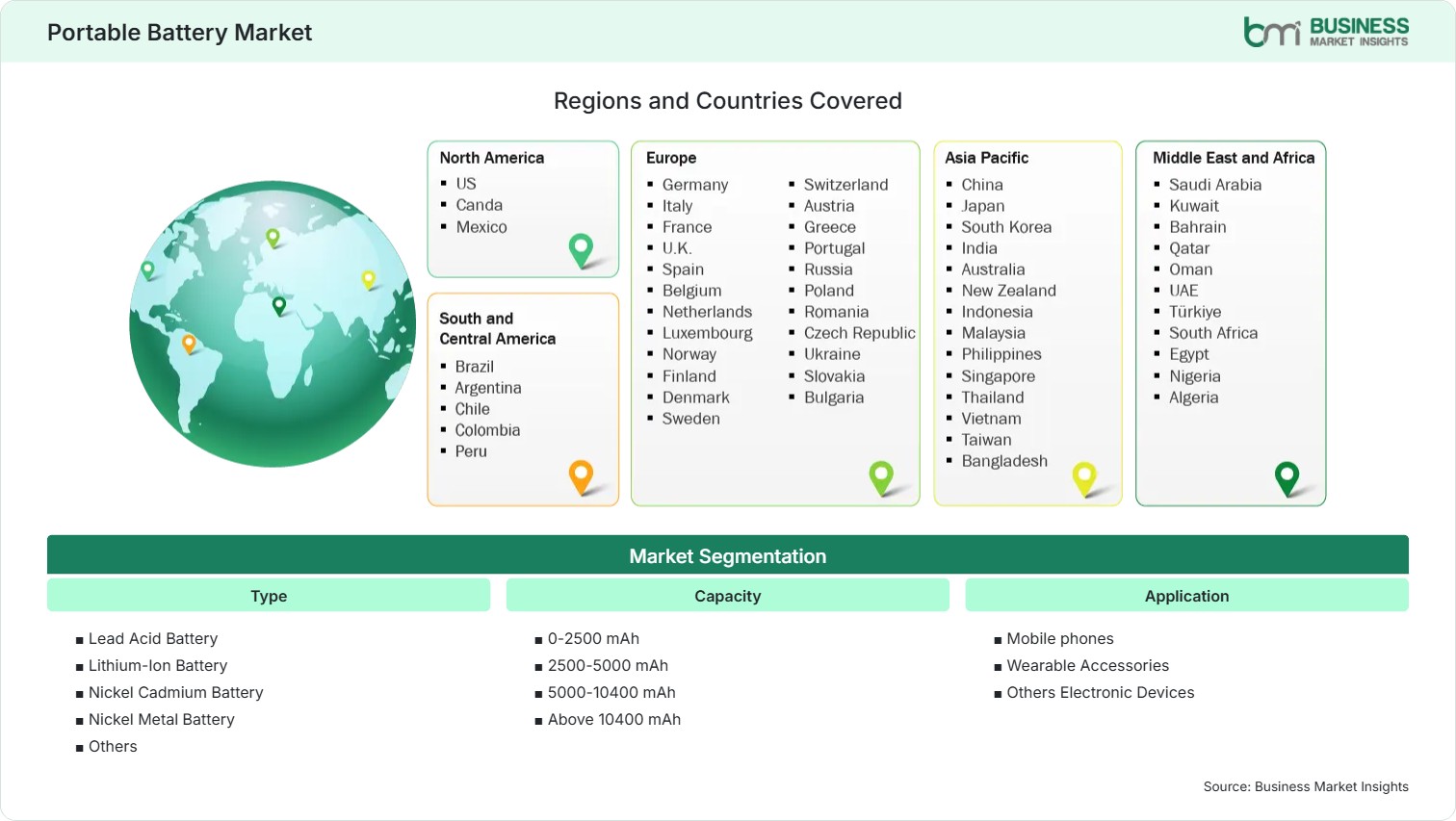
  • Type: Lead Acid Battery, Lithium-Ion Battery, Nickel Cadmium Battery, Nickel Metal Battery, Others
  • Capacity: 0-2500 mAh, 2500-5000 mAh, 5000-10400 mAh, Above 10400 mAh
  • Application: Mobile phones, Wearable Accessories, Others Electronic Devices
US$ 13.64 Bn Market size in 2025
US$ 31.05 Bn Market Size by 2033
10.8% CAGR, 2026 - 2033
2026-2033 Forecast Period

01 AI Overview

Portable Battery Market Summary

  • North America Region: North America holds a market share of 24%–27% in 2025 and is projected to grow at a CAGR of 10.2%–10.7% during 2026–2033, supported by increasing demand for consumer electronics, portable medical devices, and premium rechargeable battery technologies. The U.S. Portable Battery market is expected to expand at a CAGR of 10.4%–10.9%, driven by strong adoption of wireless electronics and smart devices.
  • Fastest Growing Region: Asia Pacific accounts for 46%–49% of the market in 2025 and is expected to register a CAGR of 11.4%–11.9% through 2026–2033, supported by expanding electronics manufacturing, rising smartphone penetration, and increasing battery production investments.
  • Leading Segment: Lithium-Ion Battery accounts for 58%–61% of market revenue in 2025 while growing at a CAGR of 11.1%–11.6%, driven by high energy density, longer lifecycle, and widespread adoption across portable electronic devices.
  • High Growth Segment: Mobile Phones holds 42%–45% of the market in 2025 and is anticipated to expand at a CAGR of 11.3%–11.8%, supported by increasing global smartphone shipments and growing consumer demand for extended battery life.
  • Key Market Opportunity: Growing adoption of fast-charging battery technologies, energy-efficient portable electronics, and battery-powered mobility solutions continues creating substantial opportunities for advanced rechargeable battery manufacturers.
  • Major Market Players: Panasonic Holdings Corporation, LG Energy Solution Ltd., Samsung SDI Co., Ltd., Contemporary Amperex Technology Co., Limited (CATL), BYD Company Limited, Duracell Inc., Energizer Holdings, Inc., Anker Innovations Limited, Xiaomi Corporation, Sony Corporation.
02 Strategic Insights

Portable Battery Market: Strategic Insights

Portable Battery Market Strategic Framework
FREE PDF
Request your free sample
Request free sample
03 Stakeholder View

Key Takeaways

  • Battery manufacturers are increasingly localizing production and raw material sourcing to improve supply chain resilience and reduce dependence on geographically concentrated mineral supplies.
  • Smartphones, wearable electronics, portable medical equipment, and wireless accessories continue representing the highest-value application areas for advanced rechargeable batteries.
  • Product innovation is increasingly focused on silicon-anode materials, solid-state battery development, ultra-fast charging capabilities, and enhanced battery management systems.
  • Asia Pacific remains the strongest investment destination owing to its integrated battery manufacturing ecosystem, electronics production leadership, and expanding domestic consumer markets.
  • Strategic partnerships between battery manufacturers, consumer electronics companies, and material suppliers continue accelerating commercialization of next-generation portable battery technologies.
04 Geographic Outlook

Portable Battery Market Regional Highlights

North America Portable Battery Market

North America accounted for 24%–27% of the global market in 2025 and is projected to expand at a CAGR of 10.2%–10.7% during 2026–2033. Strong demand for smartphones, wearable electronics, portable medical devices, and premium consumer electronics continues supporting regional growth. The Portable Battery Market share remains robust owing to increasing adoption of rechargeable batteries and advancements in battery management technologies across multiple consumer and industrial applications.

  • The United States continues leading regional demand through strong consumer electronics sales, growing adoption of wireless devices, and increasing investments in domestic battery manufacturing.
  • Rising demand for portable healthcare equipment and smart wearable devices continues driving consumption of high-performance lithium-ion batteries across healthcare and consumer markets.
  • Expansion of data centers, IoT devices, and portable industrial equipment further supports demand for reliable rechargeable battery technologies.
  • Manufacturers continue investing in advanced battery chemistries, fast-charging technologies, and improved battery safety features to strengthen competitive positioning.
  • Growing sustainability initiatives are encouraging battery recycling programs and the adoption of environmentally responsible manufacturing practices.

US Portable Battery Market

The United States represented 20%–23% of the global market in 2025 and is anticipated to grow at a CAGR of 10.4%–10.9% through 2026–2033. Increasing adoption of premium smartphones, connected devices, wearable electronics, and portable healthcare equipment continues driving Portable Battery Market growth while strengthening domestic demand for advanced rechargeable battery technologies.

  • Consumer preference for wireless lifestyles continues accelerating replacement demand for rechargeable batteries across multiple electronic product categories.
  • Expansion of portable medical monitoring devices and home healthcare technologies strengthens battery demand across the healthcare sector.
  • Growing investments in battery research continue supporting commercialization of higher energy density and faster-charging battery technologies.
  • Government initiatives supporting domestic battery production and supply chain resilience continue encouraging investments across the battery manufacturing ecosystem.

Europe Portable Battery Market

Europe held 21%–24% of global revenue in 2025 and is expected to register a CAGR of 10.3%–10.8% during 2026–2033. Increasing sustainability regulations, growing rechargeable battery adoption, and expanding consumer electronics demand continue supporting market expansion. Germany remains the leading regional market, while Poland is projected to register the fastest growth during the forecast period.

  • Germany leads regional battery demand through advanced consumer electronics markets, automotive battery innovation, and increasing investments in battery manufacturing facilities.
  • Poland is projected to expand at a CAGR of 11.0%–11.5%, supported by growing battery production investments and expanding electronics manufacturing capacity.
  • France and Italy continue increasing adoption of rechargeable batteries across consumer electronics, healthcare devices, and industrial portable equipment.
  • The European Battery Regulation continues encouraging sustainable battery manufacturing, recycling, and circular economy initiatives throughout the region.
  • Growing renewable energy storage integration further strengthens demand for advanced rechargeable battery technologies.

Asia Pacific Portable Battery Market

Asia Pacific accounted for 46%–49% of global revenue in 2025 and is projected to register the fastest CAGR of 11.4%–11.9% during 2026–2033. The region benefits from extensive battery manufacturing capacity, expanding smartphone production, increasing consumer electronics demand, and strong government support for advanced battery technologies. China remains the leading regional market, while India represents the fastest-growing country.

  • China dominates global battery production through integrated supply chains, large-scale lithium-ion manufacturing, and extensive consumer electronics production.
  • India is projected to register a CAGR of 11.8%–12.3%, supported by increasing smartphone penetration, electronics manufacturing expansion, and government production-linked incentive programs.
  • Japan and South Korea continue leading innovation in advanced battery chemistries, high-performance materials, and next-generation portable energy storage technologies.
  • Rapid expansion of wearable electronics and IoT ecosystems continues accelerating demand for compact, high-capacity rechargeable batteries.
  • Battery manufacturers continue expanding production facilities to meet increasing domestic and international demand for lithium-ion battery solutions.

Rest of World Portable Battery Market

The Rest of the World accounted for 6%–8% of global market revenue in 2025 and is expected to expand at a CAGR of 9.8%–10.3% during 2026–2033. Market growth is supported by increasing smartphone adoption, improving digital connectivity, and expanding consumer electronics sales across South & Central America and the Middle East & Africa.

Increasing investments in telecoms infrastructure, digital transformation programs, and mobile health technologies continue to offer fresh opportunities for rechargeable battery manufacturers in developing countries, where demand for consumer electronic devices is rising.

  • Brazil remains the leading South & Central American market through increasing consumer electronics adoption and expanding retail distribution networks.
  • Saudi Arabia continues to strengthen battery demand through digital transformation initiatives and expanding smart device adoption.
  • The UAE encourages market development through the rising demand for premium electronics and investment in smart city technologies.
  • New e-commerce platforms are helping more consumers purchase rechargeable batteries and portable chargers
  • Rising adoption of portable electronic devices among younger populations continues supporting sustained long-term market demand.
Global Market Geography
FREE PDF
Request your free sample
Request free sample
05 Segment Analysis

Portable Battery Market Segmentation

Type

The Lithium-Ion Battery segment holds 58% to 61% share in 2025 and will grow with a CAGR of 11.1% to 11.6% from 2026 to 2034. Better power density, extended cycle life, compact size, and fast-charge capability make them popular in consumer electronics, portable medical devices, and smart wearables. The portable battery market scope is expanding due to manufacturers' development of efficient lithium-chemistry-based batteries.

  • Lead Acid Battery: Lead acid batteries continue serving cost-sensitive portable backup applications owing to proven reliability, mature manufacturing processes, and widespread availability despite lower energy density compared to modern rechargeable technologies.
  • Lithium-Ion Battery: Lithium-ion batteries dominate the market through superior energy density, lightweight construction, extended cycle life, and compatibility with smartphones, laptops, wearable devices, and portable electronics.
  • Nickel Cadmium Battery: Nickel cadmium batteries remain utilized in specialized industrial and emergency backup applications requiring dependable performance, high discharge rates, and operation under demanding environmental conditions.
  • Nickel Metal Battery: Nickel metal batteries continue supporting portable electronics and rechargeable consumer products by offering improved capacity, environmental advantages, and longer operational life than conventional nickel cadmium batteries.
  • Others: Other battery technologies include lithium polymer, zinc-air, alkaline rechargeable, and emerging solid-state batteries developed for niche portable electronic and specialty industrial applications.

Capacity

The 2500-5000 mAh segment accounted for 36%-39% of the overall market in 2025 and is expected to grow at a CAGR of 10.9%-11.4% from 2026 to 2034. The reason for the extensive use of this range of capacities is that it offers the best combination of operating time, small size, and charging efficiency.

  • 0–2500 mAh: Batteries within this capacity range are widely used in wearable electronics, wireless earbuds, smart sensors, and compact consumer devices requiring lightweight portable power solutions.
  • 2500–5000 mAh: This capacity category supports mainstream smartphones, portable healthcare equipment, and handheld electronics requiring extended battery life without significantly increasing device size or weight.
  • 5000–10,400 mAh: Batteries in this range increasingly power tablets, portable gaming consoles, rugged handheld devices, and premium power banks requiring longer operational duration.
  • Above 10,400 mAh: High-capacity batteries primarily serve portable power stations, high-capacity power banks, industrial equipment, and professional electronic devices requiring prolonged off-grid operation.

Application

The Mobile Phones segment accounted for 42%–45% of global revenues in 2025 and is expected to exhibit the fastest CAGR of 11.3%–11.8% from 2026 to 2034. Steady innovation in smartphones, growth in 5G usage, larger display screens, and consumer demand for longer battery life have been driving demand for superior batteries.

  • Mobile Phones: Mobile phones remain the largest application owing to continuous smartphone shipments, increasing battery capacity requirements, fast-charging adoption, and growing premium device penetration worldwide.
  • Wearable Accessories: Smartwatches, fitness trackers, wireless earbuds, and health monitoring devices continue increasing battery demand through miniaturization, enhanced connectivity, and extended operating time requirements.
  • Other Electronic Devices: Other electronic devices include tablets, digital cameras, portable gaming systems, medical equipment, Bluetooth speakers, and handheld industrial devices utilizing rechargeable battery technologies.
06 Market Forces

Portable Battery Market Dynamics

Key Market Drivers

Rising Demand for Portable Electronic Devices

The global consumption of batteries is expected to increase rapidly owing to the growing usage of smartphones, tablets, wearables, wireless earphones, laptops, gaming consoles, and health monitors, among others. Various companies are developing high-capacity, safe batteries that charge quickly and have longer life cycles for power-hungry applications. Rising digitalization, expanding connected device ecosystems, and growing dependence on mobile technologies continue supporting market growth, while evolving Portable Battery Market trends indicate sustained innovation in battery chemistry, miniaturization, and energy efficiency.

Increasing Adoption of Rechargeable Battery Solutions

Disposable batteries are being replaced by rechargeable batteries by both consumers and industries, as they offer higher cost-effectiveness and efficiency, and have environmental advantages as well. Lithium-ion batteries remain the dominant rechargeable battery technology due to their higher energy density, longer lifespan, and lower maintenance requirements. Environmental policies, battery recycling programs, and increased environmental awareness further encourage widespread adoption across consumer electronics, medical devices, industrial equipment, and portable energy storage applications.

Growing Consumer Preference for Wireless Technologies

Rapid deployment of wireless consumer electronic devices such as Bluetooth products, smart home gadgets, wearables, and portable entertainment devices has led to increased demand for small, lightweight, high-performance rechargeable batteries. With advancements in wireless technology standards, fast charging, and battery management systems, long battery runtime is achieved through smaller devices. Consumer demand for mobility and convenience is driving battery development.

Key Market Opportunities

Expansion of Electric Mobility Applications

The growing use of electric bicycles, electric scooters, mobile batteries, and light electric vehicles will present significant business opportunities for portable battery manufacturers. Batteries with high performance, improved energy density, and fast-charging capabilities will be key to the future of mobility. Consistent efforts to develop new batteries and energy storage systems will support positive Portable Battery Market forecasts, thereby motivating companies to expand production capacity and develop innovative lithium-ion battery platforms tailored for portable mobility applications.

Growing Demand for Fast-Charging Batteries

There is a growing expectation among consumers that their electronic devices offer long battery life and shorter charging times. For that reason, there is an increased need for high-speed battery charging technology. There are efforts by battery makers toward silicon-anode materials, improved electrolyte solutions, improved thermal management techniques, and software for battery management. Fast charging technology is being rapidly commercialized for smartphones, laptops, wearables, and power banks, and continues creating attractive opportunities for battery suppliers and consumer electronics manufacturers.

Increasing Integration with Renewable Energy Systems

Portable and rechargeable batteries are finding applications with residential solar energy systems, portable energy storage systems, mobile power packs, and emergency backups. Consumer demand for dependable off-grid energy, disaster relief, and green energy storage is expanding the range of applications for modern portable batteries. Advancements in battery efficiency, charging capability, and lifespan continue to drive their adoption in the renewable energy industry, creating profitable business opportunities for battery makers.

Market Restraints and Challenges

Limited Battery Energy Density Improvements

Factor: Although lithium-ion technology continues advancing, improvements in energy density have become increasingly incremental due to material limitations, safety considerations, and electrochemical constraints. Impact: Due to low energy density, there are limitations in operation times, miniaturization, and performance of future portable electronics; hence, there is a need for manufacturers to invest significant effort in developing solid-state batteries, silicon-anode batteries, and new battery technologies.

High Raw Material Price Volatility

Factor: Portable battery production depends on critical minerals, including lithium, cobalt, nickel, graphite, and manganese, whose prices fluctuate due to mining constraints, geopolitical risks, and supply-demand imbalances. Impact: Price fluctuations in raw materials lead to higher production costs, reduced profit margins, and unpredictable pricing for electronic device manufacturers. Therefore, battery manufacturers are still working to diversify their supply chains, develop battery recycling technologies, and identify new material chemistries.

07 Company Analysis

Competitive Landscape

The Portable Battery Market analysis reveals that dominant firms are focusing on enhancing their raw material procurement processes, developing new battery chemistry technologies, and forging strategic collaborations with consumer electronics firms to improve their performance.

Company Name

Overview

Products and Services Relevant to this Market

Panasonic Holdings Corporation

Global electronics and energy technology company with extensive expertise in rechargeable battery manufacturing.

Lithium-ion batteries, rechargeable battery cells, portable energy storage solutions, consumer batteries, and battery management technologies.

LG Energy Solution Ltd.

Leading global battery manufacturer supplying advanced rechargeable batteries for consumer electronics and mobility applications.

Lithium-ion batteries, cylindrical cells, pouch cells, battery modules, and energy storage technologies.

Samsung SDI Co., Ltd.

Global advanced battery producer specializing in high-performance rechargeable batteries and energy storage systems.

Lithium-ion batteries, portable device batteries, battery packs, energy storage systems, and advanced battery materials.

Contemporary Amperex Technology Co., Limited (CATL)

One of the world's largest battery manufacturers focused on advanced lithium battery technologies.

Lithium-ion battery cells, battery systems, rechargeable batteries, energy storage products, and battery technologies.

BYD Company Limited

Diversified technology company producing rechargeable batteries, consumer electronics components, and energy storage solutions.

Rechargeable batteries, lithium-ion cells, battery packs, portable power solutions, and energy storage technologies.

Duracell Inc.

Global battery manufacturer recognized for consumer portable batteries and long-lasting power solutions.

Rechargeable batteries, alkaline batteries, specialty batteries, portable charging products, and consumer power solutions.

Energizer Holdings, Inc.

Leading global battery company serving consumer electronics and portable power markets worldwide.

Rechargeable batteries, alkaline batteries, specialty batteries, portable chargers, and battery accessories.

Anker Innovations Limited

Consumer electronics company specializing in portable charging technologies and advanced battery-powered accessories.

Power banks, portable chargers, lithium-ion battery products, charging accessories, and fast-charging technologies.

Xiaomi Corporation

Global consumer electronics manufacturer offering smartphones, portable charging devices, and connected electronics.

Power banks, rechargeable batteries, smartphones, charging accessories, and smart consumer electronic devices.

Sony Corporation

Global technology company with expertise in advanced battery technologies and portable electronic products.

Rechargeable lithium-ion batteries, consumer electronics batteries, portable energy solutions, and battery technologies.

08 Industry Activity

Recent Developments

February 2025

Samsung SDI Co., Ltd. announced to showcase a wide range of next-generation battery products and innovations under the slogan “InCelligent Life, upgrading daily lives with battery technologies.

January 2025

Anker Innovations Limited expanded its portable charging product portfolio with new power bank solutions incorporating higher-capacity batteries, advanced charging technologies, and improved safety features for consumer electronics users.

September 2024

LG Energy Solution Ltd. began production of advanced cylindrical 4680 battery cells at its Ochang facility in South Korea, expanding next-generation cylindrical battery manufacturing capabilities for electric mobility and high-performance applications.

April 2024

Panasonic Holdings Corporation established a new battery technology development facility in Japan to strengthen research and development capabilities for next-generation lithium-ion batteries, focusing on improving battery performance, manufacturing processes, and energy storage solutions.

10 Trust & Transparency

Research Methodology

The market analysis combines proprietary research with secondary data from government agencies, company disclosures, regulatory filings, industry databases and expert interviews. Market estimates are validated through data triangulation, cross-market benchmarking and analyst review.

View Full Research Methodology

11 Questions Answered

Frequently Asked Questions

How does the Pet Food Extrusion Report evaluate market opportunities?

The Pet Food Extrusion Market Report evaluates growth opportunities through analysis of equipment innovation, product trends, pet ownership patterns, regional manufacturing expansion, and evolving consumer nutrition preferences.

How are manufacturers improving extrusion sustainability?

Companies are adopting energy-efficient equipment, automated process controls, optimized production methods, and improved resource management practices to reduce operating costs and environmental impact.

Which product categories offer strong future opportunities?

Premium dry-kibble, functional treats, veterinary diets, and customized nutrition products offer strong opportunities as consumers increasingly prioritize pet wellness and specialized feeding solutions.

Why is twin-screw extrusion gaining importance in pet food production?

Twin-screw extrusion provides improved mixing capability, processing flexibility, and better handling of complex formulations containing functional ingredients, alternative proteins, and specialized nutritional components.

What factors are increasing demand for pet food extrusion technology?

Rising pet ownership, premium nutrition demand, functional ingredient adoption, and increasing production requirements are encouraging manufacturers to invest in advanced extrusion systems that improve efficiency and product diversity.

Access the Full Portable Battery Market Report

Get segment-level forecasts, regional estimates, competitive benchmarking, company profiles and downloadable Excel datasets.

Access the full Portable Battery Market Report
350 pages PDF & Excel | 2026-08-03