Military Battery Market Outlook: Size, Share, Trends, Growth Analysis, Competitive Landscape & Forecast, 2026-2033

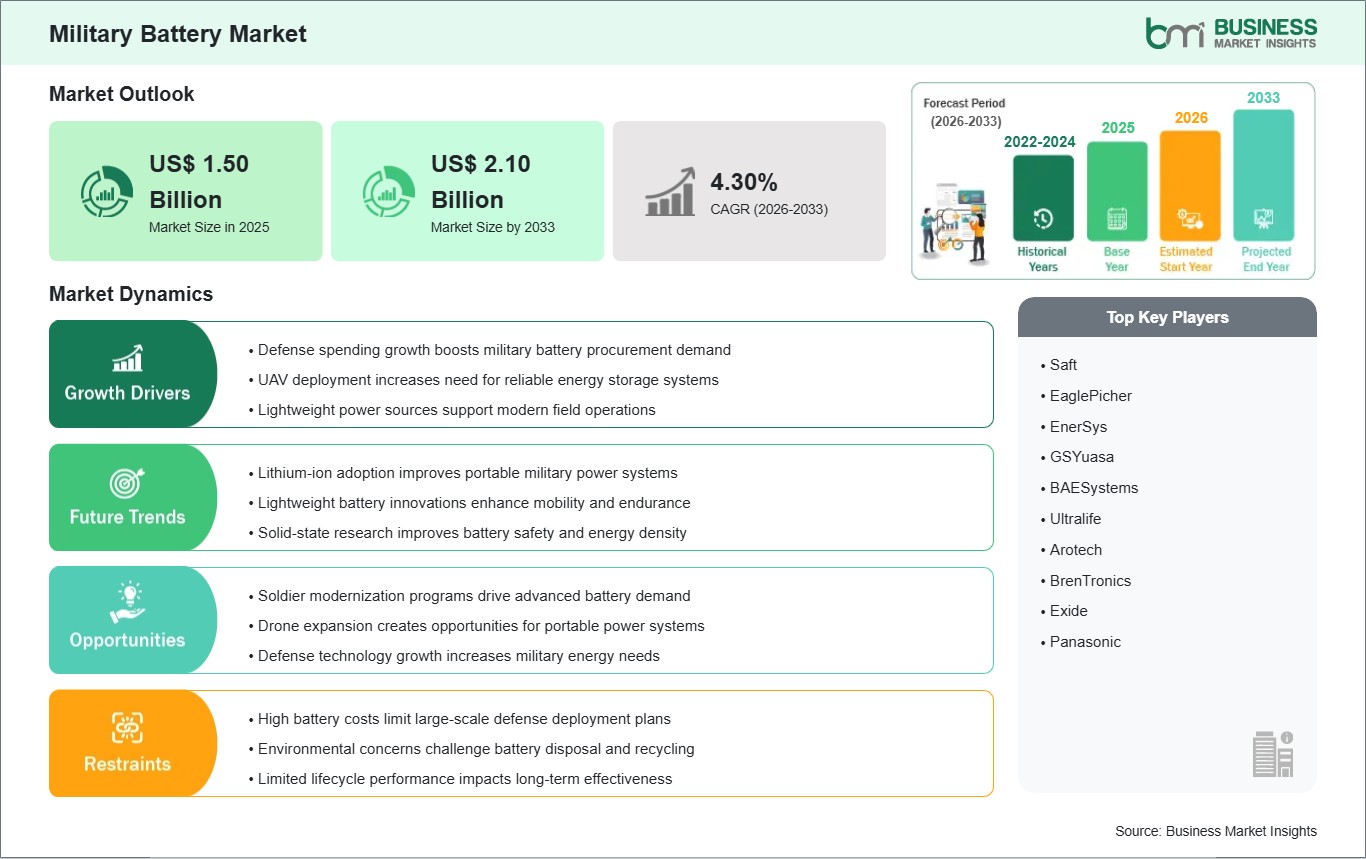
The Military Battery market size is expected to reach US$ 2.10 billion by 2033 from US$ 1.50 billion in 2025. The market is estimated to record a CAGR of 4.30% from 2026 to 2033.

Report Coverage
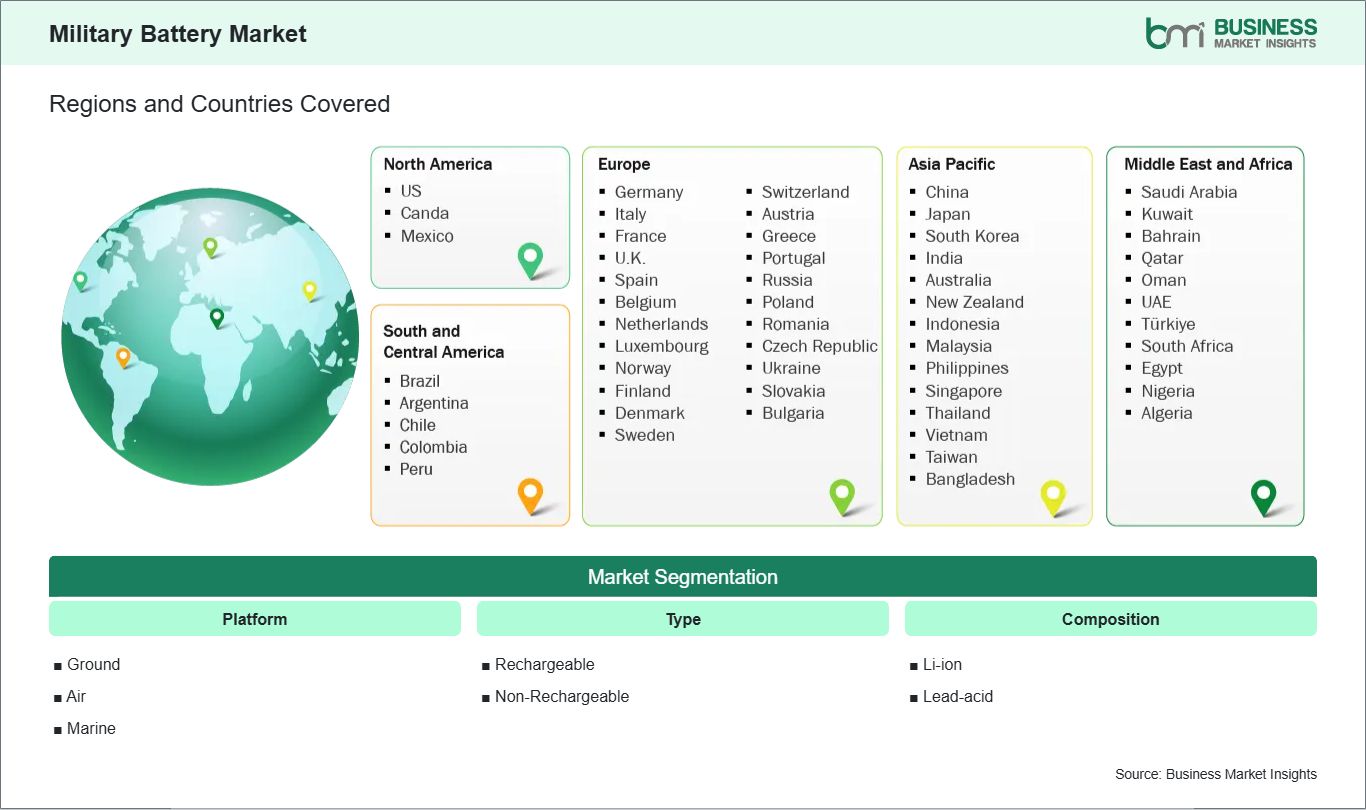
  • Platform: Ground, Air, Marine
  • Type: Rechargeable, Non-Rechargeable
  • Composition: Li-ion, Lead-acid
US$ 1.50 Bn Market size in 2025
US$ 2.10 Bn Market Size by 2033
4.30% CAGR, 2026 - 2033
2026-2033 Forecast Period

01 Market Summery

Executive Summary and Global Market Analysis

Electrochemical power systems designed for defense use provide portable, vehicular, and mission-specific energy storage under demanding operating conditions. These systems support communications, surveillance, propulsion support, and critical electronics across land, airborne, and naval platforms. Their design prioritizes durability, energy density, safety, and operational continuity in environments where reliability directly affects mission effectiveness.

Procurement priorities across defense organizations increasingly favor power solutions that reduce logistical burden and support longer operational windows. Electrified subsystems, portable mission equipment, and silent-watch requirements have intensified the need for batteries with higher endurance and lower maintenance profiles. This transition has encouraged wider integration of advanced battery technologies within security and defense infrastructure.

Segment analysis indicates ground platforms retain broad relevance because they support tactical vehicles, soldier systems, and deployable equipment. Air and marine platforms require specialized battery configurations adapted to vibration, weight, and environmental exposure constraints. Rechargeable formats show stronger alignment with recurring-use applications, while non-rechargeable units remain essential where long shelf life and immediate readiness are prioritized. Composition trends continue to favor lithium-ion solutions for energy efficiency, while lead-acid retains utility in established military power architectures.

Technology progression is centered on lightweight materials, thermal stability, intelligent battery management, and improved charge-discharge performance. Design refinements now emphasize ruggedized enclosures, faster field charging, and enhanced lifecycle control. These developments strengthen operational adaptability while supporting compact form factors required in mobile and mission-critical systems.

02 Strategic Insights

Military Battery Market: Strategic Insights

military-battery-market-market-strategic-framework
FREE PDF
Request your free sample
Request free sample
03 Segment Analysis

Military Battery Market Segmentation

The market is segmented based on platform, type, and composition requirements.

By Process

  • Ground - Supports tactical vehicles, portable systems, and field-deployed defense electronics
  • Air - Requires lightweight configurations suited to airborne mission environments
  • Marine - Operates under corrosive conditions and extended endurance expectations

By Type

  • Rechargeable - Fits repeated-use missions requiring field charging and lifecycle efficiency
  • Non-Rechargeable - Suits reserve power roles demanding long storage stability

By Composition

  • Li-ion - Delivers higher energy density with weight-saving advantages
  • Lead-acid - Maintains relevance in proven configurations requiring dependable power delivery
04 Market Forces

Military Battery Market Drivers and Opportunities

Mission electrification increasing field power requirements

Modern defense systems incorporate more sensors, communications modules, navigation units, and electronic mission aids than previous generations. This expansion raises onboard and portable power requirements across operational scenarios. As forces deploy more connected equipment, battery systems must deliver dependable energy under repeated cycling, temperature variation, shock exposure, and prolonged mission conditions without adding operational complexity.

This need influences procurement and design priorities throughout the defense supply chain. Power systems now receive greater technical scrutiny because endurance affects mobility, readiness, and maintenance planning. As military programs integrate more electronics into platforms and soldier kits, battery solutions with efficient charging, high durability, and lower weight become more relevant to mission planning and operational resilience.

Advanced chemistries creating longer-duration deployment options

Progress in battery chemistry and power management is opening new opportunities for extended mission support. Improved cell design, thermal control, and intelligent monitoring allow energy systems to operate more efficiently across demanding duty cycles. These enhancements suit applications where portable power, silent operation, and reduced replacement frequency improve battlefield flexibility and simplify logistical support.

Future opportunity is tied to broader platform modernization and the increasing use of unmanned and networked defense systems. Energy storage architectures that combine endurance, safety, and compact design can support this shift effectively. As deployment requirements become more complex, advanced battery solutions will gain stronger positioning in programs seeking lighter equipment, better energy utilization, and improved operational persistence.

05 Size and Share Analysis

Military Battery Market Size and Share Analysis

The Military Battery Market was valued at US$ 1.50 Billion in 2025 to reach US$ 2.10 Billion by 2033, at a CAGR of 4.30% from 2026 to 2033. This progression reflects measured expansion tied to modernization cycles, portable power requirements, and continued replacement of legacy energy systems. The industry remains specialized, with growth shaped by defense procurement timelines and qualification requirements.

Segment positioning indicates ground platforms hold a central role because they encompass tactical mobility systems, portable equipment, and field communications. Rechargeable products are steadily advancing in prominence where repeated deployment and lifecycle efficiency matter most. Non-rechargeable units remain strategically relevant for reserve applications demanding instant readiness and long storage integrity.

From an application perspective, battlefield electronics and vehicle support functions continue to anchor utilization across defense programs. Airborne and marine use cases require highly specialized performance characteristics, but land-based deployment remains the broadest operating environment. This pattern reinforces sustained interest in battery systems that balance ruggedness, portability, and dependable energy delivery.

06 Report Highlights

Military Battery Market Report Highlights

Report Attribute Details
Market size in 2025 US$ 1.50 Billion
Market Size by 2033 US$ 2.10 Billion
Global CAGR (2026 - 2033)4.30%
Historical Data 2022-2024
Forecast period 2026-2033
Segments Covered By Platform
  • Ground
  • Air
  • Marine
By Type
  • Rechargeable
  • Non-Rechargeable
By Composition
  • Li-ion
  • Lead-acid
Regions and Countries Covered
North America US, Canada, Mexico
Europe Germany, Italy, France, U.K., Spain, Belgium, Netherlands, Luxembourg, Norway, Finland, Denmark, Sweden, Switzerland, Austria, Greece, Portugal, Russia, Poland, Romania, Czech Republic, Ukraine, Slovakia, Bulgaria
Asia-Pacific China, Japan, South Korea, India, Australia, New Zealand, Indonesia, Malaysia, Philippines, Singapore, Thailand, Vietnam, Taiwan, Bangladesh
South and Central America Brazil, Argentina, Chile, Colombia, Peru
Middle East and Africa Saudi Arabia, United Arab Emirates, Kuwait, Bahrain, Qatar, Oman, Turkiye, South Africa, Egypt, Nigeria, Algeria
Market leaders and key company profiles
  • Saft
  • EaglePicher
  • EnerSys
  • GSYuasa
  • BAESystems
  • Ultralife
  • Arotech
  • BrenTronics
  • Exide
  • Panasonic
FREE PDF
Request your free sample
Request free sample
07 Report Coverage

Military Battery Market Report Coverage and Deliverables

The "Military Battery Market Size and Forecast (2022-2033)" report provides a detailed analysis of the market covering below areas:

  • Market size and forecast at global, regional, and country levels for all market segments covered under the scope
  • Market trends, as well as drivers, restraints, and opportunities
  • Market analysis covering key trends, global and regional framework, major players, regulations, and recent developments
  • Industry landscape and competition analysis covering market concentration, heat map analysis, prominent players, and recent developments for the market
  • Detailed company profiles, including SWOT analysis
08 Geographic Insights

Military Battery Market Geographic Insights

The Military Battery market shows diverse regional adoption patterns influenced by defense modernization priorities, procurement structures, platform mix, and operational doctrine. Countries with mature defense ecosystems emphasize qualified, high-reliability energy systems, while developing programs focus on practical deployment, lifecycle management, and interoperability. Across the global landscape, energy storage decisions increasingly reflect mission endurance requirements, logistics simplification goals, and the electrification of critical subsystems within tactical and support platforms.

North America demonstrates a highly structured environment shaped by established defense contractors, demanding technical standards, and sustained investment in next-generation warfighting capabilities. Procurement attention extends beyond battery capacity toward ruggedization, charging architecture, and integration with portable electronics and tactical vehicles. This regional profile supports continuous refinement of rechargeable and reserve power solutions tailored to mission readiness, training requirements, and long-term sustainment planning.

Asia Pacific reflects expanding deployment patterns linked to force modernization, border security requirements, and regional investment in indigenous defense production. Military planners in this region increasingly value compact and efficient power systems that reduce equipment burden while supporting connected operational frameworks. Ground and naval applications remain especially relevant, with procurement strategies often favoring durable solutions capable of operating across diverse climates, mobility conditions, and extended operational tempos.

Europe maintains a disciplined procurement approach centered on interoperability, mission flexibility, and compliance with strict technical qualifications. Regional programs frequently prioritize batteries that align with soldier modernization, vehicle electronics, and portable communications requirements. Beyond Europe, emerging markets in the Middle East, Africa, and South America are strengthening defense capabilities through selective upgrades, creating opportunities for robust battery systems that combine reliability, manageable maintenance, and operational suitability for challenging field conditions.

global-market-geography
FREE PDF
Request your free sample
Request free sample
09 Report Guidance

Military Battery Market Report Guidance

  • The report includes qualitative and quantitative data in the market across process, type, composition, and geography.
  • The report starts with the key takeaways (chapter 2), highlighting the key trends and outlook of the market.
  • Chapter 3 focuses on the research methodology of the study.
  • Chapter 4 includes ecosystem analysis.
  • Chapter 5 highlights the major industry dynamics in the market, including factors that are driving the market, prevailing deterrents, potential opportunities, as well as future trends. Impact analysis of these drivers and restraints is also covered in this section.
  • Chapter 6 discusses the market scenario, in terms of historical market revenues, and forecast till the year 2033.
  • Chapters 7 to 10 cover market segments by process, type, composition, and geography across North America, Europe, Asia Pacific, Middle East and Africa, and South and Central America. They cover the market revenue, forecast, and factors driving the market.
  • Chapter 11 describes the competitive analysis along with the heat map analysis for the key players operating in the market.
  • Chapter 12 describes the industry landscape analysis. It provides detailed descriptions of business activities such as market initiatives, new developments, mergers, and joint ventures globally, along with a competitive landscape.
  • Chapter 13 provides detailed profiles of the major companies operating in the market. Companies have been profiled on the basis of their key facts, business descriptions, products and services, financial overview, SWOT analysis, and key developments.
  • Chapter 14, i.e., the appendix, is inclusive of a brief overview of the company, list of abbreviations, and disclaimer.
10 Industry Activity

Recent Developments

The Military Battery market is evaluated by gathering qualitative and quantitative data post primary and secondary research, which includes important corporate publications, association data, and databases. Recent developments and news in the market include:

  • In September 2025, EnerSys launched HAWKER ARMASAFE iON-X 24-volt lithium-ion batteries for military vehicle applications, using Bren-Tronics expertise to support onboard electronics, silent watch operations, robotics, unmanned vehicles, and weapon systems.
  • In July 2024, EnerSys completed its acquisition of Bren-Tronics to expand its presence in critical defense applications and strengthen its military and lithium battery portfolio.
11 Trust & Transparency

Research Methodology

The market analysis combines proprietary research with secondary data from government agencies, company disclosures, regulatory filings, industry databases and expert interviews. Market estimates are validated through data triangulation, cross-market benchmarking and analyst review.

View Full Research Methodology

Key Sources Referred:

Industry reports covering defense energy storage systemsGovernment defense procurement and modernization dataElectrochemistry and battery engineering journalsCompany WebsitesCompany Annual ReportsCompany Investor Presentations

12 Questions Answered

Frequently Asked Questions

How big is the Military Battery Market?

The Military Battery Market is valued at US$ 1.50 Billion in 2025, it is projected to reach US$ 2.10 Billion by 2033.

What is the CAGR for Military Battery Market by (2026 - 2033)?

As per our report Military Battery Market, the market size is valued at US$ 1.50 Billion in 2025, projecting it to reach US$ 2.10 Billion by 2033. This translates to a CAGR of approximately 4.30% during the forecast period.

What segments are covered in this report?

The Military Battery Market report typically cover these key segments-

  • Platform (Ground, Air, Marine)
  • Type (Rechargeable, Non-Rechargeable)
  • Composition (Li-ion, Lead-acid)

What is the historic period, base year, and forecast period taken for Military Battery Market?

The historic period, base year, and forecast period can vary slightly depending on the specific market research report. However, for the Military Battery Market report:

  • Historic Period : 2022-2024
  • Base Year : 2025
  • Forecast Period : 2026-2033
Who are the major players in Military Battery Market?

The Military Battery Market is populated by several key players, each contributing to its growth and innovation. Some of the major players include:

  • Saft
  • EaglePicher
  • EnerSys
  • GSYuasa
  • BAESystems
  • Ultralife
  • Arotech
  • BrenTronics
  • Exide
  • Panasonic
Who should buy this report?

The Military Battery Market report is valuable for diverse stakeholders, including:

  • Investors: Provides insights for investment decisions pertaining to market growth, companies, or industry insights. Helps assess market attractiveness and potential returns.
  • Industry Players: Offers competitive intelligence, market sizing, and trend analysis to inform strategic planning, product development, and sales strategies.
  • Suppliers and Manufacturers: Helps understand market demand for components, materials, and services related to concerned industry.
  • Researchers and Consultants: Provides data and analysis for academic research, consulting projects, and market studies.
  • Financial Institutions: Helps assess risks and opportunities associated with financing or investing in the concerned market.

Essentially, anyone involved in or considering involvement in the Military Battery Market value chain can benefit from the information contained in a comprehensive market report.

Access the Full Military Battery Market Report

Get segment-level forecasts, regional estimates, competitive benchmarking, company profiles and downloadable Excel datasets.

Access the full Military Battery Market Report
400 pages PDF & Excel | 2026-06-24