Market Summary
Executive Summary and Global Market Analysis
Electric vehicle batteries are rechargeable systems that power both passenger and commercial vehicles. They are the main energy source, affecting how far a vehicle can go, how quickly it charges, its safety, and its overall efficiency. Ongoing advances in battery chemistry, manufacturing, and energy density have made these batteries even more important in the shift to electric vehicles.
As more electric vehicles are used around the world, the demand for advanced batteries keeps growing. Governments, car makers, and transport companies are focusing on electrification to cut emissions and use energy more efficiently. With more electric vehicles being made, battery companies are expanding and investing in new technologies to meet changing needs for performance and cost.
Demand for batteries differs by battery type, vehicle category, and propulsion system. Lithium-ion batteries are widely used because they perform well and are easy to produce at scale. Most batteries go into passenger cars, since these vehicles are made in large numbers. New developments in LFP and solid-state batteries are also drawing interest as companies look for better safety, lower costs, faster charging, and higher energy density.
Companies in the industry are competing by expanding production, developing new batteries, and improving supply chains. They are investing in advanced factories, better ways to get raw materials, and research into future battery technologies. Focusing on local production and building large battery plants is shaping how the global electric vehicle battery market will grow.
Segment Analysis
Electric Vehicle Battery Market Segmentation
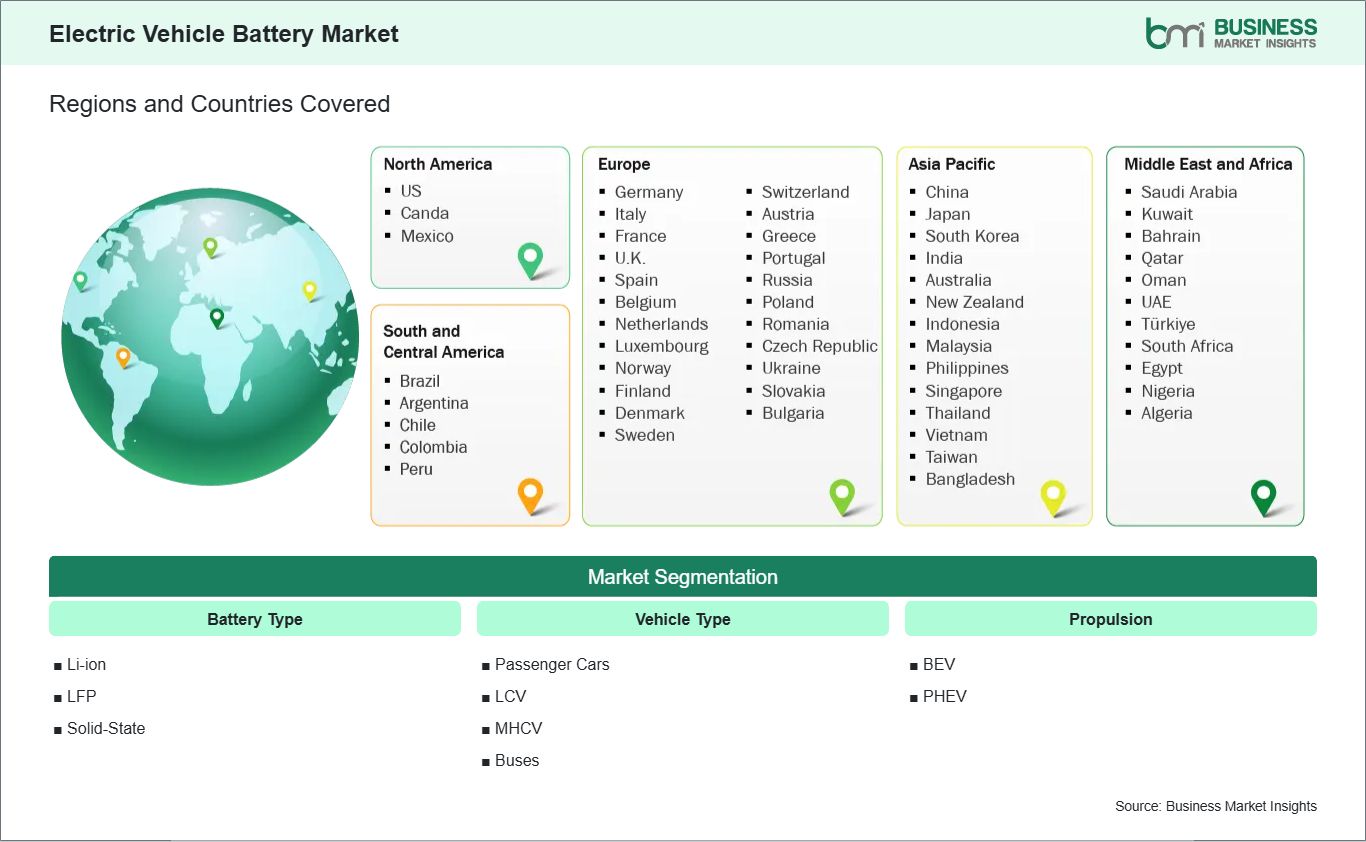
The electric vehicle battery market is segmented based on battery type, vehicle type, and propulsion, reflecting the growing demand for energy storage solutions across diverse electric mobility applications.
By Battery Type
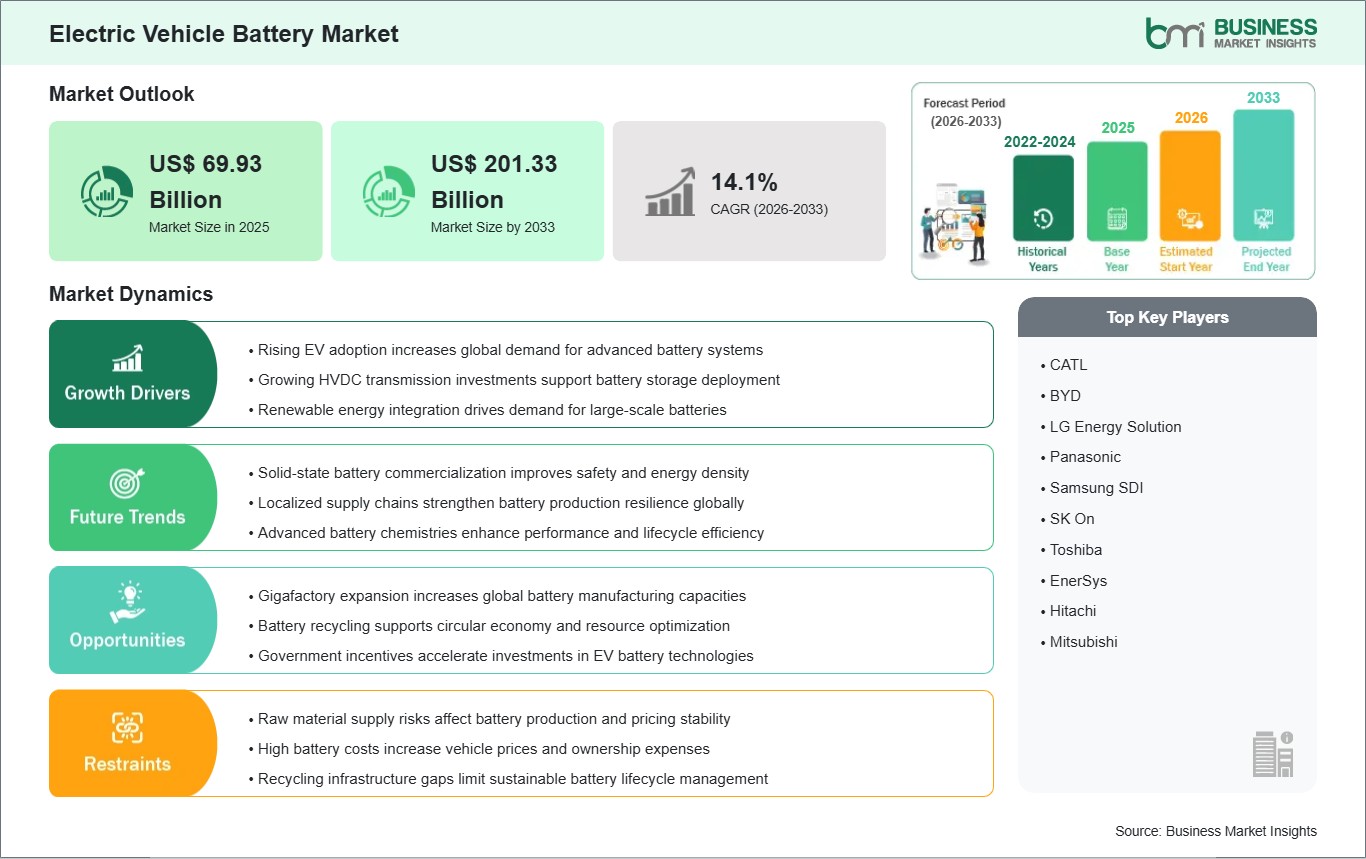
- Li-ion: Established manufacturing capabilities and balanced performance characteristics support widespread utilization across electric vehicles.
- LFP: Enhanced thermal stability and cost efficiency encourage adoption in high-volume vehicle production programs.
- Solid-State: Advanced energy density potential and safety advantages support long-term development and commercialization efforts.
By Vehicle Type
- Passenger Cars: Large-scale vehicle production and rising consumer adoption sustain substantial battery demand.
- LCV: Fleet electrification initiatives encourage deployment across urban delivery and service transportation applications.
- MHCV: Increasing focus on sustainable freight transportation supports battery integration in heavy-duty vehicle platforms.
- Buses: Public transportation electrification programs strengthen demand for high-capacity battery systems.
By Propulsion
- BEV: Fully electric operation requires larger battery capacities, supporting significant battery consumption volumes.
- PHEV: Hybrid propulsion flexibility sustains demand for battery systems optimized for combined electric and conventional operation.
Market Forces
Electric Vehicle Battery Market Drivers and Opportunities
Rising EV adoption boosting demand
Expanding adoption of electric vehicles across passenger and commercial transportation segments is creating substantial demand for advanced battery technologies. Automakers are increasing production capacity and introducing new electric models to address evolving consumer preferences and regulatory requirements. This transition toward electrified mobility has elevated the importance of reliable, efficient, and scalable battery solutions capable of supporting diverse vehicle platforms.
Higher electric vehicle production directly translates into greater battery consumption across the automotive value chain. Manufacturers are responding through investments in capacity expansion, supply chain development, and battery innovation initiatives. As electrification strategies continue to gain momentum globally, battery demand remains closely linked to vehicle deployment trends and the broader transition toward sustainable transportation systems.
Expansion of giga-factories worldwide
The establishment of giga-factories across major automotive regions presents a significant opportunity for the electric vehicle battery industry. Large-scale manufacturing facilities enable higher production volumes, improved economies of scale, and greater supply chain efficiency. These investments are helping address growing battery demand while supporting localization strategies aimed at reducing logistical complexities and strengthening supply security.
Future expansion of giga-factory networks is expected to accelerate battery availability, encourage technological innovation, and improve manufacturing competitiveness. In addition, increased production capacity may also contribute to lower battery costs and broader accessibility of electric vehicles. Since both the government and other stakeholders want to maintain a competitive domestic battery manufacturing ecosystem, it is highly likely that gigafactories will continue to be a major factor in the future growth of the overall battery industry and a key building block of an improved battery supply chain.
Size and Share Analysis
Electric Vehicle Battery Market Size and Share Analysis
The electric vehicle battery market is projected to grow from US$ 69.93 billion in 2025 to US$ 201.33 billion by 2033, registering a CAGR of 14.1% from 2026 to 2033.
By battery type, the Li-ion segment accounts for a significant share due to its established manufacturing ecosystem, favorable energy density, and broad compatibility with electric vehicle platforms. Continuous technological improvements and extensive commercial deployment have reinforced its position as the preferred battery technology across the automotive industry.
By vehicle type, the passenger cars segment leads the market owing to large-scale electric vehicle production and expanding consumer adoption of battery-powered mobility solutions. Strong demand from personal transportation applications continues to drive substantial battery consumption across global automotive markets.
Report Coverage
Electric Vehicle Battery Market Report Coverage and Deliverables
The "Electric Vehicle Battery Market Size and Forecast (2022-2033)" report provides a detailed analysis of the market covering below areas:
- Market size and forecast at global, regional, and country levels for all key market segments covered under the scope
- Market trends, along with market dynamics such as drivers, restraints, and key opportunities
- Market analysis covering key trends, global and regional frameworks, major players, regulations, and recent developments
- Industry landscape and competitive analysis covering market concentration, heat map analysis, prominent players, and recent developments
- Detailed company profiles, including SWOT analysis
Geographic Insights
Electric Vehicle Battery Market Geographic Insights
The Electric Vehicle Battery market shows diverse regional adoption patterns influenced by electric vehicle production volumes, battery manufacturing investments, government policies, and supply chain development initiatives. Regional demand varies according to automotive industry maturity, electrification targets, and access to battery production infrastructure.
North America maintains strong market activity supported by increasing investments in domestic battery manufacturing, electric vehicle production expansion, and strategic supply chain localization efforts. Government incentives and industrial development programs continue to encourage battery ecosystem growth throughout the region.
Asia Pacific represents the largest concentration of battery production and electric vehicle manufacturing activity. Strong industrial capabilities, extensive supply chain networks, and substantial investments in battery technologies support widespread deployment across passenger and commercial vehicle applications. The region remains a major hub for battery innovation and capacity expansion.
Europe continues to witness significant market development driven by ambitious decarbonization goals, automotive electrification strategies, and investments in localized battery production facilities. Emerging markets across Latin America, the Middle East, and Africa are gradually strengthening their role in the battery value chain through resource development initiatives, industrial investments, and growing interest in electric mobility solutions.
Industry Activity
Recent Developments
The electric vehicle battery market is evaluated by gathering qualitative and quantitative data post primary and secondary research, which includes important corporate publications, association data, and databases. Recent developments and news in the market include:
- In March 2025, SK On and Nissan Motor Co. announced a battery supply agreement under which SK On will supply approximately 100 GWh of U.S.-manufactured batteries for Nissan's next-generation electric vehicles produced in North America from 2028 onward.
- In November 2025, Ascend Elements, a leader in engineered battery materials and lithium‑ion recycling, announces a multi‑year offtake agreement for lithium carbonate with Trafigura, a market leader in the global commodities industry. The agreement totals 15,000 metric tons (15 kilotons) to be delivered between 2027 and 2031.
- In April 2025, CATL announced the launch of its new Naxtra sodium-ion battery brand, with mass production scheduled for late 2025. The company also unveiled the second-generation Shenxing fast-charging EV battery capable of providing approximately 520 km of range from a five-minute charge.
Trust & Transparency
Research Methodology
The market analysis combines proprietary research with secondary data from government agencies, company disclosures, regulatory filings, industry databases and expert interviews. Market estimates are validated through data triangulation, cross-market benchmarking and analyst
review.
View Full Research Methodology
Key Sources Referred:
Society of Automotive Engineers Institute of Electrical and Electronics Engineers (IEEE) European Automobile Manufacturers' Association (ACEA) Japan Automobile Manufacturers Association (JAMA) China Association of Automobile Manufacturers (CAAM) Indian Automotive Component Manufacturers Association (ACMA) International Energy Agency (IEA) Electric Drive Transportation Association (EDTA) International Road Transport Union (IRU) Company Websites Company Annual Reports Company Investor Presentations