Market Summary
Executive Summary and Global Market Analysis
Energy storage systems using lithium sulfur chemistry are the next generation of rechargeable batteries. They feature sulfur-based cathodes and lithium anodes. These systems focus on lightweight designs and high theoretical energy density, which leads to better performance than traditional lithium-ion batteries.
As aviation and mobility applications continue to electrify, the need for better battery technologies is growing. There's an increasing demand for energy-to-weight efficiency. This demand comes from aerospace projects, unmanned systems, and long-range electric mobility, all of which need lighter systems.
Recent trends show a stronger shift toward solid-state and semi-solid designs rather than liquid-based ones. Most applications are still in the aerospace and defense areas, but there is a gradual move into automotive electrification and stationary storage.
Technological development focuses on stabilizing electrolytes, reducing dendrite formation, and extending cycle life. Advances in material engineering help improve efficiency and cut down degradation during repeated charge and discharge cycles.
The competitive landscape features research-focused development pipelines and efforts to commercialize at pilot scales. Most innovative work aims to enhance durability, scalability, and manufacturing feasibility for large-scale use.
Segment Analysis
Lithium Sulfur Battery Market Segmentation
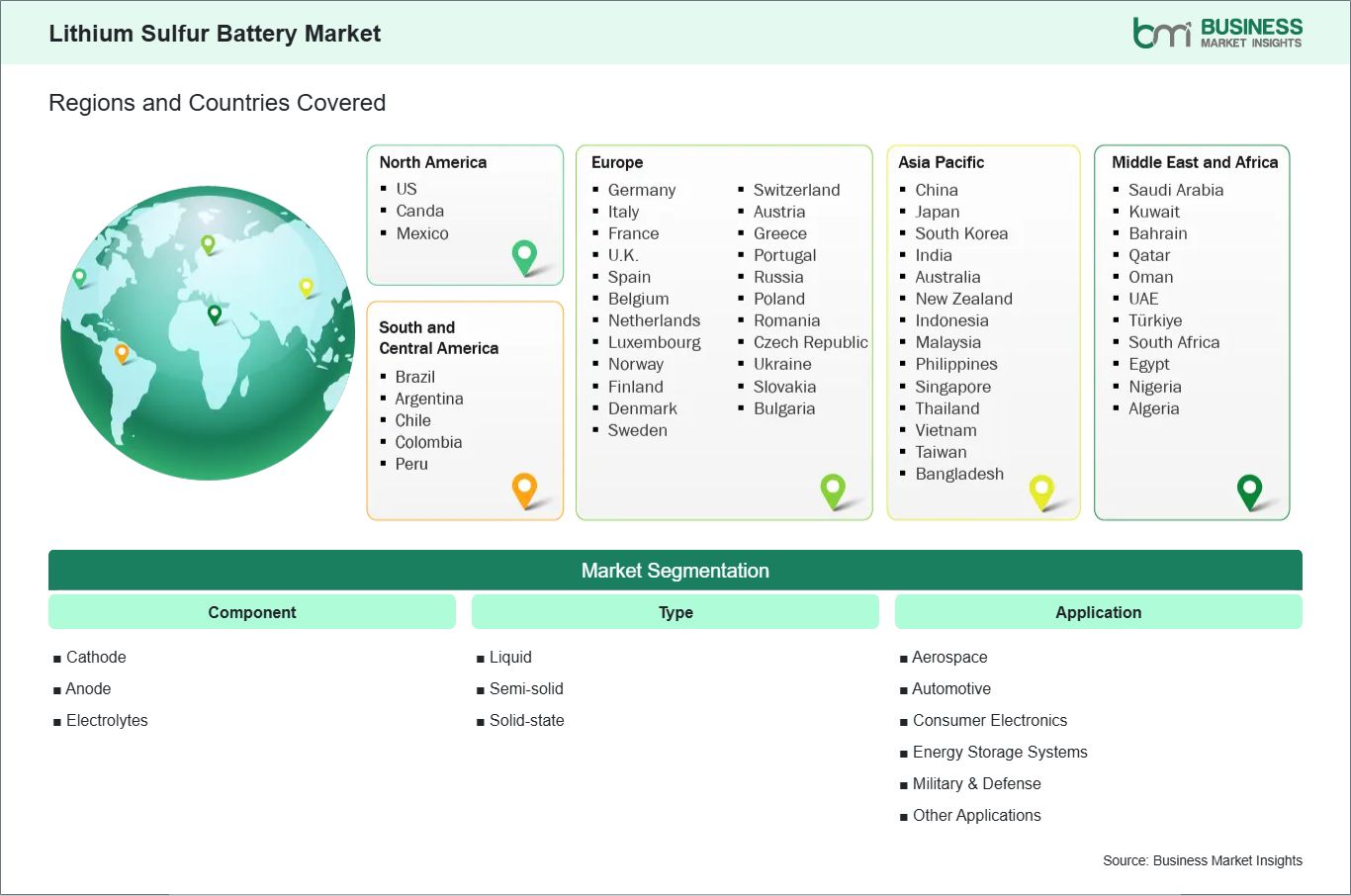
The market is segmented based on component, type, and application.
By Component
- Cathode - sulfur-based composite optimization for stability
- Anode - lithium metal enhancement for cycle efficiency
- Electrolytes - stabilization systems improve ionic transport
By Type
- Liquid - early-stage configuration with cost benefits
- Semi-solid - better safety and moderate stability balance
- Solid-state - high energy density with a focus on structural stability
By Application
- Aerospace - lightweight systems for long-duration missions
- Automotive - growing use in next-gen EV platforms
- Energy Storage Systems - expanding grid-level storage potential
- Military & defense - high-performance portable energy solutions
- Consumer Electronics - compact device integration potential
- Other Applications - specialized industrial deployments
Market Forces
Lithium Sulfur Battery Market Drivers and Opportunities
Rising Demand for High-Energy Storage Systems
The need for lightweight and high-energy-density storage solutions is driving the use of lithium sulfur battery systems. Traditional lithium-ion technologies have limitations in energy-to-weight efficiency, especially in aerospace, defense, and long-range mobility applications. This gap in performance is pushing manufacturers and researchers to explore alternative chemistries that can offer longer operational ranges with less system weight and better energy efficiency in challenging environments. One can see the impact most clearly in aviation platforms, unmanned aerial systems, and electric mobility programs, where reducing weight leads to better endurance and operational efficiency.
The growing focus on electrification and reducing carbon emissions in transportation is also increasing demand. As industries seek longer runtimes and less energy loss, lithium sulfur systems are becoming more relevant as a next-generation storage option with strong application-specific benefits.
Advancement in Next-Generation Battery Materials
Ongoing innovation in electrode design and electrolyte formulation is boosting the stability and efficiency of lithium sulfur systems. Progress in sulfur cathode composites, lithium-metal protection layers, and solid-state electrolyte integration is tackling key technical issues like polysulfide shuttle effects and cycle degradation. These enhancements are gradually making large-scale production and commercial use more feasible. The changing material landscape is creating chances for wider use in energy storage systems and advanced mobility platforms.
Better electrochemical performance is leading to longer lifecycle stability and improved efficiency retention during repeated cycles. As research moves from lab testing to pilot-scale production, this technology is likely to open new commercial opportunities in aerospace, defense, and high-performance electric vehicle applications.
Size and Share Analysis
Lithium Sulfur Battery Market Size and Share Analysis
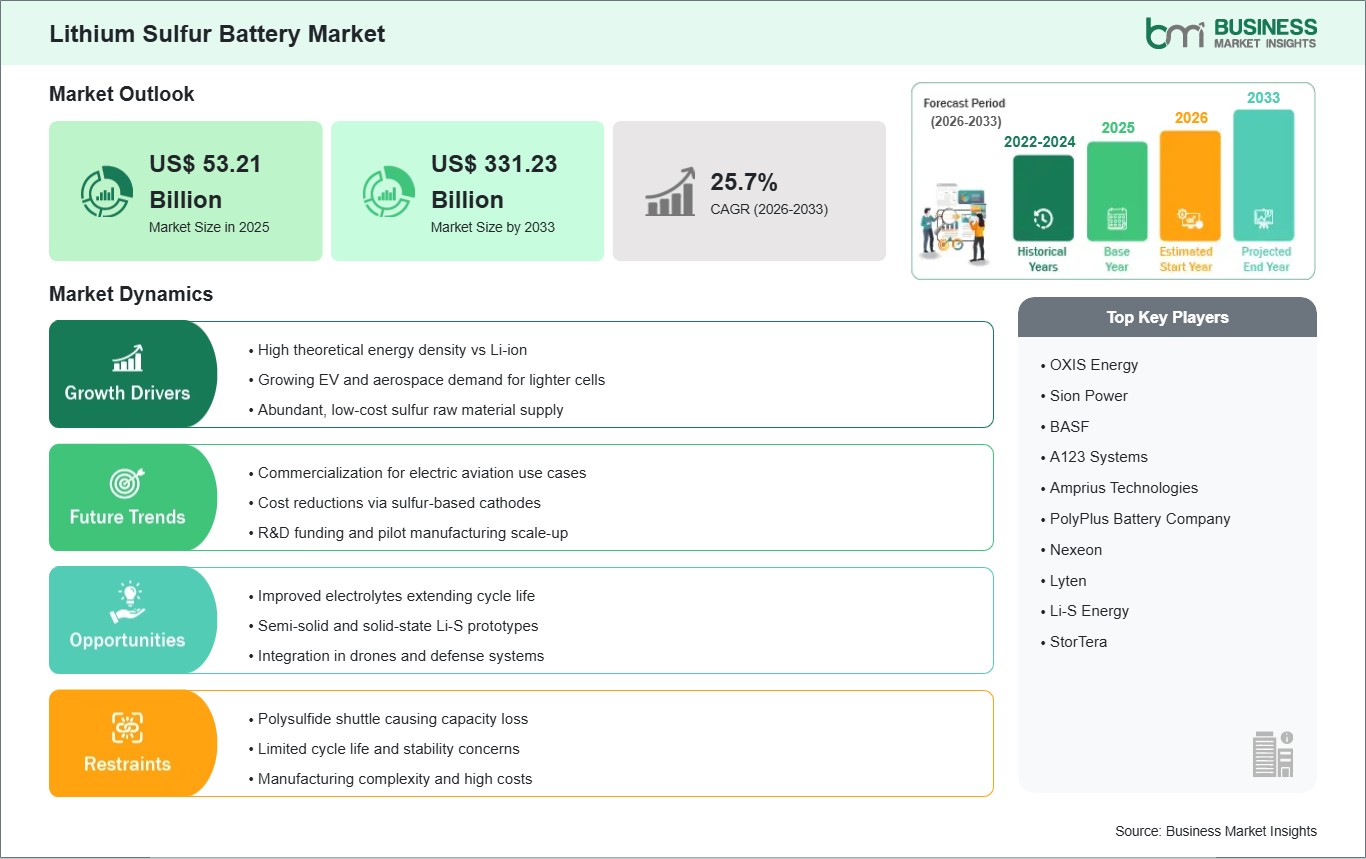
The lithium-sulfur battery market is projected to reach US$ 331.23 billion by 2033, up from US$ 53.21 billion in 2025. The market is expected to grow at a rate of 25.7% annually from 2026 to 2033.
This growth is driven by a rising emphasis on high-energy-density storage systems for mobility and aerospace uses, where performance efficiency and weight reduction are crucial factors in technology choices for next-generation platforms.
Market share is mainly concentrated in early-stage and high-performance application areas, where technology validation and pilot projects are further along. Aerospace and defense applications hold a large share because of their strict operational needs and a preference for lightweight energy systems. Automotive electrification and stationary storage solutions are slowly increasing their share as material stability and lifecycle enhancements improve commercial feasibility.
The dominance in applications is significantly shaped by aerospace and military needs, where energy density and reliability are more important than cost. However, there is increasing interest in automotive electrification and grid-scale storage systems, which are gradually changing demand patterns. As technology advances, the market share is likely to shift toward wider industrial use beyond just specialized high-performance areas.
Report Coverage
Lithium Sulfur Battery Market Report Coverage and Deliverables
The "Lithium Sulfur Battery Market Size and Forecast (2022-2033)" report provides a detailed analysis of the market covering below areas:
- The market size and forecast at global, regional, and country levels for all market segments covered under the scope
- The market trends, as well as drivers, restraints, and opportunities
- The market analysis covering key trends, global and regional framework, major players, regulations, and recent developments
- Industry landscape and competition analysis covering market concentration, heat map analysis, prominent players, and recent developments for the market
- Detailed company profiles, including SWOT analysis
Geographic Insights
Lithium Sulfur Battery Market Geographic Insights
The lithium sulfur battery market shows varied regional adoption patterns influenced by improvements in high-energy-density storage systems and the rise of electrification in transportation and defense. Regional demand varies due to different levels of technological readiness, industrial investment, and a focus on next-generation battery development. Early adoption mainly occurs in advanced economies, where research environments and defense upgrades support the experimental use of high-performance energy storage solutions.
North America shows strong development activity, driven by advancements in aerospace, defense upgrades, and significant spending on battery research. The region benefits from established research and development facilities and collaboration between technology developers and government programs. Demand is particularly affected by the need for lightweight energy storage systems in aviation and unmanned platforms, where efficiency and a longer operational range are top priorities.
Asia Pacific is becoming an important development center due to growing manufacturing capabilities and a strong focus on electrification efforts. The region is seeing more investment in advanced battery technologies, supported by industrial growth and increasing demand for electric mobility solutions. Active involvement from research institutions and materials science companies is speeding up development and positioning the region as a key player in the future commercialization and scaling of lithium sulfur technologies.
Europe, along with emerging regions, is making steady progress through energy transition initiatives focused on sustainability and government support for low-emission technologies. European countries emphasize strategies for reducing carbon emissions in transportation and energy storage, promoting the use of advanced battery systems. At the same time, emerging economies are slowly testing pilot-scale projects and research partnerships, mainly focusing on the potential for long-term energy storage and electrification as technology matures.
Industry Activity
Recent Developments
The lithium sulfur battery market is evaluated by gathering qualitative and quantitative data post primary and secondary research, which includes important corporate publications, association data, and databases. Recent developments and news in the market include:
- In March 2026, research introduced a nanoscale sulfide coating that improves lithium-ion battery performance. It allows for a cycle life exceeding 1,000 cycles, increases stability, and reduces degradation. This supports more efficient and longer-lasting energy storage systems for the next generation.
- In February 2026, Gelion announced its plans to deliver its first demonstration commercial lithium-sulfur pouch cells this year. The company is moving towards large-scale production for electric vehicles, drones, and robotics. It is doing this through partnerships focused on battery commercialization and expanding manufacturing.
Trust & Transparency
Research Methodology
The market analysis combines proprietary research with secondary data from government agencies, company disclosures, regulatory filings, industry databases and expert interviews. Market estimates are validated through data triangulation, cross-market benchmarking and analyst
review.
View Full Research Methodology
Key Sources Referred:
International Energy Agency (IEA)S. Department of Energy (DOE)Battery Innovation AllianceIEEE Energy Storage Standards CommitteeCompany WebsitesCompany Annual ReportsCompany Investor Presentations