
Secondary Battery Market Outlook: Size, Share, Trends, Growth Analysis, Competitive Landscape & Forecast, 2026-2033

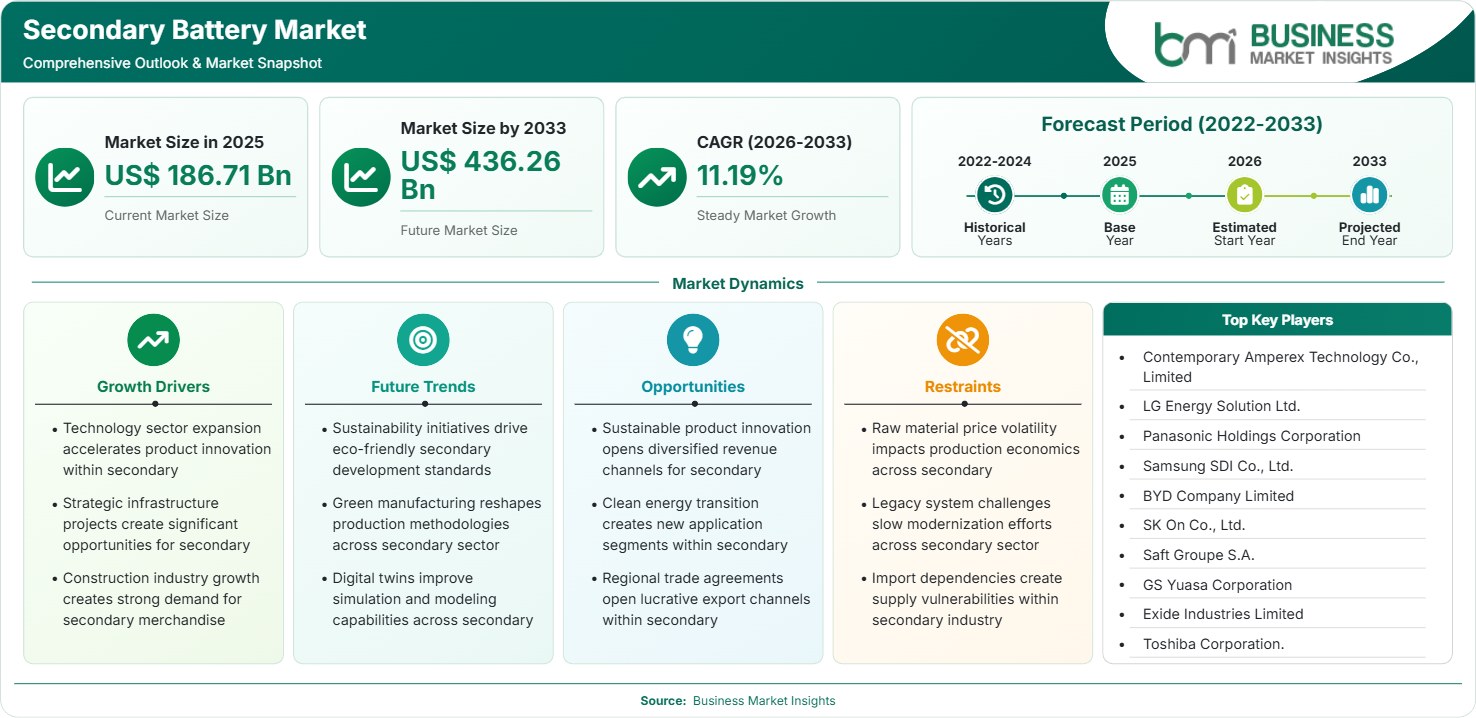
The Secondary Battery Market size was valued at US$ 186.71 Billion in 2025 and is projected to reach US$ 436.26 Billion by 2033, growing at a CAGR of 11.19% during 2026–2033, driven by EV electrification, grid storage deployment, digital devices, battery innovation, and resilient energy infrastructure.

Report Coverage
  • Battery Type: Lithium-ion Battery, , Lead Acid Battery , Nickel-Based Battery, Sodium-Ion Battery, Others
  • End-User: Electric Vehicles , Consumer Electronics , Energy Storage System, Industrial, Others
US$ 186.71 Bn Market size in 2025
US$ 436.26 Bn Market Size by 2033
11.19% CAGR, 2026 - 2033
2026-2033 Forecast Period

AI Overview

Secondary Battery Market Summary

  • North America Region: North America holds market share of 12%–15% in 2025, growing at a CAGR of 9.8%–10.8% during 2026–2033, supported by EV manufacturing, grid-scale storage, data centers, domestic battery investment, and policy incentives. The US represents the dominant regional demand center, with a 9.5%–10.5% CAGR through 2033 as localized manufacturing and energy-storage deployments expand.
  • Fastest Growing Region: Asia Pacific holds market share of 55%–59% in 2025, growing at a CAGR of 12.0%–13.0% during 2026–2033, supported by EV production, electronics manufacturing, battery-cell capacity expansion, renewable integration, supply-chain localization, and accelerating adoption across China, India, Japan, and Southeast Asia.
  • Leading Segment: Lithium-ion Battery holds market share of 82%–86% in 2025, growing at a CAGR of 11.5%–12.5% during 2026–2033, supported by superior energy density, falling manufacturing costs, expanding EV applications, energy-storage deployment, fast charging, and diversified cell chemistries.
  • High Growth Segment: Energy Storage System represents approximately 10%–13% of 2025 demand, expanding at a CAGR of 14.0%–16.0% during 2026–2033, driven by renewable integration, grid balancing, data-center resilience, peak shaving, distributed storage, and declining battery-system costs.
  • Key Market Opportunity: Battery manufacturers can capture incremental value through sodium-ion systems, localized ESS production, battery-management software, second-life applications, recycling, and integrated storage solutions serving grids, mobility, robotics, and data centers.
  • Major Market Players: Contemporary Amperex Technology Co., Limited, LG Energy Solution Ltd., Panasonic Holdings Corporation, Samsung SDI Co., Ltd., BYD Company Limited, SK On Co., Ltd., Saft Groupe S.A., GS Yuasa Corporation, Exide Industries Limited, and Toshiba Corporation.
Strategic Insights

Secondary Battery Market: Strategic Insights

Secondary Battery Market Strategic Framework
FREE PDF
Request your free sample
Request free sample
Stakeholder View

Key Takeaways

  • Value-chain integration is becoming decisive: Competitive advantage increasingly depends on coordinated access to cathode materials, cells, packs, battery-management systems, recycling channels, and application-level software rather than cell manufacturing alone.
  • Energy storage provides the strongest diversification path: Grid-scale storage, data-center backup, renewable integration, and commercial peak shaving create demand outside automotive cycles and provide manufacturers with longer-duration contractual opportunities.
  • Chemistry portfolios are broadening: LFP remains central to cost-sensitive applications, while NMC retains relevance where energy density matters. Sodium-ion and solid-state technologies are advancing as strategic options for supply diversification and performance improvements.
  • India and Southeast Asia are becoming important demand and production nodes: EV adoption, renewable capacity, electronics manufacturing, and government-supported localization create opportunities for regional battery ecosystems beyond established China, Japan, and Korea supply chains.
  • Investment is moving from capacity alone toward capability: Manufacturers are prioritizing automation, AI-enabled cell design, dry-electrode processing, thermal control, digital battery passports, recycling, and lifecycle analytics to improve yields and margins.
Geographic Outlook

Secondary Battery Market Regional Highlights

North America Secondary Battery Market

North America accounted for 12%–15% Secondary Battery Market share in 2025 and is projected to expand at a 9.8%–10.8% CAGR during 2026–2033. The region benefits from EV localization, utility-scale storage, data-center power requirements, and domestic battery manufacturing. The US dominates regional demand, while Canada contributes through battery-material development and clean-energy investment. IEA data show US battery manufacturing capacity expanded rapidly in 2024, supported substantially by Korean producers attracted by policy incentives.

  • US automakers are increasingly sourcing localized cells, strengthening demand for cylindrical, pouch, and prismatic architectures while reducing exposure to overseas logistics.
  • Grid-scale storage is becoming a major demand contributor as renewable generation, electricity-load growth, and data-center expansion increase requirements for dispatchable flexibility.
  • Domestic-content rules encourage manufacturers to establish regional cell, module, pack, and recycling operations, increasing capital intensity while strengthening supply-chain resilience.
  • Canada provides opportunities in battery minerals, cathode materials, recycling, and clean-power integration, complementing the larger US manufacturing ecosystem.

US Secondary Battery Market

The US represented approximately 75%–80% of North American Secondary Battery Market demand in 2025, with a projected 9.5%–10.5% CAGR during 2026–2033. Demand is supported by EV manufacturing, stationary storage, data centers, consumer electronics, and industrial backup power. Battery investments increasingly emphasize domestic production and integrated supply chains. LG Energy Solution reported more than 50 GWh of planned North American ESS capacity by year-end 2026, demonstrating the scale of localization underway.

  • Utility-scale storage is gaining strategic importance because data-center electricity requirements and renewable penetration are increasing the value of flexible grid resources.
  • Domestic battery production is expanding across multiple states, supported by automaker partnerships, energy-storage projects, and demand for locally manufactured cells.
  • Advanced battery software, diagnostics, thermal control, and lifecycle management are emerging as higher-margin opportunities alongside physical battery manufacturing.

Europe Secondary Battery Market

Europe held 18%–21% Secondary Battery Market share in 2025 and is estimated to grow at a 10.3%–11.3% CAGR through 2033. Germany and France remain leading demand centers, while Poland and Hungary are important production locations. High-growth opportunities are emerging in Poland, Spain, and selected Nordic markets, supported by renewable integration, EV manufacturing, and energy-storage deployment. EU battery rules are also increasing requirements for traceability, carbon information, and circularity.

  • Germany remains a major automotive battery market because vehicle electrification, industrial manufacturing, and premium EV production support demand for high-performance cells.
  • Poland is strengthening its position as an ESS and battery manufacturing hub, illustrated by LG Energy Solution’s 981 MWh supply agreement with PGE.
  • France benefits from energy-transition investment, aerospace applications, industrial storage, and domestic battery technology development, supporting diversified demand.
  • Spain and Nordic countries offer high-growth opportunities through renewable generation, grid flexibility requirements, and increasing utility-scale storage deployment.

Asia Pacific Secondary Battery Market

Asia Pacific represented 55%–59% Secondary Battery Market share in 2025 and is projected to record a 12.0%–13.0% CAGR during 2026–2033, making it the largest and fastest-growing regional market. China remains the dominant manufacturing and demand center, while India, Indonesia, Japan, and South Korea contribute through expanding EV, electronics, storage, and battery-material ecosystems. IEA data indicate China accounted for more than 80% of global lithium-ion manufacturing capacity at end-2025.

  • China combines mineral processing, cathode and anode production, cell manufacturing, EV integration, and recycling, creating unmatched scale and cost advantages across the value chain.
  • India is developing domestic cell manufacturing while electric two-wheelers, passenger vehicles, commercial mobility, and renewable storage broaden local demand.
  • Japan maintains strong positions in advanced battery research, consumer electronics, industrial batteries, hybrid vehicles, and next-generation chemistry development.
  • South Korea remains strategically important through large-scale cell production, advanced materials, automotive partnerships, and technology development spanning multiple battery chemistries.

Rest of World Secondary Battery Market

The rest of the world represented approximately 8%–11% Secondary Battery Market share in 2025, with a projected 11.5%–12.5% CAGR through 2033. South and Central America are gaining momentum from EV adoption, renewable power, telecom infrastructure, and distributed storage. Brazil is a leading opportunity, while Mexico benefits from proximity to North American manufacturing. In the Middle East and Africa, Saudi Arabia, the UAE, and South Africa offer expanding opportunities.

Latin American markets increasingly require batteries for renewable integration, mobility, telecom backup, and industrial power systems. Middle Eastern investments in solar generation and data-center infrastructure create additional storage requirements. Africa presents longer-term potential through off-grid electrification, telecom infrastructure, distributed solar, and commercial backup applications.

  • Brazil combines renewable electricity, expanding electric mobility, and industrial applications, creating a diversified battery-demand base beyond passenger EVs.
  • Mexico benefits from automotive manufacturing integration with North America and offers opportunities for localized battery assembly, components, recycling, and logistics.
  • Saudi Arabia and the UAE are investing in renewable generation and digital infrastructure, creating demand for high-reliability energy-storage systems.
  • South Africa provides opportunities across telecom, mining, renewable integration, backup power, and industrial applications where reliable storage is commercially important.
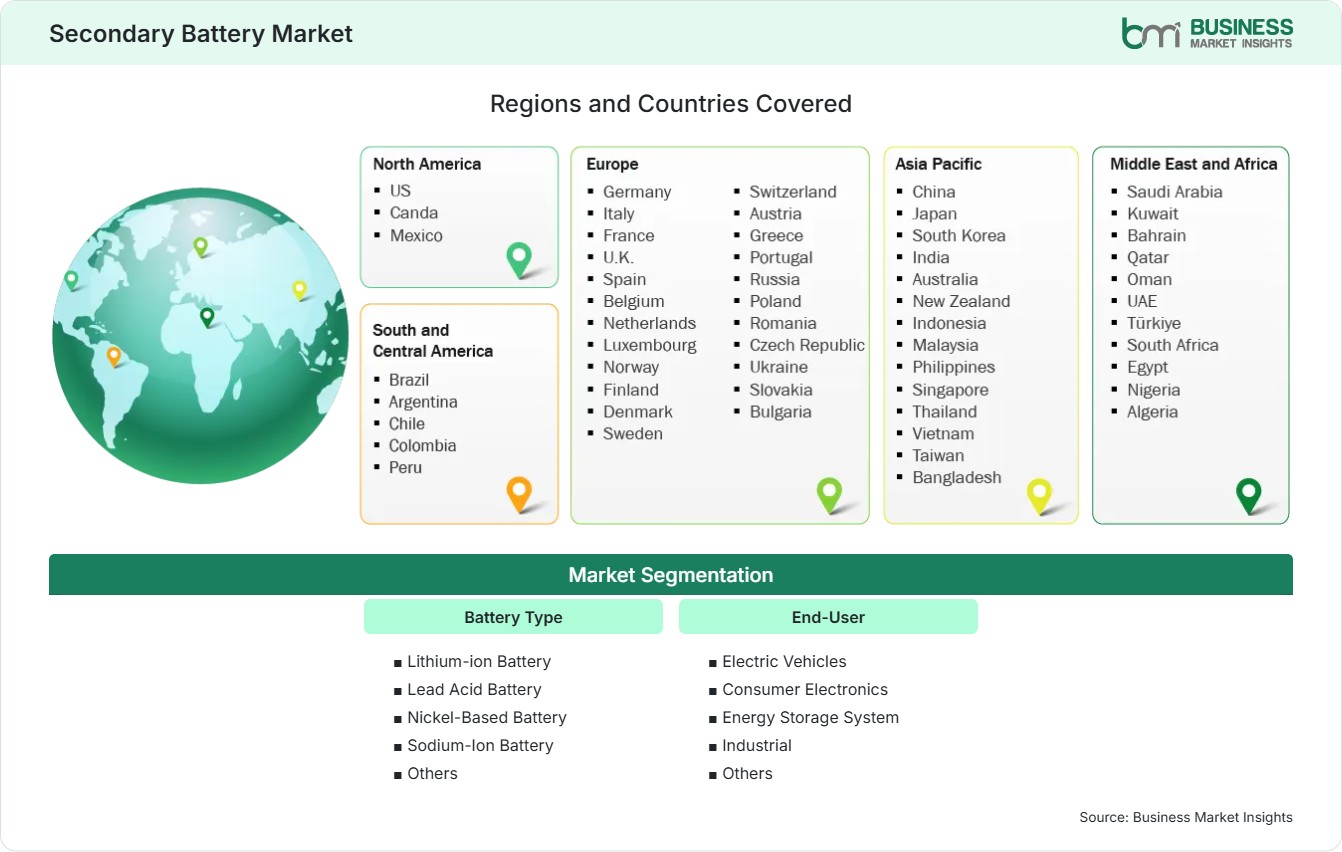
Global Market Geography
FREE PDF
Request your free sample
Request free sample
Segment Analysis

Secondary Battery Market Segmentation

Battery Type

Lithium-ion Battery dominated with approximately 82%–86% Secondary Battery Market share in 2025 and is projected to grow at a 11.5%–12.5% CAGR during 2026–2033. Its scale, energy density, charging performance, manufacturing maturity, and broad EV and ESS applicability keep it ahead, while alternative chemistries diversify future applications and supply-chain risk.

  • Lithium-ion Battery: Broad application across EVs, electronics, storage, and industrial equipment supports continued adoption as manufacturing scale improves performance, safety, charging speed, and cost efficiency.
  • Lithium Iron Phosphate: LFP benefits from strong thermal stability, lower reliance on nickel and cobalt, competitive costs, and increasing use in mainstream EVs and stationary storage systems.
  • Lithium Nickel Manganese Cobalt: NMC remains important for applications requiring higher energy density, particularly premium EVs, where driving range and compact pack architecture influence purchasing decisions.
  • Lithium Nickel Cobalt Aluminium: NCA technology remains relevant in high-energy automotive applications, supported by established manufacturing expertise, high energy density, and performance requirements for long-range electric vehicles.
  • Lithium Titanate: LTO serves specialized applications requiring rapid charging, high cycle life, and strong low-temperature performance, including buses, industrial equipment, and high-utilization transportation systems.
  • Lead Acid Battery: Lead-acid remains important across automotive replacement, telecom, UPS, industrial backup, and infrastructure because of established recycling networks, low upfront cost, and reliable performance.
  • Flooded Lead Acid Battery: Flooded batteries retain demand in automotive, industrial, and backup applications where cost efficiency, established maintenance practices, and broad distribution networks outweigh space and maintenance disadvantages.
  • Valve Regulated Lead Acid Battery (VRLA): VRLA supports telecom, UPS, data centers, railways, and infrastructure because sealed construction, low maintenance, and predictable standby performance suit controlled indoor installations.
  • Nickel-Based Battery: Nickel-based systems retain specialized demand where durability, temperature tolerance, reliability, and safety are critical, including industrial equipment, aviation, rail, and backup applications.
  • Sodium-Ion Battery: Sodium-ion technology is progressing toward commercial deployment because abundant raw materials, low-temperature performance, and reduced lithium dependence create attractive opportunities for storage and cost-sensitive mobility.

End-User

Electric Vehicles represent the largest end-user category, supported by global vehicle electrification, while Energy Storage System is the fastest-growing application with approximately 10%–13% Secondary Battery Market share in 2025 and a 14.0%–16.0% CAGR through 2033. Consumer electronics and industrial applications provide stable diversification.

  • Electric Vehicles: EV adoption remains the principal demand engine, with passenger cars leading volumes while commercial vehicles increasingly require higher-capacity packs, rapid charging, and long service life.
  • Passenger EVs: Passenger EVs drive cell-volume expansion through growing model availability, declining battery costs, improved charging infrastructure, and increasing consumer acceptance across developed and emerging markets.
  • Commercial EVs: Commercial EVs require durable batteries capable of high utilization, rapid charging, and predictable lifecycle economics, creating demand for optimized packs in buses, trucks, vans, and fleets.
  • Consumer Electronics: Portable electronics sustain demand for compact rechargeable cells as smartphones, computing devices, wearables, and connected products require higher energy density and longer operating times.
  • Smart Phones: Smartphone batteries prioritize compactness, energy density, charging speed, safety, and cycle life, encouraging improvements in cell materials, thermal management, and fast-charging architectures.
  • Laptops and Tablets: Computing devices require balanced energy density, thermal stability, charging efficiency, and longevity, supporting continued demand for lightweight lithium-ion battery formats.
  • Wearables: Wearables favor miniature rechargeable batteries with high volumetric efficiency, flexible packaging, rapid charging, and long cycle life for continuous health, connectivity, and sensor functions.
  • Energy Storage System: ESS deployment is accelerating through renewable integration, grid balancing, data-center backup, peak shaving, and distributed power resilience, increasing demand for scalable and long-life battery systems.
  • Industrial: Industrial applications include telecom, UPS, material handling, rail, mining, automation, and backup systems, where reliability, lifecycle cost, safety, and predictable maintenance remain primary selection criteria.
Market Forces

Secondary Battery Market Dynamics

Key Market Drivers

Rapid electrification of passenger and commercial transportation

EV adoption is increasing the volume and diversity of rechargeable battery demand. IEA data show EV battery demand exceeded 950 GWh in 2024, representing approximately 25% growth from 2023, while electric truck battery demand increased by more than 75%. These trends reinforce that Secondary Battery Market growth is occurring in passenger electric vehicles, buses, trucks, and even in heavy-duty applications. At the same time, car manufacturers are calling for rapid charge times, high energy density, extended warranty lives, and decreased costs of battery packs. LFP is being used increasingly in cost-sensitive applications, while NMC is still relevant for high-range applications.

Expansion of grid-scale storage and renewable integration

Energy storage is moving from a supporting technology to a core electricity-system asset as solar and wind generation increase. The IEA estimates global energy storage capacity must expand sixfold to 1,500 GW by 2030 in its Net Zero Emissions scenario, with batteries accounting for most of the increase. This structural requirement supports Secondary Battery Market growth, which will occur due to demand beyond automobiles and will provide opportunities for contracts that run longer than before. Batteries are increasingly important for grid operators in frequency regulation, peak shifting, renewable generation support, congestion relief, and resilience. The data centers will form another segment of demand, as high-density computing needs an uninterrupted power supply.

Battery manufacturing scale and technology optimization

Production capabilities for batteries are increasing fast amid competition on yields, energy density, safety, charging time, and economic feasibility over battery lifecycles. Manufacturing capabilities for lithium-ion batteries worldwide had already surpassed 4 TWh by the end of 2025, being more than triple the size of many single regional markets. The lion’s share (over 80%) of all capacities was still held by China. Secondary Battery Market trends are thus evolving towards AI-based design, dry electrodes, better formation process, inspection, thermal conductance, and digital quality management. For instance, CATL recently talked about their AI battery-design platform that relies on large internal data sets to speed up the development process.

Key Market Opportunities

Sodium-ion commercialization for diversified storage applications

Sodium-ion technology offers manufacturers an opportunity to reduce dependence on lithium and selected critical minerals while targeting applications where energy density requirements are less restrictive. In 2026, CATL said that the GWh-level industrialization of its Naxtra sodium-ion battery was complete, with the mass production process set to be put in place within the same year. Moreover, GS Yuasa was selected to carry out a research project in Japan supported by NEDO to commercialize the next generation of sodium-ion batteries. This makes a case for investment in grid storage, affordable mobility, and cold climates. This is not only about the chemistry of the cell, since there are a number of other ecosystems required for successful commercialization.

Battery intelligence, diagnostics, and lifecycle services

Battery software can create recurring value after cell manufacturing by improving safety, state-of-health prediction, warranty management, fleet utilization, and second-life decisions. LG Energy Solution has evolved battery software technologies into software-defined vehicle ecosystems with algorithms that predict degradation and manage the life cycle of the battery. Saft launched the OptiLife technology in 2026 to offer state-of-charge intelligence and predictive battery analytics in industrial and IoT solutions. These technologies present a chance to move away from revenue models based on hardware purchases to service-based income models.

Localized energy-storage systems for data centers and grids

Growing electricity consumption from AI computing is creating an attractive market for localized ESS capacity, UPS systems, battery backup units, and grid-scale storage. Panasonic is one company that sees power stability within data centers as a strategic application and is reinforcing its energy storage supply chain framework. LG Energy Solution is another company that is increasing its North American ESS capacity and focusing on opportunities within the utility and data center sectors. The investment opportunity is extensive and ranges from batteries, power electronics, controls, cybersecurity, thermal management, to maintenance.

Market Restraints and Challenges

Critical-mineral concentration and supply-chain exposure

Factor: The manufacturing of batteries is still vulnerable to intensive refining and processing of lithium, nickel, cobalt, graphite, manganese, and similar resources. According to the IEA report, the proportion of the top three refiners of important energy minerals rose to about 86% in 2024.

Impact: Shortages in battery supply, trade restrictions, or project delays may lead to rising battery costs and reduced competitiveness in regional battery production. According to the International Energy Agency (IEA), an extended crisis in the supply of critical minerals may push up the average global cost of battery packs by 40%-50%.

Manufacturing overcapacity and uneven regional competitiveness

Factor: Global battery manufacturing capacity has expanded faster than demand in several segments, while production remains heavily concentrated in China.

Impact: High levels of competition may force companies to reduce margins, postpone utilization goals for plants, and even struggle economically after setting up new plants in the regions. The IEA claims that total global manufacturing capacity had surpassed 4 TWh by the end of 2025, with China responsible for more than 80%. Companies from other countries are forced to differentiate themselves through their technologies and offer localization, proximity to clients, policies, and lifecycle services. Factories also take several years to reach nominal utilization.

Company Analysis

Competitive Landscape

The Secondary Battery Market analysis indicates competition is concentrated among vertically integrated battery manufacturers, automotive-focused cell suppliers, industrial battery specialists, and diversified energy-technology companies. Product differentiation increasingly centers on chemistry, cell format, fast charging, safety, manufacturing scale, software, recycling, and localized production.

Company Name

Overview

Products and Services relevant to this market

Contemporary Amperex Technology Co., Limited

China-based battery manufacturer with extensive EV and energy-storage scale and diversified chemistry capabilities.

EV cells, LFP and NCM batteries, sodium-ion systems, ESS, battery swapping, battery-management and lifecycle solutions.

LG Energy Solution Ltd.

South Korean battery producer serving automotive, energy-storage, electronics, and emerging mobility applications globally.

Cylindrical and pouch cells, LFP batteries, ESS, automotive batteries, BMS software, next-generation battery technologies.

Panasonic Holdings Corporation

Japanese technology group with major battery capabilities through Panasonic Energy and strong automotive relationships.

Cylindrical lithium-ion cells, automotive batteries, ESS technologies, battery-management solutions, manufacturing and recycling initiatives.

Samsung SDI Co., Ltd.

South Korean battery producer focused on automotive, ESS, consumer, and next-generation battery technologies.

Prismatic and cylindrical cells, ESS batteries, lithium-metal research, solid-state batteries, battery materials and systems.

BYD Company Limited

Chinese vertically integrated EV and battery producer with strong LFP expertise and proprietary Blade Battery technology.

Blade Battery, EV battery systems, energy-storage batteries, charging infrastructure, integrated mobility and storage solutions.

SK On Co., Ltd.

South Korean battery manufacturer focused primarily on automotive electrification and large-scale cell production.

EV pouch cells, high-nickel batteries, battery materials partnerships, manufacturing systems and automotive battery solutions.

Saft Groupe S.A.

French advanced-battery specialist and TotalEnergies subsidiary serving demanding industrial and energy applications.

Industrial batteries, ESS, aviation batteries, mobility systems, advanced battery management and lifecycle services.

GS Yuasa Corporation

Japanese battery specialist with extensive lead-acid expertise and expanding lithium-ion and sodium-ion development.

Automotive batteries, industrial batteries, lithium-ion ESS, VRLA systems, sodium-ion research and battery-management technologies.

Exide Industries Limited

Indian battery manufacturer with broad lead-acid coverage and growing lithium-ion manufacturing capabilities.

Automotive and industrial lead-acid batteries, VRLA, UPS systems, lithium-ion modules, packs and cell manufacturing initiatives.

Toshiba Corporation

Japanese technology company offering SCiB rechargeable lithium-ion technology for high-power applications.

SCiB modules, EV bus and marine batteries, stationary storage, high-power rechargeable systems and lifecycle applications.

Trust & Transparency

Research Methodology

The market analysis combines proprietary research with secondary data from government agencies, company disclosures, regulatory filings, industry databases and expert interviews. Market estimates are validated through data triangulation, cross-market benchmarking and analyst review.

View Full Research Methodology

Questions Answered

Frequently Asked Questions

What is the Secondary Battery Market scope for emerging applications?

Emerging opportunities include robotics, marine mobility, aviation, industrial automation, data centers, distributed storage, battery swapping, second-life batteries, and digitally managed energy-storage systems.

Why is energy storage becoming strategically important for battery manufacturers?

Grid-scale storage, renewable integration, data-center backup, peak shaving, and power resilience create large battery requirements independent of vehicle sales cycles, helping manufacturers diversify revenue and utilization.

What role will battery software play in future markets?

Battery software can improve state-of-health monitoring, degradation prediction, safety diagnostics, warranty management, charging optimization, fleet utilization, and second-life assessment, creating recurring service opportunities beyond cell sales.

Why are sodium-ion batteries attracting investment?

Sodium-ion batteries can reduce dependence on lithium and selected critical minerals, while offering attractive characteristics for stationary storage and cost-sensitive applications where maximum energy density is less important.

Which chemistry currently dominates rechargeable battery demand?

The Secondary Battery Market Report highlights that Lithium-ion batteries dominate because they combine high energy density, mature manufacturing, broad supplier ecosystems, competitive costs, and extensive deployment across EVs, electronics, and stationary storage.

Access the Full Secondary Battery Market Report

Get segment-level forecasts, regional estimates, competitive benchmarking, company profiles and downloadable Excel datasets.

Access the full Secondary Battery Market Report
350 pages PDF & Excel | 2026-08-28