
Modular UPS Market Outlook: Size, Share, Trends, Growth Analysis, Competitive Landscape & Forecast, 2026-2033

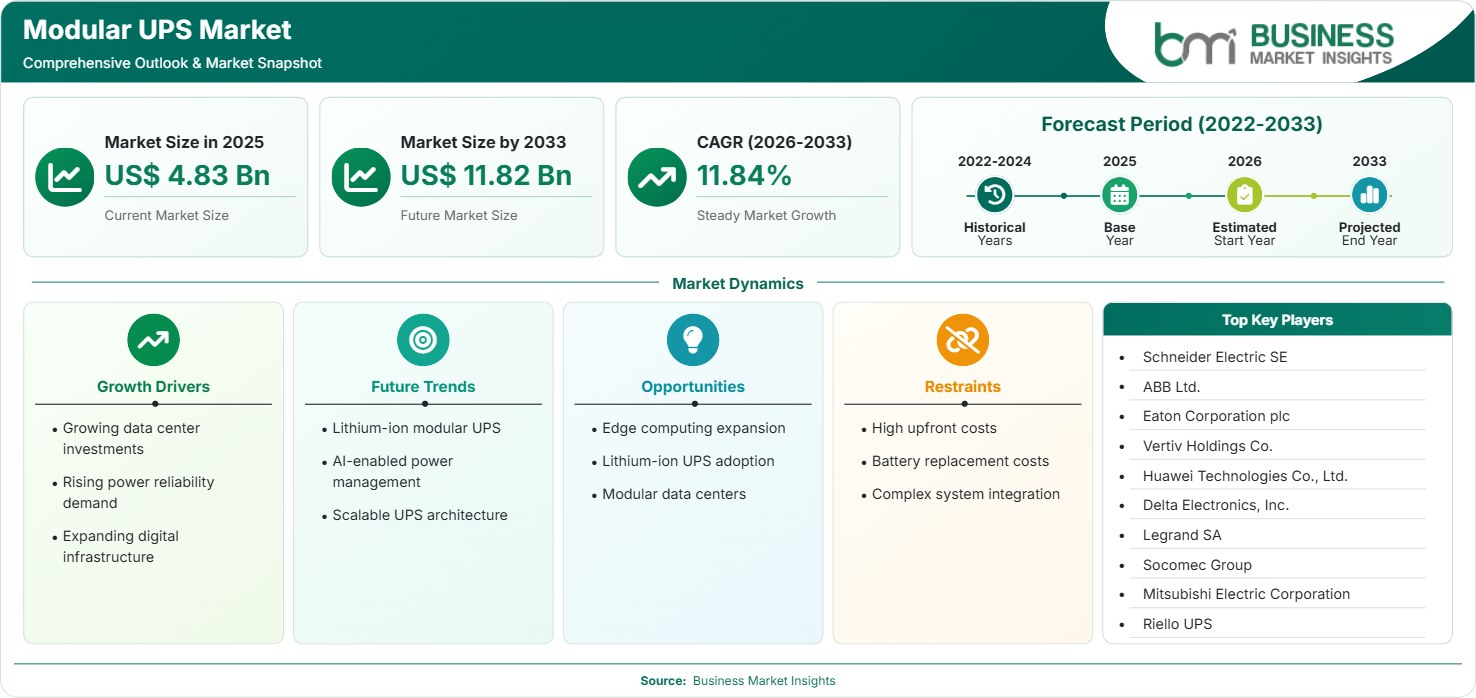
The Modular UPS market size was valued at US$ 4.83 billion in 2025 and is projected to reach US$ 11.82 billion by 2033, growing at a CAGR of 11.84% during 2026–2033, driven by growing data center investments, rising power reliability demand, expanding digital infrastructure, edge computing expansion, lithium-ion UPS adoption, and modular data center development.

Report Coverage
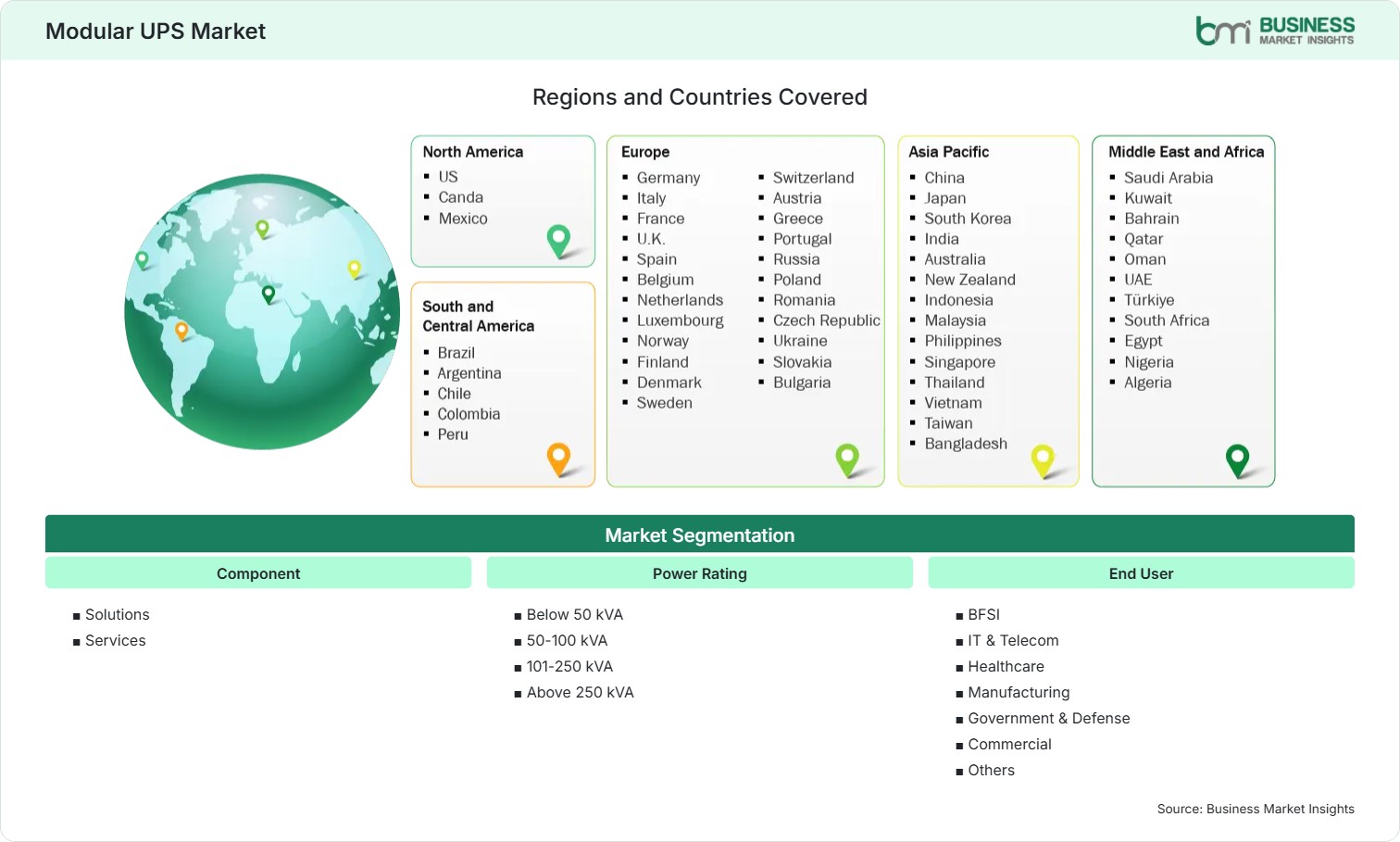
  • Component: Solutions, Services
  • Power Rating: Below 50 kVA, 50-100 kVA, 101-250 kVA, Above 250 kVA
  • End User: BFSI, IT & Telecom, Healthcare, Manufacturing, Government & Defense, Commercial, Others
US$ 4.83 Bn Market size in 2025
US$ 11.82 Bn Market Size by 2033
11.84% CAGR, 2026 - 2033
2026-2033 Forecast Period

01 AI Overview

Modular UPS Market Summary

  • North America Region: North America accounts for an estimated 35%–39% share in 2025 and is projected to grow at a CAGR of 11.5%–12.0% during 2026–2033. Data center expansion, cloud infrastructure investments, digital transformation, and power continuity requirements create opportunities. The U.S. market remains a major contributor with a CAGR of 11.6%–12.1%, supported by hyperscale facilities and enterprise IT modernization.
  • Fastest Growing Region: Asia Pacific holds approximately 30%–34% share in 2025 and is expected to expand at a CAGR of 12.5%–13.2% through 2033. Rapid digitalization, data center construction, industrial automation, and expanding telecom networks support regional growth opportunities.
  • Leading Segment: Solutions components represent around 75%–80% share in 2025 and are expected to grow at a CAGR of 11.7%–12.2%. Increasing demand for scalable UPS modules, battery systems, static switches, and power distribution solutions drives adoption.
  • High Growth Segment: Services account for approximately 20%–25% share in 2025 and are projected to expand at a CAGR of 12.0%–12.6%. Installation, maintenance, and consulting services are gaining importance due to complex power infrastructure requirements.
  • Key Market Opportunity: Edge computing expansion, lithium-ion UPS adoption, modular data centers, and scalable power protection systems create opportunities for companies developing flexible and energy-efficient UPS architectures.
  • Major Market Players: Schneider Electric SE, ABB Ltd., Eaton Corporation plc, Vertiv Holdings Co., Huawei Technologies Co., Ltd., Delta Electronics, Inc., Legrand SA, Socomec Group, Mitsubishi Electric Corporation, Riello UPS.
02 Strategic Insights

Modular UPS Market: Strategic Insights

modular-ups-market-market-strategic-framework
FREE PDF
Request your free sample
Request free sample
03 Stakeholder View

Key Takeaways

  • The market ecosystem is shifting toward scalable power management solutions involving UPS manufacturers, battery technology providers, data center operators, and digital infrastructure companies.
  • Data centers, IT infrastructure, and edge computing applications represent major growth opportunities due to increasing demand for uninterrupted power and flexible capacity expansion.
  • Technology innovation is focused on lithium-ion batteries, intelligent monitoring platforms, energy efficiency improvements, and software-enabled UPS management systems.
  • Asia Pacific offers strong investment potential due to rapid digitalization, expanding data center capacity, telecom growth, and industrial automation adoption.
  • Companies are strengthening competitive positions through product launches, strategic partnerships, and investments in advanced modular power solutions.
04 Geographic Outlook

Modular UPS Market Regional Highlights

North America Modular UPS Market

North America represented approximately 35%–39% of the global market in 2025 and is projected to expand at a CAGR of 11.5%–12.0% during 2026–2033. The region benefits from large-scale data center investments, cloud infrastructure expansion, enterprise digitalization, and demand for reliable power systems. The Modular UPS market share remains significant due to increasing deployment across hyperscale facilities, commercial buildings, and critical infrastructure environments.

  • The United States remains the largest contributor due to strong data center construction and cloud service expansion.
  • Canada supports growth through digital infrastructure investments and increasing adoption of efficient power management systems.
  • Data center operators are implementing modular UPS solutions to improve scalability and operational flexibility.
  • Enterprises are upgrading power infrastructure to support increasing digital workloads and reliability requirements.

US Modular UPS Market

The United States accounted for approximately 31%–35% of global revenue in 2025 and is expected to register a CAGR of 11.6%–12.1% through 2033. The country remains a leading market due to extensive data center development, cloud computing growth, and increasing demand for uninterrupted power solutions. The Modular UPS market growth is supported by hyperscale facilities, artificial intelligence infrastructure, and enterprise technology modernization.

  • Hyperscale data centers are increasing adoption of scalable UPS architectures for higher efficiency.
  • AI and cloud computing workloads are driving demand for advanced power protection systems.
  • Businesses are investing in modular infrastructure to improve reliability and reduce downtime risks.

Europe Modular UPS Market

Europe held an estimated 22%–26% share in 2025 and is forecast to grow at a CAGR of 11.0%–11.6% between 2026 and 2033. The region benefits from energy efficiency regulations, expanding data centers, industrial automation, and sustainability-focused infrastructure upgrades. Germany, the United Kingdom, France, Italy, and the Netherlands represent important markets due to digital transformation initiatives and increasing demand for efficient power systems.

  • Germany supports adoption through industrial automation and advanced infrastructure investments.
  • The United Kingdom demonstrates growth through expanding data center capacity and cloud services.
  • France and the Netherlands are developing opportunities through digital infrastructure expansion.
  • European companies are adopting energy-efficient UPS technologies to improve operational performance.

Asia Pacific Modular UPS Market

Asia Pacific accounted for approximately 30%–34% of the Modular UPS Market in 2025 and is expected to achieve the fastest growth with a CAGR of 12.5%–13.2% through 2033. Rapid digitalization, increasing data center investments, telecom expansion, and industrial development are supporting regional adoption. China, India, Japan, South Korea, and Southeast Asian economies represent major growth markets.

  • China leads regional adoption through large-scale data center expansion and technology infrastructure investments.
  • India represents strong growth potential due to digital services expansion and increasing cloud adoption.
  • Japan supports demand through advanced technology infrastructure and enterprise modernization.
  • Southeast Asian countries are investing in data centers and reliable power management solutions.

Rest of World Modular UPS Market

The Rest of World region accounted for approximately 8%–12% of the market share in 2025 and is projected to grow at a CAGR of 11.8%–12.5% in the Modular UPS Market forecasts. Latin America, the Middle East, and Africa are witnessing increasing adoption due to expanding digital services, telecom infrastructure development, and modernization of commercial facilities. Modular UPS solutions support reliable power delivery in regions requiring flexible infrastructure.

  • Brazil represents a growing market due to digital transformation and enterprise infrastructure investments.
  • Mexico supports demand through telecom expansion and commercial technology adoption.
  • Middle Eastern countries are investing in data centers and smart infrastructure projects.
  • African markets are developing opportunities through expanding connectivity and digital services.
  • Regional organizations are adopting modular power systems to improve energy reliability and operational continuity.
global-market-geography
FREE PDF
Request your free sample
Request free sample
05 Segment Analysis

Modular UPS Market Segmentation

Component

The Component segment accounted for approximately 95%–97% of the Modular UPS Market revenue in 2025 and is projected to grow at a CAGR of 11.6%–12.1% during 2026–2033. Increasing demand for scalable power infrastructure, rising data center deployments, and growing digital workloads are driving adoption of modular UPS components. Solutions dominate due to demand for flexible UPS configurations, while services are gaining importance through installation support, maintenance contracts, and consulting services. The increasing complexity of critical power environments is encouraging organizations to invest in integrated modular UPS ecosystems that enhance reliability, efficiency, and lifecycle performance.

  • Solutions: Solutions drive adoption through UPS modules, battery modules, static switches, and power distribution modules that provide scalable and efficient power protection.
  • UPS Modules: UPS modules enable flexible capacity expansion, redundancy improvement, and optimized power management for data centers, enterprises, and critical infrastructure applications.
  • Battery Modules: Battery modules support energy storage requirements through improved backup duration, reliability, and integration with advanced lithium-ion technologies.
  • Static Switch Modules: Static switch modules improve power transfer reliability by enabling rapid switching between power sources during disruptions or system failures.
  • Power Distribution Modules: Power distribution modules enhance electricity management by enabling efficient power allocation across connected equipment and modular infrastructure environments.
  • Services: Services support deployment through installation, maintenance, consulting, and lifecycle management, ensuring efficient operation of modular UPS systems.
  • Installation: Installation services provide system configuration, integration, commissioning, and deployment support for complex modular power infrastructure projects.
  • Maintenance: Maintenance services improve system reliability through preventive inspections, remote monitoring, repairs, and performance optimization activities.
  • Consulting: Consulting services assist organizations with power planning, infrastructure assessment, system design, and optimization strategies for UPS deployment.

Power Rating

The Power Rating segment represented approximately 97%–99% Modular UPS Market share in 2025 and is expected to expand at a CAGR of 11.7%–12.2% through 2033. Demand varies according to application requirements, facility scale, and power infrastructure complexity. High-capacity modular UPS systems are increasingly deployed in large data centers and industrial facilities, while lower-capacity systems support smaller commercial and enterprise environments. Increasing digital workloads and demand for uninterrupted power are encouraging adoption across different power categories.

  • Below 50 kVA: Systems below 50 kVA support small businesses, branch offices, and compact IT environments requiring reliable backup power solutions.
  • 50–100 kVA: This category serves medium-sized facilities requiring scalable protection for network equipment, commercial operations, and distributed infrastructure applications.
  • 101–250 kVA: These systems support enterprise facilities, healthcare applications, and medium-scale data centers requiring higher power availability and redundancy.
  • Above 250 kVA: High-capacity systems address hyperscale data centers, industrial facilities, and critical infrastructure requiring advanced scalability and continuous power protection.

End User

The End User segment represented approximately 98%–99% share in 2025 and is expected to grow at a CAGR of 11.8%–12.3% during 2026–2033. Increasing dependence on digital systems, automation, and connected infrastructure is driving demand across multiple industries. Data-intensive sectors require reliable power protection to prevent operational disruptions and maintain service continuity. Modular UPS systems are gaining adoption due to their scalability, energy efficiency, and ability to support evolving infrastructure requirements.

  • BFSI: Financial institutions adopt modular UPS systems to protect transaction platforms, banking infrastructure, and mission-critical digital services requiring uninterrupted operations.
  • IT & Telecom: IT and telecom sectors represent major users due to expanding data centers, cloud services, network infrastructure, and high availability requirements.
  • Healthcare: Healthcare facilities utilize modular UPS systems to support medical equipment, electronic records, diagnostic technologies, and critical operational systems.
  • Manufacturing: Manufacturing industries deploy modular UPS solutions to protect automated production systems, robotics, and industrial control infrastructure.
  • Government & Defense: Government and defense organizations adopt secure power systems for communication networks, operational continuity, and critical infrastructure protection.
  • Commercial: Commercial facilities implement modular UPS solutions for office buildings, retail operations, and smart building technology requirements.
06 Market Forces

Modular UPS Market Dynamics

Key Market Drivers

Growing Data Center Investments

Increasing investments in data center infrastructure are accelerating demand for modular UPS systems that provide scalable and reliable power protection. The rise in cloud computing, artificial intelligence workloads, digitalization of services, and enterprise application will raise the demands for power needs across the globe. Power suppliers are increasingly embracing the modular UPS design since the system allows for scaling-up without making any changes to existing infrastructure. The design offers improved energy efficiency, resilience, and flexibility relative to conventional power management systems. Growth in edge and hyperscale data centers will drive demand. Current Modular UPS market trends indicate growing adoption of intelligent monitoring, lithium-ion batteries, and energy-efficient designs across modern data center environments.

Rising Power Reliability Demand

Growing dependence on digital operations is increasing demand for uninterrupted power solutions across industries. Businesses in healthcare, finance, telecommunications, manufacturing, and government sectors require continuous electricity supply to maintain critical services and prevent operational losses. Modular UPS systems provide enhanced reliability through redundant configurations, scalable capacity, and faster maintenance capabilities. There is an increasing trend towards organizations opting to implement modular systems instead of the traditional power backup solutions in order to cater to changing electricity needs. Increased worries over power outages and power infrastructure have led to increased adoption of advanced UPS technology. There is an increasing demand for reliable energy management solutions.

Expanding Digital Infrastructure

Increased use of internet technologies, the rise of cloud computing and digitalization initiatives has driven the creation of infrastructure in the modern world, which is generating a high requirement for modular UPSs in data centers, telecom infrastructure, and enterprise technology environments. Modular UPS solutions support these environments by providing flexible power capacity, improved efficiency, and simplified maintenance. Telecom providers and technology firms are making investment in power systems that will be able to meet the increased data traffic and connectivity. In the wake of digital transformation efforts being undertaken by firms, there is an increased demand for flexible power protection products. This trend will continue as smart infrastructure ecosystems evolve.

Key Market Opportunities

Edge Computing Expansion

As more edge computing facilities emerge, the potential for modular UPS suppliers becomes evident since more smaller computing centers have to be built near customers’ locations. Edge centers need scalable and reliable power units that can support important workloads. Modular UPS solutions offer advantages through flexible capacity, simplified installation, and efficient maintenance in decentralized environments. Network providers, businesses, and industrial organizations are scaling their edge network deployments in order to minimize latency and enhance performance of their services. This will generate an increased need for power protection solutions that suit a distributed network architecture. Firms designing miniature modular UPS systems can capitalize on the increased edge facility investments globally.

Lithium-ion UPS Adoption

The growing acceptance of lithium-ion batteries is opening doors for modular UPS vendors, making it possible to offer efficient and reliable systems through increased efficiency, decreased maintenance needs, and longer battery life. Lithium-ion batteries have some advantages over other types of batteries that include higher energy density, longer lifetime, and faster charge time. Manufacturers investing in advanced battery integration can strengthen their competitive positioning. Growing focus on energy efficiency and sustainability is expected to support wider adoption of lithium-ion-based modular UPS solutions across commercial and industrial applications.

Modular Data Center Development

Expansion of modular data centers is creating opportunities for UPS providers by increasing demand for compact, scalable, and rapidly deployable power systems. Modular data centers require flexible infrastructure that can be expanded according to computing demand. The modular nature of UPS systems satisfies these needs by providing flexibility through the addition of incremental capacity and easy installation. Modular facilities are increasingly being used by businesses, telcos, and cloud service providers to expedite the process of infrastructure building. There is potential for businesses that provide integrated power solutions for modular data centers. Increasing demand for adaptable digital facilities is expected to support long-term Modular UPS Market expansion.

Market Restraints and Challenges

High Upfront Costs

Factor: Modular UPS systems require significant initial investment in power modules, battery systems, installation, integration, and supporting infrastructure.

Impact: High upfront costs can limit adoption among small and medium-sized organizations with restricted capital budgets. Although modular UPS systems provide long-term benefits through scalability and efficiency, the initial expenditure may delay purchasing decisions. Additional costs related to system design, installation complexity, and infrastructure upgrades can increase project expenses. Manufacturers need to develop cost-effective configurations and flexible financing models to improve adoption. Reducing entry barriers will be important for expanding deployment across emerging markets and smaller commercial facilities requiring reliable power protection solutions.

Battery Replacement Costs

Factor: Battery systems require periodic replacement, maintenance, and lifecycle management, creating ongoing operational expenses for users.

Impact: Replacement costs can increase the total ownership expense of modular UPS systems and influence investment decisions among organizations. Battery degradation, disposal requirements, and maintenance activities create additional operational considerations. Companies adopting traditional battery technologies may face higher long-term expenses compared with advanced alternatives. Manufacturers are focusing on lithium-ion solutions and improved battery management systems to reduce maintenance frequency and enhance lifecycle performance. Managing battery-related costs will remain essential for increasing adoption across data centers, healthcare facilities, enterprises, and other critical infrastructure environments.

07 Company Analysis

Competitive Landscape

The competitive landscape includes power management companies, electrical equipment manufacturers, data center infrastructure providers, and automation technology specialists competing through scalable power solutions, lithium-ion integration, digital monitoring platforms, and energy-efficient architectures. The Modular UPS market analysis highlights increasing competition among companies developing intelligent power protection systems designed for data centers, telecom networks, healthcare facilities, and other mission-critical applications.

Company Name

Overview

Products and Services relevant to this market

Schneider Electric SE

Global energy management company providing critical power infrastructure solutions.

Modular UPS systems, battery solutions, power management software, monitoring platforms, and data center infrastructure.

ABB Ltd.

Electrical technology company focused on automation and power solutions.

Modular UPS systems, power protection equipment, energy management solutions, and digital monitoring technologies.

Eaton Corporation plc

Power management company offering electrical infrastructure solutions worldwide.

Modular UPS systems, backup power solutions, power distribution products, and monitoring software.

Vertiv Holdings Co.

Digital infrastructure provider specializing in critical power and cooling systems.

Modular UPS systems, data center power solutions, lithium-ion UPS technology, and remote monitoring platforms.

Huawei Technologies Co., Ltd.

Technology company providing digital infrastructure and power solutions.

Modular UPS systems, smart power solutions, battery technologies, and intelligent data center infrastructure.

Delta Electronics, Inc.

Power electronics company offering energy-efficient solutions globally.

Modular UPS systems, power management technologies, data center solutions, and energy optimization platforms.

Legrand SA

Electrical and digital infrastructure company serving commercial applications.

UPS systems, power distribution solutions, data center infrastructure, and energy management technologies.

Socomec Group

Power control specialist providing critical power solutions.

Modular UPS systems, power switching solutions, monitoring software, and energy reliability services.

Mitsubishi Electric Corporation

Technology company developing electrical and automation solutions.

UPS systems, power electronics, monitoring technologies, and industrial power management solutions.

Riello UPS

UPS manufacturer specializing in power continuity solutions.

Modular UPS systems, backup power equipment, battery solutions, and monitoring services.

08 Industry Activity

Recent Developments

July 2026

Centiel SA secured its first order worth USD 8.7 million in the U.S. market under a strategic distribution agreement with Neo Critical Power LLC, covering the delivery of a UPS system for a data center project. The Switzerland-based provider of modular UPS technologies confirmed delivery within the current financial year.

May 2026

Toshiba International Corporation introduced the 3000 TP Series, a three-phase modular uninterruptible power system scaling from 40 kW to 200 kW in a single 42U enclosure. The system features a six-shelf hot-swap power module architecture, 96.5% efficiency, and advanced IIoT-based diagnostics for predictive maintenance, targeting edge data centers and enterprise IT deployments.

May 2026

Socomec announced the UK & Ireland availability of its expanded MODULYS XM range an ultra-modular Uninterruptible Power Supply (UPS) system designed for medium-power data centre applications.

May 2026

Legrand received the "Data Centre Sustainability Innovation of the Year" award at the DCS Awards 2026 for its Keor FLEX modular UPS. The system achieves up to 98.6% efficiency in double-conversion mode, scales from 100 kW to 1.2 MW per frame (up to 4.8 MW in parallel), and features silicon carbide technology, true hot-swappable modular architecture, and 85% certified recyclability.

10 Trust & Transparency

Research Methodology

The market analysis combines proprietary research with secondary data from government agencies, company disclosures, regulatory filings, industry databases and expert interviews. Market estimates are validated through data triangulation, cross-market benchmarking and analyst review.

View Full Research Methodology

11 Questions Answered

Frequently Asked Questions

What does the Modular UPS Market Report include?

The report covers market size, segmentation, regional analysis, competitive landscape, market dynamics, developments, trends, opportunities, challenges, and forecasts through 2033.

What opportunities are emerging in the Modular UPS industry?

Edge computing expansion, lithium-ion battery adoption, modular data centers, and intelligent power management platforms are creating new opportunities for manufacturers and technology providers.

Why are data centers adopting modular UPS systems?

Data centers adopt modular UPS systems because they provide scalability, redundancy, energy efficiency, simplified maintenance, and reliable power protection for growing digital workloads.

Which segment dominates the market?

Solutions represent the leading component segment due to strong demand for UPS modules, battery modules, static switch modules, and scalable power distribution systems.

What factors are driving the Modular UPS Market growth?

The market is driven by increasing data center investments, expanding digital infrastructure, rising demand for power reliability, edge computing deployment, and adoption of advanced battery technologies.

Access the Full Modular UPS Market Report

Get segment-level forecasts, regional estimates, competitive benchmarking, company profiles and downloadable Excel datasets.

Access the full Modular UPS Market Report
350 pages PDF & Excel | 2026-07-31