
Data Center UPS Market Outlook: Size, Share, Trends, Growth Analysis, Competitive Landscape & Forecast, 2026-2033

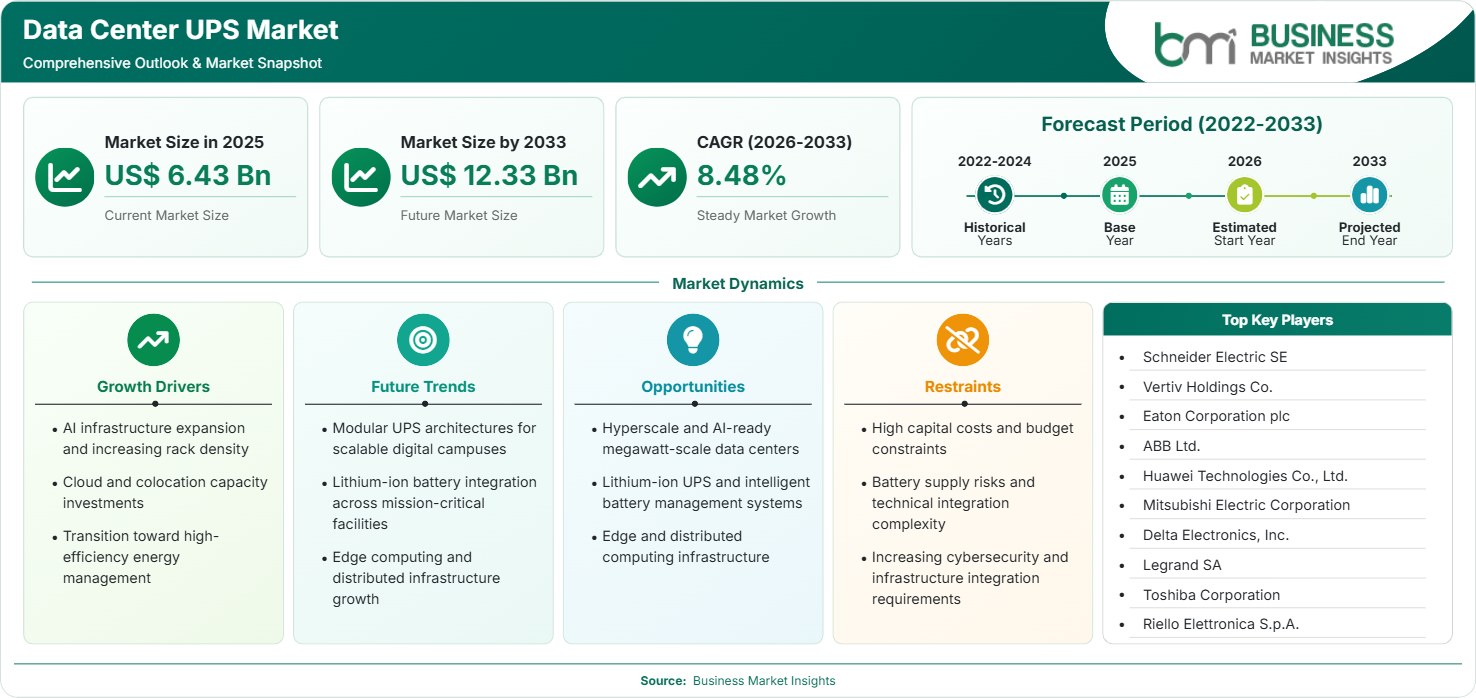
The Data Center UPS Market size was valued at US$ 6.43 Billion in 2025 and is projected to reach US$ 12.33 Billion by 2033, growing at a CAGR of 8.48% during 2026–2033. Rising hyperscale data center investments, AI-driven rack density growth, power reliability requirements, lithium-ion adoption, edge infrastructure expansion, and sustainability-focused power management initiatives are creating substantial market opportunities.

Report Coverage
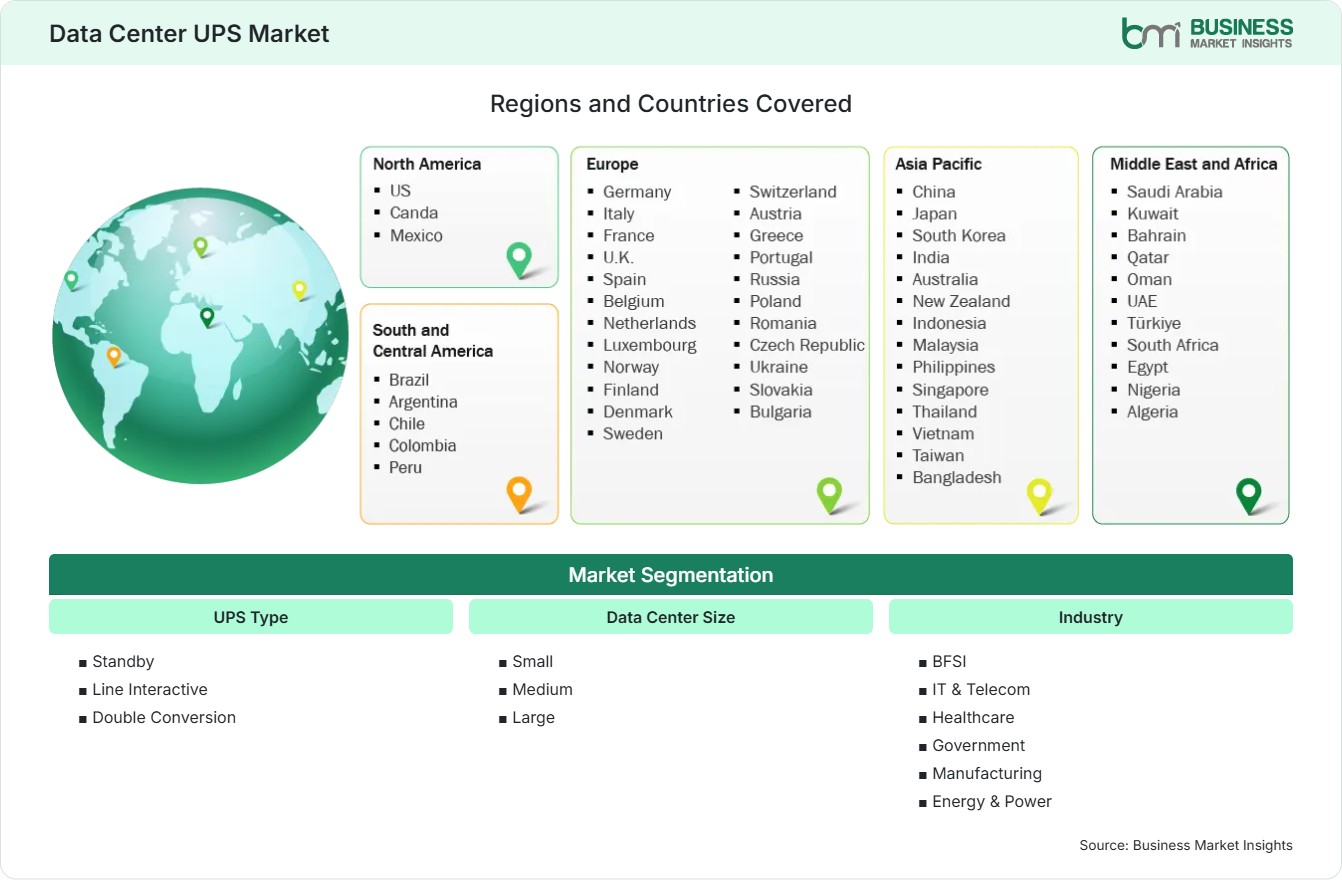
  • UPS Type: Standby, Line Interactive, Double Conversion
  • Data Center Size: Small, Medium, Large
  • Industry: BFSI, IT & Telecom, Healthcare, Government, Manufacturing, Energy & Power
US$ 6.43 Bn Market size in 2025
US$ 12.33 Bn Market Size by 2033
8.48% CAGR, 2026 - 2033
2026-2033 Forecast Period

AI Overview

Data Center UPS Market Summary

  • North America Region: North America holds a market share of 35%–38% in 2025, growing with a CAGR of 7.8%–8.4% during 2026–2033, supported by hyperscale data center expansion, AI workload deployment, cloud investment growth, resilience mandates, utility modernization, and adoption of advanced lithium-ion backup systems across mission-critical environments. Brief US analysis: The United States accounts for 76%–80% of regional demand and is projected to advance at 8.0%–8.6% CAGR through 2033, supported by AI campuses and colocation investments.
  • Fastest Growing Region: Asia Pacific holds a Data Center UPS Market share of 27%–30% in 2025, growing with a CAGR of 10.0%–10.8% during 2026–2033, driven by digital infrastructure buildout, cloud region launches, government digitization initiatives, semiconductor investments, colocation growth, and increasing reliability requirements across emerging economies and enterprise facilities.
  • Leading Segment: Double Conversion holds a market share of 54%–58% in 2025, growing with a CAGR of 8.6%–9.2% during 2026–2033, supported by superior protection capabilities, voltage regulation performance, compatibility with AI infrastructure, high-load stability requirements, and adoption across hyperscale and enterprise facilities.
  • High Growth Segment: Large data centers hold a Data Center UPS Market share of 46%–50% in 2025, growing with a CAGR of 9.5%–10.2% during 2026–2033, encouraged by hyperscale expansion, GPU-intensive workloads, colocation demand, modular infrastructure deployments, power density escalation, and long-term investments from cloud service providers.
  • Key Market Opportunity: Expansion of AI-ready megawatt-scale facilities is accelerating demand for modular, scalable, energy-efficient UPS architectures integrating lithium-ion batteries, digital monitoring, predictive maintenance, and grid-interactive capabilities across global infrastructure networks.
  • Major Market Players: Schneider Electric SE, Vertiv Holdings Co., Eaton Corporation plc, ABB Ltd., Huawei Technologies Co., Ltd., Mitsubishi Electric Corporation, Delta Electronics, Inc., Legrand SA, Toshiba Corporation, and Riello Elettronica S.p.A.
Strategic Insights

Data Center UPS Market: Strategic Insights

Data Center UPS Market Strategic Framework
FREE PDF
Request your free sample
Request free sample
Stakeholder View

Key Takeaways

  • The value chain is evolving from hardware-centric procurement toward integrated power infrastructure ecosystems combining UPS systems, batteries, monitoring software, remote diagnostics, and lifecycle service contracts.
  • Hyperscale facilities, AI workloads, and large colocation campuses represent the strongest commercial opportunity due to increasing power-density requirements and long-term capacity planning.
  • Innovation is shifting toward lithium-ion storage, silicon-carbide power electronics, predictive analytics, and modular designs capable of supporting rapid scaling and reduced downtime.
  • India, Indonesia, Malaysia, Saudi Arabia, and the United Arab Emirates present compelling investment destinations due to cloud-region expansion and supportive digital infrastructure policies.
  • Strategic acquisitions across power equipment, battery management, and data center infrastructure segments indicate ongoing industry consolidation and technology integration.
  • Sustainability metrics are becoming procurement criteria, encouraging adoption of high-efficiency systems capable of lowering operating expenses and improving environmental performance.
Geographic Outlook

Data Center UPS Market Regional Highlights

North America Data Center UPS Market

North America accounts for 35%–38% of the Data Center UPS Market share in 2025 and is expected to record a CAGR of 7.8%–8.4% through 2033. The region benefits from strong hyperscale investment, rapid AI infrastructure deployment, mature colocation ecosystems, and enterprise migration toward hybrid cloud platforms. Utility reliability requirements and strict uptime expectations continue to support premium power protection solutions. Large investments by technology companies in digital infrastructure further reinforce regional demand. Continuous modernization of mission-critical facilities remains a core growth catalyst.

  • AI server clusters are increasing rack densities, encouraging operators to deploy scalable UPS platforms capable of supporting megawatt-level loads while maintaining uptime and energy efficiency standards.
  • Cloud providers continue expanding campuses across Virginia, Texas, Arizona, and Ohio, generating sustained demand for advanced power continuity systems and intelligent energy management platforms.
  • Lithium-ion battery integration is accelerating because of longer service life, reduced maintenance needs, and improved operational efficiency compared with conventional battery technologies.
  • Colocation operators are increasingly standardizing modular systems to reduce deployment timelines, improve redundancy strategies, and support phased capacity expansion requirements.

US Data Center UPS Market

The United States represents 76%–80% of North American demand in 2025 and is projected to grow at 8.0%–8.6% CAGR. Large-scale AI infrastructure investments, widespread cloud adoption, and increasing enterprise digitalization continue driving installation activity. Major technology firms are expanding hyperscale capacity, while colocation operators are investing in resilient power architectures. Federal cybersecurity initiatives and demand for uninterrupted digital services contribute to continued technology upgrades.

  • Rapid deployment of generative AI facilities is creating unprecedented demand for resilient backup power systems capable of supporting high-performance computing environments.
  • Increasing edge-computing deployments across healthcare, telecom, and industrial applications support adoption of compact and remotely managed solutions.
  • Data sovereignty, cybersecurity, and resilience requirements are encouraging continuous investment in infrastructure modernization and power redundancy strategies.

Europe Data Center UPS Market

Europe holds approximately a 24%–27% share in 2025 and is forecast to expand at 7.5%–8.1% CAGR of the Data Center UPS Market through 2033. Digital sovereignty initiatives, cloud adoption, and sustainability objectives are shaping procurement strategies. Germany remains the leading market, while Poland demonstrates the highest growth trajectory with a CAGR near regional upper levels. Operators increasingly prioritize efficient power protection technologies that support carbon-reduction goals alongside operational reliability. Expansion of colocation facilities across major metropolitan hubs continues strengthening regional demand fundamentals.

  • Energy efficiency regulations encourage replacement of aging infrastructure with high-performance UPS systems featuring enhanced conversion efficiencies and digital monitoring capabilities.
  • Germany leads regional deployment volumes due to concentration of enterprise facilities, cloud infrastructure, and industrial digitization initiatives.
  • Poland records strong growth as international providers expand capacity and enterprises adopt advanced digital infrastructure across emerging technology corridors.
  • Growing renewable energy integration is increasing interest in intelligent power-management capabilities capable of supporting grid fluctuations and sustainability objectives.

Asia Pacific Data Center UPS Market

Asia Pacific commands a 27%–30% share in 2025 and represents the fastest-growing regional market with a CAGR of the Data Center UPS Market of 10.0%–10.8%. Strong cloud investments, digital economy expansion, rising internet traffic, and government-backed infrastructure development continue stimulating demand. China remains the largest regional market, while India demonstrates the strongest growth profile. Large-scale capacity additions from global cloud providers and local operators are creating significant opportunities for advanced power continuity solutions.

  • China maintains leadership through extensive hyperscale infrastructure development and sustained enterprise digital transformation programs.
  • India records the strongest growth trajectory owing to data localization requirements, cloud investment flows, and an expanding colocation ecosystem.
  • Southeast Asian markets are attracting substantial investment as enterprises diversify digital infrastructure beyond established regional hubs.
  • Telecommunications modernization and 5G deployment are supporting wider adoption of resilient power protection platforms across distributed environments.

Rest of World Data Center UPS Market

Rest of World holds a market share of 10%–13% in 2025 and is forecast to maintain a CAGR of 8.5%–9.2% through 2033. Increasing investments in cloud regions and advancements in fintech technologies will drive South and Central America. Smart city projects, government digitization initiatives, and technological investments from other countries will drive growth in the Middle East and Africa. Brazil is the leader in demand in Latin America, and Saudi Arabia is a fast-growing country demonstrating particularly strong expansion momentum through large-scale digital infrastructure projects.

  • Brazil remains a leading destination for colocation and enterprise infrastructure investments supporting financial services and e-commerce growth.
  • Mexico is attracting increasing deployment activity due to connectivity advantages and proximity to major North American digital ecosystems.
  • Saudi Arabia benefits from strategic digital transformation programs and substantial public-sector infrastructure investments.
  • The United Arab Emirates continues expanding technology ecosystems, increasing demand for reliable backup power systems across mission-critical facilities.
Global Market Geography
FREE PDF
Request your free sample
Request free sample
Segment Analysis

Data Center UPS Market Segmentation

UPS Type

The UPS Type was a basic purchasing type. The market share of Double Conversion systems was estimated at 54%-58% in 2025, and the forecasted growth rate was 8.6%–9.2% CAGR for the period. Increasing power density, uptime requirements, and use in hyperscale data centers will continue to drive adoption. Increasingly, the scope of the Data Center UPS market includes scalable systems that provide an uninterrupted power supply to mitigate disturbances and utility fluctuations.

  • Standby: Common across smaller facilities requiring economical backup protection where power disturbances are less frequent and infrastructure complexity remains relatively limited.
  • Line Interactive: Gains traction in medium-scale deployments by offering better voltage regulation, improved efficiency, and balanced performance for cost-sensitive operators.
  • Double Conversion: Preferred for mission-critical facilities because of superior power conditioning, continuous protection, and compatibility with high-density computing environments.

Data Center Size

Large data centers hold a 46%-50% share and are expected to grow at a 9.5%-10.2% CAGR. Hyperscale construction and AI computing are becoming more influential in buying decisions. Medium data centers show strong deployment activity, whereas small ones tend to utilize compact modular structures that allow greater scalability and flexibility.

  • Small: Demand is supported by edge computing locations, branch infrastructure, healthcare facilities, and distributed enterprise workloads requiring dependable power continuity.
  • Medium: Adoption benefits from regional colocation growth, enterprise modernization initiatives, and scalable infrastructure strategies balancing costs with reliability needs.
  • Large: Significant investments from hyperscalers and cloud providers drive deployment of advanced high-capacity systems across expanding digital campuses.

Industry

Despite BFSI retaining the largest market share in 2025, with a 22%-25% CAGR, Healthcare is the fastest-growing segment, with a 9.0%-9.8% CAGR, driven by the development of digital health infrastructure. Emerging Data Center UPS Market trends across sectors focus on business continuity, cybersecurity preparedness, and increased data dependency in applications.

  • BFSI: Continuous transaction processing, regulatory compliance requirements, and cybersecurity priorities reinforce demand for resilient power protection infrastructure.
  • IT & Telecom: Network modernization, cloud migrations, and data traffic growth drive expansion of advanced backup power deployments.
  • Healthcare: Electronic medical records, connected diagnostics, and telehealth services increase requirements for uninterrupted power reliability.
  • Government: Digital public services, secure infrastructure projects, and national data initiatives strengthen procurement activity.
  • Manufacturing: Industrial automation and smart-factory investments generate demand for reliable digital infrastructure support capabilities.
  • Energy & Power: Grid monitoring, operational technology systems, and renewable integration initiatives support implementation of advanced backup solutions.
Market Forces

Data Center UPS Market Dynamics

Key Market Drivers

AI Infrastructure Expansion and Increasing Rack Density

The power demands of AI training clusters and high-performance computing environments are considerably higher than those of conventional enterprise environments. Based on industry research, advanced AI racks have been shown to exceed 50 kW and are trending upward. There is thus a need for reliable power supply systems. There is investment in robust architectures capable of handling varying power loads without compromising reliability. The issue of power resilience is increasingly being seen as a point of competition by data center operators, especially hyperscale operators. All these developments contribute to long-term equipment demand and boost the revenue from services related to monitoring, predictive maintenance, and lifecycle optimization of critical digital infrastructure estates.

Cloud and Colocation Capacity Investments

Global cloud providers continue investing billions of dollars in new campuses, edge locations, and regional availability zones. Growth in digital services, e-commerce activity, enterprise software adoption, and content delivery requirements is stimulating the deployment of new facilities that require highly reliable power infrastructure. Colocation operators are also expanding aggressively into emerging markets to meet demand for enterprise outsourcing. The resulting increase in white-space capacity and server installations creates sustained procurement opportunities for UPS systems, batteries, software, and maintenance services. Long-term contracts and recurring operational requirements further reinforce market visibility for infrastructure providers.

Transition Toward High-Efficiency Energy Management

Sustainability objectives and energy costs drive the implementation of highly efficient power protection solutions. Businesses are looking for equipment that offers low losses, advanced monitoring capabilities, and integration with renewable energy systems. Improvements in battery technology and analysis software enable better utilization while reducing maintenance costs. The focus on reducing emissions also contributes to modernization efforts. Modern systems offer far greater efficiency compared to older systems. Therefore, companies continue to modernize their outdated infrastructure, improve sustainability, and enhance overall operational performance.

Key Market Opportunities

Modular UPS Architectures for Scalable Digital Campuses

Hyperscale growth offers significant commercial potential for companies with modular, fast-deployable capabilities. Increasingly, businesses are looking for technologies that enable them to scale their systems without service disruption. Phased investments based on power usage are possible due to a modular architecture that also improves redundancy. This feature is particularly relevant for colocation facilities that serve many clients and require increasing amounts of electricity. A modular architecture is more flexible, and therefore more cost-effective and faster to deploy. The Long-Term Data Center UPS Market Forecasts indicate growing demand for scalable products as organizations prioritize adaptability in increasingly dynamic computing environments.

Lithium-Ion Battery Integration Across Mission-Critical Facilities

Lithium-ion systems have longer lifespans, reduced maintenance needs, and higher energy densities than many legacy options. Such traits make for an appealing total cost-of-ownership proposition for companies interested in effective, efficient backup power systems. The implementation of battery management software enables additional monitoring and predictive maintenance capabilities. Implementation remains most prevalent in the hyperscale and colocation sectors; however, growing awareness is driving increased deployment in the healthcare, banking, and government sectors. Hardware and software ecosystem providers stand to benefit from incremental revenues.

Edge Computing and Distributed Infrastructure Growth

Edge Computing systems are increasingly being deployed across manufacturing, telecommunications, transportation, healthcare, and smart-city use cases. The distributed nature of these architectures calls for small-form-factor, remote-management, and highly reliable power solutions that can operate across a wide range of conditions. Real-time analytics, IoT connectivity, and low-latency digital services continue to drive infrastructure development beyond conventional large campuses. This presents an opportunity for vendors to provide systems with design flexibility, predictive monitoring features, and easy maintenance procedures. With the decentralization of computing workloads, the need for reliable power protection will grow significantly.

Market Restraints and Challenges

High Capital Costs and Budget Constraints

Factor: Systems that feature lithium-ion batteries, digital monitoring, and high-efficiency power electronics require significant capital investment. Impact: Budget-constrained firms will tend to postpone upgrades despite anticipated gains in operational effectiveness. Small firms will always prioritize today's financial planning over long-term energy efficiency. This is likely to affect replacement intervals and adoption rates in some markets. Financial concerns, installation costs, and integration considerations all play an important role in purchase decisions. Suppliers must increasingly demonstrate a return on investment through efficiency gains and increased reliability.

Battery Supply Risks and Technical Integration Complexity

Factor: The problem stems from dependence on critical minerals and batteries, and from complex infrastructure integration processes. Impact: There will likely be problems with the project's timely completion due to the need to acquire certain parts or integrate them into existing infrastructure. In addition, there will be a requirement for specific expertise in integrating infrastructure into the existing electrical system. The cybersecurity implications of monitoring systems must also be taken into consideration. These factors can increase deployment complexity, prolong implementation schedules, and elevate project costs, particularly across large facilities undergoing phased modernization initiatives.

Company Analysis

Competitive Landscape

The competitive environment remains characterized by technology innovation, service integration, and global expansion strategies. This Data Center UPS Market analysis indicates increasing emphasis on modularity, battery advancements, software-enabled monitoring, and high-efficiency architectures.

Company Name

Overview

Products and Services relevant to this market

Schneider Electric SE

Global energy management and automation leader with strong hyperscale and enterprise infrastructure presence.

Galaxy UPS, APC systems, lithium-ion solutions, monitoring software, maintenance and lifecycle services.

Vertiv Holdings Co.

Major provider of critical digital infrastructure technologies serving cloud and colocation operators.

Liebert UPS platforms, integrated power systems, thermal management, monitoring and support services.

Eaton Corporation plc

Diversified power management company with extensive backup power and electrical infrastructure portfolio.

9PX, 93PM, power quality systems, battery integration, monitoring and energy management solutions.

ABB Ltd.

Industrial technology company focusing on electrification and high-efficiency critical power systems.

MegaFlex UPS, power distribution solutions, digital monitoring, service and modernization offerings.

Huawei Technologies Co., Ltd.

Technology provider supporting digital infrastructure development worldwide.

Modular UPS solutions, intelligent power systems, energy management platforms and smart monitoring.

Mitsubishi Electric Corporation

Established supplier of mission-critical power protection technologies.

Large-scale UPS systems, industrial backup solutions, maintenance and lifecycle support services.

Delta Electronics, Inc.

Power electronics specialist with broad data center infrastructure capabilities.

Modular UPS products, energy-efficient power systems and infrastructure management technologies.

Legrand SA

Global specialist in electrical and digital building infrastructure solutions.

UPS equipment, power distribution, rack infrastructure and monitoring technologies.

Toshiba Corporation

Long-standing participant in industrial and critical power markets.

High-capacity UPS systems, backup power equipment and associated technical services.

Riello Elettronica S.p.A.

European specialist focused on power continuity technologies and energy solutions.

UPS platforms, battery systems, monitoring software and maintenance services.

Trust & Transparency

Research Methodology

The market analysis combines proprietary research with secondary data from government agencies, company disclosures, regulatory filings, industry databases and expert interviews. Market estimates are validated through data triangulation, cross-market benchmarking and analyst review.

View Full Research Methodology

Questions Answered

Frequently Asked Questions

What role does modular architecture play in future deployments?

Modular systems enable phased capacity expansion, lower deployment risks, improved redundancy management, and greater flexibility for organizations managing evolving computing requirements.

How does this Data Center UPS Market Report support strategic planning?

It provides insights into regional dynamics, segment performance, competitive positioning, technology developments, growth opportunities, and investment priorities relevant to stakeholders.

Which industries generate the highest demand for advanced power protection?

BFSI, IT & telecom, healthcare, government, manufacturing, and energy sectors represent major end users due to their dependence on uninterrupted digital operations.

Which battery technology is gaining the strongest momentum?

Lithium-ion batteries are gaining traction because of longer operational life, reduced maintenance needs, improved energy density, and better lifecycle economics for large-scale facilities.

What factors are accelerating adoption of advanced UPS systems in digital infrastructure?

AI workloads, cloud expansion, higher rack densities, stricter uptime requirements, and increasing enterprise dependence on digital services are raising demand for resilient and scalable power protection solutions.

Access the Full Data Center UPS Market Report

Get segment-level forecasts, regional estimates, competitive benchmarking, company profiles and downloadable Excel datasets.

Access the full Data Center UPS Market Report
350 pages PDF & Excel | 2026-08-31