
Small Modular Nuclear Reactor Market Outlook: Size, Share, Trends, Growth Analysis, Competitive Landscape & Forecast, 2022-2033

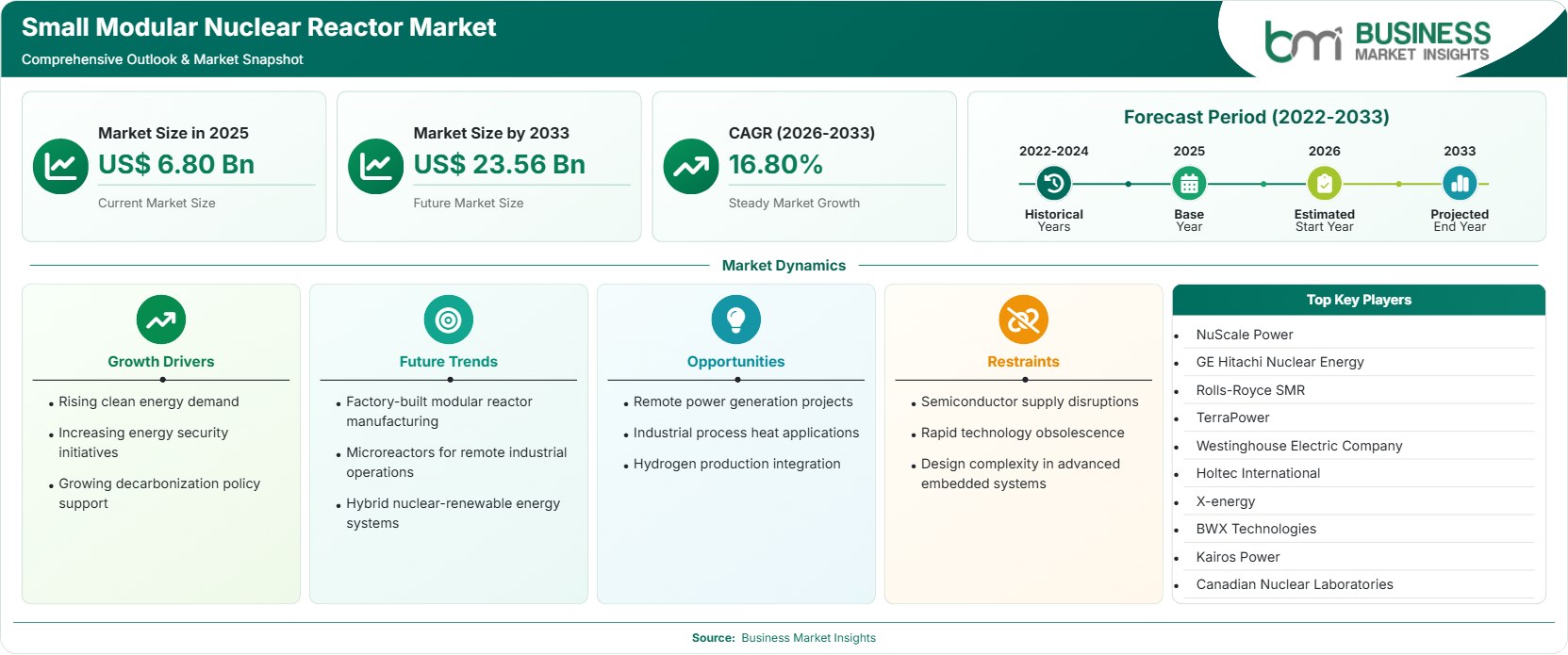
The Small Modular Nuclear Reactor Market size was valued at US$ 6.8 billion in 2025 and is projected to reach US$ 23.56 billion by 2033, growing at a CAGR of 16.80% during 2026–2033. Rising clean energy demand, increasing energy security initiatives, and growing decarbonization policy support are driving market expansion, while remote power generation, industrial heat applications, and hydrogen production integration create significant long-term opportunities.

Report Coverage
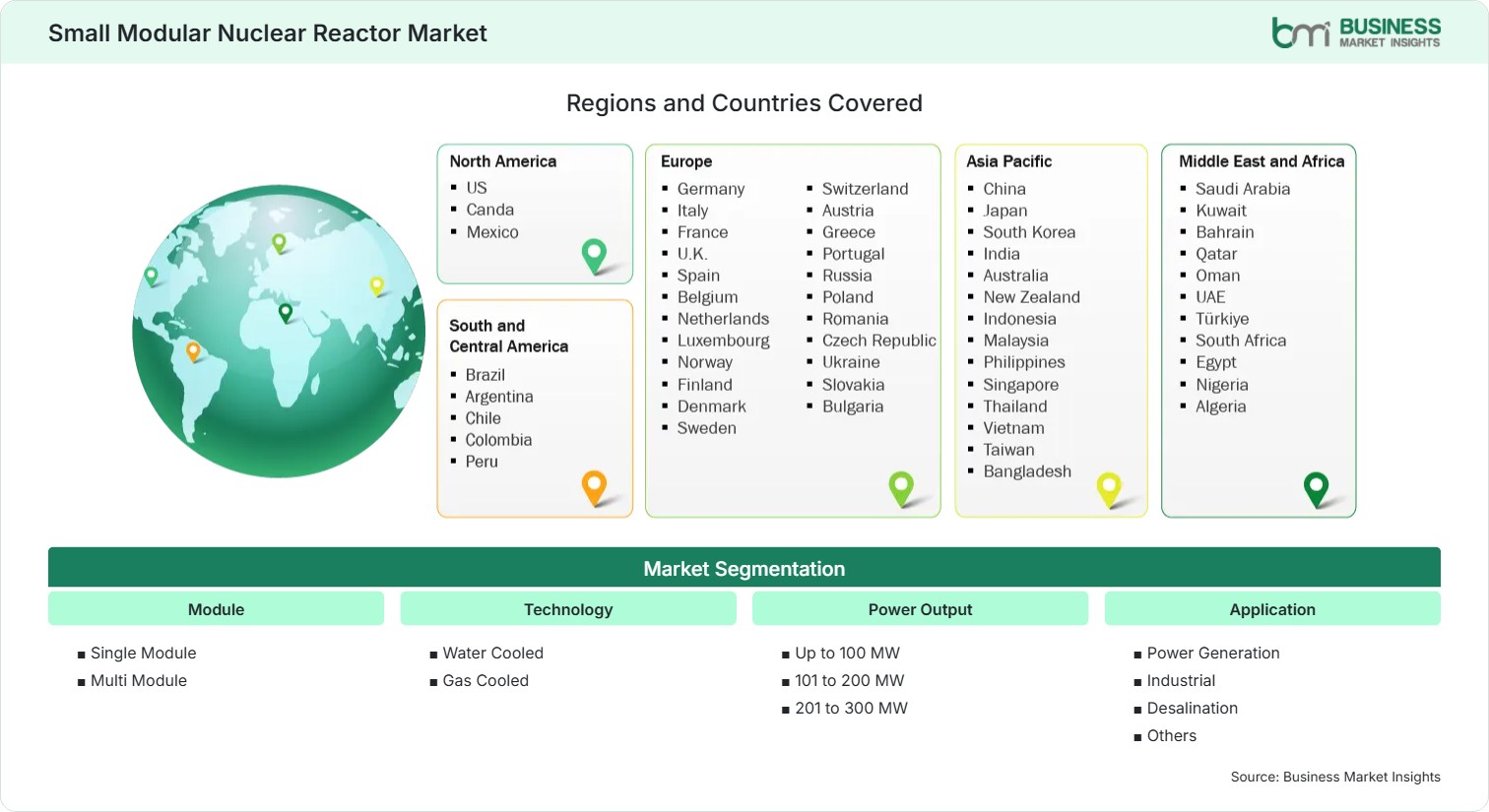
  • Module: Single Module, Multi Module
  • Technology: Water Cooled, Gas Cooled
  • Power Output: Up to 100 MW, 101 to 200 MW, 201 to 300 MW
  • Application: Power Generation, Industrial, Desalination, Others
US$ 6.80 Bn Market size in 2025
US$ 23.56 Bn Market Size by 2033
16.80% CAGR, 2026 - 2033
2026-2033 Forecast Period

01 AI Overview

Small Modular Nuclear Reactor Market Summary

  • North America Region: North America holds 36%–39% market share in 2025 and is projected to expand at a CAGR of 16.2%–16.8% during 2026–2033. Strong government funding, advanced nuclear technology development, and increasing investments in clean energy infrastructure continue supporting regional leadership. The U.S. market is expected to register a CAGR of 16.4%–17.0% during the forecast period.
  • Fastest Growing Region: Asia Pacific accounts for 27%–30% of the market in 2025 and is forecast to grow at a CAGR of 17.5%–18.1% through 2033. Rising electricity demand, expanding nuclear energy programs, and government decarbonization initiatives continue accelerating regional deployment.
  • Leading Segment: Water Cooled technology represents 74%–77% of the market in 2025 and is anticipated to expand at a CAGR of 16.4%–17.0% during the forecast period. Proven reactor technology, regulatory familiarity, and commercial readiness continue supporting segment dominance.
  • High Growth Segment: Power Generation accounts for 63%–66% market share in 2025 while advancing at a CAGR of 17.1%–17.7% through 2033. Growing demand for reliable low-carbon electricity generation and grid modernization continues driving rapid adoption.
  • Key Market Opportunity: Expanding deployment of modular nuclear reactors for remote communities, industrial facilities, hydrogen production, and hybrid renewable energy systems is creating substantial opportunities for technology developers and utility operators.
  • Major Market Players: NuScale Power Corporation, GE Hitachi Nuclear Energy, Rolls-Royce SMR Limited, TerraPower LLC, Westinghouse Electric Company LLC, Holtec International, X-energy, Inc., BWX Technologies, Inc., Kairos Power LLC, and Canadian Nuclear Laboratories.
02 Strategic Insights

Small Modular Nuclear Reactor Market: Strategic Insights

Small Modular Nuclear Reactor Market Strategic Framework
FREE PDF
Request your free sample
Request free sample
03 Stakeholder View

Key Takeaways

  • The market ecosystem is evolving through strategic collaboration among reactor developers, engineering firms, utility companies, component suppliers, regulatory authorities, and research organizations to accelerate commercialization and reduce deployment risks.
  • Industrial energy applications represent a major long-term growth opportunity, as energy-intensive industries increasingly evaluate small modular reactors for reliable electricity supply, process heat generation, and long-term carbon emission reduction.
  • Innovation is focused on advanced reactor designs, including passive safety systems, modular construction, digital monitoring technologies, and factory-manufactured components that reduce construction complexity and improve operational efficiency.
  • Asia Pacific offers the strongest future investment potential, supported by rising electricity consumption, government-backed nuclear expansion programs, growing industrialization, and long-term decarbonization commitments across major economies.
  • Government funding, strategic partnerships, and public-private collaborations continue accelerating commercialization. Reactor developers are securing investments, demonstration projects, and technology licensing agreements to strengthen global deployment capabilities.
04 Geographic Outlook

Small Modular Nuclear Reactor Market Regional Highlights

North America Small Modular Nuclear Reactor Market

North America accounted for approximately 36%–39% market share in 2025 and is projected to register a CAGR of 16.2%–16.8% during 2026–2033. Strong government funding, advanced nuclear research, and supportive energy transition policies continue reinforcing regional leadership. Increasing investments in next-generation reactor technologies are significantly contributing to Small Modular Nuclear Reactor Market growth across utility and industrial energy applications.

  • Government funding programs continue accelerating reactor demonstration projects, commercialization efforts, and domestic nuclear supply chain development across the United States and Canada.
  • Utility companies increasingly evaluate modular nuclear technologies to strengthen grid reliability while supporting carbon neutrality and long-term energy security objectives.
  • Advanced manufacturing techniques and standardized reactor modules continue reducing construction complexity, improving deployment efficiency, and lowering lifecycle project risks.
  • Strategic partnerships between reactor developers, engineering companies, and research institutions continue supporting technology validation and commercial deployment.
  • Rising demand for clean baseload electricity continues encouraging investments in advanced nuclear infrastructure alongside renewable energy systems.

US Small Modular Nuclear Reactor Market

The United States represented approximately 31%–34% of the global Small Modular Nuclear Reactor Market share in 2025 and is projected to grow at a CAGR of 16.4%–17.0% during the forecast period. Federal investments, supportive nuclear policies, and increasing demonstration projects continue driving commercial deployment of advanced reactor technologies.

  • Public-private partnerships continue supporting reactor licensing, engineering validation, and commercialization initiatives across multiple advanced nuclear developers.
  • Growing electricity demand from data centers, manufacturing facilities, and critical infrastructure continues strengthening interest in reliable nuclear power generation.
  • Research institutions continue advancing next-generation fuel technologies, reactor safety systems, and digital monitoring capabilities.
  • Nuclear modernization programs continue encouraging investment in resilient low-carbon energy infrastructure across utility and industrial sectors.

Europe Small Modular Nuclear Reactor Market

Europe accounted for approximately 24%–27% of the market in 2025 and is expected to register a CAGR of 16.6%–17.2% during 2026–2033. Decarbonization policies, energy security priorities, and increasing investment in advanced nuclear technologies continue to support regional market expansion.

  • The United Kingdom leads regional demand with a CAGR of 16.8%–17.4%, driven by government support, nuclear replacement programs, and strong investments in modular reactor development.
  • Poland is projected to record the fastest regional growth with a CAGR of 17.2%–17.8%, supported by expanding nuclear energy infrastructure and long-term energy diversification strategies.
  • France continues investing in advanced reactor technologies to strengthen low-carbon electricity generation and maintain long-term nuclear leadership.
  • Finland and Romania continue evaluating modular reactor deployment for energy security and industrial decarbonization initiatives.
  • Increasing collaboration between governments and technology developers continues accelerating licensing and demonstration activities throughout Europe.

Asia Pacific Small Modular Nuclear Reactor Market

Asia Pacific accounted for approximately 27%–30% of the market in 2025 and is projected to register the fastest CAGR of 17.5%–18.1% during 2026–2033. Expanding electricity demand, industrial development, and government commitments toward clean energy continue driving regional market growth.

  • China dominates regional deployment with a CAGR of 17.6%–18.2%, supported by strong government investment, advanced reactor development, and expanding clean energy infrastructure.
  • India is expected to record the fastest regional growth with a CAGR of 18.0%–18.6%, driven by increasing electricity demand, nuclear policy support, and industrial energy requirements.
  • Japan continues strengthening advanced reactor research and next-generation nuclear technology commercialization following energy diversification initiatives.
  • South Korea remains a leading exporter of nuclear technology while investing in advanced modular reactor development and international partnerships.
  • Growing industrial electrification and hydrogen economy initiatives continue expanding long-term regional opportunities.

Rest of World Small Modular Nuclear Reactor Market

The Rest of World region accounted for approximately 8%–10% of the global market in 2025 and is projected to expand at a CAGR of 16.9%–17.5% during the forecast period. Rising energy demand, mining operations, and remote infrastructure development continue creating opportunities across South & Central America and the Middle East & Africa.

Government diversification strategies and increasing investments in reliable low-carbon electricity generation continue supporting future deployment of modular nuclear technologies.

  • The United Arab Emirates leads regional adoption with a CAGR of 17.1%–17.7%, supported by long-term clean energy strategies and expanding nuclear infrastructure.
  • Saudi Arabia is projected to record the fastest regional growth with a CAGR of 17.4%–18.0%, driven by energy diversification programs and industrial development initiatives.
  • Brazil continues evaluating advanced nuclear technologies to strengthen long-term energy security and grid reliability.
  • South Africa continues exploring modular nuclear deployment to support electricity reliability and industrial energy requirements.
Global Market Geography
FREE PDF
Request your free sample
Request free sample
05 Segment Analysis

Small Modular Nuclear Reactor Market Segmentation

Technology

The Technology segment held a market share of about 74%–77% in 2025 and is estimated to grow at a CAGR of 16.4%–17.0% from 2026 to 2033. Innovations in reactor safety, modularity, and standardization will remain at the forefront of reactor development and deployment in the coming years. The expanding Small Modular Nuclear Reactors market scope has compelled manufacturers to develop more efficient reactors.

  • Water Cooled: Water-cooled reactors dominate the market due to their proven commercial reliability, mature supply chain, established regulatory framework, and extensive operational experience across global nuclear power programs.
  • Gas Cooled: Gas-cooled reactor technologies are gaining attention for their high operating temperatures, enhanced thermal efficiency, passive safety characteristics, and suitability for industrial heat and hydrogen production applications.

Power Output

The Power Output segment represented approximately 42%–45% of the market in 2025 and is expected to expand at a CAGR of 17.0%–17.6% during the forecast period. Higher demand for scalable power generation, mobility, and energy distribution sources further fuels adoption across a variety of reactor capacities.

  • Up to 100 MW: These reactors are increasingly deployed for remote communities, mining operations, military installations, and isolated industrial facilities requiring reliable low-carbon electricity generation.
  • 101 to 200 MW: Medium-capacity reactors support regional utilities and industrial users by balancing generation efficiency, modular deployment, and operational flexibility across diverse energy applications.
  • 201 to 300 MW: Higher-capacity modular reactors are gaining adoption for utility-scale electricity generation, grid stabilization, and integrated industrial energy systems requiring continuous power output.

Application

The Application segment accounted for approximately 63%–66% of the market in 2025 and is projected to register a CAGR of 17.1%–17.7% during 2026–2033. Increasing global demand for reliable low-carbon electricity and industrial decarbonization continues driving commercial adoption. Emerging Small Modular Nuclear Reactor Market trends are expanding applications beyond electricity generation into industrial processing and clean hydrogen production.

  • Power Generation: Power generation remains the largest application due to increasing investments in clean baseload electricity, grid modernization, and long-term energy security initiatives worldwide.
  • Industrial: Industrial facilities increasingly evaluate modular reactors to provide continuous electricity and process heat while reducing dependence on fossil fuels and lowering carbon emissions.
  • Desalination: Small modular reactors support sustainable desalination by delivering stable, low-carbon energy for freshwater production in water-stressed regions.
  • Others: Additional applications include district heating, hydrogen production, research facilities, defense installations, and integrated hybrid renewable energy systems.
06 Market Forces

Small Modular Nuclear Reactor Market Dynamics

Key Market Drivers

Rising clean energy demand

Global commitments to reduce greenhouse gas emissions are accelerating investments in reliable low-carbon electricity generation technologies. Small modular reactors provide carbon-free baseload power while complementing intermittent renewable energy sources. Growing electricity demand from industrial facilities, digital infrastructure, and transportation electrification continues to drive growth in the Small Modular Nuclear Reactor Market, encouraging governments and utilities to diversify their future energy portfolios.

Increasing energy security initiatives

Countries are strengthening domestic energy independence by investing in advanced nuclear technologies that deliver reliable electricity while reducing dependence on imported fossil fuels. Small modular reactors provide scalable, resilient, and long-term energy solutions that support national energy security strategies and help maintain a stable electricity supply amid changing energy market conditions.

Growing decarbonization policy support

National net-zero commitments and supportive energy policies continue encouraging the deployment of advanced nuclear technologies alongside renewable energy. Financial incentives, demonstration funding, and streamlined licensing initiatives are accelerating commercial development. These policy measures reinforce trends in the Small Modular Nuclear Reactor Market by improving investor confidence and supporting commercialization across multiple global regions.

Key Market Opportunities

Remote power generation projects

Mining operations, island communities, military bases, and isolated industrial facilities increasingly require reliable electricity where conventional grid infrastructure remains unavailable. Small modular reactors offer long operating cycles, reduced fuel logistics, and dependable low-carbon power generation. This opportunity significantly strengthens long-term Small Modular Nuclear Reactor Market Forecasts across remote energy applications.

Industrial process heat applications

Heavy industries, including chemicals, refining, steel, and cement manufacturing, require continuous high-temperature process heat. Small modular reactors provide stable, low-carbon thermal energy to support industrial decarbonization while reducing dependence on conventional fossil-fuel systems.

Hydrogen production integration

The expanding hydrogen economy creates opportunities for modular reactors to supply continuous electricity and process heat for large-scale hydrogen production. Integration with electrolysis and advanced hydrogen generation technologies enables efficient clean fuel production while improving energy system flexibility and supporting future decarbonization strategies.

Market Restraints and Challenges

High development costs

Factor: The primary Factor limiting commercialization is the substantial capital investment required for reactor development, engineering, licensing, manufacturing infrastructure, and first-of-a-kind deployment.

Impact: High upfront costs increase financing challenges, extend investment payback periods, and delay commercial deployment despite strong long-term operational advantages.

Lengthy regulatory licensing

Factor: The major Factor restricting faster Small Modular Nuclear Reactor market expansion is the complex regulatory approval process governing nuclear safety, environmental compliance, and reactor certification.

Impact: Extended licensing timelines increase project uncertainty, delay commercial operations, raise development costs, and slow the widespread adoption across international energy markets.

07 Company Analysis

Competitive Landscape

The competitive environment is shaped by investments in advanced reactor technologies, strategic government partnerships, and the commercialization of next-generation nuclear energy solutions. The Small Modular Nuclear Reactor Market analysis indicates that leading companies are focusing on modular reactor development, passive safety systems, fuel innovation, and international collaborations to strengthen their competitive positions.

Company Name

Overview

Products and Services Relevant to this Market

NuScale Power Corporation

U.S.-based developer specializing in advanced small modular nuclear reactor technology.

Integrated SMR power plants, reactor design, engineering services, licensing support, nuclear technology solutions.

GE Hitachi Nuclear Energy

Joint venture providing advanced nuclear reactor technologies for global utilities.

BWRX-300 SMR technology, reactor engineering, fuel services, plant modernization, nuclear lifecycle solutions.

Rolls-Royce SMR Limited

UK developer focused on factory-built modular nuclear power plants.

Small modular reactors, engineering services, modular construction technologies, lifecycle support.

TerraPower LLC

Advanced nuclear technology company developing next-generation reactor systems.

Advanced reactor technologies, sodium-cooled reactors, nuclear innovation, engineering, and research services.

Westinghouse Electric Company LLC

Global provider of nuclear power plant technologies and engineering services.

AP300 SMR technology, reactor engineering, fuel management, maintenance, and nuclear support services.

Holtec International

Nuclear technology company specializing in SMR development and energy systems.

SMR-300 reactor technology, nuclear equipment, spent fuel management, and engineering services.

X-energy, Inc.

Advanced reactor developer focused on high-temperature gas-cooled reactor technology.

Xe-100 reactor technology, TRISO fuel solutions, reactor engineering, and clean energy systems.

BWX Technologies, Inc.

Nuclear technology company serving government and commercial nuclear markets.

Nuclear components, reactor engineering, fuel manufacturing, and advanced nuclear technologies.

Kairos Power LLC

Developer of molten salt-cooled advanced reactor technologies.

Fluoride salt-cooled reactors, reactor engineering, advanced fuel technologies, nuclear R&D services.

Canadian Nuclear Laboratories

Canada's premier nuclear science and technology research organization.

Nuclear research, reactor testing, technology validation, licensing support, and advanced nuclear innovation.

08 Industry Activity

Recent Developments

June 2026

Rolls-Royce SMR Ltd. was selected by Vattenfall to supply SMRs for Sweden's planned new nuclear power project at the Ringhals site, marking a significant commercial milestone for its international expansion.

April 2026

Rolls-Royce SMR Ltd signed a contract with Great British Energy Nuclear to commence technology design activities for the UK's first Small Modular Reactor (SMR) project, following its selection as the preferred technology partner in 2025.

March 2026

GE Vernova Hitachi Nuclear Energy advanced deployment of its BWRX-300 SMR technology through a U.S.–Japan energy partnership aimed at supporting new SMR projects in Tennessee and Alabama, accelerating commercialization of advanced nuclear power.

May 2025

NuScale Power Corporation received U.S. Nuclear Regulatory Commission (NRC) approval for its 77 MWe uprated SMR design, making it the second SMR design approved for deployment in the United States.

10 Trust & Transparency

Research Methodology

The market analysis combines proprietary research with secondary data from government agencies, company disclosures, regulatory filings, industry databases and expert interviews. Market estimates are validated through data triangulation, cross-market benchmarking and analyst review.

View Full Research Methodology

11 Questions Answered

Frequently Asked Questions

Who are the leading companies operating in the market?

Major participants include NuScale Power Corporation, GE Hitachi Nuclear Energy, Rolls-Royce SMR Limited, TerraPower LLC, Westinghouse Electric Company LLC, Holtec International, X-energy, Inc., BWX Technologies, Inc., Kairos Power LLC, and Canadian Nuclear Laboratories.

Which application is expected to witness the highest growth?

Power generation remains the fastest-growing application as governments and utilities increasingly invest in low-carbon baseload electricity generation, grid reliability, and long-term energy diversification strategies.

Which technology segment dominates the market?

As highlighted in the Small Modular Nuclear Reactor Market report, the Water-cooled reactor technology leads the market due to its proven operational reliability, a mature regulatory framework, an established manufacturing ecosystem, and widespread commercial acceptance across global nuclear energy programs.

Which region leads the Market?

North America holds the largest market share owing to strong government funding, advanced nuclear technology development, established regulatory capabilities, and increasing deployment of demonstration projects across the United States and Canada.

What factors are driving the growth of the Small Modular Nuclear Reactor Market?

The market is driven by rising clean energy demand, increasing energy security initiatives, expanding government decarbonization policies, advancements in modular reactor technologies, and growing investments in reliable low-carbon electricity generation.

Access the Full Small Modular Nuclear Reactor Market Report

Get segment-level forecasts, regional estimates, competitive benchmarking, company profiles and downloadable Excel datasets.

Access the full Small Modular Nuclear Reactor Market Report
350 pages PDF & Excel | 2026-07-28