
Nuclear Power Plant Control System Market Outlook: Size, Share, Trends, Growth Analysis, Competitive Landscape & Forecast, 2026-2033

Historic Data: 2022-2024   |   Base Year: 2025   |   Forecast Period: 2026-2033
Report Content: Market Scope, Market Segmentation, Market Dynamics, and Competitive Analysis

Report Coverage:
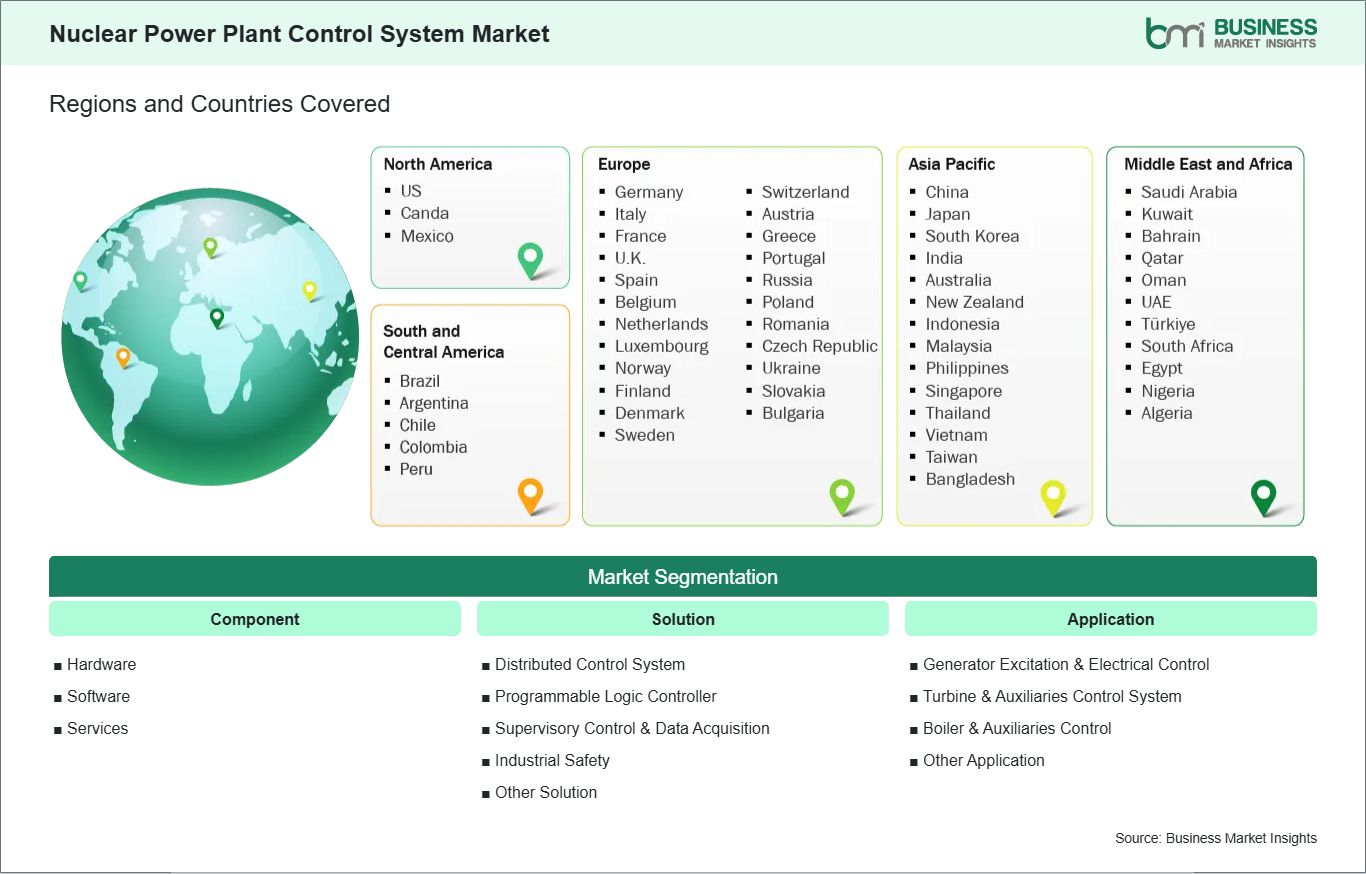
  • Component (Hardware, Software, Services)
  • Solution (Distributed Control System (DCS), Programmable Logic Controller (PLC), Supervisory Control & Data Acquisition (SCADA), Industrial Safety, Other Solution)
  • Application (Generator Excitation & Electrical Control, Turbine & Auxiliaries Control System, Boiler & Auxiliaries Control, Other Application)

No. of Pages: 400
Report Code: BMIPUB00035385
Category: Energy and Power
Nuclear Power Plant Control System Market

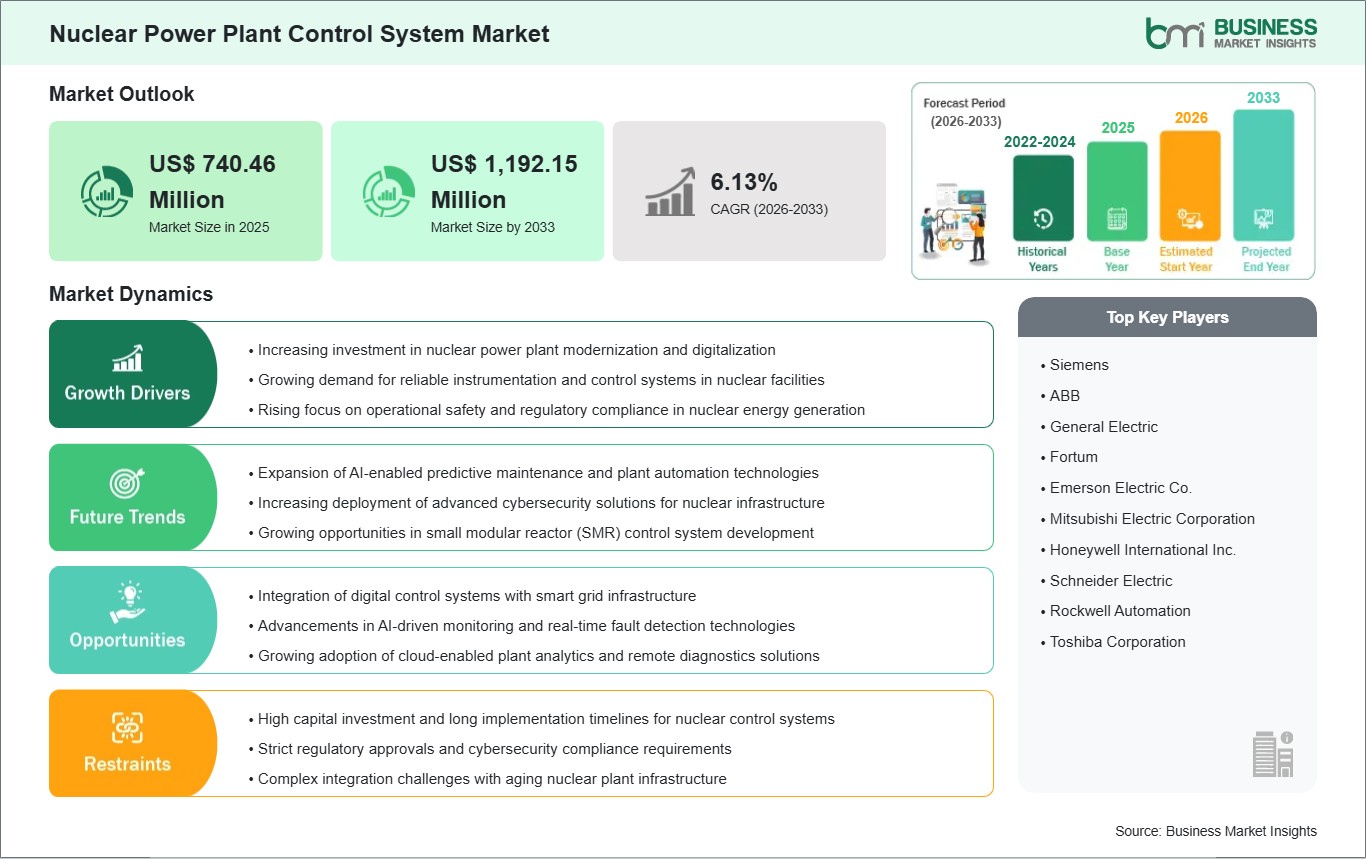
The Nuclear Power Plant Control System Market size is expected to reach US$ 1,192.15 Million by 2033 from US$ 740.46 Million in 2025.The market is estimated to record a CAGR of 6.13% from 2026 to 2033.

Executive Summary and Global Market Analysis:

Nuclear Power Plant Control Systems refer to advanced instrumentation, automation, and monitoring solutions designed to continuously manage, regulate, and safeguard nuclear reactor operations and associated power generation processes. These systems leverage distributed control systems (DCS), supervisory control and data acquisition (SCADA) platforms, programmable logic controllers (PLCs), advanced sensors, and AI-powered analytics to ensure reliable, precise, and real-time operational control within highly sensitive nuclear environments. By enabling continuous monitoring of reactor conditions, coolant systems, turbine performance, and safety mechanisms, nuclear power plant control systems support efficient power generation, operational stability, and rapid anomaly detection. This technology is becoming a core component of modern nuclear energy infrastructure, particularly within reactor automation, plant safety systems, and smart grid integration frameworks. Market expansion is being driven by increasing investments in nuclear power plant modernization, rising global demand for low-carbon energy generation, and growing adoption of digital instrumentation and control technologies across nuclear facilities.

However, several factors may restrain market progression. The high capital investment associated with advanced control infrastructure, cybersecurity systems, and safety-critical instrumentation remains a significant barrier for new installations and retrofitting projects. The industry also faces technical challenges related to system reliability, interoperability, and compliance with stringent nuclear safety regulations under highly complex operational environments. Cybersecurity concerns surrounding digital control networks further complicate large-scale deployment, as nuclear facilities require highly secure and resilient communication architectures to prevent operational disruptions and cyber threats. Additionally, integration complexities associated with aging nuclear infrastructure increase implementation timelines and maintenance requirements. The need for continuous system validation, redundancy management, and regulatory certification further elevates operational costs and deployment complexity for plant operators and technology providers.

Despite these challenges, the market outlook remains highly favorable as the energy sector transitions toward intelligent, digitally connected, and safety-centric nuclear power ecosystems. Opportunities are emerging through the convergence of artificial intelligence, predictive maintenance technologies, and cloud-enabled plant analytics, enabling highly responsive nuclear control systems capable of real-time fault detection and performance optimization. The expansion of small modular reactor (SMR) projects and next-generation nuclear technologies is accelerating demand for advanced automation and digital safety platforms. Furthermore, increasing adoption of AI-driven diagnostics, digital twins, and remote monitoring solutions is creating new opportunities for operational efficiency and asset lifecycle management. Ongoing advancements in cybersecurity frameworks, smart sensors, and autonomous process control are also enhancing system reliability and resilience. Collectively, these developments position the nuclear power plant control system market for sustained growth as a critical enabler of safe, efficient, and next-generation nuclear energy infrastructure.

Nuclear Power Plant Control System Market - Strategic Insights:

global-market-strategic-framework
Get more information on this report

Nuclear Power Plant Control System Market Segmentation Analysis:

The nuclear power plant control system market is segmented based on component, reactor type, and application, reflecting the increasing integration of intelligent sensing and AI-driven safety solutions across modern automotive systems.

By Component

  • Distributed Control Systems (DCS): Utilizes centralized and distributed automation platforms to monitor and control reactor operations, turbine systems, and plant processes in real time
  • Supervisory Control and Data Acquisition (SCADA): Enables remote monitoring, data acquisition, and operational supervision across critical nuclear plant infrastructure
  • Programmable Logic Controllers (PLCs): Provides automated process control and safety interlocks for reliable and precise plant operations
  • Human Machine Interface (HMI): Enhances operator interaction through real-time visualization, control dashboards, and performance monitoring systems
  • Safety Instrumentation and Control Systems: Integrates sensors, alarms, and automated shutdown mechanisms to maintain nuclear reactor safety and regulatory compliance

By Reactor Type

  • Pressurized Water Reactor (PWR): Includes nuclear facilities using pressurized water systems for reactor cooling and heat transfer operations
  • Boiling Water Reactor (BWR): Covers reactors where steam is generated directly within the reactor vessel for electricity production
  • Small Modular Reactor (SMR): Focuses on compact and modular nuclear reactor systems requiring advanced digital control and automation technologies
  • Other Reactor Types: Includes heavy water reactors, gas-cooled reactors, and advanced next-generation nuclear reactor systems

By Application

  • Reactor Control and Monitoring: Focuses on maintaining stable reactor performance, operational safety, and real-time process management
  • Turbine and Generator Control: Supports efficient power generation through automated turbine speed, pressure, and energy output regulation
  • Radiation and Safety Monitoring: Detects radiation levels and operational anomalies to ensure plant safety and environmental protection
  • Plant Asset Management and Predictive Maintenance: Enables real-time diagnostics, equipment monitoring, and AI-driven maintenance optimization
  • Grid Integration and Power Distribution Management: Supports synchronization of nuclear power generation with smart grid and energy distribution networks
Nuclear Power Plant Control System Market Drivers and Opportunities:

Rising Demand for Nuclear Plant Modernization, Operational Safety, and Digital Automation

The Nuclear Power Plant Control System market is being driven by the increasing need for enhanced operational safety, real-time process monitoring, and compliance with stringent nuclear regulatory standards. Unlike conventional plant management systems, modern nuclear control systems utilize distributed control systems (DCS), supervisory control and data acquisition (SCADA), advanced sensors, and AI-based analytics to ensure accurate monitoring and control of reactor operations, turbine performance, radiation levels, and safety mechanisms in real time. The rising modernization of aging nuclear power plants is significantly accelerating demand, as energy operators focus on improving plant efficiency, operational reliability, and safety performance. Growing concerns regarding energy security and low-carbon electricity generation, along with increasing investments in nuclear energy infrastructure, are further strengthening market adoption. Additionally, the expansion of small modular reactors (SMRs) and next-generation nuclear facilities is increasing the need for intelligent automation and advanced digital instrumentation systems as critical components of modern reactor operations.

In large-scale nuclear facilities and energy generation networks, advanced control systems are gaining strong traction due to their ability to enhance operational efficiency, minimize downtime, and improve predictive maintenance capabilities. The development of smart grid ecosystems and connected energy infrastructure is further supporting adoption by enabling real-time monitoring, automated diagnostics, and intelligent energy distribution management. Technological advancements in AI-driven analytics, cybersecurity solutions, and high-performance industrial automation platforms are improving system reliability while reducing operational complexity. Collectively, these factors are driving sustained market growth, supported by the convergence of digital transformation, energy modernization, and increasing deployment of intelligent nuclear control technologies.

Rising Integration of AI, Predictive Analytics, and Smart Energy Infrastructure

Opportunities in the Nuclear Power Plant Control System market are expanding through the integration of artificial intelligence, predictive maintenance technologies, and next-generation smart energy ecosystems. AI-powered systems are enabling advanced capabilities such as anomaly detection, automated fault diagnostics, and real-time reactor performance optimization, significantly enhancing plant safety and operational intelligence. The adoption of digital twins, cloud-enabled monitoring platforms, and integrated sensor networks is improving system resilience and operational visibility across complex nuclear environments.

The evolution of small modular reactors (SMRs) and advanced nuclear technologies is creating strong opportunities, where highly automated control systems play a critical role in ensuring efficient and safe plant operations. Additionally, the growth of smart grid infrastructure and connected energy management systems is opening new opportunities for real-time power distribution optimization and remote plant monitoring. Increasing investments in industrial cybersecurity and AI-driven operational analytics are further accelerating innovation across the market. The emergence of autonomous process control, edge computing, and advanced human-machine interface (HMI) technologies is also improving scalability and decision-making efficiency. Furthermore, advancements in smart sensors and remote diagnostics platforms are reducing maintenance costs and enhancing asset lifecycle management. Collectively, the convergence of AI, intelligent automation, and digitally connected energy ecosystems is positioning the nuclear power plant control system market for sustained long-term expansion.

Nuclear Power Plant Control System Market Size and Share Analysis:

The Nuclear Power Plant Control System Market is projected to grow from US$ 740.46 Million in 2025 to US$ 1,192.15 Million by 2033 , registering a CAGR of 6.13% from 2026 to 2033.

By component, distributed control systems (DCS) account for a significant share as they enable centralized and real-time monitoring of reactor operations, turbine performance, and plant-wide automation with high reliability and operational precision. Supervisory control and data acquisition (SCADA) systems continue to grow due to their ability to support remote monitoring, data acquisition, and intelligent process supervision across critical nuclear infrastructure. Programmable logic controllers (PLCs) are gaining traction as they provide reliable automated control and safety interlocks for mission-critical plant operations. Human machine interface (HMI) systems are expanding steadily, driven by their capability to improve operator decision-making through real-time visualization, diagnostics, and control dashboards. Safety instrumentation and control systems are also witnessing strong adoption as they integrate sensors, alarms, and automated shutdown mechanisms to enhance operational safety, regulatory compliance, and reactor protection.

By reactor type, pressurized water reactors (PWRs) dominate adoption due to their widespread deployment across global nuclear power generation facilities and their strong reliance on advanced automation and control technologies for safe reactor operations. Boiling water reactors (BWRs) continue to maintain significant demand owing to their integrated steam generation systems and requirement for continuous monitoring and process optimization. Small modular reactors (SMRs) are experiencing strong growth as governments and energy providers increasingly invest in compact, next-generation nuclear technologies that require highly advanced digital control systems, remote diagnostics, and intelligent automation capabilities for efficient and scalable deployment.

Nuclear Power Plant Control System Market Report Highlights:

Report Attribute Details
Market size in 2025 US$ 740.46 Million
Market Size by 2033 US$ 1,192.15 Million
Global CAGR (2026 - 2033)6.13%
Historical Data 2022-2024
Forecast period 2026-2033
Segments Covered By Component
  • Hardware
  • Software
  • Services
By Solution
  • Distributed Control System
  • Programmable Logic Controller
  • Supervisory Control & Data Acquisition
  • Industrial Safety
  • Other Solution
By Application
  • Generator Excitation & Electrical Control
  • Turbine & Auxiliaries Control System
  • Boiler & Auxiliaries Control
  • Other Application
Regions and Countries Covered
North America US, Canada, Mexico
Europe Germany, Italy, France, U.K., Spain, Belgium, Netherlands, Luxembourg, Norway, Finland, Denmark, Sweden, Switzerland, Austria, Greece, Portugal, Russia, Poland, Romania, Czech Republic, Ukraine, Slovakia, Bulgaria
Asia-Pacific China, Japan, South Korea, India, Australia, New Zealand, Indonesia, Malaysia, Philippines, Singapore, Thailand, Vietnam, Taiwan, Bangladesh
South and Central America Brazil, Argentina, Chile, Colombia, Peru
Middle East and Africa Saudi Arabia, United Arab Emirates, Kuwait, Bahrain, Qatar, Oman, Turkiye, South Africa, Egypt, Nigeria, Algeria
Market leaders and key company profiles
  • Siemens
  • ABB
  • General Electric
  • Fortum
  • Emerson Electric Co.
  • Mitsubishi Electric Corporation
  • Honeywell International Inc.
  • Schneider Electric
  • Rockwell Automation
  • Toshiba Corporation
Get more information on this report

Nuclear Power Plant Control System Market Report Coverage and Deliverables:

The "Nuclear Power Plant Control System Market Size and Forecast (2022–2033)" report provides a detailed analysis of the market covering below areas:

  • Nuclear power plant control system market size and forecast at global, regional, and country levels for all market segments covered under the scope
  • Nuclear power plant control system market trends, as well as drivers, restraints, and opportunities
  • Nuclear power plant control system market analysis covering key trends, global and regional framework, major players, regulations, and recent developments
  • Industry landscape and competition analysis covering market concentration, heat map analysis, prominent players, and recent developments for the nuclear power plant control system market
  • Detailed company profiles, including SWOT analysis

Nuclear Power Plant Control System Market Geographic Insights:

The Nuclear Power Plant Control System Market shows diverse regional adoption patterns influenced by rising energy security concerns, increasing investments in nuclear power generation, and growing deployment of advanced automation and digital control technologies across nuclear facilities.

North America, being a technologically advanced and highly regulated energy region, holds a strong position in the market due to the presence of major nuclear operators, automation technology providers, and strong government support for nuclear energy modernization. The United States and Canada are witnessing increasing deployment of advanced nuclear control systems in reactor operations, plant safety management, and grid integration applications. The region is heavily focused on improving operational safety, extending the lifecycle of aging nuclear plants, and enhancing efficiency through digital instrumentation and control systems. Strong investments in distributed control systems (DCS), cybersecurity solutions, and AI-enabled predictive maintenance platforms are further supporting market expansion. Additionally, well-established regulatory frameworks and growing interest in small modular reactors (SMRs) are accelerating modernization efforts across nuclear infrastructure.

Asia Pacific is experiencing significant growth, driven by rapid expansion of nuclear energy capacity, rising electricity demand, and strong government initiatives to reduce carbon emissions. Countries such as China, India, Japan, and South Korea are actively investing in new nuclear power plants and upgrading existing facilities with advanced control and automation systems. The region’s strong industrial base and cost-competitive manufacturing ecosystem are enabling large-scale deployment of distributed control systems, SCADA platforms, and advanced instrumentation and control technologies. Increasing focus on energy diversification, urbanization, and long-term power security is further contributing to adoption, particularly in large-scale nuclear generation projects. Additionally, rising investments in smart grid infrastructure, digital twin technologies, and AI-driven plant monitoring systems are supporting continuous innovation across the region.

Both regions are contributing significantly to the growth of the Nuclear Power Plant Control System Market, driven by technological advancements, increasing emphasis on low-carbon energy generation, and rising adoption of intelligent automation and digital control solutions across nuclear power infrastructure.

global-market-geography
Get more information on this report

Nuclear Power Plant Control System Market Research Report Guidance:

  • The report includes qualitative and quantitative data for the nuclear power plant control system market across component, reactor type, application, and geography.
  • The report starts with the key takeaways (chapter 2), highlighting the key trends and outlook of the nuclear power plant control system market.
  • Chapter 3 focuses on the research methodology of the study.
  • Chapter 4 includes ecosystem analysis.
  • Chapter 5 highlights the major industry dynamics in the nuclear power plant control system market, including factors that are driving the market, prevailing deterrents, potential opportunities, as well as future trends. Impact analysis of these drivers and restraints is also covered in this section.
  • Chapter 6 discusses the nuclear power plant control system market scenario, in terms of historical market revenues, and forecast till the year 2033.
  • Chapters 7 to 10 cover nuclear power plant control system market segments by component, reactor type, application, and geography across North America, Europe, Asia Pacific, Middle East and Africa, and South and Central America. They cover the market revenue, forecast, and factors driving the market.
  • Chapter 11 describes the competitive analysis along with the heat map analysis for the key players operating in the market.
  • Chapter 12 describes the industry landscape analysis. It provides detailed descriptions of business activities such as market initiatives, new developments, mergers, and joint ventures globally, along with a competitive landscape.
  • Chapter 13 provides detailed profiles of the major companies operating in the nuclear power plant control system market. Companies have been profiled on the basis of their key facts, business descriptions, products and services, financial overview, SWOT analysis, and key developments.
  • Chapter 14, i.e., the appendix, is inclusive of a brief overview of the company, list of abbreviations, and disclaimer.

Nuclear Power Plant Control System Market News and Key Development:

The nuclear power plant control system market is evaluated by gathering qualitative and quantitative data post primary and secondary research, which includes important corporate publications, association data, and databases. A few of the key developments in the nuclear power plant control system market are:

  • In May 2026, Rosatom Automated Control Systems JSC (RASU JSC, the Instrumentation & Control and Electrical Engineering Division of Rosatom State Corporation) integrated the Operator Information Support System (OISS) into the I&C of Rooppur NPP Unit 1, which is currently undergoing commissioning procedures in the Republic of Bangladesh. This is the first time when OISS is implemented at a non-Russian nuclear power facility. Novovoronezh NPP was the pilot site. In addition, the system has already been launched at Kursk NPP-2, at the most powerful new power unit in Russia. The system will help the personnel of the first nuclear power plant in Bangladesh to monitor the parameters of the power unit and improve the efficiency of the plant.
  • In India’s Union Budget 2025, a Nuclear Energy Mission was launched with an allocation of INR 20,000 crore for research and development (R&D) in small modular reactors (SMRs) that would be capable of resolving many of India’s energy dilemmas and contributing to its energy transition.

Key Sources Referred:

  • World Bank – Global Trade Indicators
  • World Trade Organization (WTO)
  • (International Monetary Fund )IMF
  • International Trade Administration (ITA)
  • Company website
  • Company annual reports
  • Company investor presentations
The List of Companies - Nuclear Power Plant Control System Market
  • Siemens
  • ABB
  • General Electric
  • Fortum
  • Emerson Electric Co.
  • Mitsubishi Electric Corporation
  • Honeywell International Inc.
  • Schneider Electric
  • Rockwell Automation
  • Toshiba Corporation
Frequently Asked Questions
How big is the Nuclear Power Plant Control System Market?

The Nuclear Power Plant Control System Market is valued at US$ 740.46 Million in 2025, it is projected to reach US$ 1,192.15 Million by 2033.

What is the CAGR for Nuclear Power Plant Control System Market by (2026 - 2033)?

As per our report Nuclear Power Plant Control System Market, the market size is valued at US$ 740.46 Million in 2025, projecting it to reach US$ 1,192.15 Million by 2033. This translates to a CAGR of approximately 6.13% during the forecast period.

What segments are covered in this report?

The Nuclear Power Plant Control System Market report typically cover these key segments-

  • Component (Hardware, Software, Services)
  • Solution (Distributed Control System (DCS), Programmable Logic Controller (PLC), Supervisory Control & Data Acquisition (SCADA), Industrial Safety, Other Solution)
  • Application (Generator Excitation & Electrical Control, Turbine & Auxiliaries Control System, Boiler & Auxiliaries Control, Other Application)

What is the historic period, base year, and forecast period taken for Nuclear Power Plant Control System Market?

The historic period, base year, and forecast period can vary slightly depending on the specific market research report. However, for the Nuclear Power Plant Control System Market report:

  • Historic Period : 2022-2024
  • Base Year : 2025
  • Forecast Period : 2026-2033
  • Who are the major players in Nuclear Power Plant Control System Market?

    The Nuclear Power Plant Control System Market is populated by several key players, each contributing to its growth and innovation. Some of the major players include:

  • Siemens
  • ABB
  • General Electric
  • Fortum
  • Emerson Electric Co.
  • Mitsubishi Electric Corporation
  • Honeywell International Inc.
  • Schneider Electric
  • Rockwell Automation
  • Toshiba Corporation
  • Who should buy this report?

    The Nuclear Power Plant Control System Market report is valuable for diverse stakeholders, including:

    • Investors: Provides insights for investment decisions pertaining to market growth, companies, or industry insights. Helps assess market attractiveness and potential returns.
    • Industry Players: Offers competitive intelligence, market sizing, and trend analysis to inform strategic planning, product development, and sales strategies.
    • Suppliers and Manufacturers: Helps understand market demand for components, materials, and services related to concerned industry.
    • Researchers and Consultants: Provides data and analysis for academic research, consulting projects, and market studies.
    • Financial Institutions: Helps assess risks and opportunities associated with financing or investing in the concerned market.

    Essentially, anyone involved in or considering involvement in the Nuclear Power Plant Control System Market value chain can benefit from the information contained in a comprehensive market report.

    Available Report Formats

    pdf-format excel-format pptx-format
    Buy Now
    Sales Assistance
    +1 646 791 7070 (US & UK)
    Customization Form

    Please tell us your area of interest
    (Market Segments/ Regions and Countries/ Companies)