
Nuclear Power Plant Equipment Market Outlook: Size, Share, Trends, Growth Analysis, Competitive Landscape & Forecast, 2026–2033

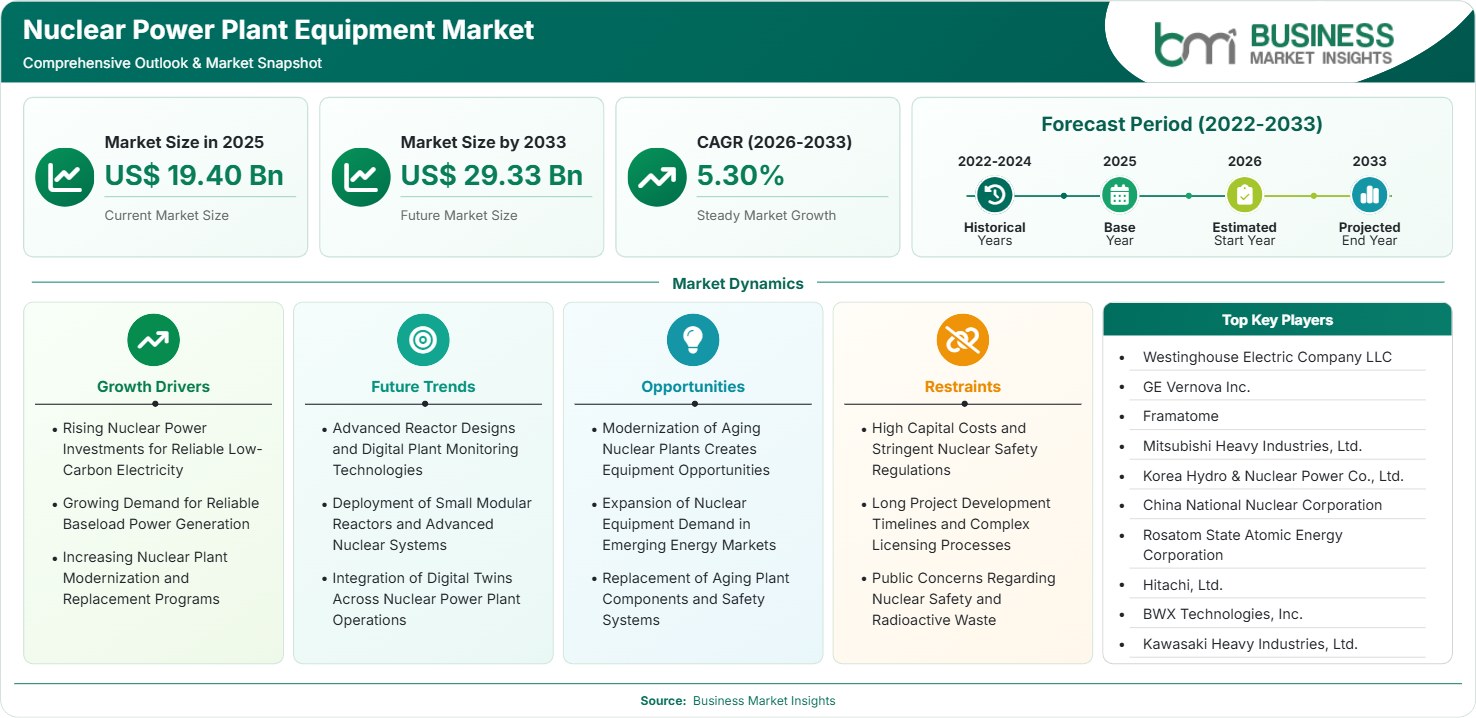
The Nuclear Power Plant Equipment Market size was valued at US$ 19.40 Billion in 2025 and is projected to reach US$ 29.33 Billion by 2033, growing at a CAGR of 5.30% during 2026–2033. Reactor construction, plant life extension, equipment replacement, safety modernization, and demand for dependable low-carbon electricity create attractive equipment opportunities.

Report Coverage
  • Equipment Type: Island Equipment, Auxiliary Equipment
  • Reactor Type: Pressurized Water Reactors , Boiling Water Reactors , Pressurized Heavy Water Reactors , Others
US$ 19.40 Bn Market size in 2025
US$ 29.33 Bn Market Size by 2033
5.30% CAGR, 2026 - 2033
2026-2033 Forecast Period

01 AI Overview

Nuclear Power Plant Equipment Market Summary

  • North America: North America holds a 22%–25% share in 2025, growing at a 4.6%–5.3% CAGR during 2026–2033, supported by refurbishment, life extension, advanced reactors, and federal policy incentives. The US market combines reactor life extension, equipment replacement, and advanced nuclear investment, with growth of approximately 4.8%–5.5% CAGR through 2033.
  • Fastest Growing Region: Asia Pacific holds a 39%–43% Nuclear Power Plant Equipment Market share in 2025, expanding at a 6.2%–7.0% CAGR during 2026–2033, supported by construction pipelines, electricity demand, localization, standardized reactor designs, industrial decarbonization, and increasing procurement of primary and auxiliary equipment.
  • Leading Segment: Island Equipment accounts for a 60%–64% share in 2025, advancing at a 5.1%–5.7% CAGR during 2026–2033, driven by reactor construction, pressure-boundary systems, turbine equipment, steam-generation packages, replacement requirements, and nuclear safety specifications.
  • High Growth Segment: Auxiliary Equipment represents a 36%–40% share in 2025, expanding at a 5.7%–6.4% CAGR during 2026–2033, supported by upgraded cooling, electrical, monitoring, instrumentation, waste management, emergency systems, digital controls, and modernization programs.
  • Key Market Opportunity: Long-duration plant operation, advanced reactors, component replacement, digital instrumentation, domestic supply-chain development, and standardized equipment platforms can create recurring procurement and lifecycle-service revenue opportunities.
  • Major Market Players: Westinghouse Electric Company LLC, GE Vernova Inc., Framatome, Mitsubishi Heavy Industries, Ltd., Korea Hydro & Nuclear Power Co., Ltd., China National Nuclear Corporation, Rosatom State Atomic Energy Corporation, Hitachi, Ltd., BWX Technologies, Inc., Kawasaki Heavy Industries, Ltd.
02 Strategic Insights

Nuclear Power Plant Equipment Market: Strategic Insights

Nuclear Power Plant Equipment Market Strategic Framework
FREE PDF
Request your free sample
Request free sample
03 Stakeholder View

Key Takeaways

  • Equipment procurement is increasingly organized around integrated engineering, manufacturing, qualification, commissioning, maintenance, and replacement ecosystems, making supplier certification, traceability, and long-term service capability critical competitive differentiators.
  • Auxiliary systems provide attractive recurring demand because operating reactors require continuing upgrades to cooling, electrical distribution, instrumentation, monitoring, emergency response, and waste-management infrastructure.
  • Advanced reactors and SMRs are encouraging modular equipment architectures, digital instrumentation, factory fabrication, improved materials, automated inspection, and design standardization aimed at reducing construction complexity.
  • Asia Pacific offers the strongest project pipeline, with China reporting 38 reactors under construction and India reporting eight under construction in the latest World Nuclear Association database.
  • Suppliers are strengthening manufacturing capacity through acquisitions and strategic partnerships. BWX Technologies, Inc. completed its acquisition of Precision Components Group in July 2026, expanding US nuclear component manufacturing.
  • Companies that secure qualified regional manufacturing, engineering partnerships, and component standardization can improve delivery reliability while reducing exposure to project-specific supply-chain bottlenecks.
04 Geographic Outlook

Nuclear Power Plant Equipment Market Regional Highlights

North America Nuclear Power Plant Equipment Market

North America represents a 22%–25% share in 2025, with a 4.6%–5.3% CAGR during 2026–2033. Demand is supported by reactor life extension, refurbishment, advanced reactor programs, domestic manufacturing, and grid reliability priorities. The region combines mature operating assets with emerging SMR opportunities. US utilities are prioritizing long-term equipment reliability, while Canada is progressing advanced reactor deployment.

  • Life-extension programs create recurring requirements for steam generators, pumps, valves, electrical systems, instrumentation, and safety-support equipment across mature reactor fleets.
  • Advanced reactor programs are encouraging localized component manufacturing, modular fabrication, digital controls, and specialized engineering partnerships that can shorten delivery cycles for future projects.
  • US and Canadian suppliers are strengthening nuclear manufacturing capabilities to reduce dependence on international supply chains and improve availability of safety-critical components.
  • Increasing electricity demand from industrial facilities and data centers strengthens the commercial case for dependable nuclear generation, supporting equipment modernization and capacity expansion.

US Nuclear Power Plant Equipment Market

The US nuclear power plant equipment market represents approximately 75%–80% of North American demand in 2025, with a 4.8%–5.5% CAGR during 2026–2033. The market combines a large installed fleet with advanced reactor development and renewed interest in nuclear manufacturing. Equipment demand is concentrated around life extension, turbine and generator upgrades, instrumentation, controls, safety systems, and replacement components. Government-backed initiatives are also supporting domestic nuclear fuel, manufacturing, and advanced reactor capabilities, strengthening the long-term supplier ecosystem.

  • Operating fleet modernization supports replacement of aging components, instrumentation systems, electrical equipment, pumps, valves, and monitoring technologies during planned maintenance cycles.
  • Advanced reactor initiatives are creating opportunities for specialized manufacturers supplying modular components, reactor systems, digital controls, heat-transfer equipment, and factory-fabricated assemblies.
  • Domestic manufacturing investments can improve delivery resilience, particularly for large components requiring specialized nuclear-grade fabrication, certification, testing, and quality assurance.

Europe Nuclear Power Plant Equipment Market

Europe nuclear power plant equipment market holds a 25%–28% share in 2025, expanding at a 3.8%–4.6% CAGR during 2026–2033. France remains the leading equipment market because of its extensive nuclear fleet and modernization requirements, while the United Kingdom represents a major new-build opportunity. France is expected to grow around 4.0%–4.7% CAGR, while the UK can reach approximately 5.0%–6.0% CAGR as new-build and replacement programs progress.

  • France's large operating fleet supports sustained demand for maintenance, replacement components, safety upgrades, instrumentation, electrical equipment, and reactor modernization services.
  • The United Kingdom offers high-value opportunities linked to new nuclear construction, including equipment packages for large reactors and emerging advanced nuclear technologies.
  • Central and Eastern European markets are evaluating new reactors to strengthen energy security, increasing demand for qualified suppliers, engineering services, and long-term equipment maintenance.
  • European nuclear procurement increasingly emphasizes lifecycle reliability, safety qualification, standardized documentation, cybersecurity, and supply-chain resilience alongside initial equipment cost.

Asia Pacific Nuclear Power Plant Equipment Market

Asia Pacific commands a 39%–43% share in 2025, representing the fastest-growing region at a 6.2%–7.0% CAGR during 2026–2033. China leads regional construction activity, while India, South Korea, and Japan contribute major equipment demand. China is expected to expand around 6.5%–7.3% CAGR, while India can reach approximately 7.0%–8.0% CAGR. Current global construction activity confirms Asia's dominant position in future reactor deployment.

  • China has the largest construction pipeline, supporting high-volume procurement of reactor-island systems, steam-generation equipment, pumps, valves, controls, and auxiliary infrastructure.
  • India is expanding nuclear capacity through PHWR projects and additional planned reactors, creating opportunities for domestic manufacturing, component localization, engineering, and equipment standardization.
  • South Korea retains strong export capabilities through established reactor designs, while Japan's restarting fleet creates refurbishment and replacement demand for qualified equipment suppliers.
  • Asia Pacific's expanding industrial base and electricity consumption support nuclear investment, strengthening long-term requirements for reliable baseload generation and associated equipment.

Rest of World Nuclear Power Plant Equipment Market

Rest of World represents an 8%–11% share in 2025, growing at a 4.4%–5.3% CAGR during 2026–2033. South and Central America are led by Brazil and Argentina, while the Middle East and Africa offer emerging opportunities. Brazil can grow approximately 4.2%–5.0% CAGR, whereas Egypt and Saudi Arabia represent stronger prospective growth markets as nuclear programs mature and supplier relationships develop. Middle Eastern deployment is supported by energy diversification and industrial development, while African markets remain earlier-stage opportunities. Egypt's four reactors under construction demonstrate that nuclear equipment demand is extending into newer nuclear markets.

  • Brazil's operating fleet and additional capacity plans support refurbishment, component replacement, and engineering opportunities for qualified international and domestic suppliers.
  • Argentina offers specialized opportunities around reactor operation, refurbishment, and technology partnerships as its nuclear program develops additional capacity.
  • Egypt represents an important emerging market, with four reactors under construction and substantial requirements for reactor-island, auxiliary, electrical, cooling, and safety equipment.
  • Middle Eastern developers increasingly evaluate nuclear power for reliable electricity, industrial applications, desalination, and long-term energy diversification strategies.
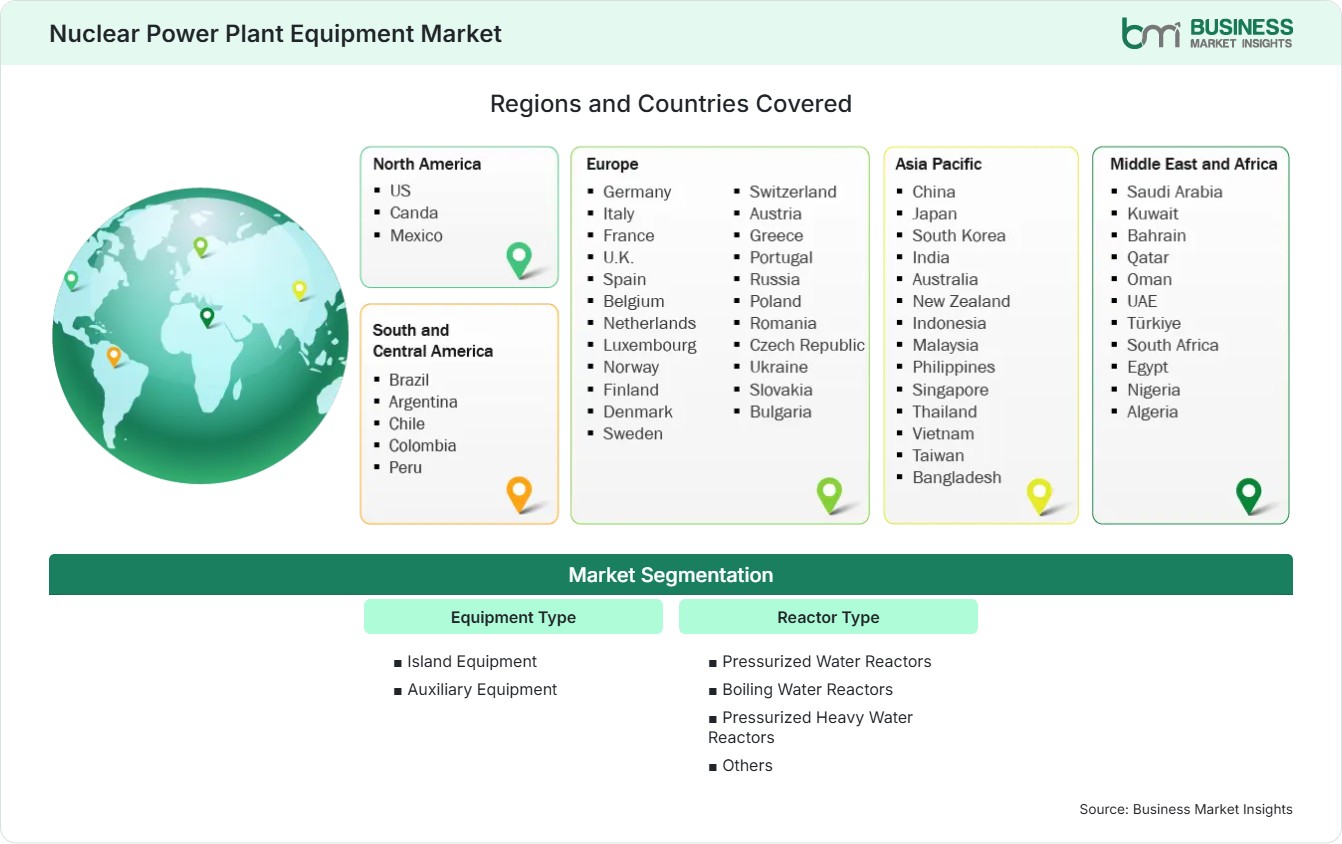
Global Market Geography
FREE PDF
Request your free sample
Request free sample
05 Segment Analysis

Nuclear Power Plant Equipment Market Segmentation

Equipment Type

Island Equipment represents a 60%–64% share in 2025 and grows at a 5.1%–5.7% CAGR between 2026–2033, reflecting high-value reactor, turbine, steam-generation, and primary-system procurement. Auxiliary Equipment holds the remaining 36%–40% share and grows at a faster 5.7%–6.4% CAGR, supported by modernization, monitoring, cooling, electrical, and safety upgrades. The Nuclear Power Plant Equipment Market scope therefore spans both initial construction packages and recurring lifecycle procurement.

  • Island Equipment: Includes reactor, turbine, steam-generation, primary-system, and associated nuclear-island equipment requiring rigorous qualification, precision manufacturing, safety documentation, and long-term reliability.
  • Auxiliary Equipment: Covers cooling, electrical, instrumentation, monitoring, waste-handling, safety-support, and plant-balance systems, with demand supported by modernization and recurring maintenance requirements.

Reactor Type

Pressurized Water Reactors remain the dominant reactor architecture across the installed and new-build fleet, sustaining equipment demand through construction and replacement programs. Boiling Water Reactors support specialized equipment requirements, while Pressurized Heavy Water Reactors maintain demand particularly in Canada and India.

  • Pressurized Water Reactors (PWR): Maintain broad equipment demand across new-build and operating fleets, requiring pressure-boundary systems, steam generators, pumps, valves, controls, and safety equipment.
  • Boiling Water Reactors (PWR): Require specialized reactor, steam, containment, cooling, monitoring, and safety equipment, with modernization supporting replacement and upgrade opportunities across operating facilities.
  • Pressurized Heavy Water Reactors (PWR): Support equipment demand for pressure tubes, fuel-channel systems, heat-transfer equipment, feeders, monitoring systems, and refurbishment programs within established PHWR fleets.
06 Market Forces

Nuclear Power Plant Equipment Market Dynamics

Key Market Drivers

Rising Nuclear Power Investments for Low-Carbon Electricity

Governments are increasing nuclear investment as reliable generation becomes more important for decarbonization and energy security. The Nuclear Power Plant Equipment Market trend is therefore linked to both new construction and supporting supply-chain expansion. Equipment manufacturers are responding through capacity additions, engineering partnerships, and standardized product platforms that can serve multiple reactor projects while maintaining nuclear-grade quality assurance and certification requirements.

Growing Demand for Reliable Baseload Power Generation

Electrical power generation is becoming more reliant on reliable power that can run alongside variable sources of energy. Nuclear power plants ensure continuity in production and mitigate risks associated with volatility of costs related to fuel purchase. Investments in pumps, valves, cooling equipment, generator sets, control equipment, sensors, and spare parts are made in order to keep nuclear power plants operational. Equipment manufacturers with lifecycle services can recurrent business beyond the initial construction of power plants.

Increasing Nuclear Plant Modernization and Replacement Programs

Older reactors have a need for systematic replacement of the components that are reaching their limits in terms of their operating life, qualifying period, or the technological platform used. Digital instrumentation, automated diagnostic features, cybersecurity measures, enhanced monitoring, and better safety systems are being combined into the modernization process along with the traditional mechanical replacements of components. Component manufacturers who can design components that will interface properly with old plants.

Key Market Opportunities

Modernization of Aging Nuclear Plants Creates Equipment Opportunities

Plant modernization creates a recurring equipment opportunity because operators must maintain safety, reliability, efficiency, and regulatory compliance throughout extended operating periods. Replacement programs can cover steam generators, pumps, valves, electrical systems, instrumentation, cooling equipment, and emergency systems. The Nuclear Power Plant Equipment Market Forecasts favor vendors with established nuclear qualification, engineering documentation, and outage-support capabilities because modernization projects are highly dependent on component compatibility and installation timing.

Expansion of Nuclear Equipment Demand in Emerging Energy Markets

Emerging nuclear markets create opportunities for suppliers able to establish local partnerships, technology-transfer arrangements, and qualified manufacturing networks. Bangladesh, Egypt, India, and other developing nuclear markets demonstrate how reactor construction is expanding beyond traditional nuclear economies. Localization requirements can favor companies willing to invest in regional fabrication and supplier qualification. Strategic partnerships with utilities, engineering firms, and state-owned nuclear organizations can also improve access to long-duration projects and reduce barriers created by domestic-content policies.

Replacement of Aging Plant Components and Safety Systems

Component replacement represents a resilient opportunity since the nuclear industry cannot indefinitely delay the replacement of vital equipment due to its age. Pumps, valves, instruments, electrical systems, cooling facilities, and support facilities that need to be replaced or modernized due to reliability declines or regulatory requirements evolve. Providers will add value in the provision of engineered solutions that work in concert with the existing plant designs without requiring any major changes.

Market Restraints and Challenges

High Capital Costs and Stringent Nuclear Safety Regulations

Factor: Nuclear components need specialized material specifications, qualified production, extensive testing, traceability, quality assurance, and regulatory documents that make production and certification expenses relatively higher compared to those for regular power components. Impact: The high initial cost may limit supplier access, procurement time, and favor experienced suppliers with facilities for producing nuclear components. There is need for thorough design verification and regulatory approvals before using safety components.

Long Project Development Timelines and Complex Licensing

Factor: Nuclear projects typically entail a lengthy period involving site evaluation, design approval, licensing, financing, procurement, construction, testing, and commissioning activities before actual operations begin. Impact: The time required for the development of projects causes delays in revenue generation from the equipment, greater capital needs, and makes suppliers vulnerable to shifts in project timelines and regulations.

07 Company Analysis

Competitive Landscape

The Nuclear Power Plant Equipment Market analysis indicates a competitive structure centered on reactor technology ownership, nuclear-grade manufacturing, engineering capabilities, installed-fleet relationships, and lifecycle services. Major participants increasingly combine equipment manufacturing with modernization, digital controls, maintenance, fuel-cycle capabilities, and advanced reactor development.

Company Name

Overview

Products and Services relevant to this market

Westinghouse Electric Company LLC

Major nuclear technology provider with broad global operating-plant and new-build capabilities.

Reactor systems, nuclear fuel, instrumentation and controls, engineered solutions, parts, outage and maintenance services.

GE Vernova Inc.

Global energy technology company with established boiling-water reactor and advanced nuclear capabilities.

BWR systems, BWRX-300 technology, turbines, controls, plant services, engineering and equipment solutions.

Framatome

Major nuclear supplier supporting reactors, fuel, components, services, and modernization programs globally.

Reactor components, instrumentation, fuel systems, maintenance, engineering, inspection and lifecycle services.

Mitsubishi Heavy Industries, Ltd.

Japanese industrial group with extensive nuclear engineering and reactor equipment expertise.

Reactor systems, steam generators, turbines, pumps, valves, engineering, maintenance and modernization equipment.

Korea Hydro & Nuclear Power Co., Ltd.

Korean nuclear operator and technology ecosystem participant with domestic and international project expertise.

Reactor systems, plant engineering, equipment procurement, maintenance, commissioning and nuclear project services.

China National Nuclear Corporation

Large Chinese nuclear organization covering nuclear development, engineering, construction and technology activities.

Reactor equipment, engineering, nuclear island systems, auxiliary equipment, project development and services.

Rosatom State Atomic Energy Corporation

Integrated Russian nuclear corporation active across reactor technology, engineering and nuclear supply chains.

Reactor systems, turbine equipment, engineering, fuel-cycle services, construction and lifecycle support.

Hitachi, Ltd.

Japanese technology group involved in nuclear systems, digitalization and advanced reactor development.

BWR technology, digital plant systems, controls, engineering, grid integration and modernization solutions.

BWX Technologies, Inc.

US nuclear manufacturer with commercial, defense, fuel and complex-component manufacturing capabilities.

Steam generators, nuclear components, fuel, heavy manufacturing, engineering and specialized nuclear equipment.

Kawasaki Heavy Industries, Ltd.

Japanese industrial manufacturer with engineering and nuclear equipment capabilities.

Nuclear plant equipment, pressure vessels, piping, machinery, engineering and maintenance-related technologies.

10 Trust & Transparency

Research Methodology

The market analysis combines proprietary research with secondary data from government agencies, company disclosures, regulatory filings, industry databases and expert interviews. Market estimates are validated through data triangulation, cross-market benchmarking and analyst review.

View Full Research Methodology

11 Questions Answered

Frequently Asked Questions

Why is the Neurovascular Catheters Market Report relevant to investors?

The report provides a structured view of regional demand, product segmentation, competitive positioning, technology priorities, clinical drivers, market opportunities, and constraints influencing future commercial development.

What role does radial access play in future development?

Radial access can influence catheter architecture by requiring dedicated transition zones, appropriate lengths, distal navigability, and proximal stability. Development of radial-specific systems creates opportunities for manufacturers to address alternative access pathways.

How does physician training affect catheter adoption?

Neurovascular procedures require specialized technical expertise. Training programs, simulation, procedural support, and standardized treatment protocols can improve clinician confidence and help hospitals integrate advanced catheter technologies into emergency stroke pathways.

What makes thrombectomy catheters commercially attractive?

Thrombectomy catheters address a high-priority clinical need in acute ischemic stroke and benefit from increasing use of mechanical thrombectomy. Product differentiation centers on aspiration efficiency, lumen dimensions, distal access, vessel compatibility, and procedural reliability.

How is catheter design changing neurovascular procedures?

Low-profile shafts, hydrophilic coatings, braided reinforcement, nitinol construction, larger aspiration lumens, and improved distal flexibility are enabling more controlled navigation through complex cerebral anatomy.

Access the Full Nuclear Power Plant Equipment Market Report

Get segment-level forecasts, regional estimates, competitive benchmarking, company profiles and downloadable Excel datasets.

Access the full Nuclear Power Plant Equipment Market Report
350 pages PDF & Excel | 2026-08-24