
Solar Water Pump Market Outlook: Size, Share, Trends, Growth Analysis, Competitive Landscape & Forecast, 2026–2033

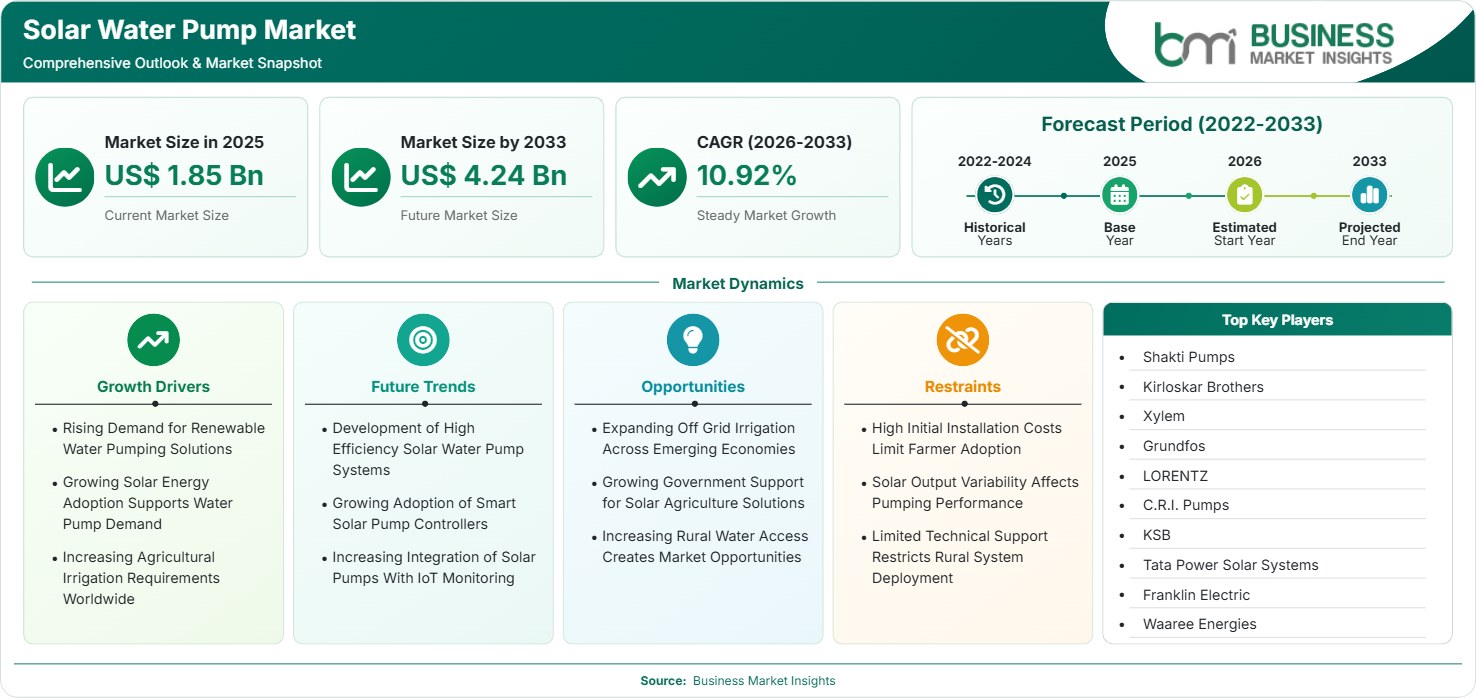
The Solar Water Pump Market size was valued at US$ 1.85 Billion in 2025 and is projected to reach US$ 4.24 Billion by 2033, growing at a CAGR of 10.92% during 2026–2033, driven by renewable energy adoption, irrigation expansion, off-grid water access, declining solar technology costs, and government support for sustainable agricultural infrastructure.

Report Coverage
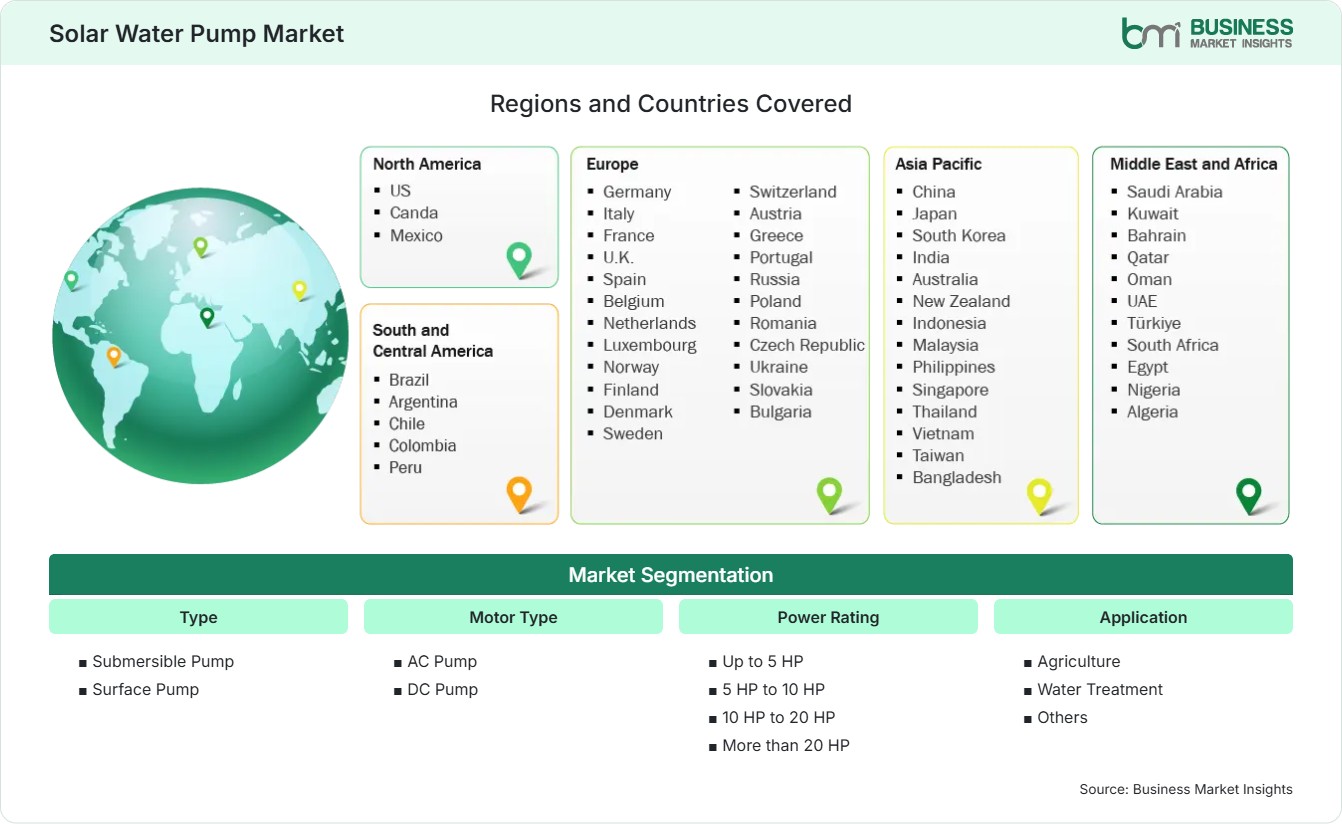
  • Type: Submersible Pump, Surface Pump
  • Motor Type: AC Pump, DC Pump
  • Power Rating: Up to 5 HP, 5 HP to 10 HP, 10 HP to 20 HP, More than 20 HP
  • Application: Agriculture, Water Treatment, Others
US$ 1.85 Bn Market size in 2025
US$ 4.24 Bn Market Size by 2033
10.92% CAGR, 2026 - 2033
2026-2033 Forecast Period

AI Overview

Solar Water Pump Market Summary

  • North America Region: North America holds a 14%–18% share in 2025, growing at a 9.5%–11.0% CAGR during 2026–2033, supported by sustainable irrigation, livestock water supply, rural infrastructure modernization, and opportunities in off-grid agricultural pumping and distributed water systems.
  • Fastest Growing Region: Asia Pacific holds a 43%–47% share in 2025, expanding at a 11.5%–13.0% CAGR during 2026–2033, driven by agricultural irrigation needs, rural electrification, solar deployment, groundwater management, and opportunities for decentralized water infrastructure.
  • Leading Segment: Submersible Pumps hold a 58%–62% share in 2025, expanding at a 10.4%–11.8% CAGR, supported by groundwater extraction, deeper wells, agricultural irrigation, reliable water delivery, and growing deployment in areas with limited grid connectivity.
  • High Growth Segment: DC Pumps hold a 38%–42% share in 2025, expanding at a 11.8%–13.2% CAGR, benefiting from direct compatibility with photovoltaic generation, efficient operation, reduced conversion losses, and suitability for decentralized agricultural and rural water systems.
  • Key Market Opportunity: Expansion of solar-powered irrigation and decentralized water infrastructure can create opportunities for integrated pump-solar packages, remote monitoring, energy storage, financing models, and locally supported installation networks.
  • Major Market Players: Shakti Pumps, Kirloskar Brothers, Xylem, Grundfos, LORENTZ, C.R.I. Pumps, KSB, Tata Power Solar Systems, Franklin Electric, and Waaree Energies.
Strategic Insights

Solar Water Pump Market: Strategic Insights

Solar Water Pump Market Strategic Framework
FREE PDF
Request your free sample
Request free sample
Stakeholder View

Key Takeaways

  • The value chain is moving toward integrated systems in which pump manufacturers, photovoltaic suppliers, controllers, installers, financing providers, and agricultural service organizations jointly influence project economics and customer adoption.
  • Agricultural irrigation represents the strongest commercial opportunity because water pumping accounts for recurring energy expenditure and solar generation can provide a decentralized operating model in suitable locations.
  • Product development is shifting toward higher-efficiency motors, intelligent controllers, remote monitoring, variable-speed operation, and integrated protection features that improve pumping performance under changing solar conditions.
  • Asia Pacific offers the strongest expansion opportunity because agricultural water demand, rural infrastructure requirements, solar deployment, and government-backed clean-energy initiatives reinforce one another.
  • Investment opportunities increasingly favor integrated project models rather than standalone equipment sales, particularly where financing, installation, maintenance, monitoring, and long-term service are bundled.
  • Successful adoption will depend on system sizing, water-table conditions, irrigation requirements, local solar resources, maintenance availability, and financing accessibility rather than pump performance alone.
Geographic Outlook

Solar Water Pump Market Regional Highlights

North America Solar Water Pump Market

North America represents a 14%–18% share in 2025 and is projected to expand at a 9.5%–11.0% CAGR through 2033. Demand is supported by agricultural irrigation, livestock watering, remote properties, and interest in renewable energy systems. The Solar Water Pump Market share benefits from established solar infrastructure and demand for reliable off-grid equipment.

  • Agricultural operators are evaluating solar pumping where grid extension is expensive or diesel consumption creates high recurring operating costs, particularly across remote farms and livestock properties.
  • Rural water applications create demand for dependable pumping systems that can operate independently from centralized electricity infrastructure while reducing fuel logistics and maintenance requirements.
  • System suppliers are increasingly emphasizing remote monitoring, variable-speed control, and integrated protection features to improve reliability and simplify operation across geographically dispersed installations.
  • Solar pumping can complement broader farm energy strategies by integrating irrigation equipment with photovoltaic generation and other distributed renewable energy assets.

US Solar Water Pump Market

The US accounts for a 78%–82% share of the North American market in 2025 and is projected to grow at a 9.8%–11.2% CAGR during 2026–2033. Irrigation, livestock watering, remote agricultural properties, and renewable energy investment support adoption.

  • Agricultural applications benefit from solar pumping where farms require dependable water delivery across remote fields, livestock areas, or properties with limited access to utility infrastructure.
  • Western and southwestern agricultural areas offer favorable conditions for solar pumping because strong solar resources coincide with substantial irrigation requirements and distributed water infrastructure.
  • Monitoring and control technologies can improve system management by allowing operators to track pump performance, water delivery, operating conditions, and equipment status remotely.

Europe Solar Water Pump Market

Europe holds a 18%–22% share in 2025 and is expected to grow at a 8.8%–10.4% CAGR through 2033. Spain leads regional potential, while Italy provides another important agricultural application base. Spain is projected to grow at a 9.5%–11.0% CAGR, while Italy could reach 9.0%–10.5% CAGR.

  • Spain provides strong potential because solar availability aligns with irrigation requirements, creating favorable operating conditions for photovoltaic-powered agricultural water pumping.
  • Italy offers opportunities across agricultural regions where irrigation modernization and renewable energy integration can reduce dependence on conventional electricity and fuel-based pumping.
  • European water-management priorities encourage more efficient pumping technologies, particularly where agricultural users face pressure to improve energy efficiency and optimize water consumption.
  • Integrated solar and pumping systems can support farms seeking to combine renewable electricity generation with decentralized water infrastructure and more predictable operating expenditure.

Asia Pacific Solar Water Pump Market

Asia Pacific holds a 43%–47% share in 2025 and is projected to grow at a 11.5%–13.0% CAGR through 2033. India represents the leading regional market, while Indonesia and other Southeast Asian economies provide additional expansion opportunities. India is projected to grow at a 12.0%–13.5% CAGR. Agricultural irrigation, rural development, and solar deployment remain central demand drivers.

  • India offers substantial potential because agricultural irrigation requirements, solarization programs, groundwater dependence, and rural energy access initiatives are converging across major farming regions.
  • Indonesia presents opportunities across dispersed agricultural communities where decentralized solar pumping can reduce dependence on conventional electricity and fuel-based water infrastructure.
  • China, Australia, and Southeast Asian markets provide opportunities through agricultural modernization, renewable energy investment, precision irrigation, and deployment of distributed pumping technologies.
  • Rural water supply projects can expand demand beyond farming by using solar pumping to serve communities and facilities located away from reliable centralized electricity infrastructure.

Rest of World Solar Water Pump Market

Rest of World accounts for a 16%–20% share in 2025 and is projected to grow at a 10.0%–11.8% CAGR through 2033. Latin America benefits from agricultural expansion, while Middle Eastern and African markets offer opportunities through water scarcity and off-grid infrastructure. Brazil is projected to grow at 10.2%–12.0% CAGR, while Saudi Arabia could reach 10.5%–12.3% CAGR.

South and Central America offers opportunities across agriculture, livestock, and rural water infrastructure. Middle Eastern and African markets are supported by solar availability, water-management requirements, remote communities, and demand for alternatives to diesel-powered pumping.

  • Brazil offers opportunities through agricultural irrigation, livestock production, rural properties, and renewable energy integration across geographically distributed farming operations.
  • Saudi Arabia presents potential for solar pumping where water infrastructure requires energy-efficient operation and renewable generation can support decentralized water-management systems.
  • African markets can benefit from solar pumping for irrigation and community water access, particularly where grid infrastructure is limited and diesel fuel creates recurring operating expenses.
  • Latin American agricultural modernization can encourage adoption of integrated solar pumping solutions where producers seek lower operating costs and greater energy independence.
Global Market Geography
FREE PDF
Request your free sample
Request free sample
Segment Analysis

Solar Water Pump Market Segmentation

Type

Submersible Pumps hold a 58%–62% share in 2025 and are projected to grow at a 10.4%–11.8% CAGR during 2026–2033. The Solar Water Pump Market scope is expanding as manufacturers improve pump efficiency, motor durability, controller integration, and monitoring capabilities for agricultural and rural water applications.

  • Submersible Pump: Designed for submerged operation, these pumps support groundwater extraction, deeper wells, irrigation systems, and rural water supply where dependable vertical water lifting is required.
  • Surface Pump: Surface systems suit shallow water sources and accessible reservoirs, offering simpler installation and maintenance for agricultural, domestic, livestock, and selected commercial water applications.

Motor Type

AC Pumps hold a 54%–58% share in 2025 and are projected to grow at a 9.8%–11.2% CAGR through 2033. The Solar Water Pump Market trends increasingly favor efficient motor-controller combinations that reduce conversion losses and improve performance under variable solar generation.

  • AC Pump: AC systems provide compatibility with established pumping infrastructure and can support higher-capacity applications when paired with suitable inverters and photovoltaic power systems.
  • DC Pump: DC pumps can operate efficiently with photovoltaic generation, making them attractive for decentralized systems where simplified power conversion and lower energy losses are priorities.

Power Rating

The Up to 5 HP category holds a 44%–48% share in 2025 and is projected to grow at a 10.2%–11.6% CAGR during 2026–2033. Lower-power systems are widely suited to small farms, rural water supply, and distributed installations.

  • Up to 5 HP: Lower-capacity systems suit small farms, household water supply, livestock applications, and community installations where pumping volumes and water-lifting requirements remain moderate.
  • 5 HP to 10 HP: Mid-range systems address larger irrigation requirements and agricultural properties requiring greater water delivery while maintaining manageable photovoltaic and installation requirements.
  • 10 HP to 20 HP: Higher-capacity pumps support larger agricultural operations and demanding water systems where greater flow rates and extended pumping requirements justify larger solar installations.
  • More than 20 HP: High-power systems serve large-scale irrigation and industrial water applications requiring substantial pumping capacity and appropriately sized photovoltaic generation and control infrastructure.

Application

Agriculture holds a 68%–72% share in 2025 and is projected to grow at a 11.0%–12.5% CAGR through 2033. Solar Water Pump Market trends indicate that agricultural systems will remain central to adoption, particularly where solar generation can align with daytime water pumping schedules.

  • Agriculture: Irrigation is the primary application, with solar pumping helping farms access water while reducing recurring dependence on grid electricity and diesel-powered pumping equipment.
  • Water Treatment: Solar-powered pumping can support decentralized water treatment and distribution systems where reliable electricity infrastructure is limited or renewable energy integration is prioritized.
Market Forces

Solar Water Pump Market Dynamics

Key Market Drivers

Rising Demand for Renewable Water Pumping Solutions

Pumping water is an energy-consuming process for agricultural irrigation, rural drinking water sources, and some industrial operations; hence, there is a need for technologies that will help in lowering energy consumption. One such technology is solar pumping technology, which relies on photovoltaics to drive water pumps without constant use of grid electricity or diesel generators. Factors driving the Solar Water Pump Market include greater utilization of renewable energy as well as the growing importance of decentralization. Solar water pumping becomes economically more beneficial when there is abundant sunlight and high costs of traditional energy sources. As a result, manufacturers concentrate on producing reliable motors, controllers, protection systems, and system configurations.

Growing Solar Energy Adoption Supports Water Pump Demand

Increased access to photovoltaic technology is making the prospect of using solar energy to support water infrastructures possible. Reduced complexity and more knowledge on the use of solar energy in generating electricity means that one can explore pumping as an application of renewable electricity. The Solar Water Pump Market trend favors packages comprising photovoltaic panels, pump, controller, and monitoring systems. Such packages can make installation easier and can also help in matching the power of the pump with the available solar energy. More use of the sun means that there are more installers, mechanics, financiers, and providers of parts, creating a better environment to sustain growth in the industry.

Increasing Agricultural Irrigation Requirements Worldwide

With rising agricultural production and altered water management needs, there is an increased need for reliable irrigation infrastructure that is reliable. Farmers require irrigation pumps that are able to move water over a greater distance of agricultural land, while at the same time considering their energy consumption and operation limitations. The solar-powered irrigation pump will offer a decentralized solution when there is little electrical infrastructure available or when diesel fuel is not easy to access. The demand is especially important in areas that have high amounts of solar energy, together with irrigation needs. It is also helpful in modernizing the agricultural infrastructure gradually through the appropriate sizing of the system. These present possibilities for scalable solutions on small farms, commercial farming, and rural irrigation schemes.

Key Market Opportunities

Expanding Off Grid Irrigation Across Emerging Economies

Opportunities in off-grid irrigation are very significant because communities involved in agriculture and lacking access to stable power must find ways to use alternatives in order to pump water. The solar system will ensure pumping of water during daytime without the need to have fuel available continuously, making it an option for some rural locations having enough solar power. Manufacturers can create a modular package containing pumps, photovoltaic energy production systems, controls, energy storage devices, and installation services. As seen from the Solar Water Pump Market Forecast, there are more opportunities when both irrigation upgrade and renewable energy use happen at the same time. Local financing, collective buying, leasing systems, and pay-per-use systems will lower more barriers to purchase and help promote decentralized irrigation among small farmers.

Growing Government Support for Solar Agriculture Solutions

Programs from the government that facilitate renewable agriculture would help in the faster implementation of these technologies by lowering the cost associated with equipment and increasing awareness among farmers. The use of subsidies, concessional finance, infrastructure programs, and rural development programs can ensure that the technology becomes competitive enough to compete with traditional options. The potential for growth goes beyond just selling equipment since the government-supported implementation of such systems could create scope for installation, maintenance, and monitoring. Manufacturers with well-established distribution and service networks stand to gain from procurement programs. Further policy backing can also help to promote efficiency in water use through the integration of solar-powered pumps with the modernization of irrigation systems.

Increasing Rural Water Access Creates Market Opportunities

Solar pumping systems are possible for decentralized water supply systems in areas that do not yet have reliable electricity distribution systems. Schools, health centers, community reservoirs, and isolated communities might need water delivery systems in a reliable manner without the ongoing process of logistics that goes with diesel generation. Suppliers can provide pumping systems that are customized according to various parameters such as well depth, flow rate, storage type, and operating conditions. There is also an opportunity for infrastructure providers and development organizations to use standard solar pumping systems in widely scattered geographical locations. The combination of pumping with the storage, treatment, and monitoring of water would be able to enhance the value of systems and develop infrastructure solutions beyond just supplying pumps.

Market Restraints and Challenges

High Initial Installation Costs Limit Farmer Adoption

Factor: Solar pumping systems require upfront expenditure for pumps, photovoltaic panels, controllers, structures, wiring, installation, and related water infrastructure. Impact: High initial investment can discourage small farmers even when long-term operating costs are attractive. Financing availability therefore becomes a major determinant of adoption. Users may compare solar systems with familiar diesel or grid-powered alternatives based on immediate affordability rather than lifecycle economics. Suppliers and policymakers can address this challenge through financing programs, leasing, subsidies, cooperative ownership, and modular equipment packages. Reducing acquisition barriers is particularly important in emerging markets where agricultural incomes fluctuate and capital availability can be limited.

Variable Solar Output Affects Pumping Performance

Factor: Solar radiation changes with weather, cloud cover, seasonality, and daylight availability. Impact: Variable photovoltaic output can affect pumping rates and create uncertainty when water demand must be maintained consistently. Systems may require appropriate sizing, water storage, intelligent controllers, or supplementary energy sources to maintain dependable service. This challenge becomes more relevant where irrigation schedules are inflexible or water demand continues beyond peak solar generation periods. Manufacturers can reduce performance variability through improved power electronics, variable-speed operation, system monitoring, and optimized storage configurations. Proper site assessment and hydraulic design remain essential for ensuring that solar pumping systems deliver reliable water volumes under changing operating conditions.

Company Analysis

Competitive Landscape

The Solar Water Pump Market analysis features competition among pump manufacturers, renewable energy companies, water technology providers, and specialized solar pumping suppliers.

Company Name

Overview

Products and Services Relevant to This Market

Shakti Pumps

Indian manufacturer specializing in solar pumping and water-management solutions with strong exposure to agricultural applications.

Solar pumps, submersible pumps, surface pumps, solar pumping systems, controllers, and integrated water pumping solutions for agriculture and rural applications.

Kirloskar Brothers

Water and fluid-management company with extensive pump manufacturing capabilities serving agricultural, industrial, and infrastructure applications.

Submersible pumps, centrifugal pumps, solar pumping solutions, water systems, controllers, and pumping equipment for irrigation and water infrastructure.

Xylem

Global water technology company providing equipment and solutions for water transport, treatment, and management.

Water pumps, pumping systems, controls, monitoring technologies, and water-management solutions applicable to decentralized and agricultural pumping.

Grundfos

Global pump manufacturer offering energy-efficient pumping and water technology solutions across multiple applications.

Solar pumping systems, submersible pumps, surface pumps, controllers, renewable-energy-compatible pumping technologies, and water-management solutions.

LORENTZ

Specialized provider focused on solar-powered water pumping systems and renewable energy applications.

Solar water pumps, submersible and surface pumping systems, controllers, monitoring technologies, and integrated photovoltaic pumping solutions.

C.R.I. Pumps

Pump manufacturer serving agricultural, domestic, industrial, and water-management applications with a broad equipment portfolio.

Solar pumps, submersible pumps, centrifugal pumps, controllers, agricultural pumping systems, and renewable-energy-compatible water solutions.

KSB

Pump and valve technology provider serving water, infrastructure, industrial, and energy applications.

Submersible pumps, water pumps, control systems, pumping equipment, and solutions supporting water infrastructure and decentralized applications.

Tata Power Solar Systems

Renewable energy company with capabilities spanning solar generation, project development, and solar-powered applications.

Solar pumping systems, photovoltaic solutions, agricultural solarization, solar EPC services, and integrated renewable energy systems for water pumping.

Franklin Electric

Water and fuel pumping technology provider with strong capabilities in motors, pumps, controls, and water systems.

Submersible pumps, motors, solar pumping systems, controllers, drives, water systems, and equipment supporting agricultural and off-grid applications.

Waaree Energies

Solar energy company offering photovoltaic products and renewable energy solutions across distributed and utility applications.

Solar modules, photovoltaic systems, solar pumping solutions, renewable energy integration, and solar infrastructure supporting water pumping applications.

Trust & Transparency

Research Methodology

The market analysis combines proprietary research with secondary data from government agencies, company disclosures, regulatory filings, industry databases and expert interviews. Market estimates are validated through data triangulation, cross-market benchmarking and analyst review.

View Full Research Methodology

Questions Answered

Frequently Asked Questions

What does the Solar Water Pump Market Report cover?

The report covers market size, growth outlook, regional development, pump types, motor technologies, power ratings, applications, competitive positioning, adoption factors, opportunities, and major market challenges.

Can solar water pumps operate without batteries?

Yes. Many systems operate directly from photovoltaic generation using controllers designed to manage variable solar output. Water storage can provide an alternative to electrical battery storage where continuous water availability is required.

Which solar pump type is widely used for groundwater applications?

Submersible pumps are well suited to groundwater applications because the pumping unit operates below the water surface and can lift water from deeper wells for irrigation and other water-supply requirements.

Why are solar pumps useful for agriculture?

They can reduce dependence on grid electricity and diesel while providing decentralized water pumping. Their suitability is strongest where solar resources are favorable and irrigation demand aligns with daytime generation.

What is a solar water pump?

A solar water pump uses electricity generated by photovoltaic panels to operate a pump for moving water. It can support irrigation, rural water supply, livestock watering, and selected water-treatment applications.

Access the Full Solar Water Pump Market Report

Get segment-level forecasts, regional estimates, competitive benchmarking, company profiles and downloadable Excel datasets.

Access the full Solar Water Pump Market Report
350 pages PDF & Excel | 2026-09-03