
Water Desalination Market Outlook: Size, Share, Trends, Growth Analysis, Competitive Landscape & Forecast, 2026–2033

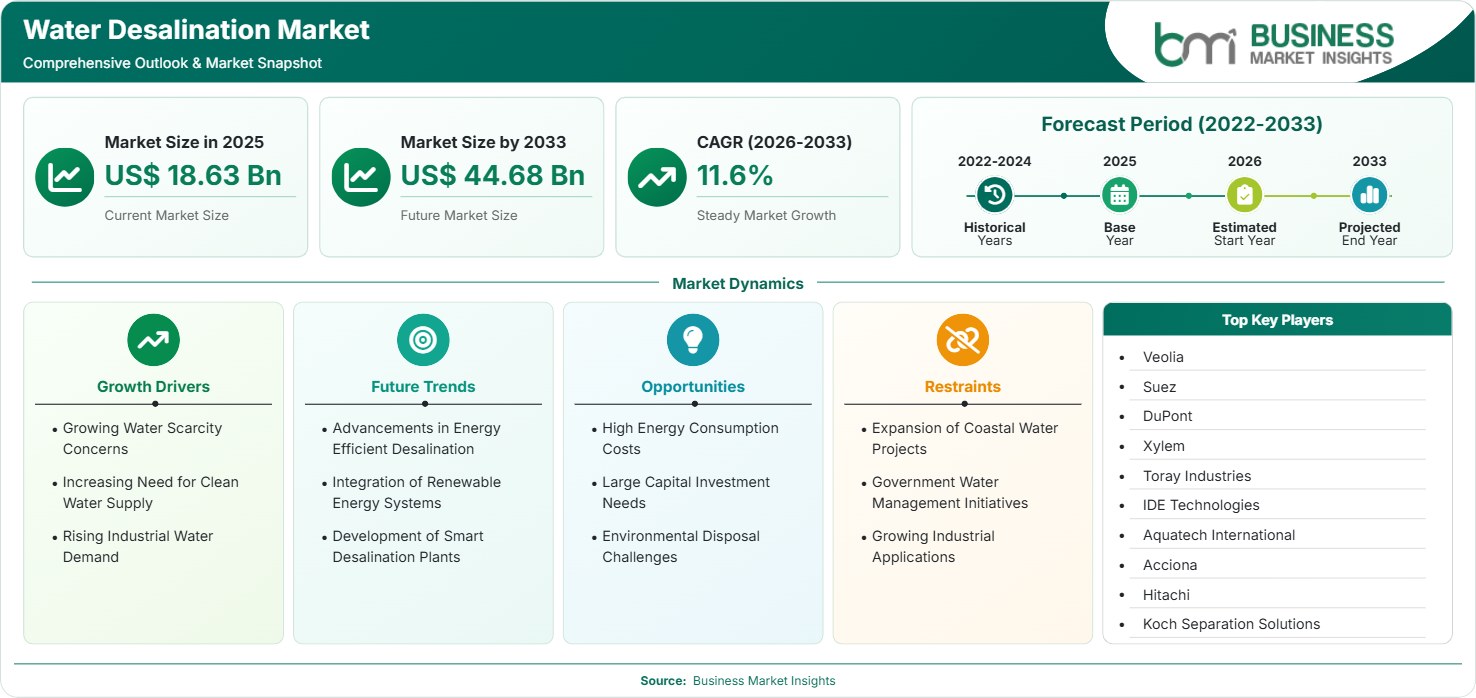
The Water Desalination Market size was valued at US$ 18.63 billion in 2025 and is projected to reach US$ 44.68 billion by 2033, growing at a CAGR of 11.6% during 2026–2033, driven by water scarcity, freshwater demand, industrial expansion, coastal infrastructure development, and investments in advanced desalination technologies.

Report Coverage
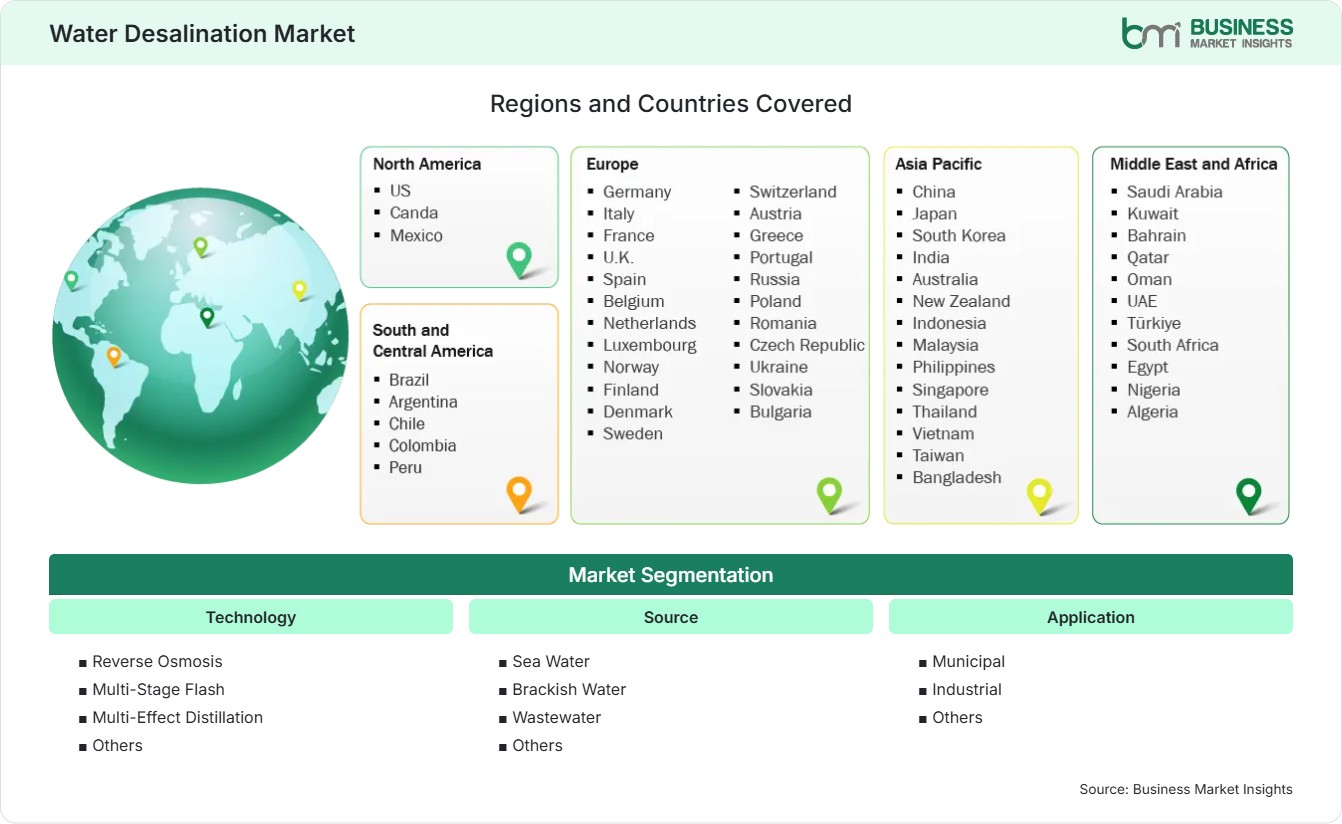
  • Technology: Reverse Osmosis, Multi-Stage Flash, Multi-Effect Distillation, Others
  • Source: Sea Water, Brackish Water, Wastewater, Others
  • Application: Municipal, Industrial, Others
US$ 18.63 Bn Market size in 2025
US$ 44.68 Bn Market Size by 2033
11.6% CAGR, 2026 - 2033
2026-2033 Forecast Period

AI Overview

Water Desalination Market Summary

  • North America Region: North America holds a 22%–25% share in 2025, growing at a CAGR of 9%–11% during 2026–2033, supported by drought management, municipal water security programs, and industrial water treatment requirements. The US market expands at a CAGR of 9%–11% during 2026–2033, driven by coastal desalination projects, water resilience investments, and advanced membrane technology adoption.
  • Fastest Growing Region: Asia Pacific accounts for a 38%–41% share in 2025, expanding at a CAGR of 13%–15% during 2026–2033, supported by rising freshwater stress, urbanization, industrial growth, and government-backed water infrastructure development across emerging economies.
  • Leading Segment: Reverse Osmosis (RO) technology holds a 60%–63% share in 2025, growing at a CAGR of 12%–14% during 2026–2033, driven by energy efficiency improvements, membrane innovation, cost advantages, and widespread adoption in municipal and industrial desalination facilities.
  • High Growth Segment: Wastewater source desalination represents a 18%–21% share in 2025, expanding at a CAGR of 13%–15% during 2026–2033, supported by water recycling initiatives, industrial reuse requirements, and increasing focus on sustainable water management practices.
  • Key Market Opportunity: Growing coastal water infrastructure, industrial water reuse, renewable energy integration, and government investments in water security create opportunities for desalination technology providers developing efficient and sustainable treatment systems.
  • Major Market Players: Veolia, Suez, DuPont, Xylem, Toray Industries, IDE Technologies, Aquatech International, Acciona, Hitachi, and Koch Separation Solutions.
Strategic Insights

Water Desalination Market: Strategic Insights

Water Desalination Market Strategic Framework
FREE PDF
Request your free sample
Request free sample
Stakeholder View

Key Takeaways

  • The desalination value chain is shifting toward integrated solutions combining membrane technology, engineering services, digital monitoring, and lifecycle management to improve operational efficiency and long-term plant performance.
  • Municipal water supply, industrial processing, and wastewater reuse applications represent major growth opportunities as organizations seek dependable water sources amid increasing freshwater constraints.
  • Technology innovation is focused on energy-efficient reverse osmosis systems, advanced membranes, artificial intelligence-based monitoring, and renewable energy-powered desalination solutions.
  • Asia Pacific and Middle Eastern markets present strong investment opportunities due to water stress, coastal development, population growth, and government-led infrastructure initiatives.
  • Strategic partnerships and project collaborations are increasing as technology providers, engineering companies, and governments work together to develop large-scale desalination capacity.
Geographic Outlook

Water Desalination Market Regional Highlights

North America Water Desalination Market

North America accounted for 22%–25% of the market in 2025 and is projected to grow at a CAGR of 9%–11% during 2026–2033. The region benefits from increasing water security investments, drought management initiatives, and industrial demand for reliable water sources. The Water Desalination Market share in North America is supported by municipal projects, coastal treatment facilities, and the adoption of advanced membrane technology across developed economies.

  • The US is expanding desalination adoption through drought-prone regions, coastal water projects, and municipal initiatives focused on improving freshwater availability.
  • Industrial sectors are increasing investment in desalination and water treatment systems to support manufacturing, energy, and processing operations.
  • Advanced reverse osmosis technologies are gaining adoption due to improved efficiency, lower operating requirements, and enhanced membrane performance.
  • Regulatory focus on water sustainability is encouraging investments in alternative water supply infrastructure across North American regions.

US Water Desalination Market

The US accounted for 18%–21% of the market in 2025 and is expected to expand at a CAGR of 9%–11% during 2026–2033. The country remains a significant market due to increasing drought conditions, industrial water requirements, and investments in coastal desalination facilities. California, Texas, and other water-stressed regions are supporting demand for advanced desalination solutions.

  • Municipal authorities are developing desalination facilities to diversify water sources and improve resilience against prolonged drought conditions.
  • Industrial users are adopting desalination systems to secure reliable water supply for manufacturing, energy, and processing applications.
  • Federal and regional water programs are supporting technology development and infrastructure upgrades for sustainable water management.

Europe Water Desalination Market

Europe accounted for 20%–23% of the market in 2025 and is forecast to grow at a CAGR of 10%–12% during 2026–2033. The region is supported by water sustainability initiatives, coastal infrastructure development, and increasing adoption in Mediterranean countries. Spain, Italy, Greece, and Cyprus remain important markets, while Portugal and other coastal economies are expanding desalination investments.

  • Mediterranean countries are increasing desalination capacity to address seasonal water shortages and strengthen municipal supply reliability.
  • European sustainability policies are encouraging energy-efficient desalination technologies and improved water resource management practices.
  • Spain continues leading regional adoption through extensive seawater desalination infrastructure and advanced treatment facilities.
  • Industrial users are exploring desalination solutions to reduce freshwater dependence and improve operational water security.

Asia Pacific Water Desalination Market

Asia Pacific accounted for 38%–41% of the market in 2025 and is projected to expand at a CAGR of 13%–15% during 2026–2033, making it the fastest-growing regional market. The region is experiencing increasing freshwater stress, rapid urbanization, industrial expansion, and government investment in water infrastructure. The Water Desalination Market growth is supported by large-scale seawater desalination projects across China, India, Australia, Japan, and Southeast Asian countries.

  • China is increasing desalination investments through coastal industrial development, municipal water security programs, and adoption of advanced reverse osmosis technologies.
  • India is expanding desalination capacity in coastal regions through urban water projects, industrial applications, and initiatives supporting long-term freshwater availability.
  • Southeast Asian countries are developing desalination facilities to address rising population needs, tourism expansion, and industrial water requirements.
  • Australia continues adopting desalination solutions due to recurring drought conditions, climate variability, and demand for resilient municipal water systems.
  • Japan and South Korea are investing in efficient desalination technologies for industrial operations, coastal communities, and advanced water management systems.

Rest of World Water Desalination Market

Rest of World accounted for a 13%–16% share in 2025 and is expected to grow at a CAGR of 12%–14% during 2026–2033. The Middle East represents a major demand center due to severe water scarcity, while Latin America and Africa are expanding desalination adoption through urban growth and industrial development. Saudi Arabia, the United Arab Emirates, Israel, Brazil, and Chile represent key growth markets.

  • Middle Eastern countries are investing heavily in seawater desalination infrastructure to support municipal supply, industrial growth, and economic diversification programs.
  • Saudi Arabia and the United Arab Emirates continue leading regional adoption through large-scale desalination projects and integration of advanced treatment technologies.
  • Latin American markets are increasing desalination deployment for mining, industrial operations, and coastal communities facing freshwater availability challenges.
  • Chile and Brazil are exploring desalination solutions to support industrial activities, urban development, and water security requirements.
  • African countries are gradually adopting desalination technologies through international partnerships, infrastructure investments, and efforts to improve access to reliable water resources.
Global Market Geography
FREE PDF
Request your free sample
Request free sample
Segment Analysis

Water Desalination Market Segmentation

Technology

The Water Desalination Market by technology is shaped by efficiency improvements, energy optimization, and increasing demand for reliable freshwater generation. Reverse Osmosis (RO) accounted for a 60%–63% share in 2025 and is projected to grow at a CAGR of 12%–14% between 2026 and 2033. Multi-Stage Flash (MSF), Multi-Effect Distillation (MED), and other technologies continue to support applications where thermal processes and specialized treatment requirements are preferred.

  • Reverse Osmosis (RO): Reverse Osmosis technology dominates desalination projects due to lower energy requirements, advanced membrane performance, scalability, and widespread adoption across municipal and industrial water treatment facilities.
  • Multi-Stage Flash (MSF): Multi-Stage Flash systems are used primarily in large-scale seawater desalination plants where reliable thermal desalination performance and integration with energy facilities are required.
  • Multi-Effect Distillation (MED): Multi-Effect Distillation technology supports efficient thermal desalination through multiple evaporation stages, making it suitable for regions with access to low-cost heat sources.

Source

The Water Desalination Market by source is expanding as governments and industries explore multiple water supply alternatives to address freshwater limitations. Sea Water represented the leading source segment in 2025 due to extensive coastal desalination projects and growing municipal applications. Brackish Water and Wastewater sources are gaining adoption through water recycling initiatives, industrial reuse programs, and increasing emphasis on sustainable water management practices.

  • Sea Water: Sea Water desalination remains the primary source due to abundant availability, coastal infrastructure development, and increasing demand for dependable freshwater generation systems.
  • Brackish Water: Brackish Water treatment is expanding through applications requiring lower salinity removal, cost-effective purification, and sustainable water supply solutions for communities and industries.
  • Wastewater: Wastewater desalination is gaining momentum through recycling initiatives, industrial reuse requirements, and technologies that improve resource recovery and reduce freshwater dependency.

Application

The market by application is driven by increasing water demand across municipalities, industries, and specialized sectors. Municipal applications accounted for a leading share in 2025 due to population growth, urban expansion, and freshwater supply challenges. Industrial adoption is increasing as manufacturing, energy, and processing sectors require reliable water sources. The Water Desalination Market scope is expanding through investments in sustainable water infrastructure and advanced treatment systems.

  • Municipal: Municipal desalination applications support drinking water supply, urban water security, and climate resilience strategies in regions facing freshwater shortages.
  • Industrial: Industrial desalination systems provide reliable process water for manufacturing, energy, mining, and chemical industries requiring consistent water quality and supply.
  • Others: Other applications include agriculture, remote communities, and specialized facilities using desalination technologies to improve access to freshwater resources and support localized water management needs.
Market Forces

Water Desalination Market Dynamics

Key Market Drivers

Growing Water Scarcity Concerns

As a result of water shortage, the need for desalination techniques is rising. The factors causing water shortage include climate change, increased population, and improper distribution of water. Desalination is needed because it converts salt water into fresh water for use in various sectors, such as municipalities and industry. Growth in the Water Desalination Market is driven by investment in membrane system technologies, energy-efficient processes, and large-scale water infrastructure. Countries experiencing recurring droughts are considering building desalination plants to improve water security and reduce dependence on scarce freshwater sources.

Increasing Need for Clean Water Supply

Growing demand for clean water is increasing the use of desalination technology in cities, industrial complexes, and water-scarce regions. Population growth and urbanization are increasing the demand for reliable drinking water sources and motivating local governments to adopt desalination technology. The increasing adoption of reverse osmosis technology is due to its energy efficiency and scalability in deployment. Companies providing water treatment services are adopting advanced automation and monitoring technologies along with filtration techniques. Economies in the process of development are building desalination plants to meet their growing water needs. Water Desalination Market Trends show that planning for water needs and resource management strategies will continue to drive investment in desalination plants.

Rising Industrial Water Demand

The growth of industries in manufacturing, energy, mining, and chemicals has increased the need for high-quality process water. Some industries have strict demands for water availability with particular quality requirements, and therefore, desalination can help ensure such availability. The industries situated in coastal and water-stressed areas are turning to the process of desalination due to the desire to decrease their dependency on municipal supplies and to manage resources more effectively. The development of industries and infrastructure provides many opportunities for companies providing desalination technology tailored to their needs.

Key Market Opportunities

Expansion of Coastal Water Projects

The development of infrastructure to address water scarcity through coastal water projects presents enormous potential for firms offering desalination-related services. Cities along the coastline are increasingly building infrastructure for seawater desalination plants to enhance municipal water resources and support climate adaptation. Large projects carried out in areas where freshwater resources are scarce are spurring growth in demand for reverse osmosis and energy-efficient technologies, as well as for water management. Engineering firms and desalination experts work together with government officials to build efficient plants. According to Water Desalination Market forecasts, this will be an important domain of opportunity.

Government Water Management Initiatives

The government's development of water management policies is creating opportunities for businesses, including funding, infrastructure, and sustainability initiatives. Government agencies are developing water policies to address issues such as increasing water availability, easing resource pressure, and building resilience to climate change risks. Governments are focusing on desalination programs because of the ability to generate water reliably, especially in areas that face water shortages. Collaborations among governments, water operators, and technology firms are driving innovation and expanding access to innovative water treatment technologies. Such developments will present more market opportunities for firms in water treatment management.

Growing Industrial Applications

With increased industrial use, there is potential for growth in the area, as industries require reliable water sources for various processes, including manufacturing, electricity generation, and processing. Desalination technologies are being adopted by many industries to ensure continuity of processes because of the need for water in these areas. The development of new treatment technologies enables industries to meet their water quality requirements. This is happening in sectors such as power generation, chemicals, mining, and food processing, where industries adopt desalination technologies to support production processes.

Market Restraints and Challenges

High Energy Consumption Costs

Factor: Desalination processes, particularly thermal technologies and reverse osmosis systems, require significant energy input for water treatment operations.

Impact: High energy use can increase operational costs, affect the financial aspects of projects, and hinder the use of desalination plants in areas where energy is costly and unstable. Energy costs are an important element in operating desalination plants, making the cost of water production in such plants depend on them. Many firms have been focusing on developing more energy-efficient membranes, renewable energy sources, and processes that minimize energy use. It is, however, difficult to maintain efficient cost operations for large-scale plants.

Large Capital Investment Needs

Factor: Desalination facilities require substantial upfront investments for plant construction, advanced equipment, infrastructure development, and maintenance systems.

Impact: High cost implications will result from delays in project implementation, financing problems, and limited use in areas with limited financial capacity to undertake investments. Desalination plants may require advanced engineering designs and constructions on the coast. Public-private partnerships have been utilized to counter financial problems and to facilitate the development of projects. It may be hard for smaller communities to adopt desalination due to financial constraints.

Company Analysis

Competitive Landscape

The Water Desalination Market analysis highlights a competitive landscape shaped by global water treatment companies, desalination technology providers, engineering firms, and membrane solution specialists. Leading participants are focusing on reverse osmosis advancements, energy-efficient systems, digital monitoring, project development capabilities, and sustainable water management solutions. Companies are expanding their technological portfolios to address growing municipal, industrial, and coastal water infrastructure requirements while strengthening partnerships with governments and private operators.

Company Name

Overview

Products and Services relevant to this market

Veolia

Global environmental services company providing water management and treatment solutions across multiple industries.

Desalination plants, water treatment systems, reverse osmosis solutions, wastewater management, and integrated water services.

Suez

International water and environmental solutions provider specializing in sustainable water management technologies.

Seawater desalination, membrane technologies, industrial water treatment, and municipal water infrastructure solutions.

DuPont

Specialty materials company offering advanced separation technologies for water purification applications.

Reverse osmosis membranes, water filtration technologies, ion exchange solutions, and desalination components.

Xylem

Water technology company providing solutions for efficient water management and infrastructure operations.

Water treatment equipment, monitoring systems, desalination support technologies, and industrial water solutions.

Toray Industries

Advanced materials manufacturer developing membrane technologies for water purification applications.

Reverse osmosis membranes, filtration products, separation technologies, and desalination solutions.

IDE Technologies

Desalination specialist providing large-scale water treatment and infrastructure solutions.

Seawater desalination plants, reverse osmosis systems, thermal desalination, and water management services.

Aquatech International

Water treatment technology company serving industrial and municipal customers globally.

Desalination systems, wastewater treatment, zero liquid discharge solutions, and advanced purification technologies.

Acciona

Infrastructure company developing sustainable water and desalination projects worldwide.

Seawater desalination facilities, engineering services, water infrastructure development, and renewable-powered solutions.

Hitachi

Technology company providing infrastructure and environmental solutions including water treatment systems.

Water purification systems, desalination technologies, digital water management, and infrastructure solutions.

Koch Separation Solutions

Separation technology provider specializing in membrane and filtration solutions.

Reverse osmosis membranes, filtration systems, water treatment technologies, and industrial separation solutions.

Industry Activity

Recent Developments

December 2025

IDE Technologies secured an EPC contract from the Brihanmumbai Municipal Corporation (BMC) to develop the Manori seawater reverse osmosis (SWRO) desalination plant in Mumbai, India. The project is expected to strengthen Mumbai’s water security and increase access to reliable freshwater resources.

September 2025

DuPont expanded its reverse osmosis manufacturing footprint in China through the acquisition of Sinochem (Ningbo) RO Memtech Co., Ltd. The acquisition strengthens DuPont’s FilmTec reverse osmosis membrane production capabilities in China and the Asia-Pacific region.

April 2025

SUEZ commissioned China’s largest industrial membrane-based seawater desalination plant for Wanhua Chemical Group’s Penglai Industrial Park. The project, designed and built by SUEZ, has a planned capacity of 300,000 m³/day across three phases.

April 2025

Veolia showcased sustainable desalination innovations at its Sur desalination plant in Oman. During its “Sustainable Desalination” event, the company presented its solar-powered desalination capabilities and advanced technologies such as the Barrel modular nanofiltration and reverse osmosis system. The initiative supports sustainable water production.

Trust & Transparency

Research Methodology

The market analysis combines proprietary research with secondary data from government agencies, company disclosures, regulatory filings, industry databases and expert interviews. Market estimates are validated through data triangulation, cross-market benchmarking and analyst review.

View Full Research Methodology

Questions Answered

Frequently Asked Questions

What are the main challenges affecting desalination adoption?

Major challenges include high energy consumption, significant infrastructure costs, complex project requirements, and operational expenses. Companies are addressing these issues through improved membranes, integration of renewable energy, efficient system designs, and advanced water management technologies.

Which regions have the highest demand for desalination solutions?

According to the water desalination market report, Asia Pacific, the Middle East, and coastal regions facing freshwater shortages represent major demand centers. Countries such as China, India, Saudi Arabia, the United Arab Emirates, and Australia are investing in desalination infrastructure to improve long-term water security.

How is sustainability influencing desalination technology development?

Sustainability is encouraging companies to develop energy-efficient desalination systems, integrate renewable energy sources, improve water recovery rates, and reduce environmental impacts. Digital monitoring and advanced automation are also helping operators optimize plant performance and resource utilization.

Which technology dominates the desalination industry?

Reverse Osmosis (RO) is the leading desalination technology due to its lower energy requirements, scalability, and suitability for both municipal and industrial applications. Continuous improvements in membrane efficiency and system optimization are driving global adoption.

What factors are driving the Water Desalination Market growth?

The market is driven by increasing water scarcity, rising freshwater demand, industrial expansion, coastal infrastructure development, and government investments in water security projects. Advanced reverse osmosis technologies and improved energy efficiency are further supporting adoption across municipal and industrial applications.

Access the Full Water Desalination Market Report

Get segment-level forecasts, regional estimates, competitive benchmarking, company profiles and downloadable Excel datasets.

Access the full Water Desalination Market Report
350 pages PDF & Excel | 2026-07-31