
Stationary Generators Market Outlook: Size, Share, Trends, Growth Analysis, Competitive Landscape & Forecast, 2026-2033

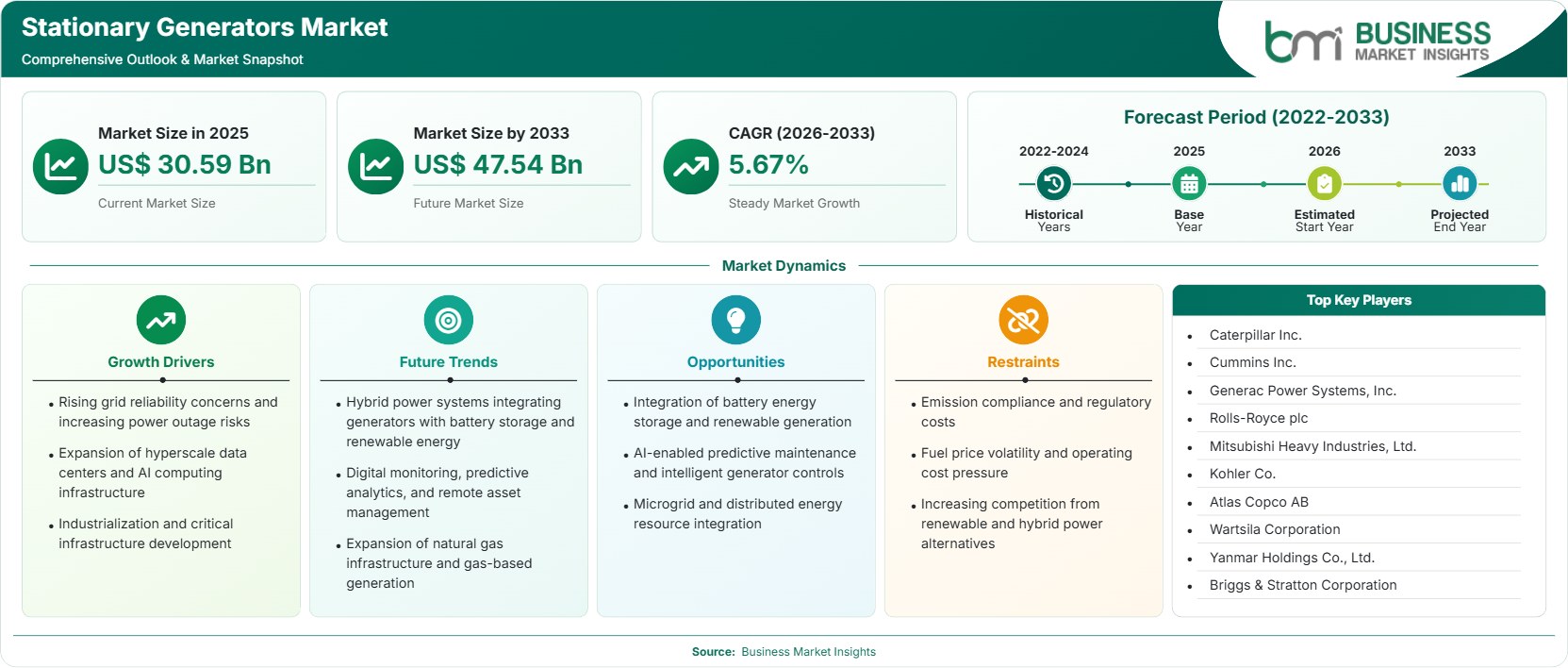
The Stationary Generators Market size was valued at US$ 30.59 Billion in 2025 and is projected to reach US$ 47.54 Billion by 2033, growing at a CAGR of 5.67% during 2026–2033. Rising grid reliability concerns, data center expansion, industrial electrification, critical infrastructure investments, and demand for resilient backup power systems are accelerating adoption, while hybrid power integration creates additional opportunities.

Report Coverage
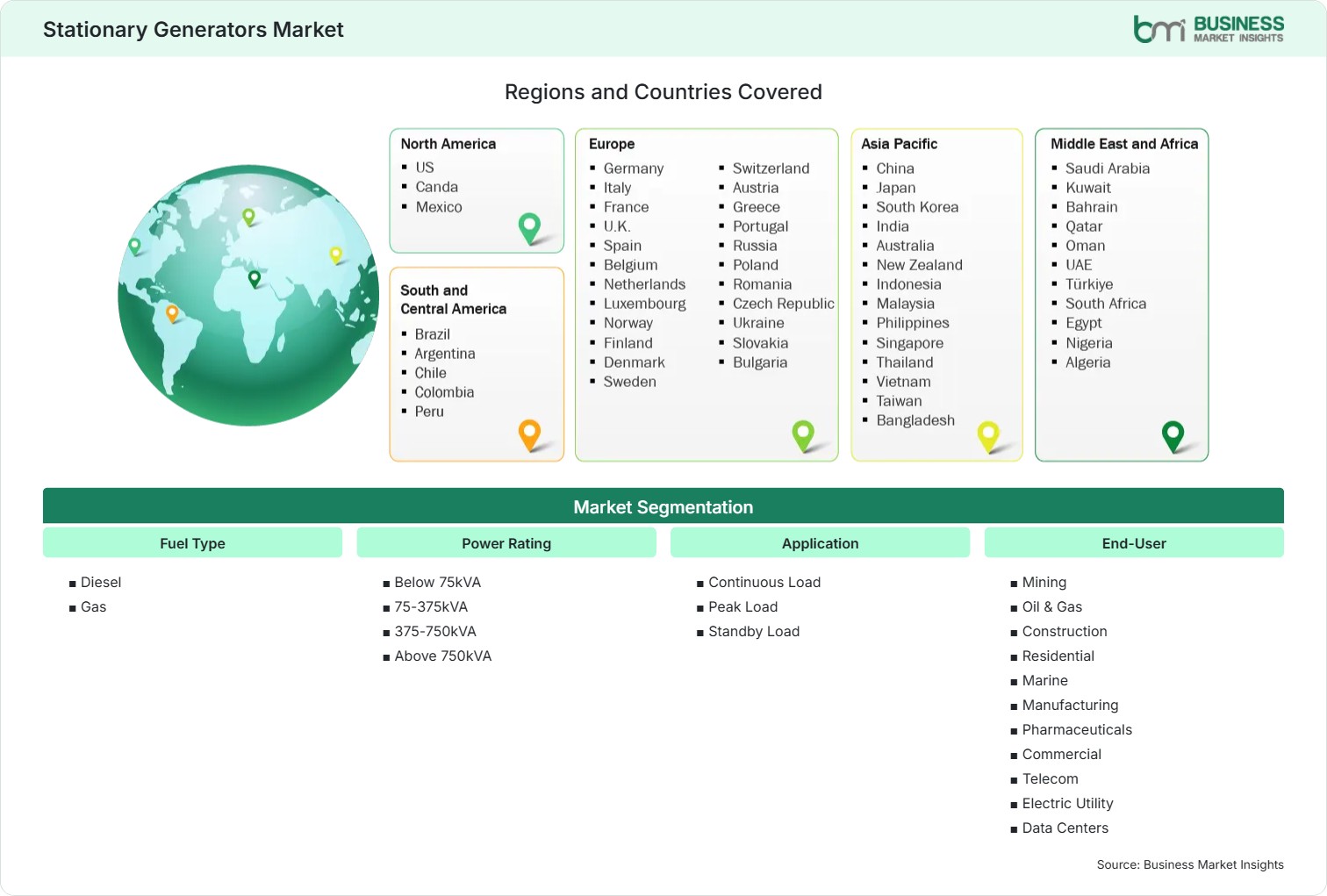
  • Fuel Type: Diesel, Gas
  • Power Rating: Below 75kVA, 75-375kVA, 375-750kVA, Above 750kVA
  • Application: Continuous Load, Peak Load, Standby Load
  • End-User: Mining, Oil & Gas, Construction, Residential, Marine, Manufacturing, Pharmaceuticals, Commercial, Telecom, Electric Utility, Data Centers
US$ 30.59 Bn Market size in 2025
US$ 47.54 Bn Market Size by 2033
5.67% CAGR, 2026 - 2033
2026-2033 Forecast Period

AI Overview

Stationary Generators Market Summary

  • North America Region: North America holds a market share of 34%–37% in 2025, growing with a CAGR of 5.0%–5.4% during 2026–2033. Aging grid infrastructure, hyperscale data center investments, utility resilience programs, industrial modernization, and emergency preparedness initiatives continue supporting deployment opportunities across commercial and critical facilities worldwide. Brief U.S. analysis: Strong data center and healthcare backup power demand supports market expansion with a CAGR of 5.1%–5.5%.
  • Fastest Growing Region: Asia Pacific holds a market share of 27%–30% in 2025, growing with a CAGR of 6.6%–7.1% during 2026–2033. Accelerating industrialization, urban infrastructure development, telecom network expansion, manufacturing relocation, and rising energy security requirements stimulate substantial investment in distributed and standby generation assets.
  • Leading Segment: Diesel holds a market share of 54%–58% in 2025, growing with a CAGR of 5.2%–5.7% during 2026–2033. Proven reliability, extensive fuel availability, high power density, remote-site suitability, and established maintenance ecosystems sustain widespread adoption across industrial and commercial operations.
  • High Growth Segment: Data Centers account for a market share of 10%–13% in 2025, growing with a CAGR of 7.5%–8.1% during 2026–2033. Expanding cloud infrastructure, AI workloads, uptime requirements, and hyperscale facility construction are increasing demand for high-capacity backup and continuous power systems.
  • Key Market Opportunity: Hybrid generator deployments combining gas engines, battery storage, digital controls, and renewable integration offer operators improved efficiency, emissions performance, resilience, and lifecycle economics across commercial and industrial facilities globally.
  • Major Market Players: Caterpillar Inc., Cummins Inc., Generac Power Systems, Inc., Rolls-Royce plc, Mitsubishi Heavy Industries, Ltd., Kohler Co., Atlas Copco AB, Wärtsilä Corporation, Yanmar Holdings Co., Ltd., Briggs & Stratton Corporation.
Strategic Insights

Stationary Generators Market: Strategic Insights

Stationary Generators Market Strategic Framework
FREE PDF
Request your free sample
Request free sample
Stakeholder View

Key Takeaways

  • The value chain increasingly integrates engine suppliers, alternator manufacturers, digital control providers, fuel infrastructure operators, EPC contractors, and aftermarket service networks, creating strong recurring revenue opportunities.
  • Data centers, telecom infrastructure, pharmaceuticals, and utility applications offer some of the highest long-term demand potential due to stringent operational continuity requirements.
  • Product innovation is moving toward low-emission engines, hybrid systems, intelligent controllers, load optimization software, and predictive maintenance platforms.
  • Asia Pacific presents a compelling investment environment because of industrial expansion, manufacturing migration, infrastructure spending, and growing electricity reliability concerns.
  • Strategic partnerships and acquisitions increasingly focus on energy management software, microgrid integration, and service capabilities that extend equipment lifecycle value.
  • Aftermarket services, maintenance contracts, remote diagnostics, and equipment upgrades are becoming critical differentiators among leading manufacturers.
Geographic Outlook

Stationary Generators Market Regional Highlights

North America Stationary Generators Market

North America accounted for 34%–37% of revenue in 2025 and is projected to expand at a 5.0%–5.4% CAGR through 2033. The region benefits from large-scale data center construction, healthcare modernization, aging electrical infrastructure, and resilient power investments. The Stationary Generators Market share remains highest in this region because enterprises prioritize business continuity and emergency preparedness. Frequent weather disruptions and utility reliability programs continue supporting replacement cycles and new installations across industrial, commercial, and institutional facilities.

  • Large hyperscale data center developments across the United States and Canada are generating sustained demand for high-capacity standby power infrastructure.
  • Healthcare facilities are increasingly deploying advanced backup systems to maintain compliance with operational continuity requirements.
  • Grid modernization projects continue to coexist with backup generation investments due to resilience concerns.
  • Industrial manufacturing facilities are upgrading legacy equipment with digitally monitored systems for improved efficiency.
  • Telecom network expansion supports deployment at distributed critical communications sites.

US Stationary Generators Market

The United States represents approximately 78%–82% of North American demand and is expected to grow at 5.1%–5.5% CAGR through 2033. Investment in AI-focused data centers, semiconductor facilities, healthcare campuses, and logistics infrastructure remains a primary growth catalyst. Utilities and municipalities continue expanding emergency preparedness programs. Strong replacement demand for aging equipment, coupled with stricter emissions standards, supports adoption of technologically advanced power solutions.

  • Data center operators are procuring larger-capacity systems with redundant configurations to maintain uptime commitments.
  • Industrial reshoring initiatives are increasing demand for reliable power support infrastructure.
  • Hospitals and public facilities continue prioritizing resilient standby generation systems.
  • Remote monitoring and predictive maintenance adoption is accelerating across commercial applications.

Europe Stationary Generators Market

Europe held 24%–27% market share during 2025 and is forecast to expand at 4.8%–5.3% CAGR through 2033. Energy security priorities, industrial resilience planning, and critical infrastructure investments continue supporting adoption. Germany remains the leading country, while Eastern European markets show stronger expansion potential. Advanced emissions regulations are encouraging replacement of older assets with cleaner and more fuel-efficient technologies, particularly gas-based systems.

  • Germany leads regional installations with strong industrial and data center demand.
  • Poland represents one of the fastest-growing opportunities, supported by infrastructure investment.
  • Hybrid systems integrating batteries and generators are gaining traction in commercial projects.
  • Telecom and healthcare sectors maintain steady procurement activity.
  • Regulatory emphasis on resiliency planning supports long-term equipment upgrades.

Asia Pacific Stationary Generators Market

Asia Pacific accounted for 27%–30% of global revenue in 2025 and is projected to register a 6.6%–7.1% CAGR, making it the fastest-growing region. Rapid industrialization, urban expansion, telecom deployment, and construction activity elevate demand. China remains the largest market, while India demonstrates the fastest expansion. Strong manufacturing output and infrastructure spending continue supporting regional Stationary Generators Market growth.

  • China leads installations due to large manufacturing and infrastructure projects.
  • India records the highest regional growth rate supported by industrial expansion.
  • Telecom tower deployment strengthens distributed power requirements.
  • Mining and construction activities support demand for high-capacity systems.
  • Commercial real estate development increases standby power installations.

Rest of World Stationary Generators Market

Rest of World represents 11%–14% market share in 2025 and is forecast to grow at a 5.8%–6.3% CAGR. South and Central America benefit from mining expansion and grid reliability challenges, while Middle East and Africa markets gain momentum from oil and gas projects, industrial diversification, and infrastructure investments. Saudi Arabia leads regional demand, whereas the UAE demonstrates strong growth in data centers and commercial developments.

  • Mining investments in Latin America support continuous-load applications.
  • Gulf infrastructure projects are increasing demand for standby power assets.
  • Oil and gas facilities remain key consumers of high-output equipment.
  • Commercial developments across the UAE support advanced backup power adoption.
  • Grid expansion gaps in several African nations create opportunities for distributed generation.
Global Market Geography
FREE PDF
Request your free sample
Request free sample
Segment Analysis

Stationary Generators Market Segmentation

Fuel Type

Fuel Type represented a core demand center, with diesel accounting for the largest contribution. The segment collectively held over half of market demand in 2025 and remains essential for high-reliability applications. Stationary Generators Market scope continues expanding as fuel flexibility, emissions compliance, and operating efficiency increasingly influence purchasing decisions. CAGR ranges vary across fuel categories through 2033.

  • Diesel: Dominant across industrial, telecom, healthcare, construction, and utility applications due to reliability, fuel availability, high power density, and proven long-duration operational performance.
  • Gas: Adoption accelerates in urban and commercial settings where pipeline access, emissions requirements, and lower operating costs support broader deployment decisions.

Power Rating

Power rating requirements differ significantly across residential, commercial, industrial, and utility environments. Mid-range capacities account for substantial procurement volumes, while larger systems benefit from data center and industrial investments. Growth remains tied to infrastructure expansion and mission-critical applications.

  • Below 75kVA: Widely used in residential properties, small businesses, retail facilities, and localized telecom sites requiring dependable backup power capabilities.
  • 75-375kVA: Strong demand across commercial buildings, healthcare facilities, educational campuses, and medium-sized industrial operations.
  • 375-750kVA: Commonly deployed in manufacturing environments, utility support applications, and critical institutional facilities requiring greater operational resilience.
  • Above 750kVA: Increasingly adopted by hyperscale data centers, mining operations, refineries, and large industrial complexes needing high-output performance.

Application

Application dynamics are shaped by reliability expectations, facility criticality, and operational continuity requirements. Standby systems represent substantial demand, while continuous-load installations remain important in remote and off-grid environments. The segment reflects evolving Stationary Generators Market trends related to energy resilience.

  • Continuous Load: Essential for remote industrial sites, mining projects, and locations with limited or unavailable grid connectivity.
  • Peak Load: Supports load management strategies, operational flexibility, and temporary capacity requirements during demand fluctuations.
  • Standby Load: Preferred across commercial, healthcare, telecom, and data center environments requiring uninterrupted operations during outages.

End-User

End-user demand remains diversified, reducing concentration risks and supporting market stability. Critical infrastructure industries increasingly emphasize resilience, efficiency, and regulatory compliance. Data centers represent the highest-growth category, while industrial sectors continue generating substantial volume demand.

  • Mining: Remote operations require durable and continuous power solutions under demanding environmental conditions.
  • Oil & Gas: Exploration, production, processing, and transportation activities depend on reliable power availability.
  • Construction: Temporary and permanent power requirements support equipment operation and project continuity.
  • Residential: Rising outage awareness encourages installation of standby power systems.
  • Marine: Vessels and port operations utilize dedicated generation assets for reliability.
  • Manufacturing: Production continuity and automation requirements drive substantial deployment activity.
  • Pharmaceuticals: Strict operational controls sustain demand for uninterrupted electricity availability.
  • Commercial: Offices, retail centers, and mixed-use developments rely on backup power preparedness.
  • Telecom: Network uptime requirements continue supporting widespread installation growth.
  • Electric Utility: Grid support and emergency response capabilities encourage procurement.
  • Data Centers: Expanding digital infrastructure accelerates demand for large-capacity standby systems.
Market Forces

Stationary Generators Market Dynamics

Key Market Drivers

Expansion of Data Center Infrastructure

Global growth in cloud computing, artificial intelligence workloads, and digital services is increasing construction of hyperscale and colocation facilities. These assets need to function with zero downtime; hence, the importance of backup generation as part of the necessary infrastructure. There has been an increasing trend of companies investing in high-capacity backup systems with advanced monitoring capabilities. With the rise of digital economies, there is increased investment in ensuring that there is an uninterrupted power supply.

Increasing Grid Reliability Challenges

Disasters due to climatic changes, old power infrastructure and high electricity demands put heavy burden on power grids. As outages and grid instability becomes common phenomenon, organizations involved in healthcare, telecommunication, manufacturing, data centers and corporate industry are investing extensively in emergency backup power. This trend is driving growth in the Stationary Generators Market, as reliable power systems are essential for business continuity. Public and private stakeholders are increasingly allocating funds toward resilience and preparedness initiatives to ensure uninterrupted operations during outages, extreme weather events, and other grid-related disruptions.

Industrialization and Infrastructure Development

Large-scale infrastructure development, including industrial parks, transportation networks, energy facilities, and urban construction projects, continues to generate strong demand for reliable electricity solutions. With growing economies, a constant electricity supply is a key requirement for factories, construction sites, and business houses in order to ensure productivity, workplace safety, and efficiency of resource management. Distributed power generation systems help meet energy requirements while expanding the grid in many developing nations. Continuous industrialization, rapid urbanization, and investments in critical infrastructure ensure a consistent demand for power equipment in different sectors.

Key Market Opportunities

Hybrid Power Systems Integration

The use of generators together with BESS and renewables is revolutionizing the current power generation system through increased efficiency, less fuel usage, and reduced costs of operation. Many firms are now opting for hybrid power systems because they offer more flexibility in the energy system and are also sustainable. Such systems ensure resilience when there is a power interruption since there will be an assured power supply. As a result, Stationary Generators Market Forecasts indicate strong growth in investments related to smart microgrids, distributed energy resources, and advanced power management platforms that balance reliability, performance, and environmental objectives.

Digital Monitoring and Predictive Analytics

Digital monitoring, predictive analytics, and remote asset management technologies are transforming industrial operations by enabling real-time visibility into equipment performance and health. The use of such strategies enables organizations to achieve savings through minimized unplanned downtime, optimization of maintenance schedules, reduced costs of operations, and prolonged asset lifecycles. The increased use of connected devices, sensors, and IIoT platforms is rapidly increasing the transition towards evidence-based strategies for operations. Firms that offer a combination of products and services related to software and analytics have great chances of earning recurring revenues from their clients.

Natural Gas Infrastructure Expansion

The growth in natural gas distribution channels within many nations is raising the likelihood of the deployment of cleaner-burning stationary energy production systems. With increased access and dependability, business buildings, institutional buildings, and industrial facilities are increasingly considering the installation of gas-fired power production facilities as cheaper energy options. This trend creates significant opportunities for manufacturers to introduce advanced gas engines, hybrid power solutions, and integrated control systems that deliver higher efficiency, improved operational performance, lower emissions, and compliance with evolving energy regulations and sustainability requirements.

Market Restraints and Challenges

Emission Compliance and Regulatory Costs

Factor: The increasing number of environmental regulations concerning engine emissions makes it necessary for companies to spend a lot on technological advancements and testing methods.

Impact: This has increased the cost of production and product development, which translates into expensive equipment to the consumer. Further, complying with changing emission standards may cause delays in the process of product development and launching of products in the market. Small companies have been seen to suffer more from these financial challenges than their bigger multinational counterparts. Users evaluate whether the cost of meeting such regulations is worth considering other power sources.

Fuel Price Volatility and Operating Cost Pressure

Factor: The fluctuations in the prices of diesel fuel and natural gas lead to substantial uncertainty regarding the costs involved and hinder accurate forecasting of the total lifecycle cost.

Impact: Such unpredictability tends to affect budgets, thereby impacting procurement processes as well as investment plans on the part of businesses. Those companies that have longer-term planning cycles tend to put off purchases, reconsider whether their projects are feasible, and consider other technologies that will cost less to operate. This becomes a problem in markets where prices matter a great deal when it comes to operations expenditures.

Company Analysis

Competitive Landscape

Stationary Generators Market analysis indicates competition is centered on product reliability, emissions compliance, service network strength, digital monitoring capabilities, and large-project execution.

Company Name

Overview

Products and Services relevant to this market

Caterpillar Inc.

Global power systems leader with extensive industrial and critical infrastructure presence.

Diesel and gas generator sets, controls, service solutions, monitoring platforms.

Cummins Inc.

Major engine and power technology company serving diversified end markets.

Generator sets, engines, power systems, digital diagnostics, aftermarket support.

Generac Power Systems, Inc.

Strong presence across residential and commercial backup power segments.

Standby generators, control systems, energy management technologies, services.

Rolls-Royce plc

Operates power systems business through advanced distributed energy solutions.

mtu generator systems, microgrid technologies, digital monitoring solutions.

Mitsubishi Heavy Industries, Ltd.

Industrial engineering company with strong power generation expertise.

Large-capacity generators, gas engine systems, industrial power solutions.

Kohler Co.

Established supplier focused on reliability and critical backup applications.

Commercial and industrial generator sets, controls, maintenance services.

Atlas Copco AB

Industrial equipment provider serving infrastructure and energy markets.

Power generators, energy equipment, support services, rental solutions.

Wärtsilä Corporation

Energy technology specialist with global distributed power footprint.

Engine-based power plants, backup systems, hybrid energy solutions.

Yanmar Holdings Co., Ltd.

Engine manufacturer serving industrial and commercial applications worldwide.

Diesel generators, energy equipment, engine technologies and support.

Briggs & Stratton Corporation

Power equipment manufacturer with diversified generation offerings.

Standby generator systems, residential and light commercial power solutions.

Trust & Transparency

Research Methodology

The market analysis combines proprietary research with secondary data from government agencies, company disclosures, regulatory filings, industry databases and expert interviews. Market estimates are validated through data triangulation, cross-market benchmarking and analyst review.

View Full Research Methodology

Questions Answered

Frequently Asked Questions

What does a Stationary Generators Market Report typically evaluate?

A comprehensive Stationary Generators Market Report assesses competitive positioning, technology shifts, regional demand patterns, regulatory impacts, end-user adoption trends, investment activity, and future growth prospects.

What end-user segment offers the strongest expansion potential?

Data centers are among the fastest-growing end-user categories due to accelerating digital infrastructure investments, increasing cloud traffic, and expanding artificial intelligence workloads.

How are digital technologies changing generator operations?

Remote monitoring, predictive maintenance, and analytics improve operational efficiency, reduce downtime, optimize servicing schedules, and enhance asset lifecycle management.

Which fuel type currently dominates market demand?

Diesel remains the leading fuel category because of high reliability, broad fuel availability, strong performance characteristics, and suitability for remote and critical infrastructure applications.

What factors are increasing generator demand in data centers?

AI computing, cloud expansion, and uptime requirements require highly reliable backup power systems. Operators invest in redundant generation architectures to minimize outage risks and support uninterrupted digital operations.

Access the Full Stationary Generators Market Report

Get segment-level forecasts, regional estimates, competitive benchmarking, company profiles and downloadable Excel datasets.

Access the full Stationary Generators Market Report
350 pages PDF & Excel | 2026-09-02