
Hydrogen Compressor Market Outlook: Size, Share, Trends, Growth Analysis, Competitive Landscape & Forecast, 2026–2033

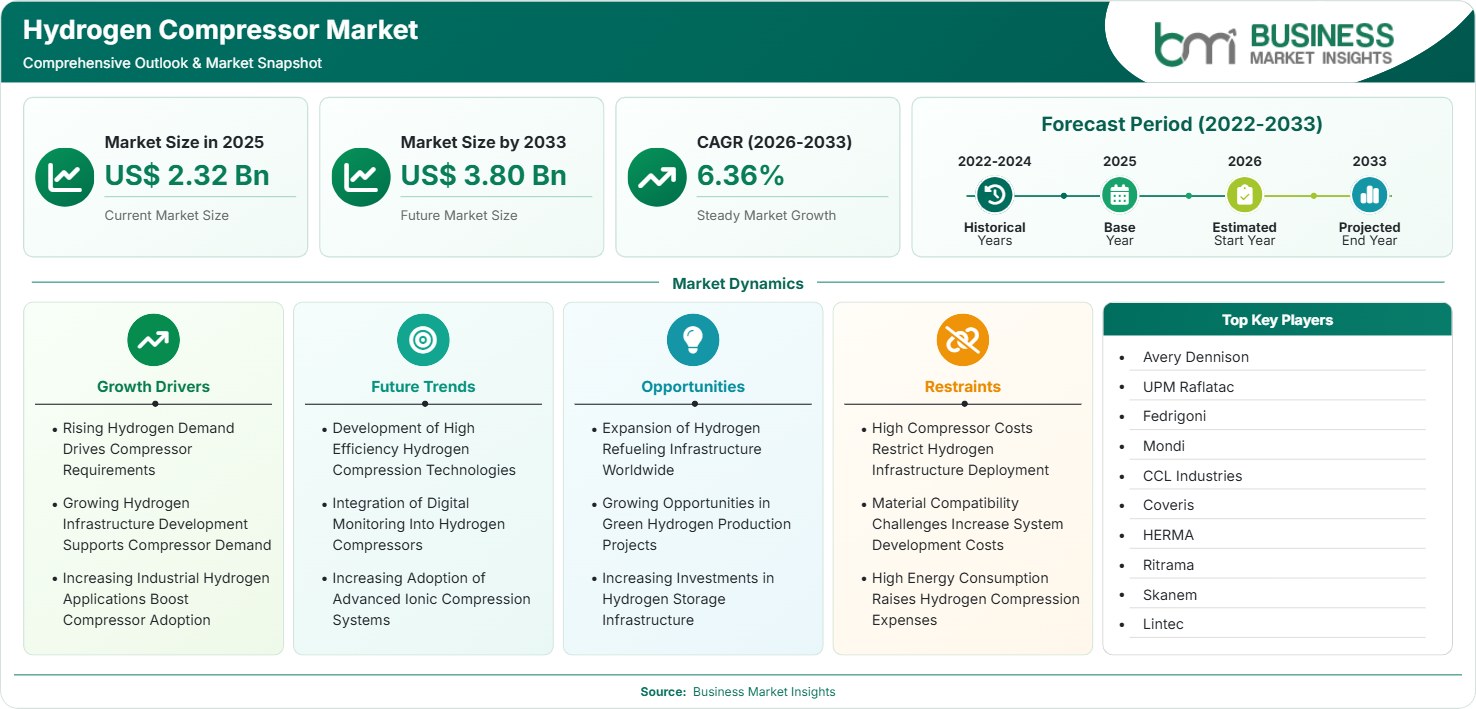
The Hydrogen Compressor Market size was valued at US$ 2.32 billion in 2025 and is projected to reach US$ 3.80 billion by 2033, growing at a CAGR of 6.36% during 2026–2033. Rising hydrogen infrastructure development, increasing clean energy investments, industrial hydrogen applications, and expanding refueling networks are driving market expansion, while advancements in storage systems and green hydrogen projects create new opportunities.

Report Coverage
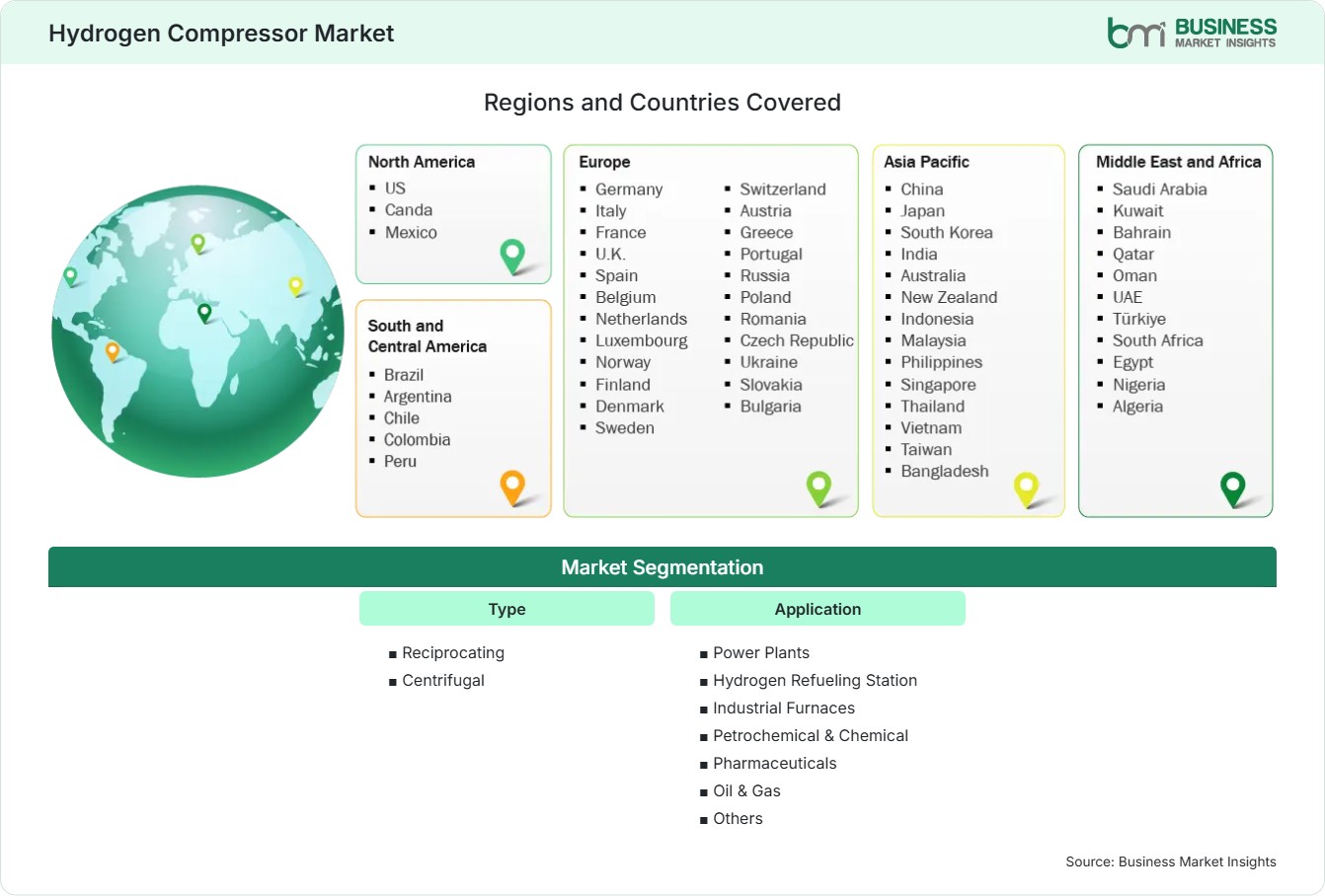
  • Type: Reciprocating, Centrifugal
  • Application: Power Plants, Hydrogen Refueling Station, Industrial Furnaces, Petrochemical & Chemical, Pharmaceuticals, Oil & Gas, Others
US$ 2.32 Bn Market size in 2025
US$ 3.80 Bn Market Size by 2033
6.36% CAGR, 2026 - 2033
2026-2033 Forecast Period

01 AI Overview

Hydrogen Compressor Market Summary

  • North America Region: North America accounts for 33%–36% market share in 2025 and is projected to expand at a 6%–7% CAGR during 2026–2033. Growth is supported by hydrogen mobility initiatives, clean energy investments, industrial decarbonization programs, and increasing hydrogen production activities. The U.S. market benefits from expanding hydrogen hubs, government-supported clean energy projects, and growing industrial demand, supporting growth at 6%–7% CAGR.
  • Fastest Growing Region: Asia Pacific represents 29%–32% market share in 2025 and is expected to grow at a 7%–8% CAGR through 2033. Increasing hydrogen investments, industrial expansion, energy transition initiatives, and development of hydrogen transportation infrastructure support regional opportunities.
  • Leading Segment: Reciprocating compressors represent 65%–68% market share in 2025 and are expected to grow at a 6%–7% CAGR. High efficiency, suitability for high-pressure applications, reliability, and widespread industrial adoption support segment leadership.
  • High Growth Segment: Hydrogen Refueling Station applications represent 22%–25% market share in 2025 and are projected to expand at a 8%–9% CAGR. Growing fuel cell vehicle adoption, mobility infrastructure development, and government hydrogen initiatives support segment growth.
  • Key Market Opportunity: Expansion of green hydrogen production, hydrogen mobility networks, storage infrastructure, and industrial decarbonization projects creates significant opportunities for compressor manufacturers.
  • Major Market Players: Avery Dennison, UPM Raflatac, Fedrigoni, Mondi, CCL Industries, Coveris, HERMA, Ritrama, Skanem, and Lintec.
02 Strategic Insights

Hydrogen Compressor Market: Strategic Insights

Hydrogen Compressor Market Strategic Framework
FREE PDF
Request your free sample
Request free sample
03 Stakeholder View

Key Takeaways

  • The hydrogen compressor value chain is becoming increasingly interconnected, involving equipment manufacturers, hydrogen producers, infrastructure developers, energy companies, and technology providers working toward scalable hydrogen solutions. This collaboration is helping accelerate technology development and strengthen hydrogen infrastructure deployment.
  • Hydrogen refueling stations, green hydrogen facilities, and industrial applications represent major growth opportunities as global energy systems increasingly incorporate hydrogen-based technologies. Rising investments in these applications are expected to drive demand for advanced compression solutions.
  • Innovation is focused on improving compressor efficiency, durability, pressure capabilities, and compatibility with renewable hydrogen production systems. These advancements are enabling compressors to meet the evolving requirements of hydrogen production and distribution.
  • Asia Pacific presents a strong investment opportunity due to expanding hydrogen strategies, industrial growth, increasing energy transition initiatives, and government-supported infrastructure development. Growing regional investments are expected to create favorable opportunities for hydrogen compressor manufacturers.
  • Strategic collaborations, technology partnerships, and capacity expansion initiatives are shaping competitive positioning as companies seek to participate in the growing hydrogen economy. These strategies are enabling companies to strengthen their technological capabilities and expand their market presence.
  • Long-term market competitiveness will depend on cost reduction, material innovation, operational reliability, and the ability to support large-scale hydrogen storage and distribution networks. Companies that address these factors effectively are likely to gain a stronger position in the evolving market.
04 Geographic Outlook

Hydrogen Compressor Market Regional Highlights

North America Hydrogen Compressor Market

North America maintains a strong position due to increasing hydrogen infrastructure investments, clean energy policies, and industrial decarbonization efforts. The region benefits from expanding hydrogen production projects and mobility applications. North America accounted for 33%–36% market share in 2025 and is expected to grow at a 6%–7% CAGR through 2033.

  • The United States leads regional demand through hydrogen hub development, clean energy investments, and increasing deployment of hydrogen infrastructure projects.
  • Canada is expanding hydrogen initiatives through renewable energy resources, industrial applications, and investments in low-carbon energy solutions.
  • Industrial companies are adopting hydrogen systems to reduce emissions and improve sustainability across energy-intensive operations.
  • Government support for hydrogen development is encouraging infrastructure investments and technology advancement across the region.

US Hydrogen Compressor Market

The U.S. market represents the largest contributor within North America due to strong hydrogen policy support, industrial demand, and expanding clean energy initiatives. The country is developing hydrogen infrastructure through production projects, transportation applications, and industrial decarbonization programs. Growing investments in hydrogen hubs are creating opportunities for compressor technology providers.

  • Hydrogen mobility projects are increasing demand for reliable compression systems at refueling stations and distribution facilities. This trend is supporting the deployment of high-performance compressors across hydrogen fueling networks.
  • Industrial users are adopting hydrogen solutions to support emission reduction goals and improve energy efficiency. This adoption is creating demand for efficient compression systems across diverse industrial applications.
  • Energy companies are investing in hydrogen infrastructure projects requiring advanced compression technologies. These investments are accelerating the need for scalable and reliable compressor solutions.

Europe Hydrogen Compressor Market

Europe continues experiencing steady growth due to strong hydrogen strategies, renewable energy integration, and industrial decarbonization objectives. Governments and industries are investing in hydrogen infrastructure to support clean energy transitions. The region represents 24%–27% Hydrogen Compressor Market share in 2025 and is projected to grow at a 6%–7% CAGR through 2033.

  • Germany remains a leading market due to hydrogen investment programs, industrial demand, and strong renewable energy capabilities.
  • France is expanding hydrogen adoption through clean energy projects and industrial applications requiring compression solutions.
  • The United Kingdom is developing hydrogen infrastructure through mobility initiatives and energy transition programs.
  • European companies are focusing on efficient compressor technologies to support hydrogen production and distribution networks.

Asia Pacific Hydrogen Compressor Market

Asia Pacific represents the fastest-growing region due to increasing hydrogen investments, industrial expansion, and government-led energy transition initiatives. Countries are developing hydrogen production and distribution infrastructure to support future energy requirements. The region accounted for 29%–32% market share in 2025 and is projected to grow at a 7%–8% CAGR during 2026–2033.

  • China is advancing hydrogen infrastructure through industrial applications, mobility projects, and clean energy development programs.
  • Japan continues investing in hydrogen technologies through transportation applications and international hydrogen supply initiatives.
  • South Korea is expanding hydrogen adoption through fuel cell mobility and hydrogen infrastructure development.
  • India is increasing focus on hydrogen production and industrial applications through national clean energy initiatives.

Rest of World Hydrogen Compressor Market

The Rest of World region, including South & Central America and the Middle East & Africa, is gradually developing due to increasing hydrogen investments and renewable energy opportunities. Countries are exploring hydrogen production and export capabilities. The region is expected to register a 6%–7% CAGR through 2033.

South and Central America are leveraging renewable energy resources to develop green hydrogen projects. Middle Eastern countries are investing in hydrogen production facilities to diversify energy portfolios and support future energy exports.

  • Brazil is exploring hydrogen opportunities through renewable energy resources and industrial decarbonization initiatives.
  • Chile is developing green hydrogen projects supported by renewable energy availability and export potential.
  • Middle Eastern countries are investing in large-scale hydrogen production projects and related infrastructure.
  • African markets are gradually developing hydrogen capabilities through renewable energy investments and international partnerships.
Global Market Geography
FREE PDF
Request your free sample
Request free sample
05 Segment Analysis

Hydrogen Compressor Market Segmentation

Type

The type segment is influenced by pressure requirements, operational efficiency, and application-specific hydrogen compression needs. Reciprocating compressors dominate due to their suitability for high-pressure applications, while centrifugal compressors are gaining attention for large-scale continuous operations. Increasing hydrogen infrastructure development is encouraging manufacturers to improve compressor reliability and performance. The Hydrogen Compressor Market scope is expanding as industries adopt compression solutions across mobility, energy, and industrial applications.

  • Reciprocating: Reciprocating compressors are widely used for hydrogen applications requiring high pressure, reliable operation, and efficient compression performance across refueling stations and industrial facilities.
  • Centrifugal: Centrifugal compressors support large-volume hydrogen processing requirements and are gaining adoption in applications requiring continuous operation and high flow capacity.

Application

The application segment is expanding due to increasing hydrogen utilization across energy, transportation, and industrial sectors. Hydrogen compressors play a critical role in storage, transportation, and processing operations. The Hydrogen Compressor Market trend is influenced by rising adoption of hydrogen-based energy systems and increasing investments in infrastructure development across multiple industries.

  • Power Plants: Power plants are exploring hydrogen integration to support cleaner energy generation and improve flexibility in future energy systems.
  • Hydrogen Refueling Station: Hydrogen refueling stations represent a growing application area due to increasing fuel cell vehicle adoption and expanding hydrogen mobility infrastructure.
  • Industrial Furnaces: Industrial furnaces are adopting hydrogen solutions to reduce carbon emissions and improve sustainability in high-temperature manufacturing processes.
  • Petrochemical & Chemical: Petrochemical and chemical industries utilize hydrogen compressors for processing requirements, feedstock applications, and operational efficiency improvements.
  • Pharmaceuticals: Pharmaceutical applications use hydrogen compression systems for specialized processing operations requiring reliable hydrogen supply and controlled operating conditions.
  • Oil & Gas: Oil and gas industries are adopting hydrogen technologies to support refining operations, emissions reduction strategies, and energy transition initiatives.
06 Market Forces

Hydrogen Compressor Market Dynamics

Key Market Drivers

Rising Hydrogen Demand Drives Compressor Requirements

As demand for hydrogen increases in transportation, industrial processing, and clean energy systems, the need for more efficient systems becomes increasingly important. Hydrogen compression systems are critical to the storage, transport, and use of hydrogen because it requires high-pressure systems. More hydrogen production ventures are leading to interest in efficient compression systems. In the energy sector and industrial applications, there is an increasing need for solutions that would enhance their efficiency and increase system reliability. This increasing demand is driving the adoption of new compressor technologies.

Growing Hydrogen Infrastructure Development Supports Compressor Demand

The development of hydrogen manufacturing plants, fueling stations, and storage systems is driving demand for compressors tailored to these applications. Investments from governments and industries are being made in hydrogen ecosystems to achieve energy transition objectives and reduce carbon emissions. Compressors are emerging as key components of hydrogen transportation and distribution systems. The growing investments in hydrogen infrastructure development will drive the Hydrogen Compressor Market growth by creating long-term demand.

Increasing Industrial Hydrogen Applications Boost Compressor Adoption

Various industries are now using hydrogen for applications such as refining, chemical production, metal fabrication, and manufacturing processes. Various industries need compression technology to enable the uninterrupted supply of hydrogen. There is increased focus on industrial decarbonization, with a need to use hydrogen as an energy source instead of conventional ones. Compressor manufacturers are focusing on producing compressors that withstand harsh industrial conditions.

Key Market Opportunities

Expansion of Hydrogen Refueling Infrastructure Worldwide

Expanding the hydrogen refueling infrastructure is generating numerous business opportunities for compressor makers as transportation increasingly adopts fuel cell technology. Rising investment in hydrogen mobility networks is raising the demand for high-performance compression systems. Both governments and automakers are investing in developing infrastructure to make hydrogen available. The compressor makers have developed compressors that are suited for refueling operations. According to the Hydrogen Compressor Market forecast, opportunities will increase as hydrogen mobility networks expand worldwide.

Growing Opportunities in Green Hydrogen Production Projects

The development of green hydrogen manufacturing projects is creating new possibilities due to the high integration of renewable energy and decarbonization efforts worldwide. Efficient hydrogen compressors are needed in electrolysis plants for the storage, transportation, and application of hydrogen. There is a need to develop technology that will enhance large-scale hydrogen production and boost efficiency. The emergence of new possibilities in green hydrogen is driving demand for compressors.

Increasing Investments in Hydrogen Storage Infrastructure

The rise in investment in the infrastructure required for hydrogen storage will increase the need for reliable compressors. Efficient compression will be needed by hydrogen storage equipment to manage hydrogen transportation and utilization. Oil and gas firms are constructing storage centers to make hydrogen delivery flexible and reliable. Compressor manufacturers have become involved in developing technologies aimed at improving the safety and performance of storage devices.

Market Restraints and Challenges

High Compressor Costs Restrict Hydrogen Infrastructure Deployment

Factor: Hydrogen compressors require advanced engineering, specialized materials, and complex manufacturing processes that increase equipment costs. Impact: High cost of capital may slow infrastructure construction and could pose problems for small operators that venture into hydrogen. The current efforts of firms involve technological advancements and production efficiencies aimed at lowering the total costs of systems. Financial issues are critical to the development of early-stage hydrogen infrastructure.

Material Compatibility Challenges Increase System Development Costs

Factor: Hydrogen exposure can create material-related challenges, including embrittlement risks and durability concerns requiring specialized engineering solutions. Impact: Extra testing, requirements for the choice of materials, and maintenance issues may lead to higher development costs and a longer time needed for the project. Companies are developing advanced materials and design solutions to make compressors more reliable. Research on hydrogen-compatible materials is contributing to improved system performance. Nonetheless, material issues are still an important factor.

07 Company Analysis

Competitive Landscape

The competitive environment is shaped by technology development, engineering capabilities, and expansion into hydrogen infrastructure applications. The Hydrogen Compressor Market analysis highlights increasing focus on efficient compression technologies, durable materials, and solutions designed for hydrogen production, storage, and transportation systems.

Company Name

Overview

Products and Services Relevant to this Market

Avery Dennison

Provides material science solutions and engineered products across multiple industries.

Advanced materials, labeling technologies, and industrial solutions supporting various applications.

UPM Raflatac

Develops sustainable labeling materials and specialty solutions for global industries.

Label materials, renewable solutions, and engineered material products.

Fedrigoni

Produces specialty materials and innovative solutions for industrial applications.

Specialty papers, films, labels, and material technologies.

Mondi

Provides packaging and material solutions focused on sustainability and innovation.

Flexible materials, industrial packaging, and specialty material solutions.

CCL Industries

Develops labeling and specialty packaging solutions for global markets.

Label technologies, engineered materials, and customized solutions.

Coveris

Provides sustainable packaging solutions across food and industrial sectors.

Flexible packaging materials and specialty product solutions.

HERMA

Develops adhesive technologies and labeling solutions for industrial applications.

Self-adhesive materials, labeling systems, and specialty products.

Ritrama

Provides adhesive materials and specialty labeling solutions.

Self-adhesive products and engineered material solutions.

Skanem

Develops sustainable labeling solutions for consumer and industrial markets.

Label materials, packaging solutions, and specialty applications.

Lintec

Provides adhesive materials and advanced surface technologies.

Specialty films, adhesive products, and engineered material solutions.

10 Trust & Transparency

Research Methodology

The market analysis combines proprietary research with secondary data from government agencies, company disclosures, regulatory filings, industry databases and expert interviews. Market estimates are validated through data triangulation, cross-market benchmarking and analyst review.

View Full Research Methodology

11 Questions Answered

Frequently Asked Questions

What does the Hydrogen Compressor Market report indicate about future competition?

The report indicates that competition will focus on energy-efficient designs, advanced materials, cost optimization, and solutions for large-scale hydrogen infrastructure. Companies developing reliable and application-specific compression technologies are expected to strengthen their market positions.

Why is hydrogen storage expansion increasing demand for compressor technologies?

Hydrogen storage systems require reliable pressure management and efficient compression solutions to maintain supply flexibility. As industries develop larger hydrogen networks, compressor technologies are gaining importance for safe handling, transportation, and utilization of stored hydrogen.

How are clean energy initiatives influencing hydrogen compressor adoption?

Clean energy initiatives are accelerating hydrogen infrastructure development by encouraging investments in production, storage, and distribution systems. Hydrogen compressors are becoming essential components in supporting renewable hydrogen projects and enabling industries to transition toward lower-carbon energy solutions.

Which applications present the strongest opportunity in the market?

Hydrogen refueling stations, green hydrogen production facilities, industrial applications, and storage infrastructure represent strong opportunities. These applications require efficient compression systems to support hydrogen availability, transportation, and integration into emerging clean energy networks.

What factors are improving Hydrogen Compressor Market return on investment?

Improved hydrogen utilization, increasing infrastructure development, operational efficiency, and growing industrial applications are improving return on investment. Hydrogen compressors enable reliable storage, transportation, and distribution while supporting energy transition initiatives across mobility, industrial processing, and clean energy projects.

Access the Full Hydrogen Compressor Market Report

Get segment-level forecasts, regional estimates, competitive benchmarking, company profiles and downloadable Excel datasets.

Access the full Hydrogen Compressor Market Report
350 pages PDF & Excel | 2026-08-12