
Centrifugal Hydrogen Compressor Market Outlook: Size, Share, Trends, Growth Analysis, Competitive Landscape & Forecast, 2026-2033

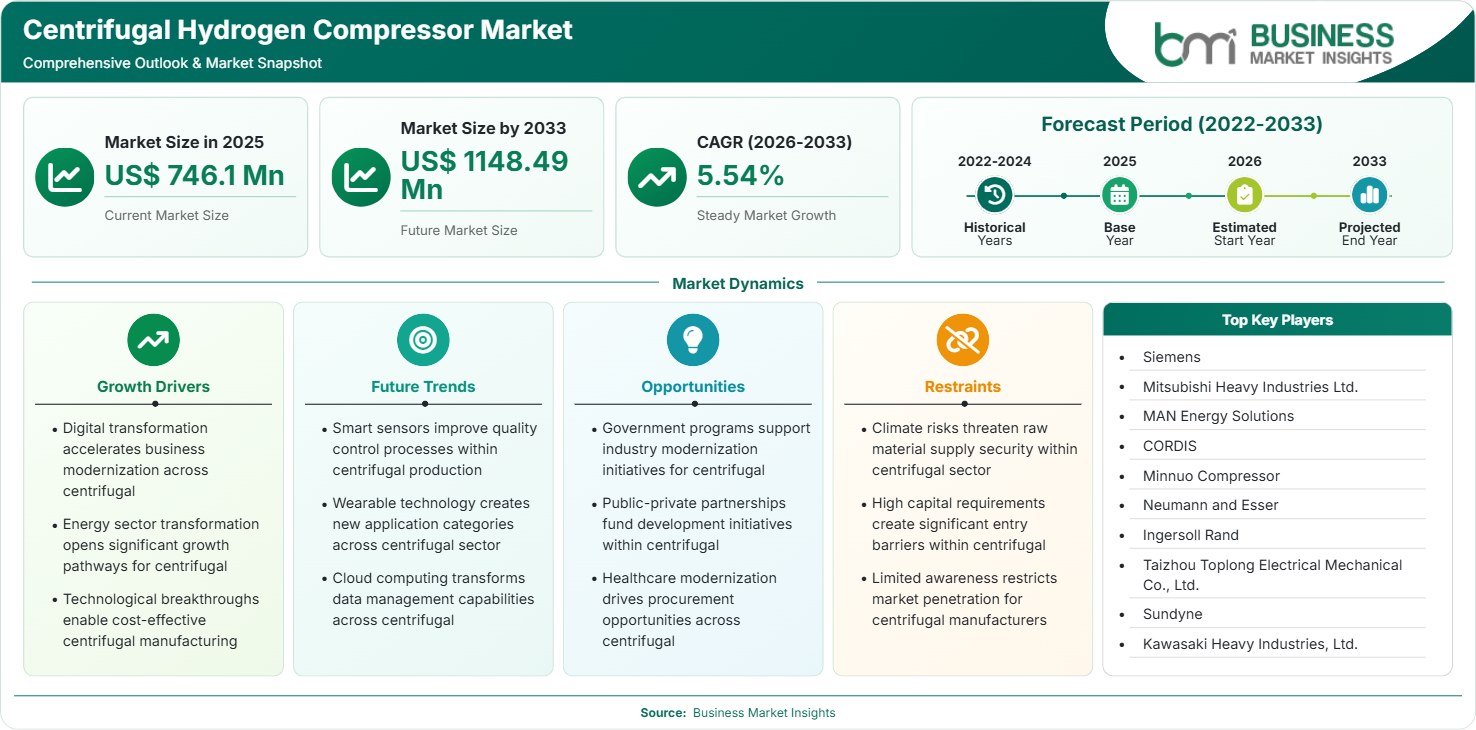
The Centrifugal Hydrogen Compressor Market size was valued at US$ 746.1 Million in 2025 and is projected to reach US$ 1148.49 Million by 2033, growing at a CAGR of 5.54% during 2026–2033. Increasing hydrogen production capacity, expansion of clean energy infrastructure, industrial decarbonization initiatives, and investments in hydrogen refueling networks continue to create strong opportunities for compressor manufacturers and technology providers.

Report Coverage
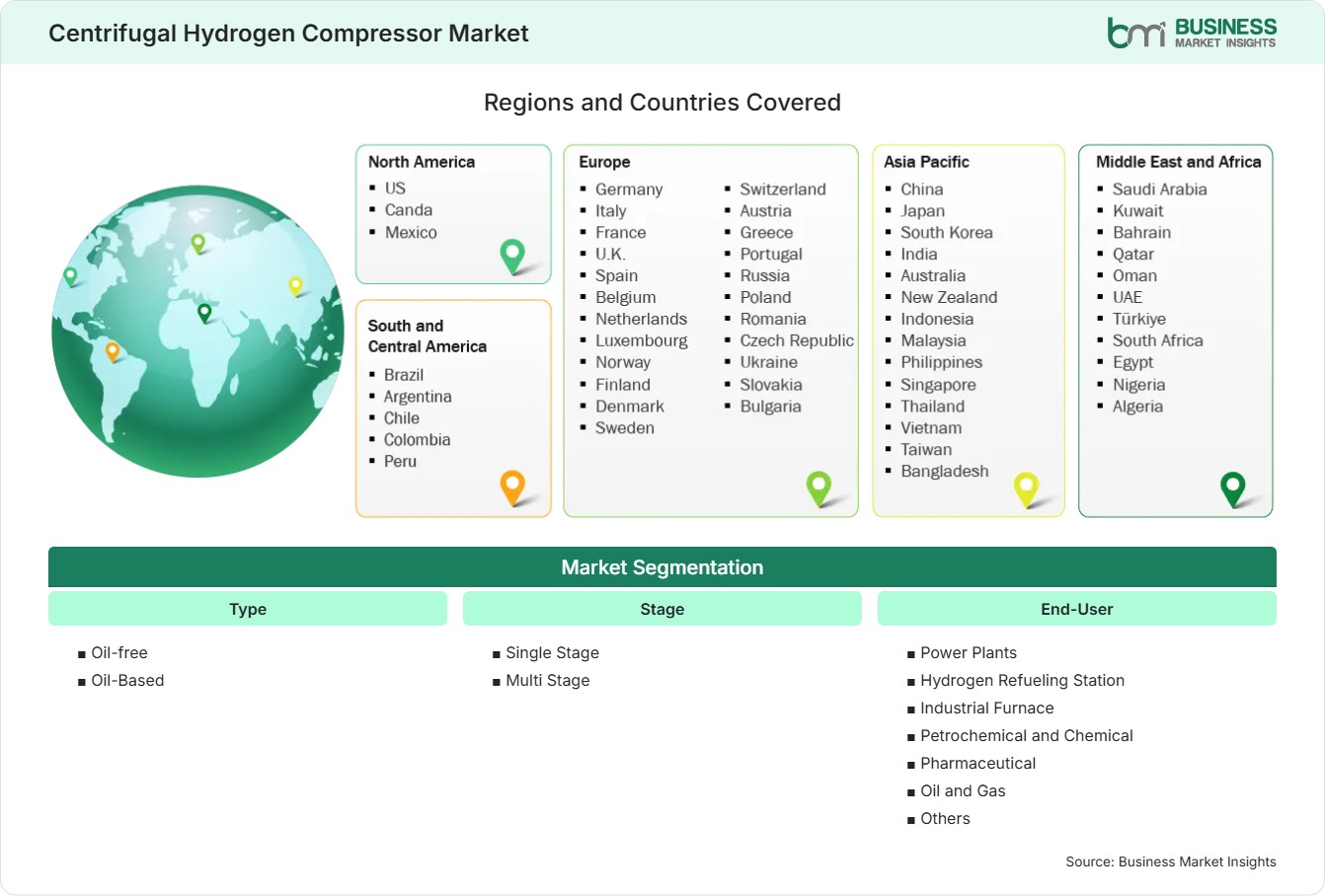
  • Type: Oil-free, Oil-Based
  • Stage: Single Stage, Multi Stage
  • End-User: Power Plants, Hydrogen Refueling Station, Industrial Furnace, Petrochemical and Chemical, Pharmaceutical, Oil and Gas, Others
US$ 746.1 Mn Market size in 2025
US$ 1148.49 Mn Market Size by 2033
5.54% CAGR, 2026 - 2033
2026-2033 Forecast Period

AI Overview

Centrifugal Hydrogen Compressor Market Summary

  • North America Region: North America holds 36%–39% market share in 2025, growing with a CAGR of 5.2%–5.6% during 2026–2033, supported by hydrogen mobility projects, clean hydrogen incentives, industrial decarbonization programs, expanding electrolyzer capacity, pipeline infrastructure investments, and rising demand for reliable high-pressure compression technologies across energy-intensive industries. The U.S. dominates regional demand through extensive hydrogen infrastructure investments and industrial decarbonization programs, advancing at a CAGR of 5.3%–5.7%.
  • Fastest Growing Region: Asia Pacific holds 26%–29% market share in 2025 and is expected to expand at a CAGR of 6.4%–6.8% during 2026–2033, driven by government hydrogen strategies, expanding fuel-cell vehicle deployment, industrial modernization, growing renewable hydrogen production, and increasing investments across manufacturing and transportation sectors.
  • Leading Segment: Oil-free compressors account for 58%–61% market share in 2025 while advancing at a CAGR of 5.7%–6.1%, supported by contamination-free hydrogen handling, stringent purity standards, lower maintenance requirements, and wider deployment across refueling stations, chemical processing, and green hydrogen production facilities.
  • High Growth Segment: Hydrogen Refueling Station applications represent 20%–23% market share in 2025 while recording a CAGR of 7.1%–7.5%, driven by accelerating fuel-cell mobility investments, government incentives, expanding dispensing infrastructure, and increasing commercial deployment of hydrogen-powered buses, trucks, and passenger vehicles.
  • Key Market Opportunity: Large-scale green hydrogen projects integrated with renewable electricity, ammonia production, and cross-border hydrogen transport infrastructure are creating sustained opportunities for advanced centrifugal compression technologies with improved efficiency, reliability, and digital monitoring capabilities.
  • Major Market Players: Siemens AG, Mitsubishi Heavy Industries, Ltd., MAN Energy Solutions SE, CORDIS Corporation, Minnuo Compressor, NEUMAN & ESSER Group, Ingersoll Rand Inc., Taizhou Toplong Electrical Mechanical Co., Ltd., Sundyne LLC, Kawasaki Heavy Industries, Ltd., Indian Compressors Limited, GE Vernova, Bharat Heavy Electricals Limited, Chart Industries, Inc., Linde plc.
Strategic Insights

Centrifugal Hydrogen Compressor Market: Strategic Insights

Centrifugal Hydrogen Compressor Market Strategic Framework
FREE PDF
Request your free sample
Request free sample
Stakeholder View

Key Takeaways

  • Supply chains are increasingly integrating compressor manufacturers, hydrogen equipment suppliers, electrolyzer developers, engineering contractors, and digital monitoring providers, creating stronger collaboration across complete hydrogen infrastructure ecosystems.
  • Hydrogen refueling stations and green hydrogen production facilities present the strongest commercial opportunities as investments shift from pilot projects toward large-scale commercial deployment.
  • Advanced impeller aerodynamics, oil-free compression technologies, predictive maintenance software, and AI-enabled monitoring systems continue improving operational efficiency while reducing lifecycle operating costs.
  • Asia Pacific offers compelling long-term investment potential owing to ambitious hydrogen roadmaps in China, Japan, South Korea, and India, alongside expanding industrial manufacturing capacity.
  • Strategic acquisitions, technology partnerships, and joint ventures are becoming increasingly common as global engineering companies strengthen hydrogen equipment portfolios and regional manufacturing capabilities.
  • Demand for highly efficient compression technologies capable of handling ultra-high-purity hydrogen will continue increasing alongside renewable hydrogen production and international hydrogen trade expansion.
Geographic Outlook

Centrifugal Hydrogen Compressor Market Regional Highlights

North America Centrifugal Hydrogen Compressor Market

North America accounts for 36%–39% of the Centrifugal Hydrogen Compressor Market share in 2025 and is projected to expand at a CAGR of 5.2%–5.6% during 2026–2033. Federal clean hydrogen incentives, industrial decarbonization programs, and large-scale investments in hydrogen production, transportation, and storage continue to strengthen regional demand. Growing deployment of electrolyzer facilities, hydrogen mobility infrastructure, and carbon capture projects further supports equipment adoption. The region also benefits from established engineering capabilities, advanced manufacturing ecosystems, and continuous technological innovation.

  • The U.S. Department of Energy's hydrogen hub initiatives continue accelerating investment in large-scale hydrogen production facilities, increasing demand for high-efficiency centrifugal compressors capable of continuous industrial operation, and supporting long-term infrastructure development.
  • Expansion of hydrogen refueling infrastructure for heavy-duty transportation is driving demand for oil-free compression systems capable of maintaining hydrogen purity while supporting higher operating pressures and reliable long-term performance.
  • Industrial sectors, including refining, chemicals, steel manufacturing, and power generation, continue to modernize hydrogen handling systems, creating sustained replacement demand for digitally monitored centrifugal compressor technologies.
  • Strategic collaborations between compressor manufacturers, EPC contractors, and hydrogen technology developers are improving project execution timelines while increasing localization of advanced manufacturing capabilities throughout North America.
  • Continued investment in carbon-neutral industrial production supports long-term equipment replacement cycles and encourages adoption of predictive maintenance solutions that minimize operational downtime and improve compressor efficiency.

US Centrifugal Hydrogen Compressor Market

The United States represents nearly 82%–85% of North American demand and is anticipated to grow at a CAGR of 5.3%–5.7% during 2026–2033. Federal funding through hydrogen hub programs, expanding private-sector investments, and increasing renewable hydrogen capacity continue to support industrial compressor installations. Petrochemical processing, hydrogen mobility, and clean energy projects remain primary contributors to the Centrifugal Hydrogen Compressor Market expansion across multiple states.

  • Large-scale hydrogen hub developments are accelerating the deployment of high-capacity compression equipment supporting production, storage, transportation, and dispensing applications across industrial and mobility sectors.
  • Strong participation from engineering companies and technology providers encourages continuous innovation in compressor efficiency, digital monitoring, and predictive maintenance capabilities.
  • Increasing renewable energy integration is encouraging greater adoption of green hydrogen production facilities requiring reliable, high-performance centrifugal compression systems.
  • Growing industrial decarbonization commitments among chemical, refining, and manufacturing companies continue stimulating investment in advanced hydrogen infrastructure.

Europe Centrifugal Hydrogen Compressor Market

Europe holds approximately 29%–32% market share in 2025 and is expected to register a CAGR of 5.6%–6.0% during 2026–2033. Strong climate legislation, hydrogen corridor initiatives, and expanding renewable energy capacity continue driving investment across the region. Germany leads regional deployment, while Spain and the Netherlands demonstrate among the fastest investment momentum owing to green hydrogen production projects and cross-border energy infrastructure development.

  • Germany remains the largest regional Centrifugal Hydrogen Compressor Market owing to advanced industrial manufacturing, established hydrogen strategies, and continued investment in large-scale electrolyzer projects supporting industrial decarbonization.
  • Spain records one of the fastest growth trajectories through expanding renewable hydrogen capacity, supported by abundant solar resources and increasing European Union funding initiatives.
  • The Netherlands strengthens hydrogen transportation infrastructure through pipeline development and port-based hydrogen logistics supporting industrial and maritime applications.
  • Industrial gas companies continue investing in hydrogen storage and distribution networks requiring reliable centrifugal compression systems with enhanced operational efficiency.
  • European manufacturers increasingly integrate digital monitoring technologies and energy-efficient compressor designs to comply with stringent sustainability objectives and operational efficiency targets.

Asia Pacific Centrifugal Hydrogen Compressor Market

Asia Pacific represents 26%–29% of the global Centrifugal Hydrogen Compressor Market demand in 2025 while recording the fastest regional expansion at a CAGR of 6.4%–6.8% through 2033. Rapid industrialization, ambitious national hydrogen roadmaps, and expanding investments in fuel-cell transportation continue to support equipment demand. China leads regional installations, while India demonstrates the fastest growth due to increasing policy support, renewable energy investments, and expanding industrial hydrogen applications.

  • China dominates regional demand through extensive hydrogen production capacity, expanding fuel-cell vehicle deployment, and significant investment in hydrogen infrastructure development.
  • India records the highest regional growth rate as government-supported green hydrogen initiatives stimulate investments in production facilities, transportation infrastructure, and industrial decarbonization programs.
  • Japan continues investing in hydrogen-powered mobility, liquefied hydrogen transportation, and advanced energy systems requiring highly efficient compression technologies.
  • South Korea expands hydrogen refueling infrastructure while strengthening domestic manufacturing capabilities for hydrogen equipment and clean energy technologies.
  • Regional manufacturers increasingly localize production, reducing equipment costs and improving availability across rapidly expanding hydrogen infrastructure projects.

Rest of World Centrifugal Hydrogen Compressor Market

The Rest of World region accounts for approximately 8%–10% Centrifugal Hydrogen Compressor Market share in 2025 and is forecast to expand at a CAGR of 5.8%–6.2% during 2026–2033.

South and Central America continue investing in renewable hydrogen projects supported by abundant wind and solar resources, particularly in Chile and Brazil, encouraging demand for advanced hydrogen compression systems.

The Middle East and Africa are increasingly focusing on export-oriented green hydrogen production. Saudi Arabia and the United Arab Emirates lead investment activity, while South Africa demonstrates growing industrial adoption supported by mining and chemical processing industries.

  • Chile continues to develop export-oriented green hydrogen projects supported by abundant renewable resources and favorable government policies encouraging international investment.
  • Brazil strengthens industrial hydrogen adoption across refining, fertilizer, and renewable energy sectors while increasing public-private collaboration on clean energy infrastructure.
  • Saudi Arabia leads Middle Eastern hydrogen investments through giga-scale renewable hydrogen projects supporting future global hydrogen exports.
  • The United Arab Emirates accelerates hydrogen ecosystem development through industrial diversification strategies and partnerships with international technology providers.
  • South Africa expands hydrogen utilization across mining and heavy industries while strengthening research and demonstration projects supporting future commercial deployment.
Global Market Geography
FREE PDF
Request your free sample
Request free sample
Segment Analysis

Centrifugal Hydrogen Compressor Market Segmentation

Type

The Type segment accounted for the largest proportion of industry demand in 2025, with Oil-free systems contributing the highest adoption. This segment held 58%–61% market share in 2025 and is projected to register a CAGR of 5.7%–6.1% during 2026–2033. Increasing purity requirements, stringent industrial standards, and expanding hydrogen mobility projects continue to strengthen the Centrifugal Hydrogen Compressor Market scope across both compressor technologies.

  • Oil-free: Oil-free centrifugal compressors are increasingly preferred for hydrogen refueling, fuel-cell production, and high-purity industrial applications because they eliminate contamination risks while improving operational reliability and reducing maintenance requirements.
  • Oil-Based: Oil-based centrifugal compressors remain widely deployed in heavy industrial operations where operating efficiency, high-capacity compression, and cost-effective performance are prioritized across petrochemical, refinery, and process manufacturing facilities.

Stage

The Stage segment continues evolving with increasing pressure requirements across hydrogen storage, transportation, and industrial processing. Multi-stage systems dominate installations with approximately 64%–67% Centrifugal Hydrogen Compressor Market share in 2025 and are expected to expand at a CAGR of 5.9%–6.3% during 2026–2033 due to superior compression efficiency and operational flexibility.

  • Single Stage: Single-stage centrifugal compressors remain suitable for moderate-pressure industrial processes where simplified system architecture, lower installation costs, and operational efficiency satisfy specific hydrogen handling requirements.
  • Multi Stage: Multi-stage systems are increasingly selected for high-pressure hydrogen applications because they improve compression efficiency, reduce discharge temperatures, and enhance operational stability across large-scale industrial facilities.

End-User

The End-User segment reflects expanding hydrogen utilization across industrial manufacturing and clean energy infrastructure. Petrochemical and Chemical applications accounted for 29%–32% market share in 2025 while advancing at a CAGR of 5.5%–5.9% through 2033. Growing industrial decarbonization initiatives, renewable hydrogen integration, and expanding production capacity continue to strengthen long-term equipment demand.

  • Power Plants: Hydrogen blending initiatives and low-carbon power generation projects continue increasing compressor installations supporting fuel flexibility, emission reduction, and reliable hydrogen fuel handling within modern power generation facilities.
  • Hydrogen Refueling Station: Rapid deployment of hydrogen mobility infrastructure supports increasing compressor demand for high-pressure dispensing systems capable of maintaining hydrogen purity, operational safety, and continuous station availability.
  • Industrial Furnace: Industrial furnace operators continue integrating hydrogen into thermal processing applications to reduce carbon emissions while maintaining production efficiency across steel, glass, ceramics, and other energy-intensive manufacturing sectors.
  • Petrochemical and Chemical: Petrochemical producers remain the largest users of centrifugal hydrogen compressors owing to extensive hydrogen consumption across refining, ammonia production, methanol synthesis, hydrocracking, and numerous chemical processing operations.
  • Pharmaceutical: Pharmaceutical manufacturing increasingly utilizes high-purity hydrogen in specialized production processes where contamination-free compression, precise pressure control, and regulatory compliance remain essential operational requirements.
  • Oil and Gas: Oil and gas companies continue modernizing hydrogen processing infrastructure to support cleaner refining operations, lower emissions, improved fuel quality, and enhanced operational efficiency across upstream and downstream facilities.
Market Forces

Centrifugal Hydrogen Compressor Market Dynamics

Key Market Drivers

Expansion of Green Hydrogen Production and Electrolyzer Capacity

The rapid expansion of green hydrogen production is becoming one of the strongest catalysts for compressor demand worldwide. According to the International Energy Agency (IEA), global electrolyzer project announcements continue to increase as governments pursue net-zero targets and diversify clean energy sources. Large-scale hydrogen production facilities require high-efficiency centrifugal compressors for hydrogen purification, storage, pipeline transmission, and industrial distribution. Continuous improvements in compressor aerodynamics, sealing technologies, and digital monitoring systems are enabling greater operational reliability while reducing energy consumption. The Centrifugal Hydrogen Compressor Market growth is closely linked to investments in renewable hydrogen infrastructure, particularly across Europe, North America, China, Japan, and Australia, where multi-gigawatt hydrogen projects are progressing toward commercial deployment.

Industrial Decarbonisation Across Heavy Manufacturing

Heavy industries, including refining, petrochemicals, steel, ammonia, and fertilizer manufacturing, are accelerating hydrogen adoption to reduce carbon emissions and comply with increasingly stringent environmental regulations. Instead of fossil fuels, hydrogen is used in various industrial applications, along with contributing to cleaner production processes. Centrifugal compressors are used in all stages of hydrogen production, storage, and application, and there is a trend among industrial manufacturers to replace their old compression equipment with new, digitally-driven equipment that helps with predictive maintenance, cost efficiency, and energy efficiency. Higher investments by industrial organizations have been driving equipment demand for a long time now.

Growth of Hydrogen Mobility Infrastructure

Governments worldwide are expanding hydrogen mobility programs supporting buses, commercial trucks, rail transport, and selected passenger vehicle applications. Hydrogen refueling stations require reliable high-pressure compression systems capable of maintaining fuel purity while ensuring continuous operation. Public funding initiatives across Europe, North America, Japan, South Korea, and China continue encouraging the deployment of hydrogen dispensing infrastructure. Compressor manufacturers are responding through modular designs, advanced monitoring platforms, and improved lifecycle performance. Rising investments from both public agencies and private operators are strengthening demand for scalable compression technologies capable of supporting expanding hydrogen transportation ecosystems while maintaining operational efficiency and safety standards.

Key Market Opportunities

Development of Global Hydrogen Export Infrastructure

Cross-border hydrogen trade is expected to become a major investment opportunity over the coming decade. Countries including Australia, Saudi Arabia, the United Arab Emirates, Chile, and Namibia are investing heavily in export-oriented hydrogen production facilities. Export terminals, liquefaction plants, ammonia conversion units, and pipeline infrastructure require advanced centrifugal compression technologies throughout the hydrogen value chain. Centrifugal Hydrogen Compressor Market Forecasts indicate sustained investment opportunities as international hydrogen trade expands and governments establish dedicated hydrogen corridors. Manufacturers capable of supplying highly efficient, digitally integrated, and large-capacity compressor systems are expected to benefit from increasing infrastructure spending and long-term supply agreements.

Digitalisation and Predictive Maintenance Solutions

Industrial operators increasingly prioritize intelligent asset management to improve equipment reliability and minimize unexpected downtime. The combination of IIoT, artificial intelligence, cloud-based diagnostic technologies, vibration analysis, and predictive maintenance tools allows operators of compressors to achieve optimal maintenance scheduling and, at the same time, extend the service life of equipment. Remote diagnostics also contribute to ensuring safety at hydrogen plants that require continuous monitoring. Companies that are able to combine their advanced compressor technologies with digital service offerings are likely to generate recurrent revenues through their lifecycle services, maintenance contracts, and performance optimizations.

Emerging Hydrogen Applications Beyond Traditional Industries

Emerging Centrifugal Hydrogen Compressor Market Trend, including Hydrogen utilization is expanding beyond refining and petrochemicals into aviation, maritime transport, data centers, synthetic fuels, sustainable aviation fuel production, and grid-scale energy storage. These new applications would need compression technologies that can support the range of pressures and environmental conditions. With governments urging for diversity in the applications of hydrogen, there will be possibilities for equipment manufacturers to come up with customized compressors that are tailored to meet the needs of new industrial applications. Efficiency and emission reduction will continue to be key areas in product development.

Market Restraints and Challenges

High Capital Investment and Project Development Costs

Factor: Hydrogen infrastructure projects require significant upfront investment covering production facilities, storage systems, transportation networks, safety systems, and compression equipment.

Impact: High capital investments lead to the postponement of projects, especially in developing countries where funding is not available. Payback periods for such investments may be too long, and there is uncertainty about hydrogen demand that can demotivate private sector investors from adopting the technology. Small-scale industries take time to adopt compression due to the high cost of acquisition and installation of modern centrifugal compressors, which are more expensive than other industrial machinery. In spite of incentives from governments, funding has not been consistent around the world.

Complex Hydrogen Handling and Stringent Safety Requirements

Factor: Hydrogen possesses unique physical characteristics, including low molecular weight, high diffusivity, and broad flammability limits, requiring specialized engineering, materials, and operational procedures.

Impact: Companies have to follow tough global safety regulations, making the process complex and expensive from an engineering perspective. Compressor systems need specific sealing solutions, leakage detection technology, corrosion-resistant materials, and constant monitoring for their safe functioning. Adhering to changing regulatory bodies may take more time and cost money in terms of certification procedures. This makes things difficult on the operational side and increases maintenance requirements.

Company Analysis

Competitive Landscape

The competitive environment is characterised by established industrial equipment manufacturers, compressor specialists, engineering companies, and industrial gas technology providers investing in product innovation, energy-efficient designs, digital monitoring, and hydrogen infrastructure. The Centrifugal Hydrogen Compressor Market analysis indicates that strategic partnerships, localisation of manufacturing, aftermarket service expansion, and hydrogen-focused R&D remain the primary competitive strategies adopted by leading participants.

Company Name

Overview

Products and Services Relevant to this Market

Siemens AG

Global industrial technology company providing advanced energy, automation, and digital solutions for hydrogen infrastructure and process industries.

High-efficiency industrial compressors, automation systems, digital monitoring platforms, hydrogen plant integration, electrification solutions, and engineering services.

Mitsubishi Heavy Industries, Ltd.

Leading Japanese engineering company serving energy, industrial machinery, and clean energy sectors through advanced compressor technologies.

Centrifugal compressors, hydrogen production equipment, industrial gas handling systems, turbomachinery, maintenance services, and integrated energy solutions.

MAN Energy Solutions SE

Global provider of turbomachinery and industrial compression technologies supporting energy transition projects worldwide.

Centrifugal compressors, process gas compressors, hydrogen compression technologies, digital lifecycle services, and industrial engineering solutions.

CORDIS Corporation

Engineering company supporting specialized industrial compression applications through customised equipment and technical services.

Hydrogen compression systems, industrial compressors, engineering support, system integration, and maintenance solutions.

Minnuo Compressor

Manufacturer specialising in industrial air and gas compression equipment serving global industrial customers.

Hydrogen compressors, gas compression equipment, pressure systems, industrial compressors, and customised engineering solutions.

NEUMAN & ESSER Group

German compression technology specialist with extensive experience across hydrogen, energy, and industrial gas applications.

Hydrogen compressors, reciprocating and centrifugal compressor technologies, service solutions, digital monitoring, and lifecycle support.

Ingersoll Rand Inc.

Diversified industrial manufacturer delivering mission-critical flow creation and industrial compression technologies worldwide.

Industrial compressors, hydrogen gas compression solutions, aftermarket services, digital asset monitoring, and engineered equipment.

Taizhou Toplong Electrical Mechanical Co., Ltd.

Chinese manufacturer supplying industrial gas compression equipment for domestic and international industrial markets.

Hydrogen compressors, industrial gas compressors, pressure equipment, engineering support, and customised manufacturing services.

Sundyne LLC

Specialist manufacturer of high-speed pumps and compressors serving chemical, energy, and hydrogen industries.

Centrifugal compressors, hydrogen process equipment, engineered systems, aftermarket support, and performance optimisation services.

Kawasaki Heavy Industries, Ltd.

Global engineering company actively investing in hydrogen production, transport, and utilisation technologies.

Hydrogen infrastructure solutions, industrial compressors, liquefied hydrogen technologies, energy systems, and engineering services.

Indian Compressors Limited

Indian compressor manufacturer serving industrial gas, petrochemical, and manufacturing industries.

Industrial compressors, gas compression packages, engineering services, maintenance support, and customised process equipment.

GE Vernova

Global energy technology company delivering advanced equipment supporting power generation and energy transition.

Industrial compression technologies, digital asset management, hydrogen-ready energy systems, and engineering solutions.

Bharat Heavy Electricals Limited

India's leading heavy engineering enterprise supporting power, industrial, and clean energy infrastructure.

Industrial compressors, power plant equipment, hydrogen handling systems, engineering services, and turnkey industrial solutions.

Chart Industries, Inc.

Global provider of cryogenic equipment and hydrogen infrastructure technologies supporting the clean energy economy.

Hydrogen storage systems, cryogenic equipment, compression integration, process engineering, and lifecycle support services.

Linde plc

International industrial gases and engineering company with a significant presence across the hydrogen value chain.

Hydrogen production, storage, compression integration, engineering services, industrial gas technologies, and turnkey hydrogen infrastructure.

Trust & Transparency

Research Methodology

The market analysis combines proprietary research with secondary data from government agencies, company disclosures, regulatory filings, industry databases and expert interviews. Market estimates are validated through data triangulation, cross-market benchmarking and analyst review.

View Full Research Methodology

Questions Answered

Frequently Asked Questions

What are the major challenges facing manufacturers?

Key challenges include high capital investment requirements, stringent hydrogen safety regulations, engineering complexity, long project development cycles, and the need for specialized materials capable of handling high-purity hydrogen safely.

What does the Centrifugal Hydrogen Compressor Market Report cover?

The report provides detailed insights into market size, growth outlook, competitive landscape, segmentation, regional performance, technological developments, investment opportunities, regulatory trends, and strategic recommendations for stakeholders across the hydrogen value chain.

Which end-user segment offers the greatest opportunity?

Hydrogen refuelling stations represent the fastest-growing end-user segment due to accelerating fuel-cell mobility adoption, expanding public infrastructure, and government-supported clean transportation initiatives.

Which region leads the global market?

North America currently holds the largest market share, supported by hydrogen hub investments, advanced industrial infrastructure, government incentives, and increasing deployment of hydrogen production and transportation facilities.

What is driving demand for the Centrifugal Hydrogen Compressor Market?

Demand is primarily driven by expanding green hydrogen production, industrial decarbonisation, hydrogen refuelling infrastructure, and increasing investments in clean energy projects requiring reliable high-pressure hydrogen compression systems.

Access the Full Centrifugal Hydrogen Compressor Market Report

Get segment-level forecasts, regional estimates, competitive benchmarking, company profiles and downloadable Excel datasets.

Access the full Centrifugal Hydrogen Compressor Market Report
350 pages PDF & Excel | 2026-08-18
Similar Research

Related Market Reports