
Advanced Metering Infrastructure Market Outlook: Size, Share, Trends, Growth Analysis, Competitive Landscape & Forecast, 2026-2033

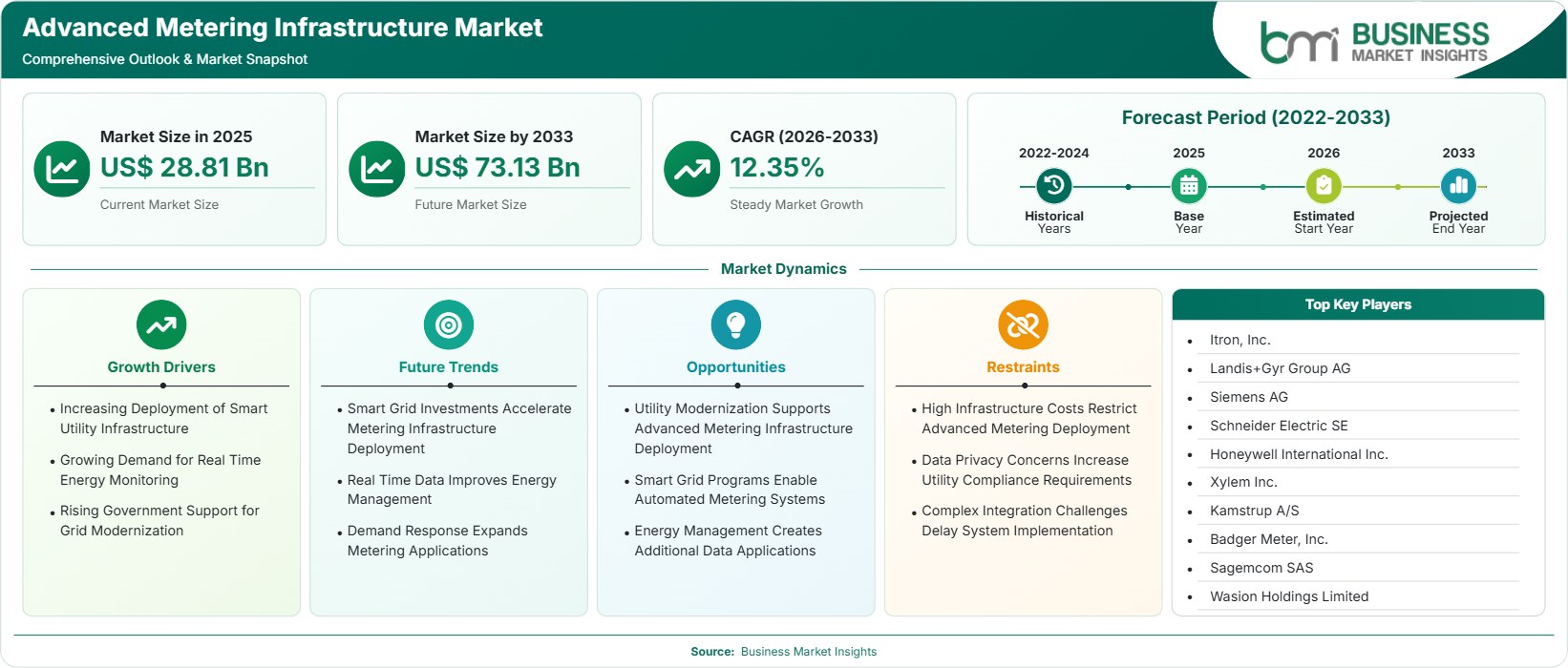
The Advanced Metering Infrastructure Market size was valued at US$ 28.81 Billion in 2025 and is projected to reach US$ 73.13 Billion by 2033, growing at a CAGR of 12.35% during 2026–2033. Key drivers include grid modernization, smart utility investments, renewable integration, outage management requirements, and water conservation initiatives, while opportunities emerge from AI-enabled analytics, multi-utility platforms, and sustainable infrastructure digitization.

Report Coverage
  • Devices: Smart Gas Meters, Smart Water Meters, Smart Electric Meters
  • Component: Smart Meters, Communication Network Infrastructure, Head-End System & MDMS, Services
  • Application: Residential Metering, Commercial & Industrial Metering, Multi-Utility & Infrastructure Metering
US$ 28.81 Bn Market size in 2025
US$ 73.13 Bn Market Size by 2033
12.35% CAGR, 2026 - 2033
2026-2033 Forecast Period

AI Overview

Advanced Metering Infrastructure Market Summary

  • North America Region: Holds a market share of 35%–38% in 2025, growing at a CAGR of 10.8%–11.6% during 2026–2033, supported by utility grid modernization, regulatory mandates, distributed energy integration, cybersecurity investments, electric vehicle adoption, operational efficiency goals, customer engagement initiatives, resilience programs, advanced analytics deployment, and infrastructure upgrades. US market benefits from mature utility networks and widespread smart meter penetration, advancing at 10.5%–11.3%.
  • Fastest Growing Region: Asia Pacific holds an Advanced Metering Infrastructure Market share of 28%–31% in 2025, growing at a CAGR of 14.2%–15.1% during 2026–2033, driven by urbanization, utility digitalization, national smart grid missions, electricity demand growth, water management modernization, renewable integration requirements, government funding programs, infrastructure expansion, and advanced communications deployment.
  • Leading Segment: Smart Electric Meters holds a market share of 48%–52% in 2025, growing at a CAGR of 12.0%–12.8% during 2026–2033, supported by utility digitization, billing automation, outage detection, demand response implementation, renewable connectivity, data-driven operations, grid visibility improvements, consumption monitoring, and customer service optimization.
  • High Growth Segment: Communication Network Infrastructure holds a market share of 23%–27% in 2025, growing at a CAGR of 13.8%–14.7% during 2026–2033, supported by RF mesh expansion, cellular connectivity adoption, IoT integration, bandwidth upgrades, cybersecurity enhancement, interoperability requirements, utility connectivity investments, and growing endpoint communication demands.
  • Key Market Opportunity: Expanding multi-utility deployments combining electricity, water, and gas metering with cloud-based analytics creates scalable recurring revenue models, improved asset visibility, operational optimization, and stronger sustainability outcomes across utilities.
  • Major Market Players: Itron, Inc.; Landis+Gyr Group AG; Siemens AG; Schneider Electric SE; Honeywell International Inc.; Xylem Inc.; Kamstrup A/S; Badger Meter, Inc.; Sagemcom SAS; Wasion Holdings Limited.
Strategic Insights

Advanced Metering Infrastructure Market: Strategic Insights

Advanced Metering Infrastructure Market Strategic Framework
FREE PDF
Request your free sample
Request free sample
Stakeholder View

Key Takeaways

  • The value chain increasingly integrates hardware vendors, communication providers, software developers, cloud platforms, and utility operators, creating a highly interconnected ecosystem centered on real-time operational intelligence.
  • Multi-utility metering deployments across electricity, water, and gas applications offer substantial upside by enabling shared communications infrastructure and centralized data management.
  • Edge computing functionality within smart meters is emerging as a major innovation direction, supporting local analytics, outage detection, and distributed energy resource management.
  • India, Indonesia, Vietnam, and Gulf countries present compelling investment potential due to large-scale utility modernization programs and expanding urban infrastructure.
  • Strategic acquisitions increasingly target analytics software, connectivity platforms, and utility intelligence capabilities as vendors seek broader recurring-revenue opportunities.
  • Cybersecurity-focused solutions are becoming a key differentiation factor as utilities prioritize resilient digital infrastructure and compliance with emerging security standards.
Geographic Outlook

Advanced Metering Infrastructure Market Regional Highlights

North America Advanced Metering Infrastructure Market

North America accounts for 35%–38% of global demand in 2025 and advances at a CAGR of 10.8%–11.6% through 2033. The region benefits from widespread smart utility adoption, mature transmission networks, and strong investment in digital grid technologies. The Advanced Metering Infrastructure Market share remains highest here due to large installed smart meter bases, utility modernization programs, and regulatory support. Growth increasingly comes from replacing first-generation deployments with advanced systems supporting distributed energy management, real-time analytics, cybersecurity upgrades, and enhanced customer engagement platforms.

  • Utilities increasingly deploy second-generation smart metering platforms supporting edge analytics, demand response functions, and distributed energy resource visibility across service territories.
  • Federal and state-level infrastructure investments encourage modernization programs focused on reliability, resilience, outage management, and decarbonization objectives.
  • Utilities prioritize cybersecurity-enhanced communication architectures as connected grid assets increase exposure to digital threats and compliance requirements.
  • Electric vehicle charging growth strengthens demand for interval consumption monitoring and advanced load management capabilities.

US Advanced Metering Infrastructure Market

The US represents approximately 76%–80% of North American revenue and grows at a CAGR of 10.5%–11.3%. Deployment maturity supports large-scale upgrades emphasizing grid-edge intelligence, fault detection, and renewable integration. Utilities increasingly leverage analytics-driven decision-making and advanced communications infrastructure. The national market benefits from substantial investments in electricity distribution modernization, water efficiency initiatives, and operational automation. Advanced Metering Infrastructure Market share remains concentrated among major investor-owned utilities, driving replacement cycles and next-generation platform adoption.

  • Investor-owned utilities increasingly transition toward intelligent metering systems capable of supporting localized grid visibility and predictive maintenance.
  • Grid resilience initiatives following climate-related disruptions continue accelerating investment across transmission and distribution infrastructure.
  • Water utilities adopt advanced monitoring tools to reduce non-revenue water losses and enhance network efficiency.

Europe Advanced Metering Infrastructure Market

Europe holds 25%–28% market share in 2025 and expands at a CAGR of 11.5%–12.4%. Regulatory frameworks supporting energy efficiency, carbon reduction, and consumer participation stimulate deployment. Italy and the United Kingdom remain leading markets, while Poland and Spain exhibit stronger expansion rates above regional averages. Utilities increasingly integrate metering assets with smart grid platforms. The region benefits from advanced regulatory oversight, interoperability standards, and decarbonization strategies supporting widespread digital utility transformation and long-term infrastructure modernization initiatives.

  • Smart grid regulations encourage expanded deployment of interoperable communication networks and secure data exchange frameworks.
  • Renewable energy integration requirements increase the need for distribution-level monitoring and consumption intelligence.
  • Italy remains a deployment leader while Poland demonstrates stronger growth supported by modernization investments.
  • Water scarcity concerns encourage adoption of intelligent water metering solutions across municipalities and utilities.

Asia Pacific Advanced Metering Infrastructure Market

Asia Pacific commands a 28%–31% share in 2025 and records the fastest CAGR of 14.2%–15.1%. Strong momentum stems from urbanization, infrastructure investments, rapidly rising electricity demand, and national utility modernization programs. China, Japan, and India lead deployment volumes, while India and Southeast Asian nations exhibit the highest expansion rates. Advanced Metering Infrastructure Market growth is supported by smart city investments, renewable integration projects, and digital utility transformation strategies. Communication infrastructure development and large consumer bases create substantial deployment opportunities across residential and industrial sectors.

  • National smart grid initiatives accelerate large-scale meter installations across electricity, gas, and water networks.
  • Rapid urban expansion requires more accurate consumption tracking and efficient utility resource management.
  • India benefits from ambitious smart metering programs targeting operational efficiency and revenue protection.
  • Telecom infrastructure expansion supports wider adoption of connected utility networks and data-driven services.

Rest of World Advanced Metering Infrastructure Market

Rest of World makes up 9%-12% share in 2025 and has a CAGR of 12.6%-13.5%. South and Central America derive benefits from utility efficiency and loss management initiatives. The Middle East and Africa markets are increasingly embracing digital utility systems as part of urban expansion, infrastructure upgrades, and water management. Brazil and Saudi Arabia emerge as leaders in implementing utilities in their regions, with the UAE and South Africa showing greater growth potential.

  • Water stress concerns promote intelligent metering adoption across municipal and utility networks.
  • Smart city programs in Gulf economies integrate connected metering technologies with broader digital infrastructure.
  • Brazil supports deployment through electricity distribution modernization and operational efficiency initiatives.
  • African utilities increasingly pursue digital transformation programs focused on resource optimization and revenue assurance.
Segment Analysis

Advanced Metering Infrastructure Market Segmentation

Devices

The devices hold a market share of 52% to 56% in 2025 and are projected to grow at 12.1% to 12.9%. The device segment is key to utility modernization initiatives, as measurement endpoints underpin analytics, operational intelligence, and customer engagement. The scope of the Advanced Metering Infrastructure Market expands with the increasing demand for large-scale device ecosystems.

  • Smart Gas Meters: Support automated consumption tracking, leak detection capabilities, improved billing accuracy, and network visibility, helping utilities improve safety, operational efficiency, and regulatory compliance across gas distribution systems.
  • Smart Water Meters: Enable real-time monitoring, non-revenue water reduction, leak identification, and enhanced asset management while supporting conservation goals and sustainable municipal water operations.
  • Smart Electric Meters: Form the largest device category, enabling dynamic pricing, outage detection, renewable integration support, demand response implementation, and improved consumer energy awareness programs.

Component

Components form the basic infrastructure behind data acquisition, communication, processing, and management. The segment holds a share of 44%-48% in 2025 and grows at a CAGR of 12.8%-13.6%. Growing utility spending on software, smarts, and communications capabilities, along with endpoints.

  • Smart Meters (Hardware): Provide measurement accuracy, remote reading functionality, and platform connectivity while enabling utilities to automate operational workflows and improve service efficiency.
  • Communication Network Infrastructure: Facilitates reliable data exchange between endpoints and utilities using RF mesh, cellular, PLC, and hybrid networking technologies to ensure operational visibility.
  • Head-End System (HES) & MDMS: Deliver centralized data collection, storage, validation, analytics, and operational insights supporting utility decision-making and regulatory reporting requirements.
  • Services: Include deployment, maintenance, consulting, integration, cybersecurity, and managed operations designed to maximize system performance and accelerate project execution.

Application

These applications arise from the increasing need for intelligent metering across various consumption settings. This market share accounts for 36%–40% of the total market in 2025 and is growing at a CAGR of 12.4%–13.2%. Increasing Advanced Metering Infrastructure Market trends increasingly emphasize monitoring and analysis.

  • Residential Metering: Drives deployment volumes through large consumer populations, billing automation needs, energy efficiency programs, and demand-side participation initiatives.
  • Commercial & Industrial (C&I) Metering: Supports advanced monitoring, energy optimization, cost control, and operational efficiency across manufacturing facilities, enterprises, and institutional users.
  • Multi-Utility & Infrastructure Metering: Expands through integrated monitoring of electricity, water, and gas assets using shared communications, centralized data management, and unified operational platforms.
Market Forces

Advanced Metering Infrastructure Market Dynamics

Key Market Drivers

Utility Grid Modernization and Digital Transformation

Utilities around the world are upgrading their infrastructure to increase efficiency, reliability, and customer satisfaction. Based on the IEA's smart grid and digitalization programs, utilities have been focusing more on the visibility of their operations and renewable energy sources. Advanced metering offers utilities interval readings, automatic outage reporting, and consumer usage insights, resulting in lower operating costs and improved grid response. Benefits for utilities include lower costs related to meter reading and billing. In view of the decentralization of energy systems, advanced metering infrastructure has been shown to be an indispensable instrument for data management and for implementing digital transformation policies.

Growth in Distributed Energy Resources and Electrification

Growth in rooftop solar installations, battery storage, electric vehicles, and distributed generation systems is driving the complexity of the Advanced Metering Infrastructure market. Granular monitoring of consumption patterns and energy flows is necessary for utilities to ensure the stability of the electricity network. Advanced meters enable utilities to engage in demand response and dynamic pricing strategies as well as incorporate renewable energy. Growing electrification in transportation, buildings, and industry further supports the need for deployment. Real-time energy intelligence is now critical for managing the dynamics between supply and demand within the utility business environment.

Rising Water Conservation and Resource Efficiency Priorities

There are increasing demands on water utilities to reduce losses, make operations more transparent, and address resource shortages. Intelligent water meters provide accurate information on usage patterns, leak detection, and improved revenue control. Smart monitoring technologies have become an absolute necessity for cities seeking to advance their sustainability goals and manage their networks. Smart technologies enable water companies to monitor anomalies in water consumption and run campaigns to raise consumer awareness. Population growth and pressure on infrastructure will only stimulate the use of such technologies. In view of government-promoted efficiency and environmental protection, metering technologies will remain a good investment for the future.

Key Market Opportunities

Expansion of Multi-Utility Digital Platforms

The multi-utility deployment is a highly lucrative opportunity for vendors because utilities are seeking to become more efficient by implementing metering for electricity, water, and gas. The common communications network, analytical platform, and management system will ensure cost reduction and better decision-making. Companies with interoperable products will have an opportunity to participate in larger projects and earn recurring revenue from their software. Today, cities prefer the integrated digital infrastructure that meets the overall requirements of creating a smart city. Utilities with a future perspective are interested in having the full picture of the database available at the enterprise level, not only at the metering level. The Advanced Metering Infrastructure Market forecasts indicate increasing demand for scalable platforms that optimize processes and enhance customer engagement.

Artificial Intelligence and Advanced Analytics Integration

AI technology is enhancing the ROI of metering assets by turning consumption data into operational insights. Utilities are increasingly using technologies such as predictive maintenance, load forecasting, anomaly detection, and asset optimization, all of which rely on sophisticated analytical techniques. This results in better-functioning networks, reduced costs, and less disruption to utility operations. AI systems are also useful for proactive infrastructure management and accurate consumption forecasting. Technology suppliers that build machine learning algorithms into metering systems can generate higher-margin software and services revenue. As utilities prioritize intelligent decision-making, analytics-driven offerings are expected to become a major growth avenue throughout the forecast period

Emerging Market Utility Modernization Programs

Utility modernization rollouts in Asia, Latin America, the Middle East, and Africa offer significant deployment opportunities. Many utility companies are still running old systems with limited visibility, revenue assurance, and automation capabilities. National energy transition policies, smart city developments, and infrastructure planning efforts are driving the adoption of connected utility solutions. The deployment initiatives involve the rollout of advanced meters, the build-out of communications networks, and the adoption of cloud-based solutions. Vendors offering full turnkey solutions with flexible financing options and localized services are well-positioned to capitalize on these deployment initiatives.

Market Restraints and Challenges

High Initial Capital Requirements and Funding Constraints

Factor: The development of advanced metering solutions requires a substantial capital outlay for equipment, communications networks, software, integration, and staff training. Impact: Utility companies with limited capital will have to postpone implementation or cut back on their plans. Moreover, the program's financial viability becomes an issue when there are no economies of scale within the company. Further complications may arise from the need to prioritize modernization efforts over other infrastructure developments, such as generation, transmission, or water processing solutions. Despite the potential for lifecycle savings, achieving alignment on long-term returns is difficult.

Cybersecurity Risks and Data Privacy Concerns

Factor: The increase in connectivity results in greater exposure to cyberattacks targeting utility network infrastructure, communication facilities, and consumers' personal data. Impact: The utility companies require increased compliance, monitoring, and investment in security. The regulatory requirements concerning privacy and protection of critical infrastructure are getting stricter. Security loopholes may result in operational difficulties, loss of stakeholder confidence, and increased implementation challenges. As a result, utilities invest in increased capacity for encryption, authentication, monitoring, and incident handling. The selection of vendors is based on their competence in cybersecurity issues. These requirements may increase implementation timelines and operational costs while creating ongoing governance obligations for utility operators.

Company Analysis

Competitive Landscape

The competitive environment reflects strong emphasis on integrated software, communications, and device capabilities. The Advanced Metering Infrastructure Market analysis indicates competition is increasingly shifting from standalone hardware toward data-driven utility intelligence platforms.

Company Name

Overview

Products and Services relevant to this market

Itron, Inc.

Global provider of intelligent utility infrastructure serving electric, gas, and water utilities with strong analytics capabilities.

Smart meters, grid-edge intelligence, communication networks, meter data management, analytics, and utility software solutions.

Landis+Gyr Group AG

Leading utility technology supplier focused on energy management and advanced metering solutions worldwide.

Electric meters, smart gas meters, communication systems, analytics platforms, and grid modernization solutions.

Siemens AG

Diversified technology company supporting utility automation and digital energy infrastructure.

Grid software, communication technologies, smart metering integration, automation, and energy management systems.

Schneider Electric SE

Global energy management specialist supporting digital utility modernization initiatives.

Smart grid software, analytics, metering systems, energy management platforms, and integration services.

Honeywell International Inc.

Industrial technology provider with automation and utility intelligence capabilities.

Smart metering technologies, industrial IoT solutions, communications, and operational software.

Xylem Inc.

Water technology leader with significant capabilities in intelligent utility networks.

Smart water metering, AMI communications, analytics platforms, and infrastructure monitoring solutions.

Kamstrup A/S

Specialist provider of smart metering technologies for utilities worldwide.

Electricity, water, and heat meters, communication infrastructure, software, and managed services.

Badger Meter, Inc.

Focuses on intelligent water management and digital utility monitoring solutions.

Smart water meters, data analytics, communication technologies, and monitoring platforms.

Sagemcom SAS

Communications and metering technology supplier serving utility customers globally.

Smart electricity meters, connectivity solutions, software systems, and deployment services.

Wasion Holdings Limited

Major smart metering manufacturer with strong presence across Asian utility markets.

Electricity meters, communication infrastructure, data management systems, and energy monitoring solutions.

Trust & Transparency

Research Methodology

The market analysis combines proprietary research with secondary data from government agencies, company disclosures, regulatory filings, industry databases and expert interviews. Market estimates are validated through data triangulation, cross-market benchmarking and analyst review.

View Full Research Methodology

Questions Answered

Frequently Asked Questions

Why is cybersecurity becoming essential for utilities?

Connected utility assets generate substantial operational data and expand digital exposure. Utilities therefore prioritize secure communications, encryption, access management, and regulatory compliance capabilities.

How does this Advanced Metering Infrastructure Market Report help stakeholders?

It provides insights into regional dynamics, technology adoption patterns, competitive positioning, investment opportunities, segmentation performance, and strategic developments influencing industry growth through 2033.

Which application area offers the strongest long-term opportunity?

Multi-utility and infrastructure metering presents significant long-term potential because it enables shared communications frameworks and centralized management across electricity, water, and gas services.

What technologies are most important in next-generation metering deployments?

Communication networks, cloud analytics, edge computing, cybersecurity platforms, AI-enabled analytics, and meter data management systems are increasingly critical for advanced utility operations.

What factors are driving adoption of intelligent utility metering systems?

Grid modernization, renewable energy integration, water conservation objectives, operational efficiency targets, and growing demand for real-time consumption intelligence are accelerating deployment across global utility networks.

Access the Full Advanced Metering Infrastructure Market Report

Get segment-level forecasts, regional estimates, competitive benchmarking, company profiles and downloadable Excel datasets.

Access the full Advanced Metering Infrastructure Market Report
350 pages PDF & Excel | 2026-09-08