
Advanced Biofuels Market Outlook: Size, Share, Trends, Growth Analysis, Competitive Landscape & Forecast, 2026–2033

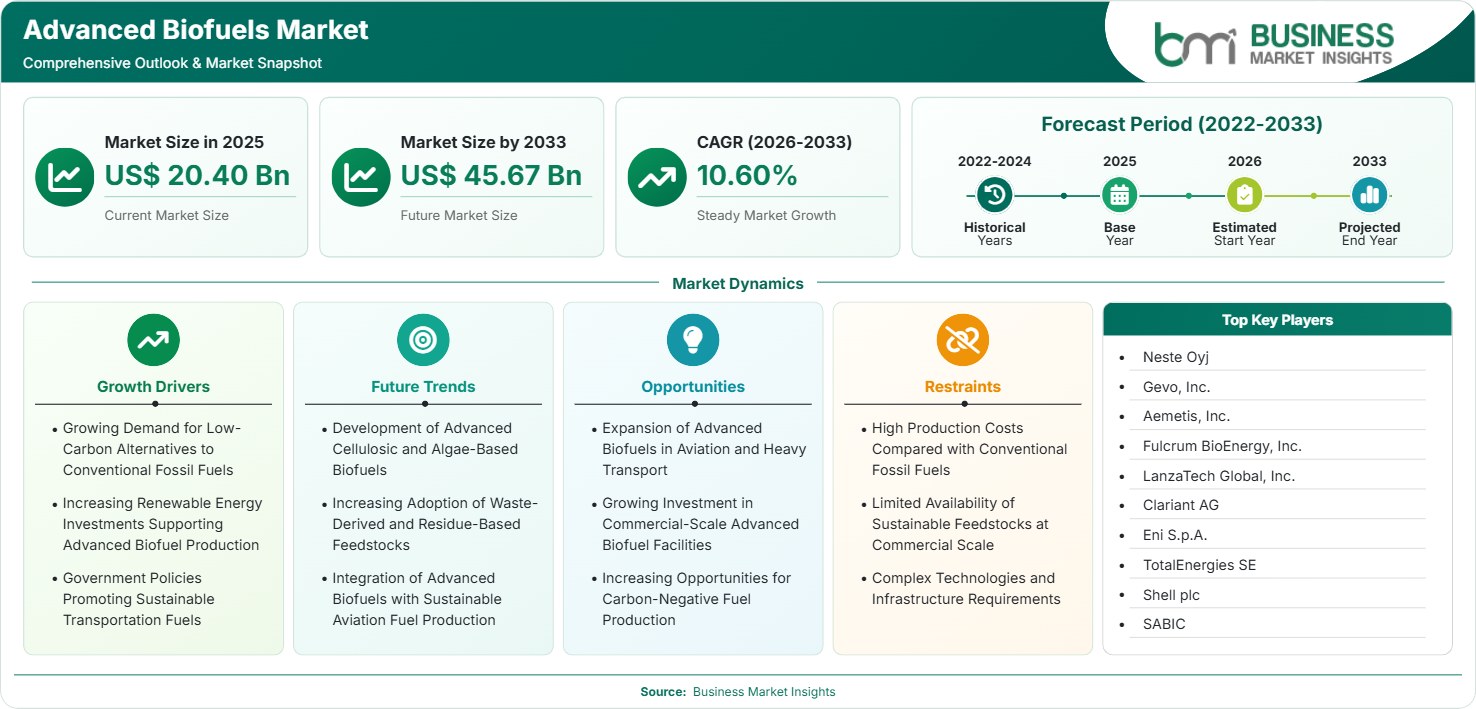
The Advanced Biofuels size was valued at US$ 20.40 Billion in 2025 and is projected to reach US$ 45.67 Billion by 2033, growing at a CAGR of 10.60% during 2026–2033, driven by rising demand for low-carbon fuels, sustainable transportation policies, and opportunities in aviation, heavy transport, and carbon-negative fuel production.

Report Coverage
  • Processing Technology: Thermochemical, Biochemical
  • Raw Material: Energy Crops, Municipal Solid Waste, Green Waste, Others
  • Type: Cellulosic Biofuel, Biodiesel, Bio-butanol, Others
US$ 20.40 Bn Market size in 2025
US$ 45.67 Bn Market Size by 2033
10.60% CAGR, 2026 - 2033
2026-2033 Forecast Period

AI Overview

Advanced Biofuels Market Summary

  • North America Region: North America holds a 34%–37% share in 2025, growing with a CAGR of 10.20%–10.80% during 2026–2033, supported by renewable fuel mandates, low-carbon fuel initiatives, advanced biofuel investments, and industrial decarbonization programs. The U.S. market is expanding at a CAGR of 10.30%–10.90% during 2026–2033, driven by sustainable aviation fuel development, federal incentives, and commercial-scale biofuel projects.
  • Fastest Growing Region: Asia Pacific represents a 28%–31% share in 2025, expanding at a CAGR of 11.20%–11.80% during 2026–2033, supported by increasing energy transition investments, transportation decarbonization targets, biomass availability, and growing demand for renewable fuels.
  • Leading Segment: Cellulosic Biofuel accounts for a 38%–41% share in 2025, growing at a CAGR of 11.00%–11.60% during 2026–2033, driven by strong carbon reduction potential, availability of non-food feedstocks, and increasing demand from transportation sectors.
  • High Growth Segment: Thermochemical Processing Technology holds a 42%–45% share in 2025, achieving a CAGR of 11.50%–12.00% during 2026–2033, supported by technological advancements, waste-to-fuel conversion capabilities, and increasing investment in scalable production systems.
  • Key Market Opportunity: Advanced biofuel producers are benefiting from expanding sustainable aviation fuel demand, heavy transport decarbonization efforts, and investments in commercial-scale facilities using waste-based and renewable feedstocks.
  • Major Market Players: Neste Oyj, Gevo, Inc., Aemetis, Inc., Fulcrum BioEnergy, Inc., LanzaTech Global, Inc., Clariant AG, Eni S.p.A., TotalEnergies SE, Shell plc, SABIC.
Strategic Insights

Advanced Biofuels Market: Strategic Insights

Advanced Biofuels Market Strategic Framework
FREE PDF
Request your free sample
Request free sample
Stakeholder View

Key Takeaways

  • Advanced biofuel value chains are becoming increasingly integrated, connecting feedstock suppliers, technology developers, fuel producers, and transportation industries.
  • Aviation and heavy transportation applications provide significant growth opportunities due to limited electrification potential and increasing decarbonization requirements.
  • Innovation is shifting toward waste-based feedstocks, carbon capture integration, advanced conversion technologies, and improved production efficiency.
  • North America and Asia Pacific present strong investment opportunities due to supportive policies, renewable fuel programs, and expanding production capacity.
  • Strategic collaborations between energy companies, technology providers, and industrial users are accelerating commercial-scale advanced biofuel deployment.
  • Carbon-negative fuel development and circular economy approaches are becoming important investment areas for future market expansion.
Geographic Outlook

Advanced Biofuels Market Regional Highlights

North America Advanced Biofuels Market

North America accounted for a 34%–37% share in 2025 and North America advanced biofuels market forecast to grow at a CAGR of 10.20%–10.80% during 2026–2033. The region benefits from supportive renewable fuel policies, advanced technology capabilities, and increasing investments in sustainable transportation fuels. Advanced Biofuels share is supported by strong biofuel infrastructure and government incentives.

  • The United States represents the largest contributor due to renewable fuel policies, investment incentives, and advanced biofuel project development.
  • Canada is expanding adoption through clean fuel regulations and renewable energy transition initiatives.
  • Aviation companies are increasing partnerships with biofuel producers to reduce transportation emissions.
  • Energy companies are investing in waste-based and low-carbon fuel production facilities.

US Advanced Biofuels Market

The U.S. advanced biofuels market accounted for a 29%–32% share of the global market in 2025 and is expected to expand at a CAGR of 10.30%–10.90% between 2026–2033. Market expansion is supported by federal renewable fuel programs, sustainable aviation fuel investments, and increasing demand for low-carbon transportation solutions. The country has strong technology capabilities and commercial-scale project development activities. Growing corporate decarbonization commitments are encouraging adoption of advanced biofuel solutions.

  • Sustainable aviation fuel projects are increasing due to airline emission reduction commitments and policy support.
  • Government incentives are improving economic feasibility of advanced biofuel production facilities.
  • Energy companies are expanding renewable fuel portfolios through strategic investments and partnerships.

Europe Advanced Biofuels Market

Europe advanced biofuels market represented a 25%–28% share in 2025 and is projected to grow at a CAGR of 10.00%–10.60% during 2026–2033. The region is supported by ambitious climate targets, renewable energy regulations, and increasing demand for sustainable transportation fuels. Germany, France, the United Kingdom, Italy, and the Netherlands are key markets.

  • Germany leads adoption through renewable energy policies, industrial decarbonization programs, and advanced fuel research.
  • The United Kingdom is increasing investment in sustainable aviation fuel and low-carbon transportation solutions.
  • France is supporting biofuel development through renewable energy targets and industrial partnerships.
  • Italy is expanding renewable fuel production through energy company investments and technology development.
  • European regulations promoting sustainable fuels are accelerating commercialization of advanced biofuel technologies.

Asia Pacific Advanced Biofuels Market

Asia Pacific advanced biofuels market accounted for a 28%–31% share in 2025 and is expected to achieve a CAGR of 11.20%–11.80% during 2026–2033. The region represents the fastest-growing market due to increasing energy demand, biomass availability, transportation sector decarbonization, and renewable energy investments. China, India, Japan, South Korea, and Southeast Asian countries are major contributors.

  • China is expanding renewable fuel investments through energy transition initiatives and technology development programs.
  • India is increasing biofuel adoption through national blending targets and agricultural residue utilization programs.
  • Japan is investing in sustainable aviation fuel and advanced biomass conversion technologies.
  • South Korea is developing renewable fuel strategies to reduce transportation sector emissions.
  • Southeast Asian countries are exploring biomass-based fuel opportunities due to abundant agricultural resources.

Rest of World Advanced Biofuels Market

Rest of World accounted for a 7%–10% share in 2025 and is projected to grow at a CAGR of 9.50%–10.20% during 2026–2033. South and Central America, the Middle East, and Africa are gradually expanding advanced biofuel adoption due to renewable energy initiatives, biomass availability, and transportation decarbonization efforts. Brazil, Argentina, South Africa, and the UAE are emerging markets supported by agricultural resources, energy transition programs, and investments in sustainable fuel production infrastructure.

  • Brazil is increasing advanced biofuel development through agricultural residue utilization and renewable energy initiatives.
  • Middle Eastern countries are exploring renewable fuel investments to diversify energy portfolios and reduce carbon emissions.
  • South Africa is developing biomass-based fuel opportunities through renewable energy and industrial decarbonization programs.
  • Latin American countries are leveraging agricultural waste resources to support sustainable fuel production.
  • Regional governments are introducing policies supporting renewable transportation fuels and clean energy investments.
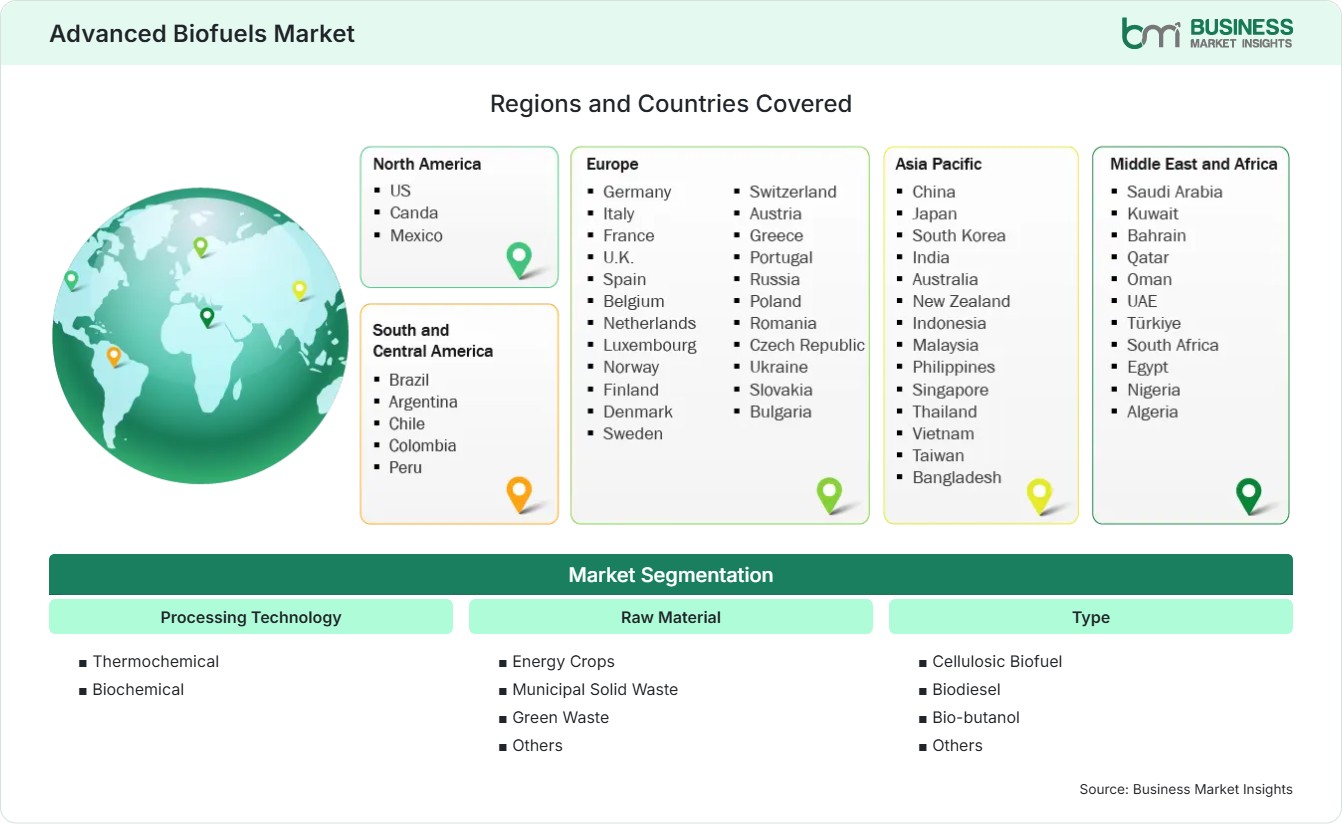
Global Market Geography
FREE PDF
Request your free sample
Request free sample
Segment Analysis

Advanced Biofuels Market Segmentation

Processing Technology

The Processing Technology segment accounted for a 58%–61% share in 2025 and is expected to grow at a CAGR of 10.70%–11.20% during 2026–2033. Increasing investment in conversion technologies, improving process efficiency, and rising demand for renewable fuels are supporting segment growth. Advanced processing methods enable utilization of diverse feedstocks, including agricultural residues, municipal waste, and energy crops. Companies are focusing on scaling production technologies to improve commercial viability and reduce dependency on conventional fuels.

  • Thermochemical: Thermochemical processing converts biomass through technologies such as gasification, pyrolysis, and liquefaction. Increasing adoption is supported by waste utilization capabilities, flexible feedstock handling, and commercial-scale production potential.
  • Biochemical: Biochemical processing utilizes biological methods including fermentation and enzymatic conversion to produce advanced fuels. Growing research in biotechnology and improved conversion efficiency are supporting adoption across renewable fuel applications.

Raw Material

The Raw Material segment accounted for a 64%–67% advanced biofuels market share in 2025 and is projected to grow at a CAGR of 10.50%–11.00% during 2026–2033. Increasing focus on sustainable feedstock availability and circular economy practices is influencing raw material selection. Companies are expanding the use of non-food biomass resources to reduce competition with food production. Waste-based feedstocks are gaining attention due to their environmental benefits and potential for carbon reduction.

  • Energy Crops: Energy crops provide dedicated biomass resources for advanced biofuel production. Increasing cultivation programs and renewable fuel initiatives are supporting their adoption as sustainable feedstock sources.
  • Municipal Solid Waste: Municipal solid waste is gaining importance due to waste reduction goals and conversion opportunities. Advanced technologies are enabling transformation of urban waste streams into renewable transportation fuels.
  • Green Waste: Green waste offers renewable feedstock potential through conversion of agricultural and landscape residues. Increasing focus on waste management and circular economy models is supporting utilization.

Type

The Type segment accounted for a 72%–75% share in 2025 and is expected to grow at a CAGR of 10.80%–11.30% during 2026–2033. Growing demand for low-carbon fuels across transportation sectors is supporting expansion across different advanced biofuel types. Cellulosic biofuels are gaining attention due to their lower environmental impact, while biodiesel and bio-butanol continue supporting renewable fuel adoption. Companies are investing in technology improvements to enhance production efficiency.

  • Cellulosic Biofuel: Cellulosic biofuels utilize non-food biomass materials and provide significant carbon reduction potential. Increasing demand for sustainable aviation and transportation fuels is supporting technology development.
  • Biodiesel: Biodiesel remains an established renewable fuel option with expanding applications in transportation and industrial sectors. Improvements in feedstock flexibility and production efficiency support continued adoption.
  • Bio-butanol: Bio-butanol is gaining attention due to higher energy content and compatibility advantages compared with conventional biofuels. Research investments are supporting commercialization and broader application potential.
Market Forces

Advanced Biofuels Market Dynamics

Key Market Drivers

Growing Demand for Low-Carbon Alternatives to Conventional Fossil Fuels

The growing emphasis on lowering carbon emissions throughout the world has created a need for carbon-reduced alternative sources of fuels in comparison to fossil fuels used in transportation and industries. Biofuels provide renewable sources of fuels which have less environmental impact in terms of carbon emissions than fossil fuel-based sources of energy. The International Energy Agency emphasizes the role of sustainable fuels in energy transitions around the world, especially those which cannot be electrified easily. Air transport, maritime transport, and logistics are increasingly relying on renewable fuels to reduce their carbon footprint.

Increasing Renewable Energy Investments Supporting Advanced Biofuel Production

Increasing investments in renewable energy infrastructure are supporting the expansion of advanced biofuel production facilities worldwide. Energy companies are allocating capital toward commercial-scale plants, technology development, and sustainable feedstock supply chains to strengthen renewable fuel portfolios. Public and private investments are improving production efficiency and enabling broader commercialization of advanced conversion technologies. Partnerships between fuel producers, technology providers, and governments are accelerating project development. Growing interest in renewable transportation fuels is encouraging companies to diversify beyond traditional energy sources.

Government Policies Promoting Sustainable Transportation Fuels

Government policies supporting renewable fuels and transportation decarbonization are creating strong growth opportunities for advanced biofuel producers. Countries are introducing blending mandates, carbon reduction targets, and incentives to encourage adoption of sustainable fuel alternatives. Regulations supporting sustainable aviation fuels and renewable transportation fuels are increasing demand for advanced biofuel technologies. Policy frameworks in North America, Europe, and Asia Pacific are encouraging investments in production facilities and infrastructure development. Government-backed programs are helping reduce commercial barriers and considered to be a major advanced biofuels market trend.

Key Market Opportunities

Expansion of Advanced Biofuels in Aviation and Heavy Transport

The expansion of advanced biofuels in aviation and heavy transport is creating significant opportunities due to the limited electrification potential of these sectors. Airlines, shipping companies, and logistics operators are increasingly adopting sustainable fuels to reduce carbon emissions and comply with environmental regulations. Sustainable aviation fuel development is becoming a major investment area as governments and industry stakeholders focus on achieving long-term emission reduction targets. Advanced biofuels produced from waste materials, agricultural residues, and other renewable feedstocks offer potential solutions for reducing transportation emissions.

Growing Investment in Commercial-Scale Advanced Biofuel Facilities

Increasing investment in commercial-scale advanced biofuel facilities is creating opportunities for technology providers, fuel producers, and infrastructure developers. Companies are expanding production capacity through new facilities, strategic partnerships, and technology improvements to meet growing renewable fuel demand. Large-scale projects are being developed to improve supply reliability and reduce production costs through operational efficiency. Government incentives, private investment, and corporate sustainability commitments are supporting the development of advanced biofuel plants.

Increasing Opportunities for Carbon-Negative Fuel Production

Increasing opportunities for carbon negative fuel generation are being seen through integrated technologies where advanced biofuels and carbon capture solutions collaborated. Such technologies have the possibility of going beyond regular renewable fuels by removing carbon at the time of fuel production. Energy corporations are looking into the technology sector that integrates biomass, carbon removal, and renewable energy to create next generation fuels. The increased interest shown by industries in net-zero emission technologies is leading to increased investments in carbon negative fuels. Increased regulatory support for carbon reduction and carbon management technologies are opening up new commercial opportunities for such fuels.

Market Restraints and Challenges

High Production Costs Compared with Conventional Fossil Fuels

Factor: Advanced biofuel production requires expensive technologies, specialized processing facilities, and complex feedstock conversion systems that increase overall manufacturing costs compared with conventional fossil fuels. Impact: Higher production expenses can limit price competitiveness, delay commercialization, and create financial challenges for large-scale project development. Companies must improve operational efficiency, optimize feedstock utilization, and adopt technological advancements to reduce costs and achieve broader market adoption.

Limited Availability of Sustainable Feedstocks at Commercial Scale

Factor: The availability of consistent, high-quality sustainable feedstocks remains a challenge due to supply chain limitations, seasonal variations, and competition with other biomass applications. Impact: Feedstock constraints can affect production reliability, increase operational complexity, and limit expansion of advanced biofuel facilities. Companies need to establish diversified sourcing networks, develop efficient logistics systems, and invest in alternative feedstock solutions to ensure long-term production scalability.

Company Analysis

Competitive Landscape

The Advanced Biofuels market analysis showcases an ecosystem that includes renewable fuel manufacturers, energy corporations, biotech firms, and technology vendors. Companies that occupy the top position within the sector are concentrating on manufacturing facilities, sustainable sourcing of raw materials, advanced biofuel conversion technology, and creating partnerships to reinforce their position within the market. Technological competencies, production scale expansion, regulations, and low-cost carbon fuel development capabilities shape the competitive environment.

Company Name

Overview

Products and Services relevant to this market

Neste Oyj

Renewable fuels company specializing in sustainable fuel production and circular solutions.

Sustainable aviation fuel, renewable diesel, waste-based fuels, and advanced biofuel production technologies.

Gevo, Inc.

Renewable chemicals and fuels company focused on low-carbon fuel solutions.

Sustainable aviation fuel, renewable hydrocarbons, bio-based alcohols, and carbon reduction technologies.

Aemetis, Inc.

Renewable energy company developing advanced biofuel and carbon reduction projects.

Renewable natural gas, advanced biofuels, ethanol technologies, and carbon capture solutions.

Fulcrum BioEnergy, Inc.

Waste-to-fuel company converting municipal waste into renewable transportation fuels.

Sustainable aviation fuel, waste conversion technologies, and renewable fuel production facilities.

LanzaTech Global, Inc.

Biotechnology company specializing in carbon recycling and sustainable fuel technologies.

Carbon-based fuel production, ethanol technologies, and waste gas conversion solutions.

Clariant AG

Specialty chemicals company providing advanced biofuel processing technologies.

Cellulosic ethanol technologies, catalysts, process solutions, and biomass conversion systems.

Eni S.p.A.

Global energy company investing in renewable fuels and energy transition solutions.

Sustainable aviation fuel, renewable fuels, biorefineries, and advanced energy technologies.

TotalEnergies SE

Integrated energy company expanding renewable and low-carbon fuel activities.

Sustainable aviation fuel, biofuels, renewable energy solutions, and fuel production infrastructure.

Shell plc

Global energy company developing renewable fuel and decarbonization solutions.

Sustainable aviation fuel, advanced biofuels, renewable fuel technologies, and energy transition services.

SABIC

Global chemicals company developing circular and sustainable material solutions.

Bio-based feedstocks, renewable materials, and technologies supporting sustainable industrial applications.

Trust & Transparency

Research Methodology

The market analysis combines proprietary research with secondary data from government agencies, company disclosures, regulatory filings, industry databases and expert interviews. Market estimates are validated through data triangulation, cross-market benchmarking and analyst review.

View Full Research Methodology

Questions Answered

Frequently Asked Questions

How will the Advanced Biofuels Report outlook evolve through 2033?

The Advanced Biofuels market report outlook will be shaped by renewable fuel policies, commercial-scale facility expansion, technology advancements, sustainable feedstock availability, and increasing demand for low-carbon transportation fuels.

What technologies are improving advanced biofuel production efficiency?

Thermochemical conversion, biochemical processing, carbon recycling, and integrated carbon capture technologies are improving production efficiency and supporting commercial-scale deployment.

How is sustainable aviation fuel influencing advanced biofuel demand?

Sustainable aviation fuel is becoming a major growth area as airlines and governments focus on reducing aviation emissions. Advanced biofuel technologies enable production of renewable jet fuel from alternative feedstocks.

Which feedstocks are commonly used for advanced biofuel production?

Advanced biofuels are produced from non-food sources including agricultural residues, municipal solid waste, green waste, lignocellulosic biomass, and dedicated energy crops.

Why are advanced biofuels gaining importance in the global energy transition?

Advanced biofuels provide renewable alternatives for sectors such as aviation, shipping, and heavy transport where direct electrification remains challenging. They support emission reduction goals through lower-carbon fuel pathways.

Access the Full Advanced Biofuels Market Report

Get segment-level forecasts, regional estimates, competitive benchmarking, company profiles and downloadable Excel datasets.

Access the full Advanced Biofuels Market Report
350 pages PDF & Excel | 2026-08-25
Similar Research

Related Market Reports