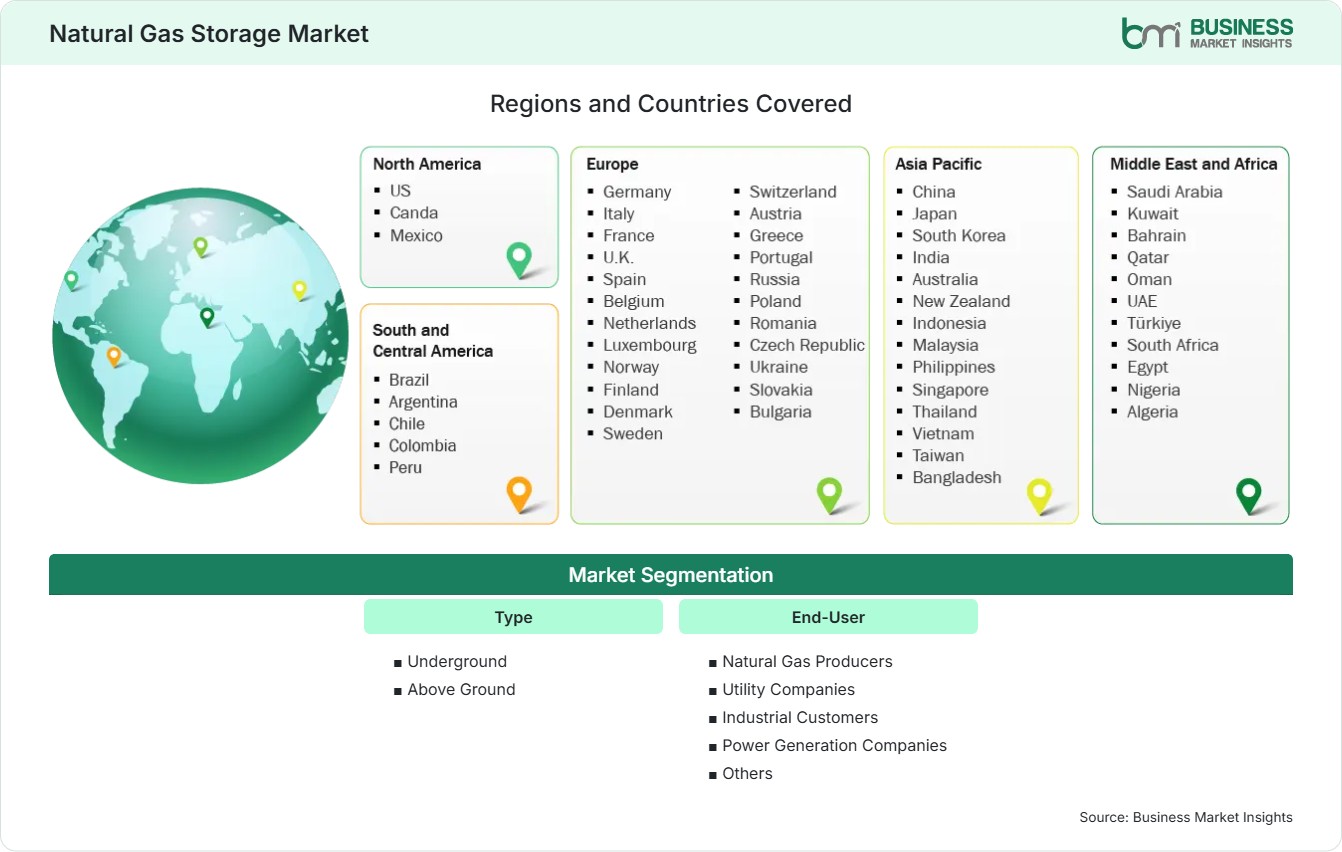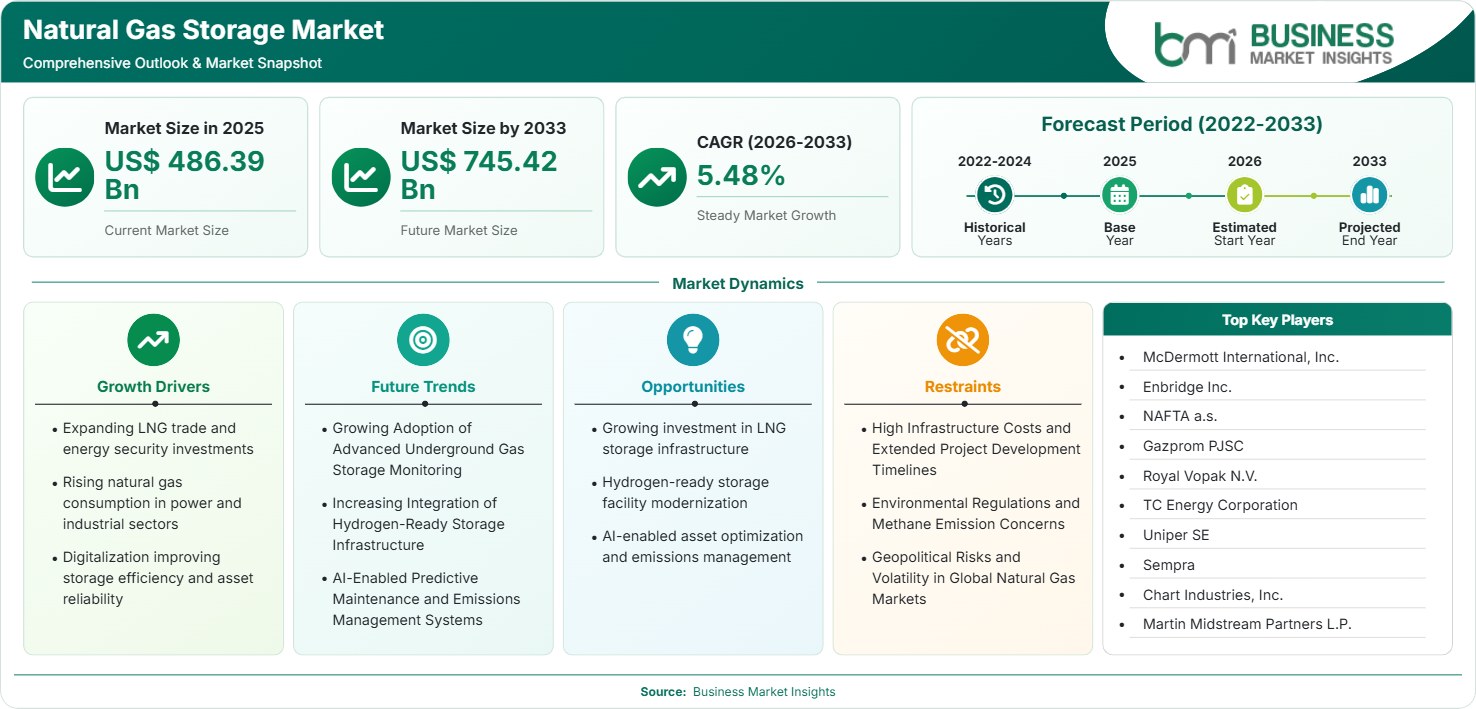
Natural Gas Storage Market Regional Highlights
North America Natural Gas Storage Market
North America accounts for 36%–39% of the Natural Gas Storage Market share in 2025 and is projected to expand at a CAGR of 5.0%–5.4% during 2026–2033. The region benefits from an extensive interstate pipeline network, large underground storage infrastructure, and increasing LNG export activities.
- Extensive depleted reservoirs and salt cavern facilities enable operators to maintain stable gas supplies during seasonal demand fluctuations while supporting residential heating, industrial production, LNG exports, and electricity generation across North America.
- Rising LNG export capacity along the U.S. Gulf Coast continues increasing demand for high-capacity storage infrastructure, improving supply flexibility and encouraging long-term investments in pipeline connectivity and storage optimization technologies.
- Utilities increasingly deploy AI-enabled monitoring, predictive maintenance, and digital reservoir management platforms to maximize storage efficiency, reduce methane emissions, and improve operational safety under evolving environmental regulations.
- Government-backed energy resilience initiatives and private infrastructure investments continue strengthening regional storage capacity, improving emergency preparedness, reducing supply disruptions, and supporting long-term energy security objectives.
- Cross-border natural gas transportation between the United States, Canada, and Mexico continues expanding regional integration while supporting reliable fuel availability for industrial consumers and power generation facilities.
US Natural Gas Storage Market
The United States represents 78%–82% of North American storage capacity and is expected to record a CAGR of 5.1%–5.5% through 2033. Extensive shale gas production, mature pipeline infrastructure, expanding LNG export terminals, and large underground storage networks contributing as a Natural Gas Storage Market trends.
- Gulf Coast LNG expansion continues increasing demand for strategic storage assets that ensure uninterrupted gas supply, improve export reliability, and optimize seasonal inventory management for domestic and international markets.
- Depleted reservoirs remain the dominant storage solution because of established infrastructure, large working gas capacity, and cost-effective integration with interstate transmission systems.
- Advanced leak detection technologies, automated compression systems, and digital reservoir analytics are improving operational efficiency while supporting environmental compliance and infrastructure reliability.
Europe Natural Gas Storage Market
Europe Natural Gas Storage Market captures 27%–30% market share in 2025 and is forecast to grow at a CAGR of 5.4%–5.9% through 2033. Diversification of gas imports, enhanced storage obligations, and stronger regional energy security policies continue driving infrastructure investments. Germany remains the leading market, while Poland records the fastest regional growth owing to expanding LNG import capacity, strategic storage expansion, and government-backed energy diversification initiatives.
- European Union regulations encouraging minimum storage filling levels continue stimulating investments in underground storage modernization and operational optimization across member states.
- Germany maintains regional leadership through extensive underground storage assets, integrated transmission infrastructure, and industrial gas demand supporting long-term utilization.
- Poland demonstrates the fastest expansion as LNG import infrastructure, interconnector projects, and strategic reserve investments strengthen national energy resilience.
- Increasing biomethane integration and hydrogen-ready infrastructure planning encourage operators to modernize existing storage facilities for future low-carbon energy applications.
Asia Pacific Natural Gas Storage Market
Asia Pacific Natural Gas Storage Market accounts for 23%–26% of the market in 2025 and is projected to register the fastest CAGR of 6.5%–7.0% during 2026–2033. Rapid industrialization, urbanization, LNG import growth, and supportive government energy policies continue accelerating storage infrastructure investments. China leads the regional market, while India records the highest growth owing to expanding gas infrastructure, cleaner energy adoption, and increasing industrial natural gas consumption.
- China continues investing in underground storage facilities and LNG terminals to improve seasonal supply stability and strengthen long-term national energy security.
- India records the fastest regional expansion through city gas distribution growth, LNG terminal development, and supportive policies encouraging higher natural gas utilization.
- Japan and South Korea continue upgrading LNG storage infrastructure to strengthen import reliability and improve resilience against international supply disruptions.
- Growing industrial demand and cleaner fuel transition strategies encourage governments to expand gas transmission networks and integrated storage capacity.
Rest of World Natural Gas Storage Market
The Rest of World region represents 10%–13% market share in 2025 and is anticipated to expand at a CAGR of 5.8%–6.3% during 2026–2033. South & Central America continue investing in gas infrastructure supporting industrial development and power generation. Meanwhile, the Middle East & Africa benefit from rising gas production, export-oriented infrastructure, and strategic energy diversification initiatives. Brazil leads South & Central America, whereas Saudi Arabia demonstrates the fastest growth across the Middle East & Africa through expanding storage investments and integrated gas development projects.
- Brazil continues strengthening storage infrastructure alongside domestic gas market liberalization and expanding industrial consumption, improving long-term energy security and supply flexibility.
- Saudi Arabia records the strongest regional growth through strategic investments in integrated gas infrastructure, supporting industrial diversification and rising domestic natural gas demand.
- Expanding LNG infrastructure across the Middle East improves export flexibility while creating additional demand for advanced storage technologies and engineering services.
- African economies continue investing in gas infrastructure development to improve electricity access, industrial productivity, and long-term economic diversification supported by international investment.