Floating Liquified Natural Gas Market Outlook: Size, Share, Trends, Growth Analysis, Competitive Landscape & Forecast, 2026-2033

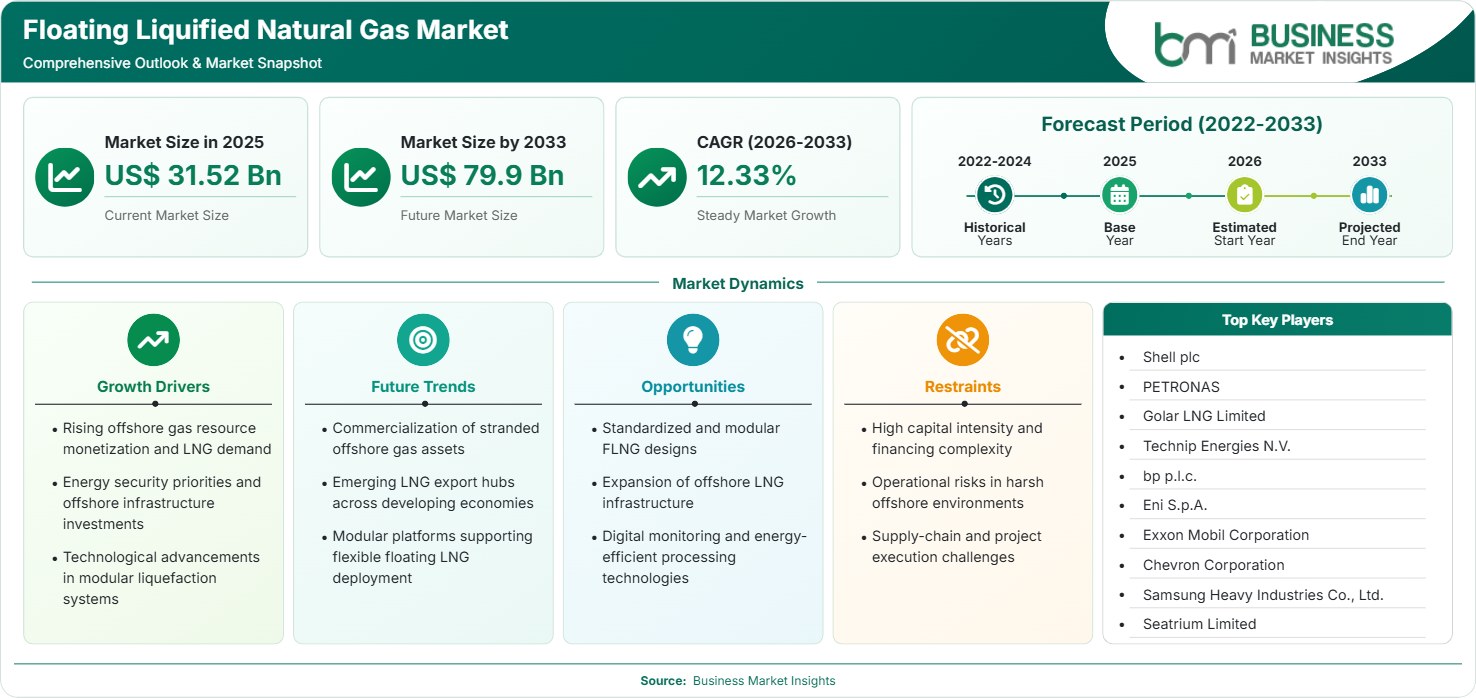
The Floating Liquified Natural Gas Market size was valued at US$ 31.52 Billion in 2025 and is projected to reach US$ 79.9 Billion by 2033, growing at a CAGR of 12.33% during 2026–2033, driven by offshore gas monetization, rising LNG trade, energy security initiatives, deepwater discoveries, modular liquefaction technologies, and increasing investments in flexible gas export infrastructure.

Report Coverage
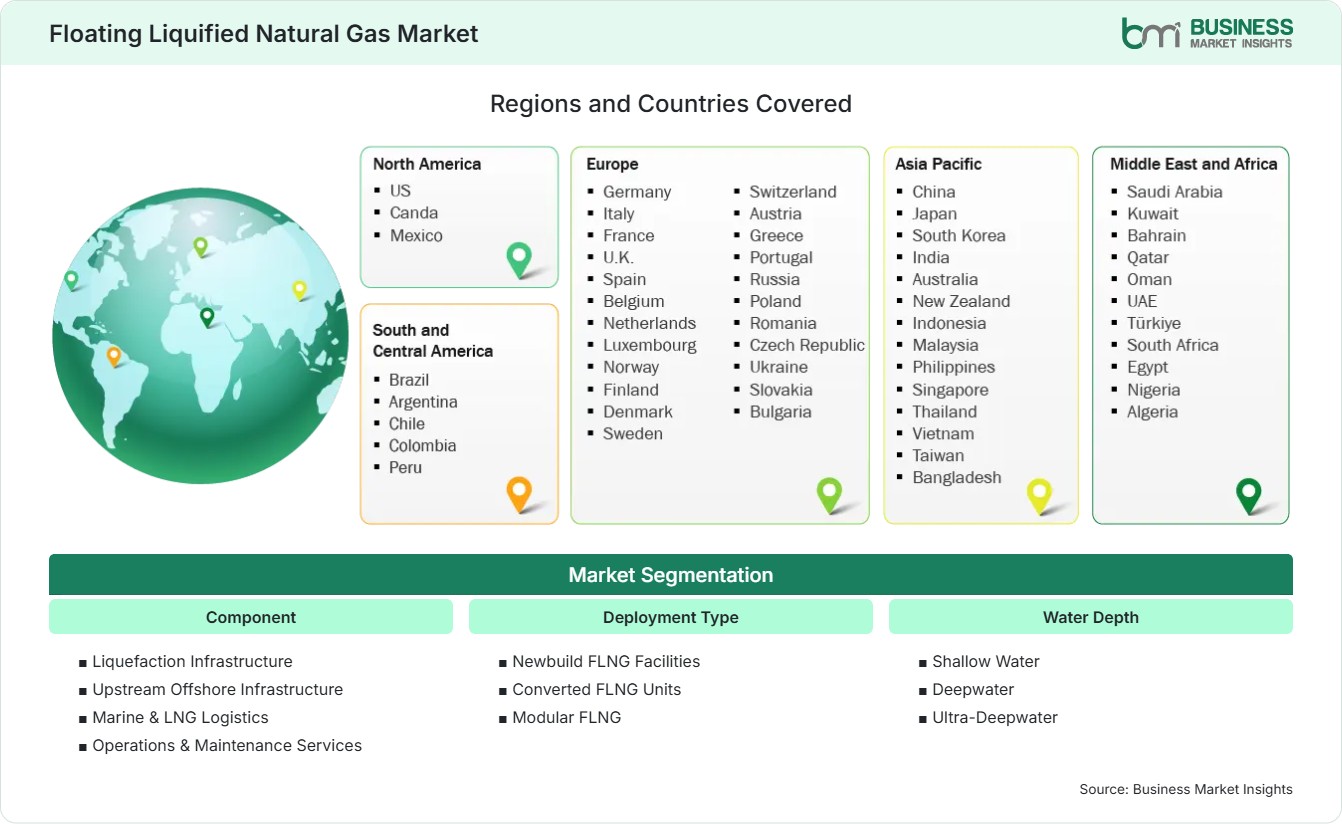
  • Component: Liquefaction Infrastructure, Upstream Offshore Infrastructure, Marine & LNG Logistics, Operations & Maintenance Services
  • Deployment Type: Newbuild FLNG Facilities, Converted FLNG Units, Modular FLNG
  • Water Depth: Shallow Water, Deepwater, Ultra-Deepwater
US$ 31.52 Bn Market size in 2025
US$ 79.9 Bn Market Size by 2033
12.33% CAGR, 2026 - 2033
2026-2033 Forecast Period

AI Overview

Floating Liquified Natural Gas Market Summary

  • North America Region: Holds a market share of 33%–36% in 2025, growing at a CAGR of 11.5%–12.0% during 2026–2033. Growth is supported by Gulf Coast LNG integration, offshore gas commercialization, vessel conversion expertise, and infrastructure financing. Expanding export capacity and project approvals strengthen long-term deployment opportunities across offshore developments. The U.S. market benefits from strong LNG export leadership and offshore investment, advancing at approximately 11.8%–12.3% CAGR.
  • Fastest Growing Region: Asia Pacific holds 28%–31% share in 2025 and advances at 13.5%–14.2% CAGR. Rising gas demand, energy transition commitments, stranded-field development, and increasing offshore exploration support substantial investments across Southeast Asia, China, Australia, and emerging LNG-exporting economies.
  • Leading Segment: Liquefaction Infrastructure accounts for 34%–37% share in 2025 and expands at 12.0%–12.8% CAGR. Demand stems from integrated offshore liquefaction systems, efficiency improvements, modular technologies, reduced shore-based infrastructure dependence, and commercialization of remote gas reserves.
  • High Growth Segment: Ultra-Deepwater represents 20%–23% share in 2025 while recording 13.8%–14.6% CAGR. Advanced subsea technologies, frontier basin discoveries, higher reserve potential, and producer focus on large offshore fields continue supporting deployment momentum.
  • Key Market Opportunity: Development of modular offshore liquefaction facilities enables operators to monetize stranded reserves faster, lower upfront infrastructure expenditure, improve project economics, accelerate deployment schedules, and enter emerging LNG export markets.
  • Major Market Players: Shell plc, PETRONAS, Golar LNG Limited, Technip Energies N.V., bp p.l.c., Eni S.p.A., Exxon Mobil Corporation, Chevron Corporation, Samsung Heavy Industries Co., Ltd., Seatrium Limited.
Strategic Insights

Floating Liquified Natural Gas Market: Strategic Insights

Floating Liquified Natural Gas Market Strategic Framework
FREE PDF
Request your free sample
Request free sample
Stakeholder View

Key Takeaways

  • The value chain increasingly integrates upstream production, liquefaction, storage, and LNG logistics on a single floating asset, improving project efficiency.
  • Ultra-deepwater developments and modular deployment configurations offer the strongest long-term commercial upside for new investments.
  • Standardized vessel designs and conversion-based projects are reducing construction complexity while enhancing scalability.
  • Southeast Asia and East Africa present compelling opportunities due to resource availability, supportive policies, and LNG export ambitions.
  • Strategic partnerships between operators, EPC contractors, and shipbuilders are accelerating project sanctioning and funding activity.
  • Growing emphasis on lower-emission LNG production is encouraging integration of digital monitoring, energy efficiency systems, and advanced processing technologies.
Geographic Outlook

Floating Liquified Natural Gas Market Regional Highlights

North America Floating Liquified Natural Gas Market

North America accounts for 33%–36% Floating Liquified Natural Gas Market share in 2025 and is expected to expand at 11.5%–12.0% CAGR through 2033. Regional leadership is supported by LNG export capabilities, offshore infrastructure expertise, and large-scale investment pipelines. The Gulf of Mexico remains central to development activity, supported by engineering capabilities and access to downstream LNG networks.

  • Growing LNG export demand encourages commercialization of offshore gas reserves.
  • Vessel conversion programs improve project economics for independent operators.
  • Energy security initiatives support long-term infrastructure financing.
  • Deepwater exploration activity sustains development opportunities across offshore basins.

US Floating Liquified Natural Gas Market

The United States represents 72%–76% of regional revenue and advances at 11.8%–12.3% CAGR. Project developers increasingly evaluate offshore liquefaction to complement onshore export terminals. Strong engineering, shipping, and natural gas production capabilities position the country as a major deployment hub.

  • Gulf Coast integration supports offshore production and LNG export value chains.
  • Large natural gas reserves enhance feedstock availability.
  • Financial institutions actively support LNG-linked infrastructure developments.
  • Technology partnerships accelerate commercialization of floating facilities.

Europe Floating Liquified Natural Gas Market

Europe holds 22%–25% share in 2025 and grows at 11.0%–11.8% CAGR. Energy diversification needs and LNG security strategies support regional investments. Norway leads deployment activity, while the United Kingdom demonstrates strong growth potential at approximately 11.9%–12.5% CAGR due to offshore development initiatives.

  • Energy security remains a primary investment catalyst.
  • North Sea infrastructure supports technology adoption.
  • LNG diversification strategies improve commercial viability.
  • Low-emission operational technologies gain increasing emphasis.

Asia Pacific Floating Liquified Natural Gas Market

Asia Pacific accounts for 28%–31% share in 2025 and represents the fastest-growing region with 13.5%–14.2% CAGR. Australia and Malaysia lead regional activity, while Indonesia experiences particularly strong growth. Expanding LNG demand and offshore reserve development continue strengthening deployment prospects.

  • Southeast Asian offshore discoveries support long-term investment.
  • Rising industrial gas consumption increases LNG requirements.
  • Government support encourages resource commercialization.
  • Advanced offshore engineering capabilities expand regional competitiveness.

Rest of World Floating Liquified Natural Gas Market

The Rest of World region contributes 12%–15% share and expands at 12.8%–13.6% CAGR. In South and Central America, Argentina and Brazil are advancing LNG export strategies. Across the Middle East and Africa, Mozambique and Mauritania remain primary development centers supported by major offshore reserves.

  • East African offshore gas resources attract international operators.
  • New LNG export projects strengthen regional competitiveness.
  • Resource monetization programs support long-term infrastructure spending.
  • Strategic partnerships accelerate project execution.
Global Market Geography
FREE PDF
Request your free sample
Request free sample
Segment Analysis

Floating Liquified Natural Gas Market Segmentation

Component

This segment holds approximately 40%–43% market share in 2025 and advances at 12.4%–13.0% CAGR. The Floating Liquified Natural Gas Market scope within components is expanding as operators prioritize integrated processing systems, offshore efficiency, and lifecycle cost optimization.

  • Liquefaction Infrastructure: Core processing assets enabling offshore gas conversion into LNG while supporting efficiency improvements and commercial viability of remote reserves.
  • Upstream Offshore Infrastructure: Includes production systems and subsea networks supporting continuous feed gas supply for floating operations.
  • Marine & LNG Logistics: Supports LNG storage, offloading, transportation, and integration with global trading networks.
  • Operations & Maintenance (O&M) Services: Increasingly important as operators seek reliability, digital monitoring, and asset life extension.

Deployment Type

Deployment type represents around 31%–34% share and records 12.1%–12.9% CAGR. The Floating Liquified Natural Gas Market trends increasingly favor flexible deployment strategies that shorten development timelines.

  • Newbuild FLNG Facilities: Designed for large-scale processing requirements with customized offshore operating capabilities.
  • Converted FLNG Units: Attractive due to lower capital expenditure and faster commissioning schedules.
  • Modular FLNG: Gains momentum through scalable design structures and deployment flexibility.

Water Depth

Water-depth applications account for 24%–28% share and expand at 12.8%–13.5% CAGR due to offshore exploration growth.

  • Shallow Water: Suitable for near-shore developments with lower installation complexity.
  • Deepwater: Supports large reserve commercialization through advanced subsea systems.
  • Ultra-Deepwater: Benefits from frontier exploration activity and high-volume resource potential.
Market Forces

Floating Liquified Natural Gas Market Dynamics

Key Market Drivers

Expansion of Offshore Gas Resource Monetization

Growing offshore gas discoveries are driving the deployment of floating liquefied natural gas (FLNG) facilities, enabling the commercialization of remote reserves that might otherwise remain economically unviable. As reported by the IEA and the LNG organizations, there is continued support for the investments in offshore gas projects from increased global demand for LNG. The FLNG technology reduces the dependency on long pipelines, makes projects more economical, and speeds up the development process. This has been especially true in Africa, South East Asia, and Latin America, where there have been many offshore gas finds.

Rising Global LNG Trade and Energy Security Priorities

As global energy demand grows, countries are increasingly seeking diversified and reliable natural gas supply sources, driving investment in LNG infrastructure. Issues of energy security, especially following supply shortages, have made LNG purchasing policies stronger among both Europe and Asia. The use of floating LNG stations and other offshore facilities provides flexibility for expansion, reduced initial capital outlays, and faster implementation than many new projects. Moreover, increasing demand for LNG imports will ensure further investments in offshore LNG-producing facilities.

Technological Advancements in Modular Liquefaction Systems

Technological advancements in modular liquefaction systems are significantly improving the viability and efficiency of LNG projects worldwide. Enhanced process designs, energy-efficient equipment, and advanced automation technologies are helping operators reduce costs while maximizing production performance. Performance monitoring and maintenance systems for digital assets help to track the real-time performance, thus ensuring that there is minimal downtime. Moreover, standardized designs of ships and modules help in the easy manufacture, transport, and installation, hence minimizing risks and speeding up the process. These developments lead to life cycle optimization and boost investor confidence, among others.

Key Market Opportunities

Commercialization of Stranded Offshore Gas Assets

Large volumes of offshore natural gas remain undeveloped because of high infrastructure costs, remote locations, and complex logistics that make conventional projects economically challenging. Floating processing and liquefaction solutions allow for the processing and export of gas from offshore fields without the requirement for significant onshore facilities and pipelines. Such solutions make it possible for operators to tap into stranded gas assets, accelerate project execution times, minimize capital costs, and increase flexibility. Floating solutions enhance the economics of projects and provide access to new gas reserves.

Emerging LNG Export Hubs Across Developing Economies

Countries with growing offshore natural gas discoveries are increasingly exploring opportunities to establish themselves as LNG exporters, particularly where conventional onshore infrastructure is limited or difficult to develop. There have been many investments in Africa, South America, and Southeast Asia that have been generating a need for scaling up of floating infrastructure that will enable monetization of offshore reserves without having to rely on huge coastline infrastructures. The use of Floating LNG is one way to achieve this objective. Long-term LNG supply contracts and international partnerships are also supporting project financing, technology deployment, engineering, and commercialization activities. As emerging economies strengthen their energy infrastructure and seek new export revenues, the development of offshore LNG hubs could create additional opportunities for FLNG operators, technology providers, and project developers.

Modular Platforms Supporting Demand for Floating LNG

Modular platform designs are creating new opportunities in the floating LNG market by offering greater scalability, redeployment potential, and flexibility compared with highly customized infrastructure. Floating Liquified Natural Gas Market Forecasts indicate that these systems can allow developers to adapt LNG facilities to different field sizes, production requirements, and project timelines, which is particularly valuable for offshore reserves that may not justify large-scale permanent installations. Modular approaches could reduce initial investment costs and streamline the processes of construction, transportation, and deployment of such platforms. In light of the growing interest in flexible infrastructures, it is expected that modular FLNG facilities will become more popular in medium and offshore oilfields. Reduced commissioning times and the possibility of relocation and reuse of facilities could bring added benefits to the projects' profitability.

Market Restraints and Challenges

High Capital Intensity and Financing Complexity

Factor: FLNG (Floating Liquefied Natural Gas) developments are associated with a large initial capital expenditure in relation to the design process, shipbuilding, subsea facilities, liquefaction plants, storage, and project start-up. The size and sophistication of FLNG projects dictate a considerable amount of money be spent before any business activity commences. It is also important to take into account costs associated with escalation, financing, commodity prices, and possible project delays.

Impact: High levels of capital are associated with complicated financing processes that may hinder or delay the making of investment decisions, especially when there is significant volatility of commodity prices and market conditions. In many cases, the success of financing will depend on investor confidence, market stability, and the visibility of revenues in the future. Small-scale players will find it difficult to get enough capital or suitable loan terms for implementing the FLNG projects. As a result, financing problems will hinder the growth of this industry.

Operational Risk in Harsh Offshore Environments

Factor: Operation of FLNG installations is carried out in harsh marine conditions due to variations in weather, currents, corrosive seawater, high waves, and distant operations. Offshore installations consist of sophisticated equipment such as liquefaction plants, processing facilities, and marine systems which must be able to function effectively despite the difficult conditions. Damage to equipment and technical problems may make operations even more difficult.

Impact: The exposure of the equipment to extreme weather conditions at sea could pose risks of equipment breakdowns, production stoppages, and maintenance costs. Technical breakdowns would need specialized manpower, equipment, and vessels to be able to rectify them. The maintenance process would take long and increase the operating cost. Disruptions in operations could lead to reduced efficiency in the use of assets, disrupted production programs, and reduced economic viability of the project. Reliability of the assets calls for constant monitoring, maintenance, safety, and emergency response mechanisms.

Company Analysis

Competitive Landscape

The Floating Liquified Natural Gas Market analysis indicates competition is centered on integrated project execution capabilities, offshore engineering expertise, vessel conversion technologies, and LNG commercialization partnerships.

Company Name

Overview

Products and Services relevant to this market

Shell plc

Pioneer in commercial FLNG deployment with extensive global LNG operations.

Prelude FLNG operations, LNG production, offshore gas development solutions.

PETRONAS

Major energy company operating multiple FLNG assets in Asia.

FLNG facilities, LNG exports, offshore gas commercialization services.

Golar LNG Limited

Specialist developer focused on floating liquefaction solutions.

FLNG conversions, LNG infrastructure, vessel-based liquefaction services.

Technip Energies N.V.

Leading engineering contractor for LNG megaprojects.

EPC services, liquefaction technologies, offshore energy engineering.

bp p.l.c.

Global energy producer with offshore gas investments.

Gas development, LNG marketing, offshore infrastructure support.

Eni S.p.A.

Active participant in offshore LNG projects worldwide.

Coral FLNG operations, upstream development, LNG production.

Exxon Mobil Corporation

Integrated energy company with large gas resource portfolio.

Offshore gas development, LNG value-chain solutions.

Chevron Corporation

Global operator investing in gas monetization projects.

LNG production, upstream offshore infrastructure and development.

Samsung Heavy Industries Co., Ltd.

Major shipbuilder supporting FLNG construction.

FLNG vessel fabrication, offshore engineering services.

Seatrium Limited

Offshore platform and vessel conversion specialist.

FLNG conversion, marine engineering, fabrication services.

Trust & Transparency

Research Methodology

The market analysis combines proprietary research with secondary data from government agencies, company disclosures, regulatory filings, industry databases and expert interviews. Market estimates are validated through data triangulation, cross-market benchmarking and analyst review.

View Full Research Methodology

Questions Answered

Frequently Asked Questions

What role does digital technology play in FLNG operations?

Digital monitoring systems improve predictive maintenance, operational efficiency, safety performance, and asset utilization while reducing downtime risks.

How does the Floating Liquified Natural Gas Market Report benefit investors?

It provides insights into regional opportunities, segment performance, competitive positioning, technology developments, and long-term demand drivers influencing investment decisions.

Why are converted FLNG units gaining popularity?

Converted units generally reduce capital requirements, shorten deployment timelines, and utilize existing vessel assets, improving project economics for operators.

Which regions offer the strongest future demand potential?

Asia Pacific, East Africa, and selected South American countries offer substantial growth potential due to rising gas demand, offshore discoveries, and LNG export ambitions.

What makes floating LNG projects different from onshore LNG facilities?

Floating facilities integrate production, liquefaction, storage, and offloading offshore, reducing dependence on pipelines and extensive land-based infrastructure while enabling stranded gas commercialization.

Access the Full Floating Liquified Natural Gas Market Report

Get segment-level forecasts, regional estimates, competitive benchmarking, company profiles and downloadable Excel datasets.

Access the full Floating Liquified Natural Gas Market Report
350 pages PDF & Excel | 2026-08-31