
Oil & Gas Sensors Market Outlook: Size, Share, Trends, Growth Analysis, Competitive Landscape & Forecast, 2026-2033

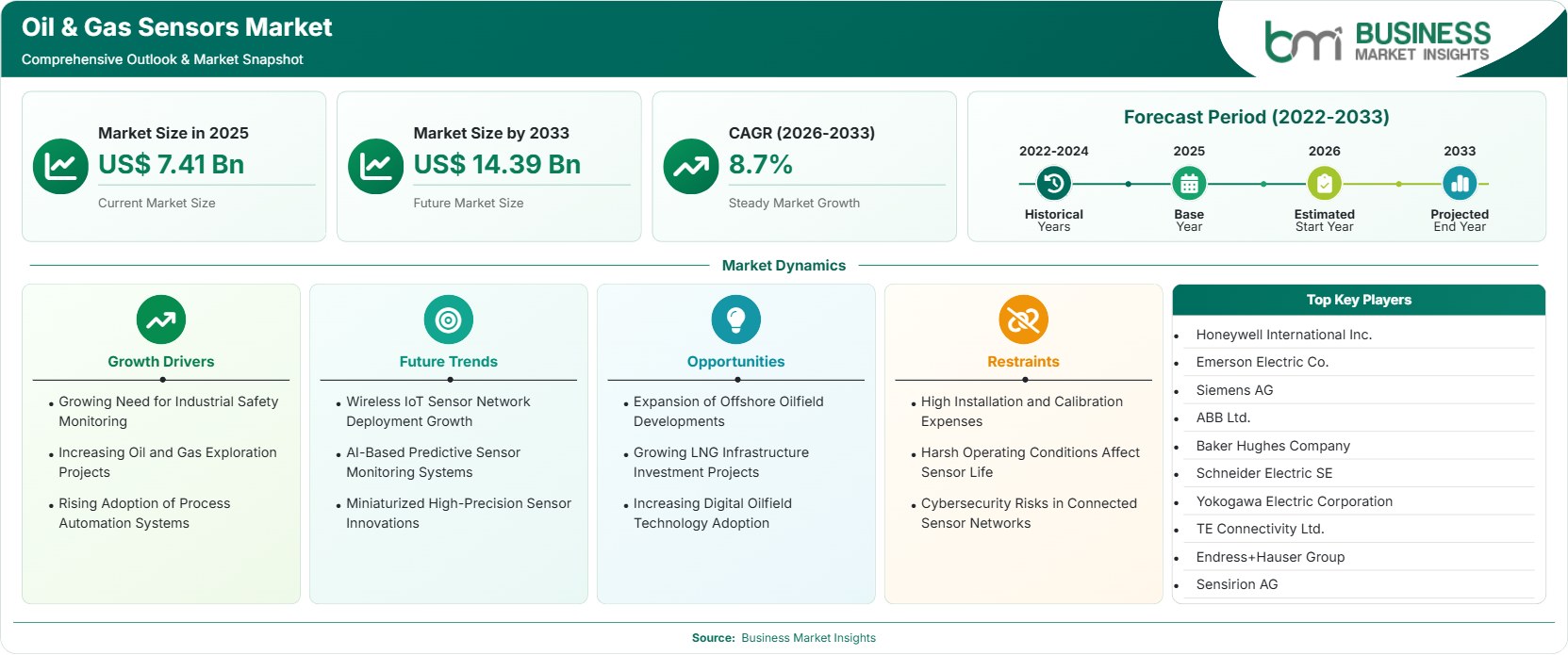
The Oil & Gas Sensors Market was valued at US$ 7.41 Billion in 2025 and is projected to reach US$ 14.39 Billion by 2033, growing at a CAGR of 8.7% during 2026–2033. Market growth is driven by increasing industrial automation, stringent safety regulations, expansion of offshore exploration, digital oilfield adoption, and rising investments in predictive maintenance and emissions monitoring technologies.

Report Coverage
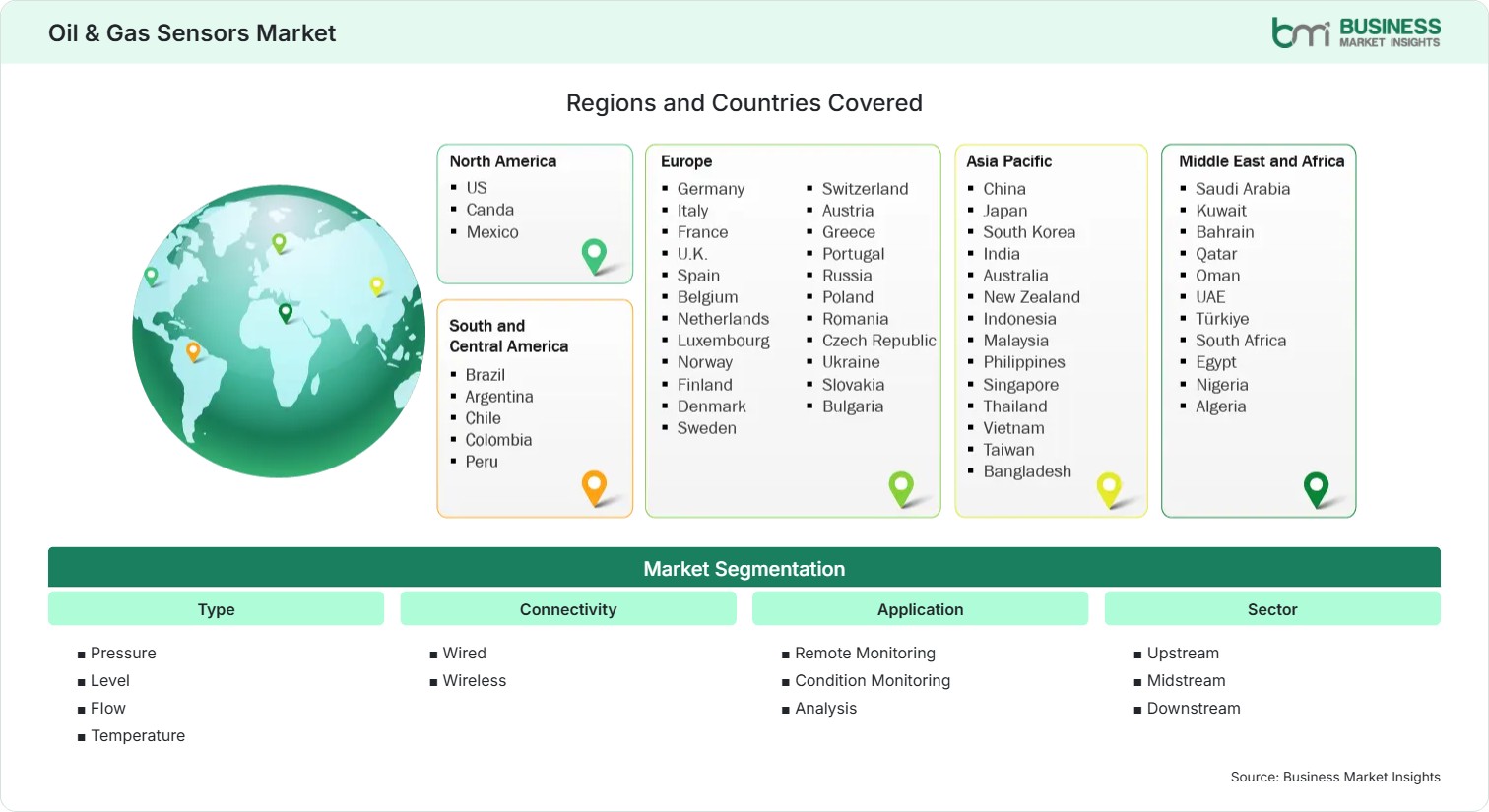
  • Type: Pressure, Level, FIow,Temperature
  • Connectivity: Wired, Wireless
  • Application: Remote Monitoring, Condition Monitoring, Analysis
  • Sector: Upstream, Midstream, Downstream
US$ 7.41 Bn Market size in 2025
US$ 14.39 Bn Market Size by 2033
8.7% CAGR, 2026 - 2033
2026-2033 Forecast Period

AI Overview

Oil & Gas Sensors Market Summary

  • North America Region: North America accounted for 35%–38% of the global market in 2025 and is expected to grow at a CAGR of 8.1%–8.5% through 2033. Oil & Gas Sensors Market growth is supported by shale production, refinery modernization, pipeline monitoring, and stricter methane emission regulations. The United States remains the largest contributor with a CAGR of 8.2%–8.6%.
  • Fastest Growing Region: Asia Pacific represents 25%–28% of market share and is the fastest-growing region, expanding at a CAGR of 9.6%–10.1% due to refinery expansion, LNG infrastructure development, offshore projects, and industrial digitalization.
  • Leading Segment: Pressure sensors lead the market with 31%–34% share in 2025 and are projected to grow at a CAGR of 8.4%–8.8%, driven by extensive use in drilling, pipelines, and production monitoring.
  • High Growth Segment: Wireless connectivity accounts for 39%–42% of the Oil & Gas Sensors market and is expected to register the highest growth (10.2%–10.7% CAGR) owing to Industrial IoT adoption, remote monitoring, and predictive maintenance.
  • Key Market Opportunity: Integration of AI-powered predictive maintenance with wireless sensing technologies to improve operational efficiency, reduce downtime, and strengthen environmental compliance.
  • Major Market Players: Honeywell International Inc., Emerson Electric Co., Siemens AG, ABB Ltd., Baker Hughes Company, Schneider Electric SE, Yokogawa Electric Corporation, TE Connectivity Ltd., Endress+Hauser Group, and Sensirion AG.
Strategic Insights

Oil & Gas Sensors Market: Strategic Insights

Oil & Gas Sensors Market Strategic Framework
FREE PDF
Request your free sample
Request free sample
Stakeholder View

Key Takeaways

  • The Oil & Gas Sensors market ecosystem is becoming increasingly integrated as sensor manufacturers collaborate with automation providers, industrial software developers, and oilfield service companies to deliver connected monitoring platforms that improve operational efficiency, equipment reliability, and regulatory compliance across the upstream, midstream, and downstream value chain.
  • Remote monitoring and condition monitoring applications present the strongest commercial opportunities as operators prioritize predictive maintenance, asset integrity management, and continuous equipment diagnostics to minimize operational downtime, reduce maintenance expenditure, and improve production efficiency across geographically dispersed facilities.
  • Product innovation is shifting toward wireless communication, AI-enabled diagnostics, Industrial Internet of Things connectivity, and multi-parameter sensing technologies capable of delivering real-time operational intelligence while supporting predictive maintenance strategies and advanced process automation across complex energy infrastructures.
  • Asia Pacific represents one of the most attractive investment destinations due to expanding LNG infrastructure, refinery capacity additions, offshore exploration activities, and government-led industrial digitalization initiatives, while North America continues generating stable demand through modernization of mature production assets.
  • Strategic partnerships, acquisitions, and technology alliances are increasing as global automation companies strengthen their sensing portfolios through integrated digital solutions, cloud-enabled analytics, and intelligent monitoring platforms designed to improve industrial safety and optimize operational performance.
Geographic Outlook

Oil & Gas Sensors Market Regional Highlights

North America Oil & Gas Sensors Market

North America accounted for 35%–38% of the global market share in 2025 and is projected to register a CAGR of 8.1%–8.5% during 2026–2033. The region benefits from mature upstream production, extensive pipeline infrastructure, refinery modernization, and high adoption of industrial automation technologies. The Oil & Gas Sensors Market share remains supported by increasing investments in methane emission monitoring, predictive maintenance systems, and digital oilfield technologies that enhance operational safety and improve production efficiency.

  • Extensive shale oil and natural gas production across the United States and Canada continues increasing demand for pressure, flow, temperature, and level sensors that enhance drilling efficiency, production monitoring, and equipment protection throughout exploration and production activities.
  • Pipeline modernization projects and stricter environmental regulations are encouraging deployment of intelligent sensing systems capable of continuous leak detection, corrosion monitoring, emissions measurement, and real-time operational diagnostics across transmission infrastructure.
  • Growing investments in Industrial Internet of Things platforms are accelerating adoption of wireless sensing technologies that improve predictive maintenance capabilities, reduce maintenance costs, and strengthen operational visibility across geographically dispersed energy assets.
  • Refinery modernization initiatives continue supporting installation of advanced process instrumentation, enabling operators to improve process optimization, enhance workplace safety, reduce unplanned shutdowns, and comply with increasingly stringent environmental performance standards.
  • Strong collaboration among automation companies, energy producers, and technology providers continues accelerating commercialization of intelligent monitoring platforms that integrate cloud analytics, artificial intelligence, and industrial communication protocols.

US Oil & Gas Sensors Market

The United States represents the largest national market within North America, accounting for 28%–31% global market share in 2025 while expanding at a CAGR of 8.2%–8.6% during the Oil & Gas Sensors Market forecast period. High investments in shale production, offshore Gulf of Mexico projects, LNG export infrastructure, and industrial automation continue strengthening technology adoption across the country's integrated oil and gas industry.

  • Continuous expansion of LNG export facilities is increasing deployment of advanced sensing technologies for cryogenic storage monitoring, process automation, and safety management across liquefaction terminals.
  • Digital transformation initiatives among leading energy operators continue driving investments in predictive maintenance platforms integrating intelligent wireless sensing technologies with cloud-based industrial analytics.
  • Increasing methane emission monitoring requirements are accelerating installation of highly accurate gas detection and environmental monitoring systems throughout production, transportation, and refining infrastructure.
  • Modernization of mature oilfields and pipeline assets continues creating replacement demand for intelligent instrumentation capable of improving operational reliability and reducing maintenance-related downtime.

Europe Oil & Gas Sensors Market

The Europe region occupied the 22% to 25% market share of the Global Oil & Gas Sensors market in 2025 and is forecasted to witness growth at a CAGR of 7.9% to 8.3% between 2026 to 2033. Key driving factors in the region include the modernization of refineries, monitoring of offshore assets, energy transition projects, and strict environmental regulations. Some key markets in the region, such as Norway, the UK, Germany, and the Netherlands, remain important markets, with Norway and the United Kingdom showing higher adoption rates due to offshore production activities and asset integrity requirements.

  • Norway is stepping up its investment in offshore production monitoring solutions, in which high-tech pressure, temperature, and flow sensors play an essential role in ensuring safe operations and increased efficiency in reservoir management at mature North Sea fields.
  • The UK market is gaining momentum due to offshore facility modernization, decommissioning processes, and emissions monitoring efforts from regulators, promoting intelligent sensing technologies in energy plants.
  • Germany and the Netherlands are improving their industrial automation capabilities by optimizing refineries and upgrading process control systems and instrumentation at high-energy-consumption industrial sites.
  • Carbon emissions and environmental legislation in Europe drive the need for precise gas detection, emissions monitoring, and remote monitoring tools.

Asia Pacific Oil & Gas Sensors Market

In Asia Pacific, market share is expected to be 25%-28% in 2025, and the region is projected to grow at a CAGR of 9.6%-10.1% between 2026-2033. This region has emerged as the fastest-growing market in the world, owing to growing refining capacity, investments in LNG infrastructure, offshore exploration, and automation of industries. Countries such as China, India, Japan, South Korea, and South East Asian economies are fueling the growth through their energy security policies.

  • China continues to be an important player in the Oil & Gas Sensors market by investing in refinery construction, petrochemical plants, pipelines, and digital monitoring systems in energy projects.
  • India is witnessing a rise in demand for advanced sensor systems owing to the construction of refinery capacity, offshore exploration, the development of natural gas infrastructure, and government-supported industrial automation initiatives.
  • Japan and South Korea are enhancing their operations at LNG terminals using advanced monitoring systems that increase process efficiency and safety management of their import and storage facilities.
  • Southeast Asian nations like Indonesia, Malaysia, and Vietnam are installing sensors via offshore exploration, production optimization projects, and refurbishment of their energy infrastructure.
  • The increasing use of wireless networks for industrial communications is facilitating remote monitoring, simplifying installation and maintenance processes.

Rest of World Oil & Gas Sensors Market

The Rest of World region accounted for 12%–15% market share in 2025 and is expected to grow at a CAGR of 8.7%–9.2% during 2026–2033. South and Central America benefit from offshore exploration, deepwater production, and refinery modernization activities, while the Middle East and Africa continue investing in production expansion, LNG projects, and asset digitalization programs. Brazil, Saudi Arabia, the United Arab Emirates, and Qatar represent key growth Oil & Gas Sensors markets.

Latin American manufacturers have increased their use of intelligent instrumentation technology to improve production processes, from offshore oil rigs to infrastructure monitoring and operational safety. Middle Eastern companies have used intelligent instruments to improve the performance of their large production facilities.

  • Brazil has been increasing the use of sensor technology in deepwater offshore operations, which require dependable monitoring technologies to facilitate subsea activities, optimize production, and maintain equipment reliability.
  • Saudi Arabia and the UAE are using digital oilfield technologies, refinery modernization, and automated monitoring to increase operational efficiency in key energy installations.
  • The construction of new LNG facilities in Qatar is driving demand for process sensors for safety monitoring and production optimization.
  • The oil and gas companies operating in Africa are increasingly turning to remote monitoring technology to enhance production processes and operational management.
  • Increasing partnerships between international technology providers and regional energy companies are supporting the deployment of advanced sensing platforms throughout developing oil and gas markets.
Global Market Geography
FREE PDF
Request your free sample
Request free sample
Segment Analysis

Oil & Gas Sensors Market Segmentation

Type

Type is one of the essential segments of the sensing infrastructure, with pressure sensors estimated to account for 31%–34% of the Oil & Gas Sensors market share in 2025, while the market is expected to grow at a CAGR of 8.4%–8.8% from 2026 to 2033. The growth is being driven by the rising need for process control, equipment safety, production optimization, and monitoring, both real-time and otherwise, in upstream, midstream, and downstream activities.

  • Pressure: Pressure sensors enable accurate monitoring of drilling systems, pipelines, compressors, and production equipment while improving operational safety, process efficiency, and predictive maintenance capabilities across oil and gas facilities.
  • Level: Level sensors support storage tank monitoring, inventory management, and process automation by providing reliable measurement solutions for liquids and gases in production, refining, and transportation applications.
  • Flow: Flow sensors assist operators in monitoring hydrocarbon movement, optimizing throughput, detecting abnormalities, and improving measurement accuracy across pipelines, processing plants, and distribution networks.
  • Temperature: Temperature sensors provide essential data for equipment protection, process optimization, and safety management, supporting reliable operations in demanding production and refining environments.

Connectivity

Connectivity is a segment that has been instrumental in making people adopt industrial sensing because of its improved communication capacity and integration with digital platforms. In 2025, wireless connectivity had a Oil & Gas Sensors market share of 39%-42% and is forecast to have a CAGR of 10.2% and 10.7% between 2026 and 2033. The demand for remote sensing, reduced installation complexities, and diverse deployment modes are fueling innovations in connectivity.

  • Wired: Wired connectivity solutions remain widely adopted in processing facilities where stable communication, high data accuracy, and continuous monitoring are essential for safety-critical industrial applications.
  • Wireless: Wireless technologies enable cost-effective deployment across remote assets, offshore platforms, and large industrial facilities by reducing cabling requirements and supporting real-time asset monitoring.

Application

The Applications segment captures the rising use of sensing technology for operational intelligence, safety improvement, and optimization. The remote monitoring segment occupies a prominent place owing to the rising need for real-time visibility into assets spread across wide distances, while condition monitoring and analytics are emerging as predictive maintenance efforts advance.

  • Remote Monitoring: Remote monitoring applications support continuous observation of pipelines, offshore platforms, and production assets by enabling operators to access operational data from centralized control environments.
  • Condition Monitoring: Condition monitoring solutions help identify equipment degradation, reduce unexpected failures, and improve maintenance planning through continuous assessment of machinery performance and operating conditions.
  • Analysis: Analysis applications utilize sensor-generated data with advanced software platforms to optimize processes, identify operational inefficiencies, and support data-driven decision-making across energy operations.

Sector

The Sector segment sees widespread adoption across all upstream, midstream, and downstream processes, while upstream processes hold the dominant position due to the large scale of exploration and production. The increase in the degree of automation in transportation networks and refineries also helps drive this segment forward. Each of these sectors needs sensing solutions to address its challenges.

  • Upstream: Upstream operations utilize sensors for drilling optimization, reservoir monitoring, production management, and equipment safety across exploration sites, offshore platforms, and extraction facilities.
  • Midstream: Midstream applications rely on sensing technologies for pipeline monitoring, transportation management, leak detection, and infrastructure protection across extensive transmission and storage networks.
  • Downstream: Downstream facilities deploy sensors for refinery process control, chemical processing optimization, emissions monitoring, and operational safety improvement throughout manufacturing environments.
Market Forces

Oil & Gas Sensors Market Dynamics

Key Market Drivers

Growing Need for Industrial Safety Monitoring

Increasing industrial safety requirements are accelerating adoption of advanced sensing systems across oil and gas operations. Stricter industrial safety regulations are driving demand for advanced sensing systems across oil and gas operations. Growing emphasis on leak detection, hazardous gas monitoring, equipment protection, and methane emission control is accelerating sensor adoption. Real-time monitoring helps identify abnormal conditions early, improving workplace safety, regulatory compliance, and operational efficiency while increasing demand for reliable, high-accuracy sensors.

Increasing Oil and Gas Exploration Projects

Expansion of exploration and production activities across offshore and unconventional reserves is creating additional demand for reliable sensing technologies. New offshore developments require advanced pressure, temperature, flow, and level monitoring systems to support complex drilling operations and improve asset performance. Increasing global energy demand, LNG project expansion, and production optimization initiatives are encouraging operators to invest in digital oilfield technologies. The increasing complexity of exploration environments is further supporting demand for durable sensing solutions designed for high-pressure, high-temperature, and remote operating conditions.

Rising Adoption of Process Automation Systems

Intelligent sensors linked to the industrial control system will continue to gain popularity due to the widespread adoption of automation technologies in production facilities. The Oil & Gas Sensors Market trends show that users prefer intelligent instruments that can improve process efficiency and support preventive maintenance. This is because automation is becoming increasingly common in the industry. Automation adoption is expanding as operators seek to reduce manual intervention, optimize production workflows, and improve asset utilization.

Key Market Opportunities

Expansion of Offshore Oilfield Developments

The growth of offshore exploration and development activities presents many new possibilities for sophisticated sensing devices capable of withstanding very harsh marine environments. Exploration in deepwater and ultra-deepwater regions demands robust solutions for measuring pressure, temperature, flow rate, and conditions to ensure production efficiency and safety. Remote monitoring has become a priority for operators to reduce maintenance needs and improve visibility.

Growing LNG Infrastructure Investment Projects

Growing investments in LNG infrastructure are generating new opportunities for sensor companies, as liquefaction plants, storage sites, and transport systems require precise measurement equipment. Modern sensors help perform key functions, such as maintaining proper temperatures, controlling pressure, detecting leaks, and ensuring safety throughout the entire LNG value chain. The growing number of automated LNG facilities is further fueling demand for such sensor systems.

Increasing Digital Oilfield Technology Adoption

The increasing adoption of digital oilfields has opened avenues for sophisticated sensing systems with artificial intelligence, cloud-based analytics, and industrial communications. Energy companies are working to build infrastructure that enables production forecasting, enhances equipment efficiency, and minimizes process inefficiencies. Digital transformation initiatives are particularly relevant for mature fields seeking improved recovery rates and for new developments requiring efficient resource management.

Market Restraints and Challenges

High Installation and Calibration Expenses

Factor: High installation and calibration expenses associated with advanced sensing systems can limit adoption among smaller operators and facilities with constrained capital budgets. Impact: Higher upfront investment requirements may delay technology upgrades and reduce deployment rates, particularly in cost-sensitive markets. Companies must balance investment decisions with expected productivity gains, regulatory compliance requirements, and maintenance savings when implementing advanced sensing infrastructure across oil and gas operations.

Harsh Operating Conditions Affect Sensor Life

Factor: Harsh operating conditions, including extreme temperatures, high pressure, corrosion exposure, and offshore environmental challenges, can reduce sensor durability and operational lifespan. Impact: Reduced equipment reliability may increase replacement requirements, maintenance frequency, and operational costs for energy companies. Improving material durability, protective coatings, and self-diagnostic capabilities remains essential for reducing lifecycle costs and enhancing reliability across challenging oil and gas environments.

Company Analysis

Competitive Landscape

The Oil & Gas Sensors Market analysis highlights an environment characterized by intense competition from automation giants worldwide, industrial solution providers, and sensing product manufacturers. Major players are working hard to secure a stronger market position through intelligent instruments, wireless capability, digital monitoring systems, and automation systems.

Company Name

Overview

Products and Services relevant to this market

Honeywell International Inc.

Global technology company providing industrial automation and sensing solutions for energy applications.

Pressure, temperature, gas detection sensors, process automation systems, and monitoring technologies.

Emerson Electric Co.

Industrial automation leader delivering measurement and control technologies for energy industries.

Pressure, flow, level, temperature measurement instruments and digital asset monitoring solutions.

Siemens AG

Global engineering company offering automation and digitalization technologies for industrial operations.

Industrial sensors, process instrumentation, automation platforms, and digital monitoring solutions.

ABB Ltd.

Technology provider specializing in electrification, automation, and industrial measurement solutions.

Process sensors, analytical instruments, automation systems, and asset performance management tools.

Baker Hughes Company

Energy technology company supporting oilfield operations with advanced industrial solutions.

Downhole sensors, condition monitoring systems, digital oilfield technologies, and measurement solutions.

Schneider Electric SE

Energy management and automation company serving industrial infrastructure markets.

Industrial monitoring systems, automation solutions, connected sensors, and control technologies.

Yokogawa Electric Corporation

Industrial automation specialist providing measurement and control solutions globally.

Process sensors, field instruments, analytical systems, and industrial automation platforms.

TE Connectivity Ltd.

Connectivity and sensor technology provider serving industrial applications.

Pressure sensors, temperature sensors, rugged sensing solutions, and industrial connectivity products.

Endress+Hauser Group

Measurement instrumentation company focused on process industries and automation.

Flow, level, pressure, temperature instruments and process monitoring systems.

Sensirion AG

Sensor technology company developing precision measurement solutions.

Environmental sensors, flow measurement technologies, and industrial sensing components.

Industry Activity

Recent Developments

March 2026

Honeywell International Inc. launched its 4-Series NDIR Hydrocarbon Gas Sensor, an infrared sensing solution designed for integration into fixed and portable gas detectors used in oil & gas, petrochemical, mining, and industrial facilities. The sensor detects flammable hydrocarbon gases such as methane, propane, and butane while offering high resistance to sensor poisoning and reduced maintenance requirements.

May 2025

Baker Hughes Company introduced its Flame Tracker Increased Low Gain (ILG) flame detection technology for gas turbines. The new flame sensing solution improves flame detection accuracy and reliability, including for turbines operating with hydrogen-blended fuels, supporting safer operation in oil & gas and power generation applications.

May 2025

Honeywell International Inc. launched its Hydrogen Leak Detector (HLD) sensor, engineered to identify microscopic hydrogen leaks in real time for industrial equipment and energy infrastructure. The solution enhances leak detection and operational safety across hydrogen and energy applications, including oil & gas facilities adopting hydrogen technologies.

March 2025

Emerson Electric Co. launched the Rosemount 625IR Fixed Gas Detector, an optical infrared gas detector designed for continuous hydrocarbon gas monitoring in hazardous industrial environments. The detector delivers rapid response, lifetime factory calibration, and reduced maintenance for oil & gas, chemical, and refining facilities.

Trust & Transparency

Research Methodology

The market analysis combines proprietary research with secondary data from government agencies, company disclosures, regulatory filings, industry databases and expert interviews. Market estimates are validated through data triangulation, cross-market benchmarking and analyst review.

View Full Research Methodology

Questions Answered

Frequently Asked Questions

Where can stakeholders find detailed insights about this market?

The Oil & Gas Sensors Market Report provides detailed analysis of market dynamics, segmentation, regional developments, competitive strategies, technology trends, and growth opportunities across the global oil and gas sensing ecosystem.

What role does digitalization play in this market?

Digitalization enables integration of sensor data with analytics platforms, artificial intelligence tools, and automation systems, helping operators optimize production, predict equipment failures, reduce downtime, and improve asset management decisions.

Why are wireless sensors gaining adoption in the oil and gas industry?

Wireless sensors reduce installation complexity, enable monitoring of remote assets, support Industrial Internet of Things integration, and provide flexible deployment options across offshore platforms, pipelines, and large processing facilities.

Which sensor type dominates oil and gas applications?

Pressure sensors represent the leading type due to extensive use in drilling operations, pipeline monitoring, production systems, and process control applications requiring accurate pressure measurement and safety management.

What factors are driving demand for oil and gas sensors?

Demand is increasing due to digital oilfield adoption, industrial automation, stricter safety regulations, methane monitoring requirements, and the need for predictive maintenance solutions that improve operational reliability across energy facilities.

Access the Full Oil & Gas Sensors Market Report

Get segment-level forecasts, regional estimates, competitive benchmarking, company profiles and downloadable Excel datasets.

Access the full Oil & Gas Sensors Market Report
350 pages PDF & Excel | 2026-07-29