
Oil Refining Market Outlook: Size, Share, Trends, Growth Analysis, Competitive Landscape & Forecast, 2026-2033

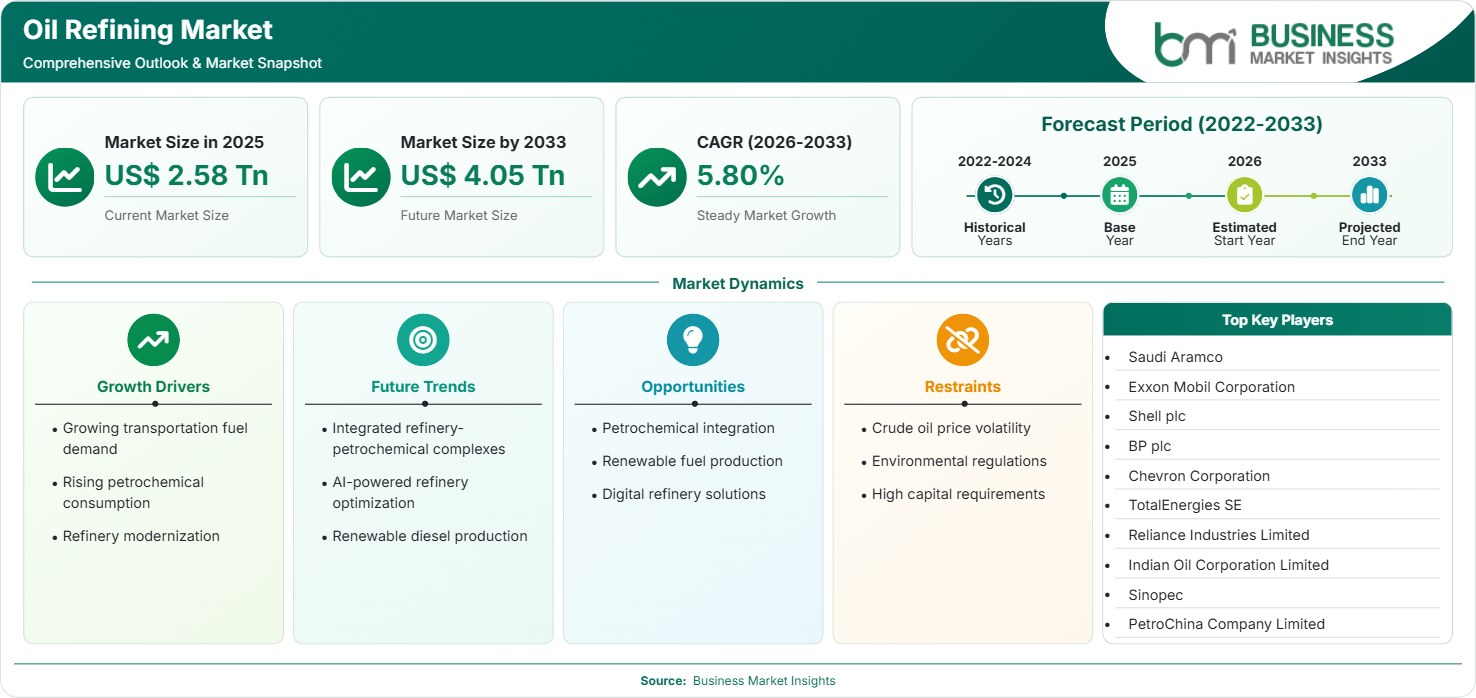
The Oil Refining Market size was valued at US$ 2.58 trillion in 2025 and is projected to reach US$ 4.05 trillion by 2033, growing at a CAGR of 5.80% during 2026–2033, driven by rising transportation fuel consumption, increasing petrochemical demand, refinery modernization initiatives, and investments in cleaner fuel production technologies.

Report Coverage
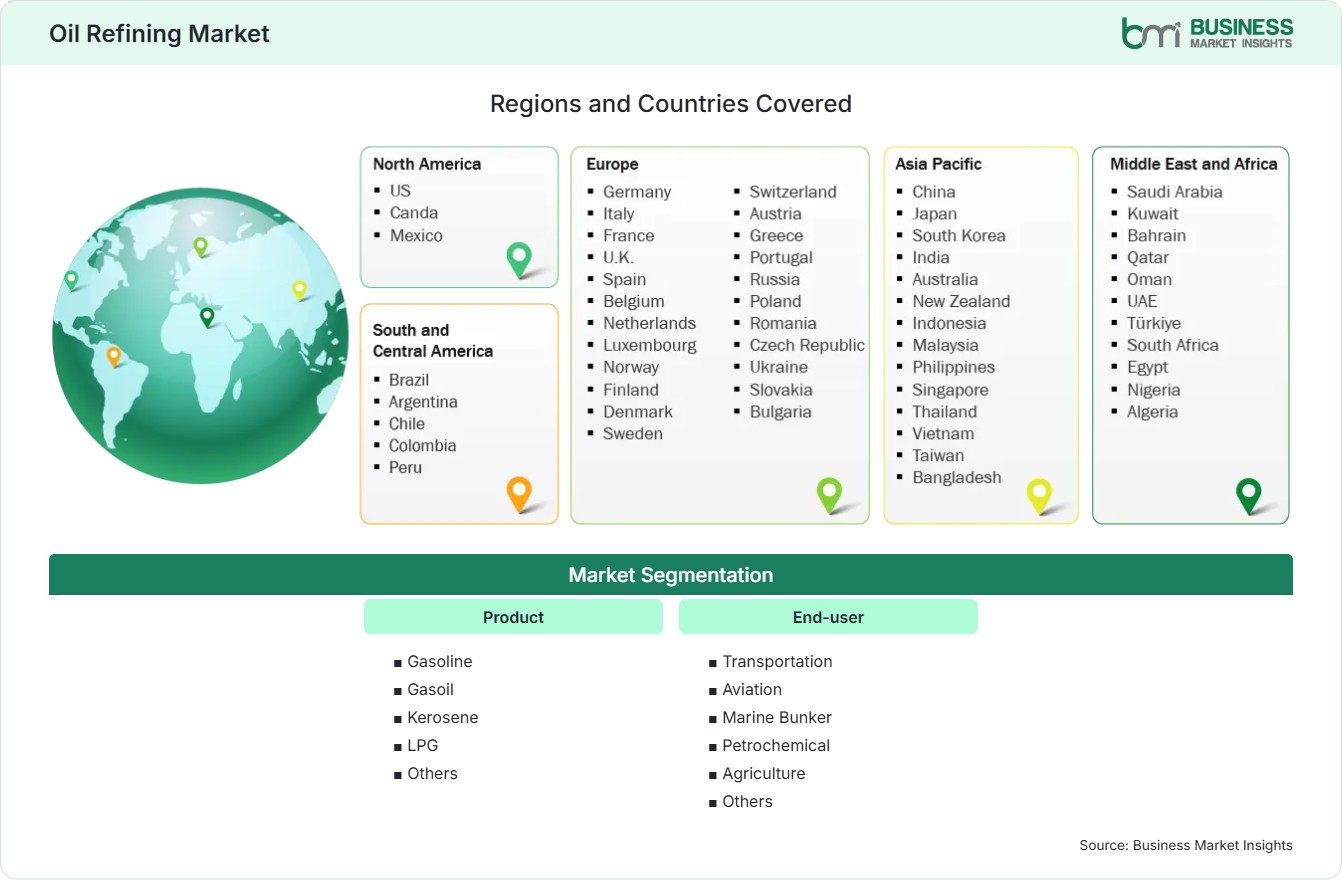
  • Product: Gasoline, Gasoil, Kerosene, LPG, Others
  • End-user: Transportation, Aviation, Marine Bunker, Petrochemical, Agriculture, Others
US$ 2.58 Tn Market size in 2025
US$ 4.05 Tn Market Size by 2033
5.80% CAGR, 2026 - 2033
2026-2033 Forecast Period

AI Overview

Oil Refining Market Summary

  • North America Region: North America accounts for an estimated 24%–27% share in 2025 and is projected to grow at a CAGR of 4.8%–5.3% during 2026–2033. Refinery upgrades, energy security investments, petrochemical integration, and cleaner fuel initiatives create opportunities. The U.S. market remains a major contributor with a CAGR of 4.9%–5.4%, supported by refinery optimization and advanced processing technologies.
  • Fastest Growing Region: Asia Pacific holds approximately 36%–40% share in 2025 and is expected to expand at a CAGR of 6.2%–6.8% through 2033. Rising mobility demand, industrialization, petrochemical expansion, and refinery capacity additions create significant growth opportunities across emerging economies.
  • Leading Segment: Transportation represents around 42%–46% share in 2025 and is expected to grow at a CAGR of 5.5%–6.0%. Increasing vehicle ownership, aviation recovery, and marine fuel requirements continue supporting refined petroleum product consumption.
  • High Growth Segment: Petrochemical applications account for approximately 18%–22% share in 2025 and are projected to expand at a CAGR of 6.5%–7.0%. Growing demand for plastics, chemicals, and industrial feedstocks supports refinery-petrochemical integration.
  • Key Market Opportunity: Refinery operators can capture new opportunities through petrochemical integration, renewable fuel production, carbon reduction technologies, and digital refinery platforms improving operational efficiency.
  • Major Market Players: Saudi Aramco, Exxon Mobil Corporation, Shell plc, BP plc, Chevron Corporation, TotalEnergies SE, Reliance Industries Limited, Indian Oil Corporation Limited, Sinopec, PetroChina Company Limited.
Strategic Insights

Oil Refining Market: Strategic Insights

Oil Refining Market Strategic Framework
FREE PDF
Request your free sample
Request free sample
Stakeholder View

Key Takeaways

  • Refinery value chains are becoming increasingly integrated, with operators combining crude processing, petrochemical production, renewable fuel manufacturing, and specialty product development to improve margins.
  • Petrochemical-linked refining assets represent attractive growth opportunities as demand for plastics, chemicals, and industrial materials continues expanding across developing economies.
  • Digital transformation is reshaping refinery operations through predictive maintenance, process automation, artificial intelligence, and real-time production optimization systems.
  • Asia Pacific provides the strongest investment potential due to expanding transportation networks, industrialization, and continued additions of refining and petrochemical capacity.
  • Strategic partnerships and acquisitions are increasingly focused on energy transition capabilities, renewable fuels, carbon management solutions, and operational efficiency improvements.
Geographic Outlook

Oil Refining Market Regional Highlights

North America Oil Refining Market

North America represented approximately 24%–27% of the global market in 2025 and is projected to expand at a CAGR of 4.8%–5.3% during 2026–2033. The region benefits from established refining infrastructure, abundant crude supply networks, and continuous investment in refinery modernization. The Oil Refining Market share remains significant due to strong demand for transportation fuels, petrochemical feedstocks, and advanced refining technologies across the United States and Canada.

  • The United States remains the dominant regional market due to extensive refining capacity, integrated petrochemical operations, and investments in operational efficiency improvements.
  • Canada supports regional growth through crude processing capabilities, export infrastructure development, and refinery modernization programs focused on efficiency.
  • Refiners are increasingly adopting digital technologies, including predictive analytics and automated process controls, to improve reliability and reduce operating costs.
  • Renewable fuel integration is gaining attention as companies invest in lower-carbon fuels and upgraded processing systems.

US Oil Refining Market

The United States accounted for approximately 21%–23% of global revenue in 2025 and is expected to register a CAGR of 4.9%–5.4% through 2033. The country remains a critical refining hub due to its extensive processing infrastructure, strong fuel demand, and growing investments in refinery optimization. Increased focus on renewable fuel blending and petrochemical production is influencing future market strategies.

  • Major refiners continue upgrading facilities to improve efficiency, increase production flexibility, and meet evolving fuel quality standards.
  • Petrochemical integration provides additional revenue opportunities by enabling refineries to capture value from growing chemical feedstock demand.
  • Digital refinery solutions are increasingly deployed to enhance predictive maintenance, energy efficiency, and operational decision-making.

Europe Oil Refining Market

Europe held an estimated 18%–21% share in 2025 and is forecast to grow at a CAGR of 3.8%–4.5% between 2026 and 2033. The region is experiencing transformation due to stringent environmental regulations, energy transition policies, and refinery conversion projects. Germany, the Netherlands, and Italy remain important refining markets, while operators increasingly invest in renewable fuels and lower-carbon processing technologies.

  • Germany continues modernizing refinery assets through efficiency improvements, digitalization, and cleaner fuel production initiatives.
  • The Netherlands remains a strategic refining location due to port infrastructure and integration with petrochemical clusters.
  • Italy is focusing on refinery transformation projects involving renewable fuel production and emissions reduction technologies.
  • European refiners are investing in carbon management solutions to align operations with climate objectives.

Asia Pacific Oil Refining Market

Asia Pacific accounted for approximately 36%–40% of the Oil Refining Market in 2025 and is projected to achieve the fastest growth rate with a CAGR of 6.2%–6.8% through 2033. The region benefits from rising fuel consumption, industrial expansion, urbanization, and growing petrochemical demand. China, India, and Southeast Asian economies continue expanding refining capabilities to support domestic energy requirements and industrial development.

  • China remains the largest regional contributor with extensive refining capacity and strong petrochemical integration.
  • India demonstrates significant growth potential due to increasing transportation demand, refinery expansion projects, and industrial development.
  • Southeast Asian countries are investing in refinery upgrades to improve fuel security and support economic growth.
  • Regional operators increasingly focus on integrated refinery-petrochemical complexes to maximize product value.

Rest of World Oil Refining Market

The Rest of World region accounted for approximately 14%–17% of the Oil Refining Market share in 2025 and is projected to grow at a CAGR of 5.0%–5.8% during the forecast period. The Middle East, Latin America, and Africa continue investing in refining capacity, export infrastructure, and integrated energy projects. Growing domestic fuel demand and industrial development are supporting refinery expansion opportunities.

  • Saudi Arabia remains a major refining hub through large-scale integrated energy projects and petrochemical investments.
  • The United Arab Emirates continues developing advanced refining and downstream facilities supporting regional energy exports.
  • Brazil maintains demand growth through transportation fuel consumption and domestic refining modernization.
  • African markets represent long-term opportunities due to increasing energy access, infrastructure development, and industrialization.
  • Latin American refiners are focusing on operational upgrades to improve efficiency and strengthen domestic fuel supply.
Global Market Geography
FREE PDF
Request your free sample
Request free sample
Segment Analysis

Oil Refining Market Segmentation

Product

The Product segment accounted for approximately 82%–86% of the Oil Refining Market revenue in 2025 and is projected to grow at a CAGR of 5.5%–6.0% during 2026–2033. Refined petroleum products remain essential for transportation, industrial operations, power generation, and petrochemical production. Demand patterns are shifting as refiners optimize output portfolios, improve processing flexibility, and integrate cleaner fuel production technologies to address changing energy requirements.

  • Gasoline: Gasoline remains a major refined product category supported by global vehicle demand, mobility growth, and continued reliance on internal combustion engine transportation systems across emerging markets.
  • Gasoil: Gasoil demand is supported by commercial transportation, heavy-duty vehicles, industrial applications, and diesel-powered equipment requiring reliable high-energy-density fuels for operations.
  • Kerosene: Kerosene consumption is influenced by aviation fuel demand, particularly jet fuel requirements from increasing passenger traffic and commercial aviation expansion across developing economies.
  • LPG: LPG demand continues expanding due to residential energy needs, industrial applications, petrochemical feedstock requirements, and increasing adoption as a cleaner-burning fuel alternative.
  • Others: Other refined products include fuel oil, lubricants, asphalt, and specialty products supporting industrial, construction, marine, and manufacturing applications globally.

End-user

The End-user segment represented approximately 78%–82% of the total Oil Refining Market demand in 2025 and is expected to expand at a CAGR of 5.6%–6.1% through 2033. Transportation remains the largest consumption area, while petrochemical industries are becoming increasingly important contributors due to rising demand for chemical feedstocks. Refiners are adapting operations to serve diverse end-user requirements through integrated production strategies.

  • Transportation: Transportation remains the leading end-user segment due to vehicle fuel consumption, logistics expansion, aviation recovery, and increasing mobility requirements in developing economies.
  • Aviation: Aviation fuel demand continues recovering as global passenger traffic increases, creating sustained requirements for refined kerosene-based products and specialized aviation fuels.
  • Marine Bunker: Marine bunker fuel demand is supported by global shipping activity, international trade growth, and investments in compliant marine fuel solutions.
  • Petrochemical: Petrochemical applications represent a high-growth area as refineries increasingly integrate chemical production facilities to capture value from plastics, polymers, and industrial material demand.
  • Agriculture: Agricultural applications rely on refined fuels for machinery, irrigation systems, transportation equipment, and agricultural supply chain operations across major farming regions.
  • Others: Other users include industrial facilities, power generation operators, commercial businesses, and specialized sectors requiring refined petroleum products for operational activities.
Market Forces

Oil Refining Market Dynamics

Key Market Drivers

Growing Transportation Fuel Demand

Growing global mobility, transport traffic, and car ownership continue to drive efficient fuel consumption around the world. Developing countries are facing increasing demand due to urbanization, logistics network expansion, and infrastructure development. As stated in international energy assessments, transport continues to be one of the largest consumers of oil globally. The continued need for reliable energy sources supports Oil Refining Market growth as refiners optimize capacity utilization and expand production capabilities. Aviation activity and shipping demands, as well as cargo transport needs, will continue to increase demand for gasoline, gasoil, and aviation fuel products. More emphasis is being placed by refinery managers on efficiency and flexibility in order to address changing needs of transportation fuels.

Rising Petrochemical Consumption

Growing demand for plastics, synthetic materials, chemicals, and industrial products is increasing the importance of refinery-petrochemical integration. Petrochemical feedstocks derived from refining processes provide essential inputs for manufacturing industries, consumer products, packaging materials, and infrastructure applications. The developing economies have registered high growth rates in the use of chemicals because of industrialization and urbanization, among other factors. The integrated refinery plants help the company increase its products' value by changing its focus from conventional fuel production to chemicals. This Oil Refining Market trend is encouraging investments in advanced processing units, downstream integration, and capacity expansion projects. Increasing petrochemical consumption is expected to remain a key factor shaping refinery strategies and investment decisions globally.

Refinery Modernization and Operational Upgrades

Refinery modernization is becoming a strategic priority as operators seek improved efficiency, higher reliability, and compliance with evolving fuel standards. Aging infrastructure requires upgrades involving process optimization, automation systems, emissions reduction technologies, and advanced control systems. Efficiencies have been enhanced through improvements in digital monitoring, predictive maintenance, and AI. The refineries have shifted their attention to technology innovation that will help them in processing a wide range of crude oil types and generate more value products. Modernization efforts help enhance competitiveness through improved margin, lower energy consumption, and greater adaptability to changing market dynamics. This becomes even more important in light of the energy transition efforts.

Key Market Opportunities

Expansion of Petrochemical Integration

Increasing integration between refining and petrochemical operations presents significant opportunities for companies seeking higher-value product portfolios. Integrated complexes allow refiners to utilize crude oil derivatives more efficiently while capturing additional revenue from chemical production. Increasing needs for polymers, specialty chemicals, and industrial products are prompting companies to build downstream plants. New technologies in refinery operations are making it possible to produce transportation fuels as well as petrochemical feedstock from the same plant. The advantage here is that it offers protection against changes in fuel demands and provides room for optimizing margins. Integration of refinery and petrochemical plants is attractive in emerging economies with growing industries.

Growth in Renewable Fuel Production

The move towards less carbon-intensive energy sources is opening up avenues for refinery companies to diversify their operations by generating renewable fuels. Some of the strategies that refineries are adopting include biofuels, sustainable aviation fuels, renewable diesel, and waste-derived fuels. These are being undertaken to help meet environmental targets and take advantage of the refinery company’s current infrastructure. The refining company’s existing resources can be re-purposed with the use of processing facilities, blending facilities, and feedstock systems. These initiatives enable traditional refiners to participate in energy transition markets while maintaining downstream expertise and operational capabilities, supporting the Oil Refining Market Forecasts.

Adoption of Digital Refinery Solutions

With digital technologies, refinery operators can benefit from increased efficiency, reduced costs, and improved decision-making. The use of artificial intelligence, machine learning, automation, and industrial analytics provides means for real-time monitoring of refining processes. Predictive maintenance solutions allow for the avoidance of failures in machinery operation. In turn, process optimization increases production and energy efficiency. Environmental and regulatory monitoring is made possible with digital refinery platforms. In an environment of increasing competition and declining margins, companies implement connected refinery ecosystems to increase productivity. The mentioned technologies offer means for upgrading existing infrastructures without the need for a full-fledged infrastructure change.

Market Restraints and Challenges

Crude Oil Price Volatility

Factor: Fluctuating crude oil prices caused by geopolitical events, supply-demand imbalances, production decisions, and global economic uncertainty create challenges for refinery profitability.

Impact: Price volatility affects refining margins, inventory valuation, operational planning, and investment decisions. Refiners must continuously adjust procurement strategies and production levels to maintain competitiveness. Sudden changes in crude availability or pricing can reduce profitability and increase financial uncertainty, particularly for operators with limited feedstock flexibility or exposure to specific crude grades.

Increasing Environmental Regulations

Factor: Stricter emissions standards, carbon reduction policies, and environmental regulations are increasing compliance requirements across refining operations.

Impact: Refiners face higher capital expenditures for emissions control systems, cleaner fuel production technologies, carbon management solutions, and operational upgrades. Regulatory pressure can increase operating costs and influence long-term investment strategies. Companies must balance environmental compliance with maintaining competitive fuel production, requiring continuous innovation and modernization of existing refinery assets.

Company Analysis

Competitive Landscape

The competitive environment is shaped by refinery capacity expansion, downstream integration, operational efficiency improvements, and investments in energy transition technologies. The Oil Refining Market analysis highlights how leading energy companies are strengthening their positions through integrated refining-petrochemical complexes, digital refinery solutions, renewable fuel initiatives, and modernization of existing processing assets.

Company Name

Overview

Products and Services relevant to this market

Saudi Aramco

One of the world's largest integrated energy companies with extensive upstream and downstream operations.

Crude refining, gasoline, diesel, aviation fuels, petrochemical feedstocks, integrated refinery complexes, and downstream energy solutions.

Exxon Mobil Corporation

Global energy company operating advanced refining and chemical production facilities worldwide.

Petroleum refining, transportation fuels, lubricants, petrochemical products, refinery technology, and integrated energy services.

Shell plc

International energy company with significant refining, trading, and downstream infrastructure.

Refined fuels, aviation fuel, marine fuels, lubricants, petrochemical feedstocks, and refinery optimization solutions.

BP plc

Global energy company focused on refining, fuel production, and lower-carbon energy transition initiatives.

Gasoline, diesel, aviation fuels, renewable fuels, refining operations, and energy transition technologies.

Chevron Corporation

Integrated energy company with refining operations and downstream fuel distribution networks.

Refined petroleum products, transportation fuels, lubricants, petrochemical products, and refinery services.

TotalEnergies SE

Multinational energy company with refining, petrochemical, and renewable energy operations.

Petroleum refining, specialty products, aviation fuels, petrochemical feedstocks, and renewable fuel solutions.

Reliance Industries Limited

Indian conglomerate operating one of the world's largest integrated refining complexes.

Crude oil refining, gasoline, diesel, petrochemical products, fuel exports, and integrated downstream solutions.

Indian Oil Corporation Limited

India's largest petroleum refining and marketing company with extensive domestic infrastructure.

Refined fuels, LPG, aviation fuel, lubricants, refinery operations, and petroleum distribution services.

Sinopec

Chinese energy company with major refining and petrochemical production capabilities.

Gasoline, diesel, petrochemicals, refining services, chemical feedstocks, and integrated energy solutions.

PetroChina Company Limited

Chinese integrated energy company operating large-scale refining and downstream assets.

Petroleum refining, transportation fuels, petrochemical products, lubricants, and downstream energy services.

Industry Activity

Recent Developments

July 2026

HPCL Rajasthan Refinery Limited (HRRL) commissioned India's first greenfield integrated refinery and petrochemical complex in over a decade at Pachpadra, Rajasthan. The refinery is designed to process 9 MMTPA of crude oil and produce BS-VI-compliant fuels along with petrochemical feedstocks, strengthening India's domestic refining capacity and energy security.

July 2026

Indian Oil Corporation announced plans to increase its annual refining capacity to 98.05 million metric tonnes by December 2026. The ₹75,000 crore expansion aims to boost export volumes after satisfying domestic demand.

June 2026

Essar Energy Transition Fuels completed a $500 million crude sourcing and product supply facility agreement with International Resources Holding (IRH) Global Trading for the Stanlow refinery in the UK. The deal strengthens stock supply, diversifies crude sourcing options, expands market access for refined products, and optimizes working capital arrangements for one of the UK's largest refining complexes.

March 2026

Klesch Group entered into a definitive agreement to acquire bp's Gelsenkirchen Refinery Business in Germany, one of Europe's largest integrated refining and petrochemical complexes with a crude throughput capacity of 265,000 barrels per day and the second-largest ethylene producer in Germany. The transaction, expected to close in Q2–Q3 2026, significantly expands Klesch's European refining platform.

Trust & Transparency

Research Methodology

The market analysis combines proprietary research with secondary data from government agencies, company disclosures, regulatory filings, industry databases and expert interviews. Market estimates are validated through data triangulation, cross-market benchmarking and analyst review.

View Full Research Methodology

Questions Answered

Frequently Asked Questions

What does the Oil Refining Market Report cover?

The report analyzes market size, segmentation, regional performance, competitive landscape, industry trends, growth drivers, opportunities, challenges, and strategic developments influencing the market through 2033.

How are refiners adapting to energy transition trends?

Refiners are investing in renewable fuels, carbon reduction technologies, digital solutions, efficiency improvements, and integrated petrochemical operations to diversify revenue streams.

Which region has the highest growth potential?

Asia Pacific offers the strongest growth outlook due to industrialization, rising energy consumption, expanding refinery capacity, and increasing petrochemical production investments.

Which product segment dominates the refining industry?

Transportation fuels, including gasoline and gasoil, represent the largest product demand category due to continued global mobility requirements and commercial transportation growth.

What factors are driving the Oil Refining Market growth?

The market is primarily driven by increasing transportation fuel demand, rising petrochemical consumption, refinery modernization programs, industrial expansion, and investments in advanced processing technologies.

Access the Full Oil Refining Market Report

Get segment-level forecasts, regional estimates, competitive benchmarking, company profiles and downloadable Excel datasets.

Access the full Oil Refining Market Report
350 pages PDF & Excel | 2026-08-04