
Oil Storage Terminal Market Outlook: Size, Share, Trends, Growth Analysis, Competitive Landscape & Forecast, 2026-2033

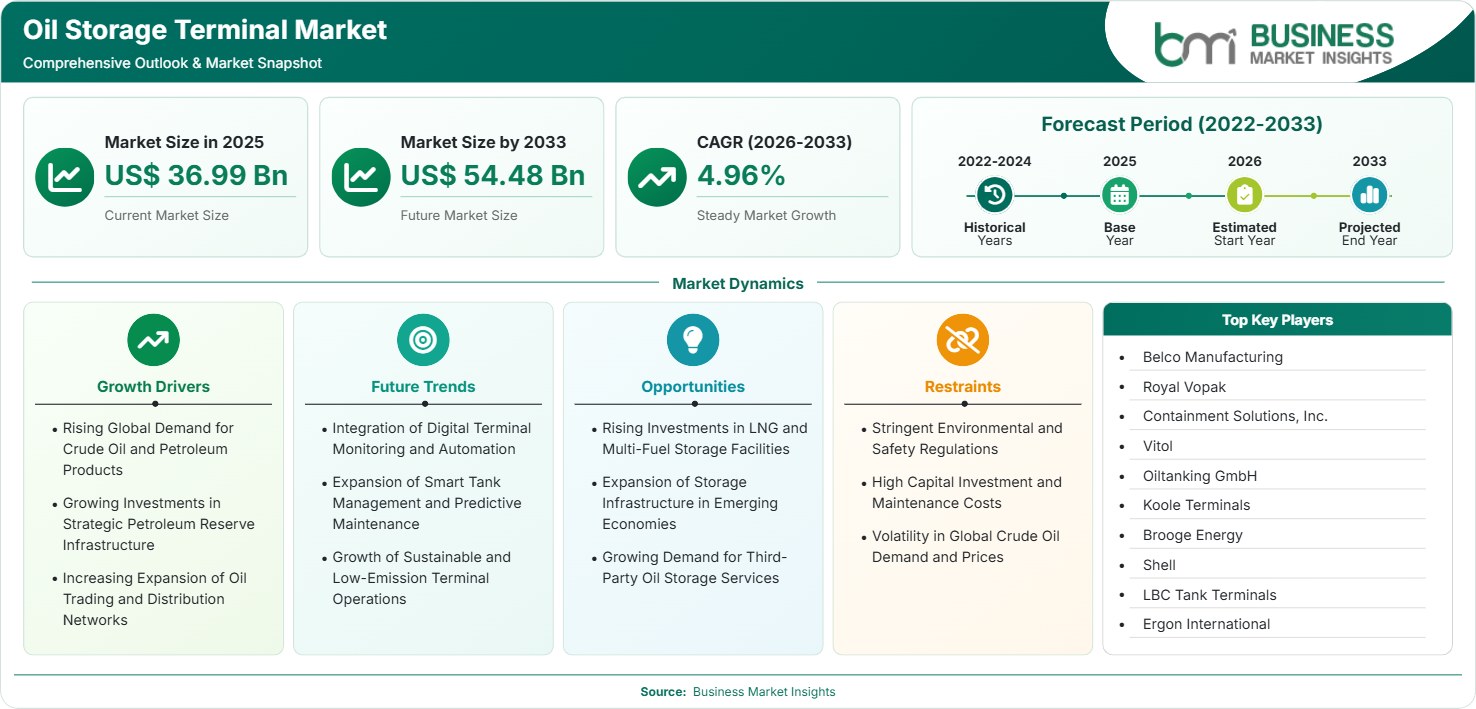
The Oil Storage Terminal Market size was valued at US$ 36.99 Billion in 2025 and is projected to reach US$ 54.48 Billion by 2033, growing at a CAGR of 4.96% during 2026–2033. Rising global energy demand, increasing strategic petroleum reserve investments, expanding international oil trade activities, and growing requirements for fuel storage infrastructure are supporting market growth globally.

Report Coverage
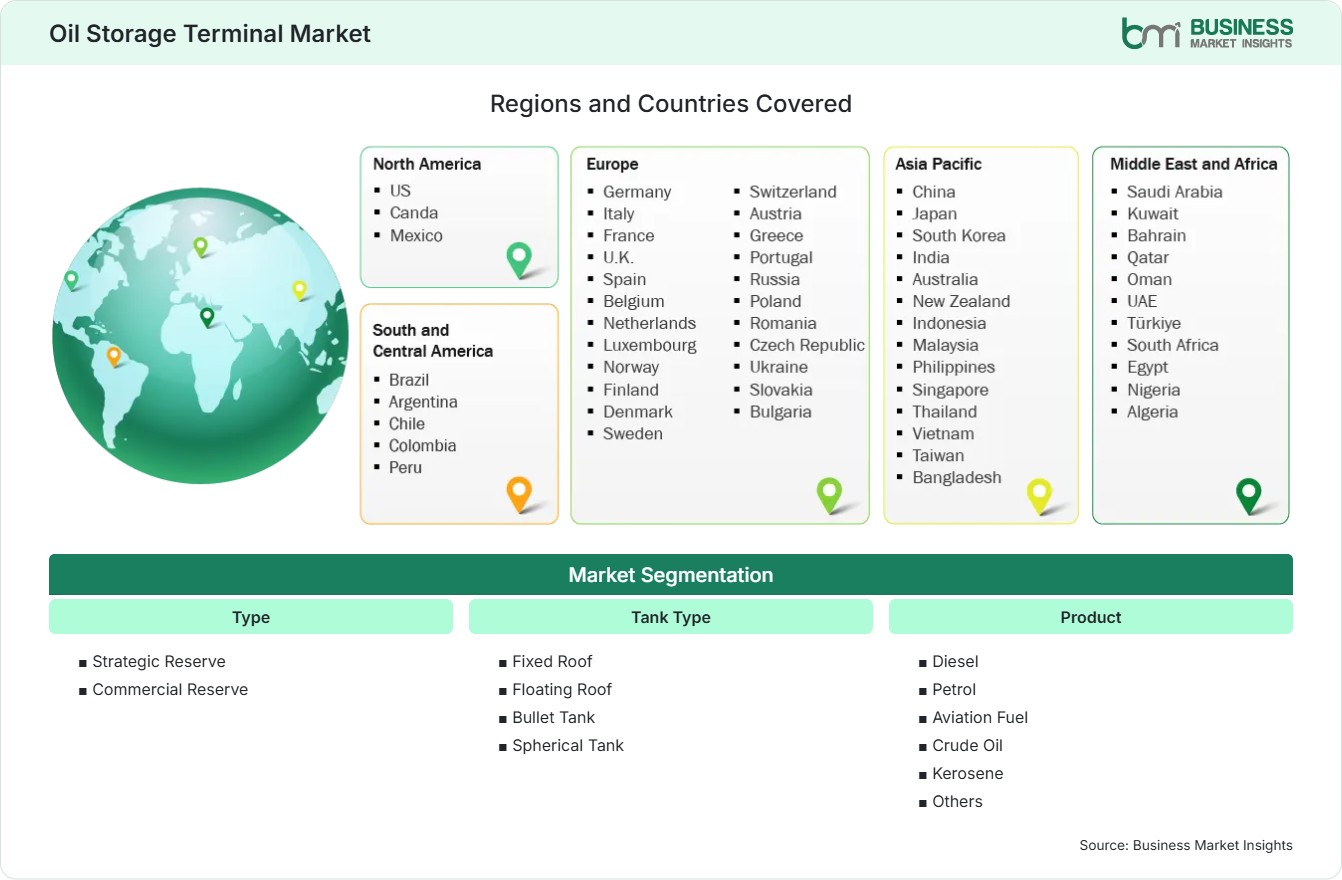
  • Type: Strategic Reserve, Commercial Reserve
  • Tank Type: Fixed Roof, Floating Roof, Bullet Tank, Spherical Tank
  • Product: Diesel, Petrol, Aviation Fuel, Crude Oil, Kerosene, Others
US$ 36.99 Bn Market size in 2025
US$ 54.48 Bn Market Size by 2033
4.96% CAGR, 2026 - 2033
2026-2033 Forecast Period

AI Overview

Oil Storage Terminal Market Summary

  • North America Region: North America holds a oil storage terminal market share of 36%–39% in 2025, growing with a CAGR of 4.5%–5.2% during 2026–2033. Strong crude oil production, extensive midstream infrastructure, and increasing investments in storage modernization continue supporting regional leadership. The U.S. market is expected to register a CAGR of 4.7%–5.4%.
  • Fastest Growing Region: Asia Pacific accounts for 27%–30% share in 2025 and is projected to grow at a CAGR of 5.5%–6.2% through 2033. Rising energy consumption, expanding refinery capacity, increasing crude oil imports, and growing strategic reserve projects continue driving regional growth.
  • Leading Segment: Commercial Reserve represents 58%–61% share in 2025 and is expected to grow at a CAGR of 5.0%–5.7% through 2033. Rising demand for fuel trading, inventory management, and supply chain optimization continues supporting segment dominance.
  • High Growth Segment: Crude Oil accounts for 34%–37% share in 2025 and is forecast to grow at a CAGR of 5.4%–6.1% during 2026–2033. Growing international crude trade movements and expanding strategic storage capacities continue accelerating segment growth.
  • Key Market Opportunity: Expansion of strategic petroleum reserves, energy security initiatives, and modernization of storage infrastructure is creating significant growth opportunities.
  • Major Market Players: Belco Manufacturing, Royal Vopak, Containment Solutions, Inc., Vitol, Oiltanking GmbH, Koole Terminals, Brooge Energy, Shell, LBC Tank Terminals, and Ergon International.
Strategic Insights

Oil Storage Terminal Market: Strategic Insights

Oil Storage Terminal Market Strategic Framework
FREE PDF
Request your free sample
Request free sample
Stakeholder View

Key Takeaways

  • Oil storage terminals remain essential infrastructure for managing global crude oil and refined fuel supply chains.
  • Commercial reserves continue dominating the oil storage terminal market due to growing trading activities and inventory management requirements.
  • Crude oil remains the leading product category supported by increasing production and global trade flows.
  • Governments continue investing in strategic petroleum reserves to strengthen national energy security.
  • Digitalization and terminal automation are improving operational efficiency and safety performance.
  • North America remains the leading market due to extensive oil production and storage infrastructure.
  • Asia Pacific is projected to witness the fastest growth owing to higher energy demand and import dependency.
  • Terminal modernization and expansion projects are expected to create long-term growth opportunities.
Geographic Outlook

Oil Storage Terminal Market Regional Highlights

North America Oil Storage Terminal Market

North America accounts for 36%–39% Oil Storage Terminal Market share in 2025 and is projected to grow at a CAGR of 4.5%–5.2% through 2033. Strong crude oil production, extensive pipeline networks, and well-established refining operations continue supporting regional leadership. The region benefits from significant commercial storage activity and ongoing investments in storage optimization and terminal modernization projects.

  • Oil producers and midstream operators continue expanding storage capacity to improve inventory management efficiency, enhance supply chain flexibility, and support fluctuating production volumes across major oil-producing regions.
  • Growing crude oil and refined product export volumes are encouraging investments in terminal infrastructure capable of handling larger cargo movements while improving operational reliability and throughput performance.
  • Strategic petroleum reserve programs remain an important driver of storage demand as governments prioritize energy security measures and strengthen preparedness against potential supply disruptions.
  • Terminal owners are increasingly deploying digital monitoring systems, automation technologies, and predictive maintenance solutions to improve asset utilization and reduce operational downtime.
  • Rising fuel demand from industrial, transportation, and commercial sectors continues supporting stable utilization levels across both commercial and strategic storage facilities.
  • Ongoing infrastructure modernization projects are helping operators improve environmental compliance, enhance safety standards, and increase storage efficiency.

US Oil Storage Terminal Market

The United States contributes approximately 85%–89% of North American revenue and is expected to register a CAGR of 4.7%–5.4% through 2033. Strong domestic oil production, active export markets, and extensive storage infrastructure continue supporting oil storage terminal market leadership.

  • Major terminal operators continue investing in storage expansion projects to support increasing crude oil exports and strengthen domestic fuel distribution capabilities.
  • Refining companies are utilizing storage assets more strategically to optimize procurement activities, balance inventories, and improve supply chain responsiveness.
  • Digital transformation initiatives are improving real-time inventory visibility, operational planning, and asset management across large storage networks.
  • Growing trade activity continues supporting demand for strategically located terminals near ports, refining centers, and transportation hubs.
  • Infrastructure maintenance and modernization investments remain essential for ensuring long-term operational reliability and compliance.

Europe Oil Storage Terminal Market

Europe represents 24%–27% of global revenue in 2025 and is anticipated to expand at a CAGR of 4.8%–5.5% through 2033. Strong energy trading activities, strategic storage requirements, and extensive import infrastructure continue supporting regional growth. The Netherlands remains the leading market while Poland demonstrates stronger growth momentum.

  • The Netherlands continues leading regional demand through its position as a major energy trading and storage hub serving both regional and international petroleum markets.
  • Poland is among the fastest-growing markets and is estimated to register a CAGR of 5.7%–6.4% during the forecast period due to expanding storage infrastructure and energy security investments.
  • Energy security concerns are encouraging governments and private operators to expand reserve capacity and improve supply resilience.
  • Terminal operators are implementing advanced monitoring technologies and automation systems to improve operational efficiency and asset utilization.
  • Continued refinery operations and fuel distribution activities remain important contributors to storage infrastructure demand across the region.
  • Investments in multi-product and flexible storage terminals are helping operators diversify services and improve revenue opportunities.

Asia Pacific Oil Storage Terminal Market

Asia Pacific accounts for 27%–30% of global revenue in 2025 and is expected to achieve the fastest CAGR of 5.5%–6.2% through 2033. Rising energy consumption, expanding refinery capacity, increasing crude oil imports, and growing strategic reserve projects continue supporting strong regional growth.

  • China remains the largest regional oil storage terminal market due to extensive crude oil imports, refinery expansion programs, and significant investments in storage infrastructure development.
  • India is projected to achieve approximately 6.2%–6.9% CAGR, supported by rising fuel demand, strategic petroleum reserve projects, and continued growth in refining capacity.
  • Governments across the region continue prioritizing energy security through investments in strategic storage facilities designed to protect against supply disruptions.
  • Rapid industrialization, urbanization, and transportation sector expansion are increasing long-term demand for petroleum storage and distribution infrastructure.
  • Growth in seaborne crude oil trade is encouraging development of port-based storage terminals capable of handling larger cargo volumes and improving logistics efficiency.
  • Energy companies are investing in advanced storage technologies to improve safety performance, operational efficiency, and inventory management capabilities.

Rest of World Oil Storage Terminal Market

Rest of World accounts for 8%–11% of global revenue in 2025 and is projected to expand at a CAGR of 4.7%–5.4% through 2033. Increasing energy trade activity, growing refining investments, and expanding fuel distribution networks continue supporting oil storage terminal market growth across developing regions.

  • Brazil continues generating demand through expanding oil production activities and ongoing investments in downstream and storage infrastructure development.
  • The UAE is strengthening its position as a global energy trading hub through terminal expansion projects and additional storage capacity development initiatives.
  • Saudi Arabia is expected to achieve approximately 5.5%–6.2% CAGR through 2033, supported by export infrastructure investments, energy sector diversification, and storage modernization programs.
  • National energy security initiatives are encouraging governments to increase strategic reserve capacity and improve domestic storage capabilities.
  • Growing regional fuel consumption is creating sustained demand for efficient storage, transportation, and distribution infrastructure across emerging economies.
  • Terminal modernization programs are helping operators improve operational efficiency, environmental performance, and long-term asset reliability.
Global Market Geography
FREE PDF
Request your free sample
Request free sample
Segment Analysis

Oil Storage Terminal Market Segmentation

Type

The type segment represents the primary storage purpose within the oil storage terminal industry, encompassing facilities designed for both energy security and commercial trading activities. The segment accounts for approximately 58%–61% share in 2025 and is projected to grow at a CAGR of 5.0%–5.7% through 2033. The expanding Oil Storage Terminal Market scope is supported by increasing crude oil consumption, rising global energy trade, growing investments in petroleum infrastructure, and the need for efficient inventory management across fuel supply chains.

  • Strategic Reserve: Strategic reserves play a critical role in ensuring national energy security by maintaining emergency oil inventories that can be utilized during supply disruptions, geopolitical conflicts, natural disasters, or unexpected demand fluctuations.
  • Commercial Reserve: Commercial reserves dominate the market due to growing petroleum trading activities, increasing refinery operations, and rising demand for inventory optimization among oil producers, traders, and distributors. These facilities provide operational flexibility and support efficient supply chain management.

Tank Type

Tank type selection significantly influences storage efficiency, safety performance, environmental compliance, and operational costs across oil terminal facilities. This segment accounts for approximately 39%–42% share in 2025 and is expected to register a CAGR of 5.2%–5.9% through 2033. Current Oil Storage Terminal Market trends indicate increasing investments in advanced storage technologies capable of improving operational safety and minimizing product losses.

  • Fixed Roof: Fixed roof tanks remain widely utilized for storing petroleum products with relatively low volatility. Their cost-effectiveness and simple construction continue supporting widespread adoption.
  • Floating Roof: Floating roof tanks represent a major segment due to their ability to reduce evaporative losses and improve environmental performance when storing crude oil and volatile petroleum products.
  • Bullet Tank: Bullet tanks are commonly utilized for pressurized products and specialty fuel storage applications where operational security and containment efficiency are critical requirements.
  • Spherical Tank: Spherical tanks are primarily deployed for storing pressurized gases and high-value petroleum products due to their superior pressure-handling capabilities and structural efficiency.

Product

The product segment reflects the diverse range of petroleum commodities handled through oil storage terminal infrastructure worldwide. This segment accounts for approximately 34%–37% share in 2025 and is projected to grow at a CAGR of 5.4%–6.1% through 2033.

  • Diesel: Diesel remains a critical product category due to its extensive use across transportation, industrial operations, mining activities, and power generation facilities.
  • Petrol: Petrol storage demand continues to be supported by global vehicle ownership growth and extensive retail fuel distribution networks.
  • Aviation Fuel: Aviation fuel storage is witnessing increasing demand as global air travel recovery and airport infrastructure expansion continue supporting fuel consumption growth.
  • Crude Oil: Crude oil remains the leading product segment due to rising international trade volumes, growing refinery demand, and expanding strategic stockpiling activities.
  • Kerosene: Kerosene continues to serve both industrial and residential applications across various regions, creating steady storage requirements.
  • Others: Additional products include fuel oil, naphtha, liquefied petroleum gases, specialty petroleum products, and blended fuel products.
Market Forces

Oil Storage Terminal Market Dynamics

Key Market Drivers

Rising Global Demand for Crude Oil and Petroleum Products

Growing energy consumption across transportation, industrial, manufacturing, and power generation sectors continues driving demand for crude oil and petroleum products worldwide. Rapid urbanization, industrial expansion, and economic development in emerging economies are increasing fuel consumption requirements and placing greater pressure on supply chain infrastructure. Oil storage terminals play a vital role in balancing supply and demand fluctuations while supporting seamless product movement throughout global energy networks. As global fuel consumption continues expanding, terminal operators are increasing storage capacities and upgrading infrastructure to manage larger petroleum inventories efficiently. This sustained demand for petroleum products is expected to remain a major growth driver for the oil storage terminal market throughout the forecast period.

Growing Investments in Strategic Petroleum Reserve Infrastructure

Strategic petroleum reserve investments are being made by governments all around the world as a means of enhancing their energy security and ensuring that they are not vulnerable to supply shocks. The geopolitical concerns, trade challenges, and volatility of the global energy market have brought into focus the need to maintain adequate stockpiles of emergency oil. Governments are able to utilize strategic oil reserves to balance out domestic energy markets in times of shock to energy supply. Countries are developing their strategic reserves as part of their overall energy resilience strategy.

Increasing Expansion of Oil Trading and Distribution Networks

The increase in international oil trade operations is leading to the need for efficient storage and transportation systems. The energy industry, including commodity traders, refiners, and distributors, needs storage facilities that can offer flexibility and manage inventory effectively as well as be located in close proximity to key transportation networks. Petroleum storage terminals act as key centers in the global supply chain system by helping in effective transfers from pipelines, tanker systems, rail systems, and finally to the consumers.

Key Market Opportunities

Rising Investments in LNG and Multi-Fuel Storage Facilities

Energy companies are increasingly diversifying storage infrastructure to accommodate changing fuel consumption patterns and growing demand for cleaner energy alternatives. Investments in LNG terminals and multi-fuel storage facilities are enabling operators to handle a broader range of energy products while improving infrastructure utilization. These facilities provide flexibility in responding to evolving market requirements and changing energy trade dynamics. As governments and corporations pursue diversified energy strategies, demand for integrated storage infrastructure is expected to increase substantially.

Expansion of Storage Infrastructure in Emerging Economies

Emerging markets continue presenting significant opportunities for oil storage terminal operators due to rising energy consumption, expanding industrial activities, and increasing fuel import requirements. Governments across Asia, Latin America, Africa, and the Middle East are investing in storage infrastructure to enhance energy security and support economic development. Growing refinery construction, expanding transportation networks, and rising petroleum demand are encouraging development of new terminal facilities. These factors are expected to create long-term growth opportunities for industry participants.

Growing Demand for Third-Party Oil Storage Services

Oil producers, traders, and refiners are increasingly utilizing third-party storage providers to improve operational flexibility and reduce infrastructure ownership costs. Independent storage operators offer scalable solutions that allow customers to optimize inventory levels while maintaining access to strategically located terminals. This trend is becoming particularly significant in regions experiencing growth in oil trading and fuel distribution activities. Long-term Oil Storage Terminal Market Forecasts remain favorable as outsourcing trends continue expanding across the energy sector.

Market Restraints and Challenges

Stringent Environmental and Safety Regulations

Factor: Oil storage terminals are subject to strict environmental, operational, and safety regulations designed to reduce risks associated with leaks, emissions, spills, and hazardous material handling. Operators must comply with extensive permitting requirements, inspection standards, environmental monitoring obligations, and infrastructure maintenance regulations. Increasing focus on sustainability and environmental protection is further strengthening compliance requirements.

Impact: Regulatory compliance can increase operating expenses, delay project approvals, and require substantial investments in safety systems, monitoring technologies, and environmental protection measures. These factors may influence project economics and operational planning decisions across the industry.

High Capital Investment and Maintenance Costs

Factor: Oil storage terminal development requires substantial capital investment in storage tanks, pipelines, loading facilities, safety systems, automation technologies, and supporting infrastructure. In addition, ongoing inspection, maintenance, and modernization activities are necessary to ensure operational reliability and regulatory compliance. Large-scale projects often involve significant financial commitments and lengthy development timelines.

Impact: High capital requirements can create barriers for new entrants and limit expansion plans among smaller operators. Companies frequently evaluate long-term utilization rates and return-on-investment expectations before committing to new storage projects, which may slow capacity expansion in certain markets.

Company Analysis

Competitive Landscape

The Oil Storage Terminal Market analysis is characterized by competition among storage infrastructure operators, energy trading companies, terminal management providers, and integrated oil and gas companies. Market participants are focusing on terminal expansion projects, storage capacity optimization, digital terminal management systems, environmental compliance initiatives, and multi-product storage capabilities to strengthen their market positions. Rising global energy demand, increasing crude oil trade volumes, growing strategic petroleum reserve investments, and expanding fuel distribution networks continue driving infrastructure development across the industry. Companies are also investing in automation, safety enhancement technologies, and sustainable terminal operations to improve efficiency and competitiveness.

Company Name

Overview

Products and Services relevant to this market

Belco Manufacturing

Storage tank and terminal equipment provider serving petroleum and industrial markets.

Oil storage tanks, terminal systems, fuel storage solutions, tank components, and infrastructure support services.

Royal Vopak

Independent tank storage company operating large-scale energy and chemical terminal networks globally.

Oil storage terminals, petroleum product storage, logistics services, inventory management, and terminal operations.

Containment Solutions, Inc.

Storage infrastructure company specializing in containment and fuel storage systems.

Underground and aboveground storage tanks, fuel storage solutions, containment technologies, and terminal infrastructure products.

Vitol

Global energy and commodities trading company with significant storage and logistics operations.

Oil storage services, petroleum trading infrastructure, terminal operations, logistics management, and energy distribution solutions.

Oiltanking GmbH

Independent storage provider focused on energy and petroleum logistics infrastructure.

Crude oil terminals, petroleum storage services, logistics solutions, blending services, and terminal management.

Koole Terminals

Independent storage and logistics company serving energy and chemical markets.

Oil storage facilities, fuel logistics services, terminal operations, blending capabilities, and inventory management solutions.

Brooge Energy

Energy infrastructure company focused on oil storage and terminal services.

Storage terminals, crude oil handling services, fuel logistics infrastructure, and petroleum distribution solutions.

Shell

Integrated energy company with significant storage, refining, and distribution capabilities.

Oil storage facilities, petroleum logistics, fuel distribution infrastructure, terminal operations, and integrated energy services.

LBC Tank Terminals

Tank storage operator providing logistics and storage services for energy and industrial sectors.

Storage terminals, liquid bulk handling services, logistics management, and terminal infrastructure solutions.

Ergon International

Energy company operating petroleum processing, storage, and distribution facilities.

Oil storage services, fuel logistics infrastructure, terminal management, and petroleum distribution solutions.

Trust & Transparency

Research Methodology

The market analysis combines proprietary research with secondary data from government agencies, company disclosures, regulatory filings, industry databases and expert interviews. Market estimates are validated through data triangulation, cross-market benchmarking and analyst review.

View Full Research Methodology

Questions Answered

Frequently Asked Questions

How are digital technologies improving oil storage terminal operations?

Digital technologies help terminal operators improve inventory visibility, automate monitoring processes, enhance safety management, optimize asset utilization, reduce downtime, and increase overall operational efficiency.

What does this Oil Storage Terminal Market Report cover?

This report covers type analysis, tank type segmentation, product assessment, regional trends, competitive landscape evaluation, market drivers, opportunities, restraints, challenges, and future growth prospects through 2033.

Why is Crude Oil the fastest-growing product segment?

Crude Oil remains the fastest-growing segment because of rising international trade volumes, increasing refinery demand, expanding strategic stockpiling activities, and ongoing investments in energy security programs.

Which type segment dominates the market?

Commercial Reserve represents the leading segment due to increasing petroleum trading activities, inventory optimization requirements, and growing demand for operational flexibility across global energy supply chains.

What is driving growth in the market?

Rising global demand for crude oil and petroleum products, growing investments in strategic petroleum reserve infrastructure, increasing oil trading activities, and expansion of fuel distribution networks are the major factors driving market growth.

Access the Full Oil Storage Terminal Market Report

Get segment-level forecasts, regional estimates, competitive benchmarking, company profiles and downloadable Excel datasets.

Access the full Oil Storage Terminal Market Report
350 pages PDF & Excel | 2026-08-31
Similar Research

Related Market Reports