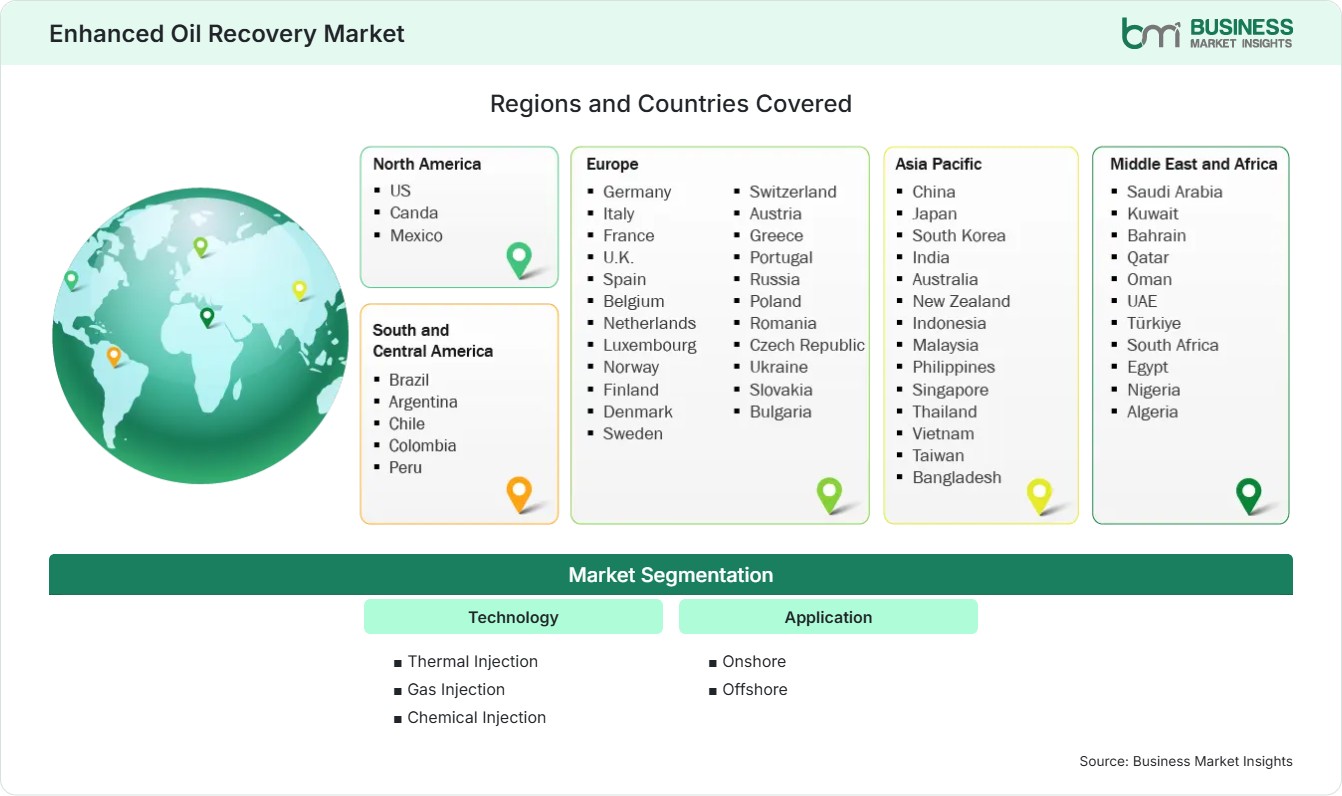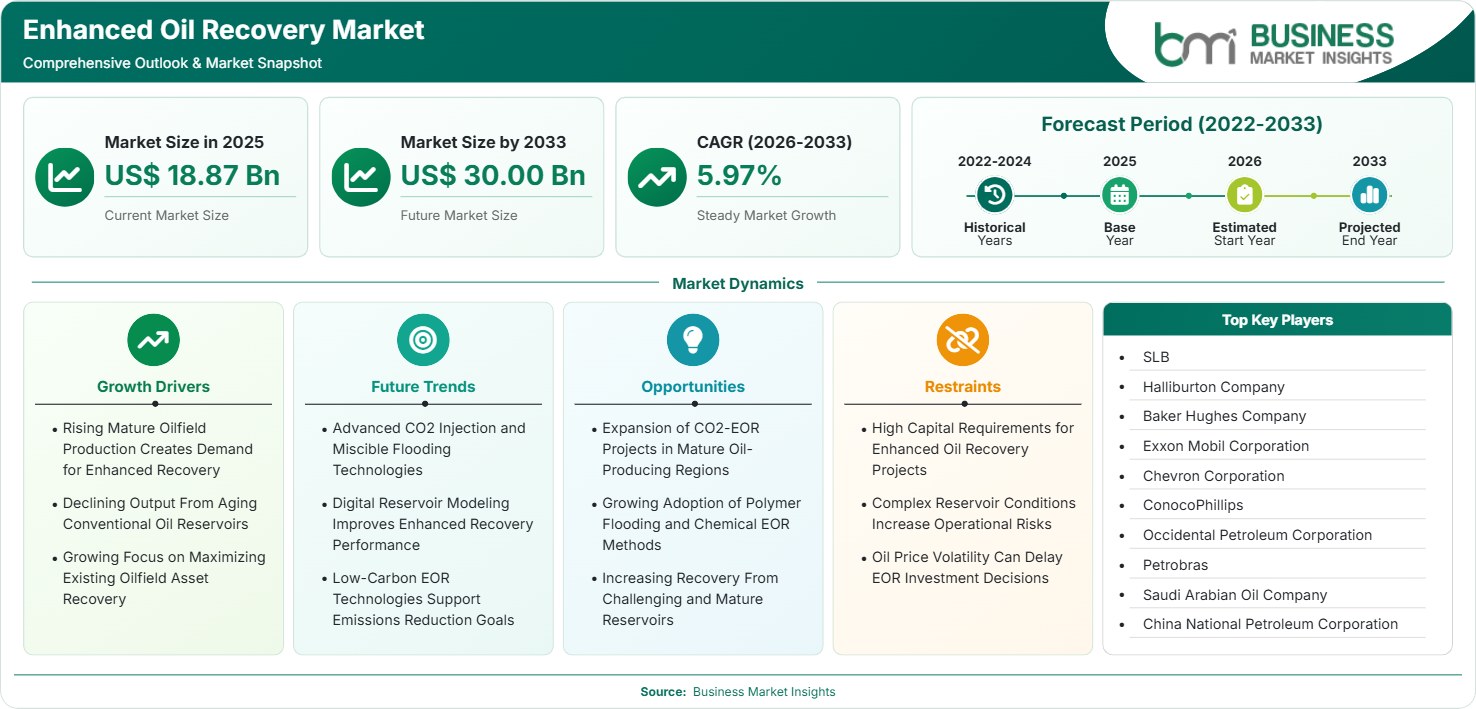
Enhanced Oil Recovery Market Regional Highlights
North America Enhanced Oil Recovery Market
North America holds a modeled 28%–32% share in 2025 and North America Enhanced Oil Recovery Market forecast to expands at a 5.5%–6.2% CAGR through 2033. The region benefits from mature conventional reservoirs, advanced oilfield services, established CO2 infrastructure, and strong reservoir engineering capabilities. The US represents the principal market, while Canada provides additional opportunities through heavy-oil and mature-field operations.
- Mature producing assets create recurring requirements for reservoir characterization, injection optimization, well intervention, production surveillance, and field redevelopment programs.
- CO2 injection remains attractive where suitable reservoirs and transportation infrastructure support economically viable gas-based recovery programs across established producing regions.
- Advanced reservoir simulation and digital workflows help operators improve injection placement, identify bypassed hydrocarbons, and optimize production from complex mature assets.
- Chemical injection provides opportunities where polymer or other formulations can improve sweep efficiency and address reservoir-specific mobility and conformance challenges.
US Enhanced Oil Recovery Market
The US Enhanced Oil Recovery Market accounts for a modeled 70%–75% share of North American demand in 2025 and expands at a 5.6%–6.3% CAGR through 2033. Mature conventional production, established oilfield infrastructure, reservoir engineering expertise, and access to recovery-enhancement technologies support adoption. Operators are increasingly evaluating incremental recovery against new drilling economics.
- Mature conventional fields support demand for recovery-enhancement programs where existing wells and infrastructure can be leveraged to improve economic returns.
- CO2 injection benefits from established technical capabilities and suitable reservoir settings, while carbon-management integration can strengthen long-term project economics.
- Digital reservoir management is improving field-level decision-making by linking subsurface interpretation, injection performance, production behavior, and intervention planning.
Europe Enhanced Oil Recovery Market
Europe Enhanced Oil Recovery Market holds a modeled 16%–20% share in 2025 and expands at a 4.6%–5.4% CAGR through 2033. The North Sea remains the leading regional opportunity, while Norway and the United Kingdom provide important mature-field applications. Norway offers comparatively stronger growth as operators continue optimizing offshore assets and extending field productivity.
- Norway remains a leading market for offshore recovery optimization, supported by established subsea capabilities, reservoir expertise, and continued focus on maximizing producing asset value.
- The United Kingdom provides mature-field opportunities where operators evaluate recovery-enhancement technologies alongside infrastructure life extension and production optimization.
- Offshore reservoir complexity increases demand for advanced simulation, injection monitoring, well intervention, and intelligent production-management capabilities.
- Environmental considerations encourage careful project screening, favoring recovery technologies that improve production efficiency while managing energy and emissions requirements.
Asia Pacific Enhanced Oil Recovery Market
Asia Pacific holds a modeled 15%–19% share in 2025 and expands at a 6.4%–7.2% CAGR through 2033, making it the fastest-growing region. China remains a leading market, while Indonesia, India, and Malaysia provide strong expansion opportunities. Mature conventional fields, offshore production, energy-security priorities, and increasing technical capabilities support adoption.
- China remains a major regional market because mature oilfields require continued recovery optimization and reservoir management to sustain established production bases.
- Indonesia provides strong Enhanced Oil Recovery Market growth potential through mature-field redevelopment, offshore production, reservoir optimization, and increased interest in integrated recovery-enhancement programs.
- India offers expanding opportunities as operators seek to improve recovery from established assets through reservoir surveillance, chemical injection, and production optimization.
- Malaysia provides offshore opportunities where advanced injection and reservoir-management technologies can support production from aging and technically complex assets.
Rest of World Enhanced Oil Recovery Market
Rest of World holds a modeled 33%–37% share in 2025 and expands at a 5.1%–5.9% CAGR through 2033. Latin America represents a major opportunity, with Brazil, Mexico, and Argentina providing established and developing production bases. Mature conventional reservoirs, offshore developments, and heavy-oil resources support demand. Regional operators increasingly seek technologies that can improve recovery while using existing infrastructure. Reservoir-specific screening remains important because field conditions vary widely across producing basins. The Middle East and Africa provide substantial opportunities through mature reservoirs, large producing assets, and strong emphasis on production optimization. Saudi Arabia and the United Arab Emirates remain leading markets, while Oman offers comparatively strong technology-driven growth.
- Brazil provides offshore opportunities through mature and complex reservoirs where advanced reservoir characterization, injection management, and production optimization can support incremental recovery.
- Mexico offers opportunities across mature producing fields as operators seek to improve recovery efficiency and extend the productive life of established assets.
- Saudi Arabia remains a leading market because large producing reservoirs support extensive reservoir-management programs and continued investment in recovery optimization.
- Oman represents a high-growth opportunity for advanced recovery technologies, particularly where challenging reservoir characteristics require thermal, chemical, or gas-based intervention strategies.