
Oil Gas Pipeline Market Outlook: Size, Share, Trends, Growth Analysis, Competitive Landscape & Forecast, 2026-2033

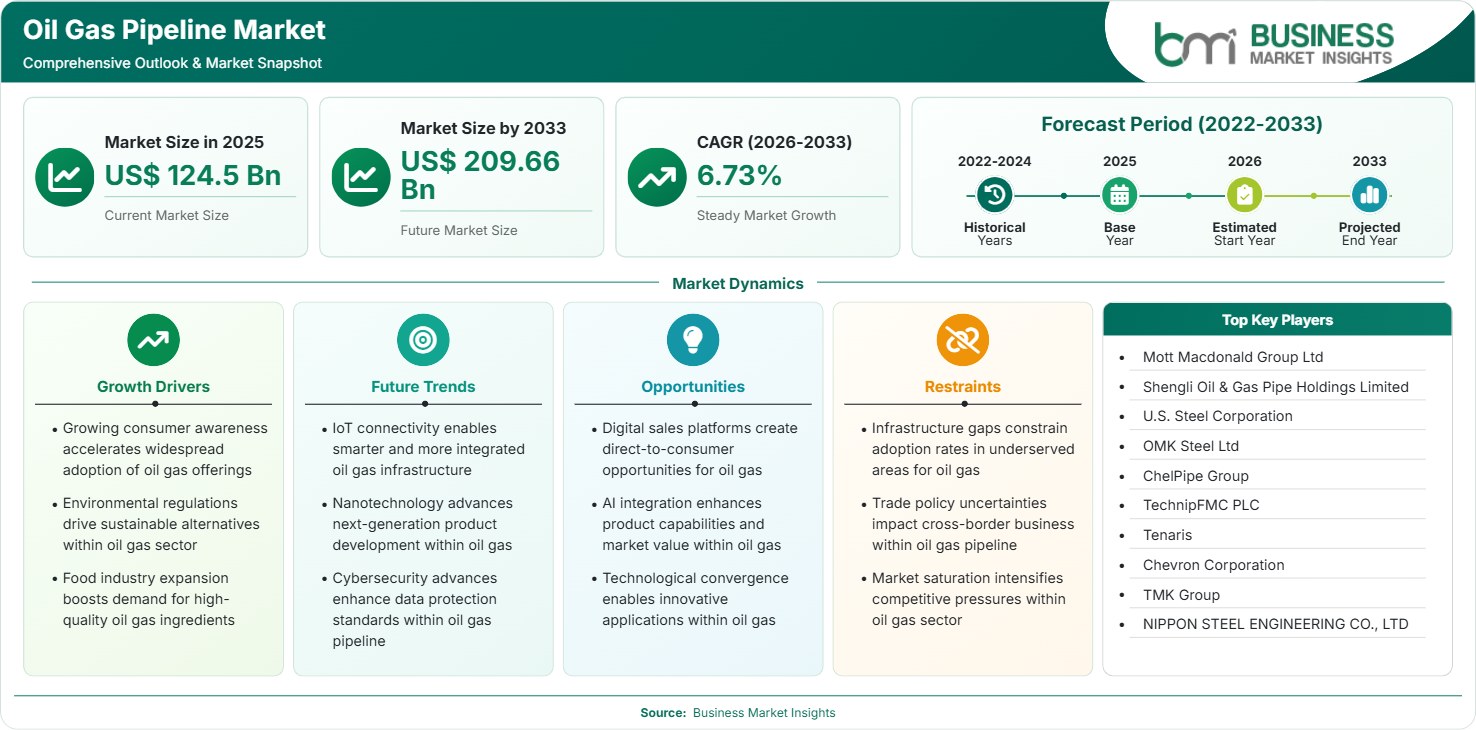
The Oil Gas Pipeline Market size was valued at US$ 124.5 Billion in 2025 and is projected to reach US$ 209.66 Billion by 2033, growing at a CAGR of 6.73% during 2026–2033. Rising investments in energy transportation infrastructure, expanding natural gas networks, digital pipeline monitoring technologies, and cross-border transmission projects continue to strengthen long-term market demand while supporting operational efficiency, supply security, and lower lifecycle operating costs.

Report Coverage
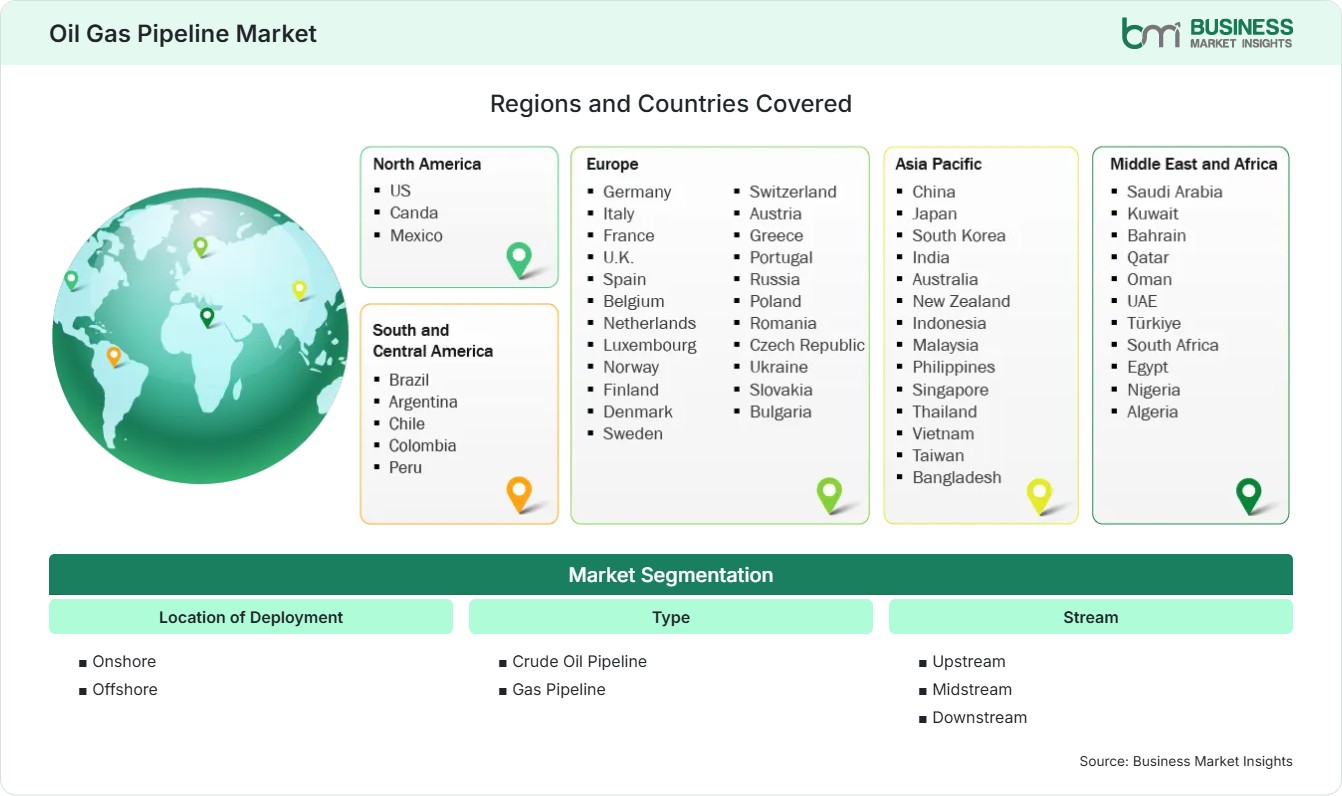
  • Location of Deployment: Onshore, Offshore
  • Type: Crude Oil Pipeline, Gas Pipeline
  • Stream: Upstream, Midstream, Downstream
US$ 124.5 Bn Market size in 2025
US$ 209.66 Bn Market Size by 2033
6.73% CAGR, 2026 - 2033
2026-2033 Forecast Period

AI Overview

Oil Gas Pipeline Market Summary

  • North America Region: North America holds 34%–37% market share in 2025, growing with a 6.1%–6.5% CAGR during 2026–2033, supported by shale production, pipeline modernization, integrity management technologies, LNG export expansion, and replacement of aging infrastructure. The U.S. benefits from strong upstream investments, interstate transmission expansion, advanced monitoring systems, and supportive energy infrastructure policies, recording an estimated 6.2%–6.6% CAGR through 2033.
  • Fastest Growing Region: Asia Pacific accounts for 28%–31% market share in 2025 while expanding at a 7.4%–7.8% CAGR through 2033, driven by industrialization, natural gas adoption, cross-border pipeline investments, energy security initiatives, urbanization, and increasing government-backed transmission infrastructure development across emerging economies.
  • Leading Segment: Onshore deployment represents 73%–76% market share in 2025 and advances at a 6.5%–6.9% CAGR, supported by extensive transmission networks, lower installation costs, expanding refining capacity, rising natural gas consumption, and continuous upgrades of aging transportation infrastructure across mature and developing markets.
  • High Growth Segment: Gas pipeline solutions account for 48%–51% market share in 2025 while registering a 7.3%–7.7% CAGR, encouraged by cleaner fuel transition strategies, LNG infrastructure growth, industrial gas demand, city gas distribution expansion, and investments in long-distance transmission corridors.
  • Key Market Opportunity: Increasing hydrogen-ready pipeline investments, digital asset management platforms, AI-enabled predictive maintenance, carbon capture transportation networks, and expanding LNG export infrastructure create long-term opportunities for engineering companies, steel manufacturers, technology providers, and energy infrastructure investors worldwide.
  • Major Market Players: Mott MacDonald Group Limited, Shengli Oil & Gas Pipe Holdings Limited, United States Steel Corporation, OMK Steel Limited, ChelPipe Group, TechnipFMC plc, Tenaris S.A., Chevron Corporation, TMK Group, Nippon Steel Engineering Co., Ltd., and NOV Inc.
Strategic Insights

Oil Gas Pipeline Market: Strategic Insights

Oil Gas Pipeline Market Strategic Framework
FREE PDF
Request your free sample
Request free sample
Stakeholder View

Key Takeaways

  • The industry value chain is becoming increasingly integrated as steel manufacturers, engineering contractors, EPC companies, inspection service providers, digital technology vendors, and energy operators collaborate to improve pipeline reliability, operational transparency, and lifecycle asset performance across upstream, midstream, and downstream activities.
  • The strongest commercial opportunities are emerging from expanding natural gas transportation infrastructure, hydrogen-compatible transmission systems, LNG connectivity projects, and modernization of aging oil transportation corridors, particularly across industrializing economies experiencing sustained energy demand growth.
  • Digital transformation continues reshaping pipeline operations through AI-assisted monitoring, satellite surveillance, fiber-optic sensing, autonomous inspection tools, predictive maintenance platforms, and cloud-based integrity management systems that significantly reduce downtime and maintenance expenditure.
  • Asia Pacific presents one of the most attractive long-term investment destinations due to industrial expansion, increasing natural gas utilization, government-supported energy infrastructure programs, and large-scale cross-border pipeline developments connecting production and consumption centers.
  • Strategic acquisitions, engineering partnerships, technology licensing agreements, and long-term infrastructure financing are accelerating industry consolidation as pipeline operators prioritize operational efficiency, regulatory compliance, and low-carbon transportation capabilities within evolving global energy systems.
  • Greater emphasis on decarbonization is encouraging investments in carbon dioxide transportation infrastructure, hydrogen-ready pipeline materials, advanced coating technologies, and intelligent monitoring systems capable of supporting future multi-energy transmission networks.
Geographic Outlook

Oil Gas Pipeline Market Regional Highlights

North America Oil Gas Pipeline Market

North America remains the largest regional market, accounting for 34%–37% Oil Gas Pipeline Market share in 2025 while advancing at a 6.1%–6.5% CAGR during 2026–2033. Strong shale oil and natural gas production across the United States and Canada continues supporting transmission infrastructure expansion. Pipeline replacement programs, integrity management investments, LNG export terminal connectivity, and digital monitoring technologies are improving operational efficiency. Regulatory oversight emphasizing safety, emissions reduction, and infrastructure modernization further strengthens long-term investment confidence across the regional pipeline ecosystem.

  • Continued shale production from the Permian Basin, Marcellus, and Bakken formations increases demand for new gathering systems, long-distance transmission lines, compressor stations, and digital asset monitoring technologies supporting higher transportation efficiency.
  • LNG export capacity expansion along the U.S. Gulf Coast stimulates investments in gas transportation corridors, creating sustained opportunities for engineering contractors, steel pipe manufacturers, inspection companies, and automation technology providers.
  • Pipeline operators increasingly deploy AI-enabled leak detection, fiber-optic sensing, intelligent pigging, and satellite-based monitoring systems that improve regulatory compliance while reducing maintenance costs and operational downtime.
  • Aging infrastructure replacement projects supported by federal and state investment programs encourage corrosion-resistant materials, advanced welding technologies, and automated inspection systems to improve long-term network reliability.
  • Carbon capture and storage initiatives increasingly require dedicated CO₂ transportation pipelines, creating additional infrastructure demand while supporting industrial decarbonization objectives across energy-intensive sectors.

US Oil Gas Pipeline Market

The United States represents approximately 78%–81% of North America's regional Oil Gas Pipeline Market while recording a 6.2%–6.6% CAGR through 2033. Expanding natural gas production, LNG export infrastructure, interstate transmission modernization, and digital integrity management systems continue strengthening pipeline investments. Large-scale energy infrastructure funding, advanced automation technologies, and increasing carbon capture projects further reinforce the country's leadership in pipeline construction, operations, and maintenance throughout the forecast period.

  • Interstate transmission modernization projects improve supply reliability between producing basins, industrial consumers, export terminals, and metropolitan demand centers while supporting growing domestic natural gas utilization.
  • Advanced SCADA platforms, drone inspections, predictive analytics, and AI-assisted maintenance solutions significantly improve operational safety, environmental monitoring, and regulatory compliance across extensive transmission networks.
  • Expansion of hydrogen pilot projects encourages operators to evaluate pipeline material compatibility, retrofit existing infrastructure, and develop future-ready transportation systems supporting low-carbon energy initiatives.
  • Investment in LNG terminals along the Gulf Coast continues driving complementary pipeline construction linking upstream production fields with export facilities serving international energy markets.

Europe Oil Gas Pipeline Market

Europe accounts for 22%–25% Oil Gas Pipeline Market share in 2025 and is expected to expand at a 5.8%–6.2% CAGR during 2026–2033. Energy diversification strategies, hydrogen infrastructure planning, pipeline modernization, and cross-border gas transmission projects support regional investment. Germany remains the leading market, while Poland demonstrates the fastest expansion with an estimated 6.5%–6.9% CAGR, supported by energy security initiatives, LNG connectivity, and strategic transmission infrastructure upgrades.

  • Hydrogen-ready transmission infrastructure receives increasing public and private investment, encouraging upgrades to existing pipeline materials, compressors, valves, and digital monitoring systems across European energy corridors.
  • Cross-border interconnection projects improve supply diversification, reducing dependence on individual energy sources while enhancing resilience through integrated regional transmission networks.
  • Germany maintains leadership through extensive industrial demand, advanced engineering capabilities, and continuous investment in modern pipeline integrity management technologies supporting energy transition objectives.
  • Poland experiences accelerated infrastructure development supported by LNG imports, strategic gas storage expansion, and diversified transmission investments enhancing long-term regional energy security.
  • Decarbonization policies continue encouraging carbon dioxide transportation infrastructure supporting carbon capture, utilization, and storage projects across industrial manufacturing clusters.

Asia Pacific Oil Gas Pipeline Market

Asia Pacific contributes 28%–31% regional Oil Gas Pipeline Market share during 2025 while registering the fastest regional expansion at a 7.4%–7.8% CAGR through 2033. Industrialization, urbanization, natural gas adoption, and government-backed infrastructure investments continue driving demand across the region. China leads overall deployment, whereas India records the fastest national expansion with a projected 7.8%–8.2% CAGR, supported by expanding city gas distribution and nationwide transmission projects.

  • China continues investing in long-distance crude oil and natural gas transmission corridors connecting inland production regions with coastal industrial and urban consumption centers.
  • India's national gas grid expansion, city gas distribution initiatives, refinery investments, and industrial development generate substantial opportunities for transmission pipeline construction and related engineering services.
  • Southeast Asian economies strengthen regional connectivity through offshore developments, LNG import facilities, and cross-border pipeline infrastructure supporting rising industrial energy consumption.
  • Increasing petrochemical investments across Asia accelerate demand for reliable feedstock transportation networks, improving supply chain efficiency and reducing logistics costs.
  • Digital pipeline management technologies, including IoT sensors, cloud analytics, and predictive maintenance platforms, become increasingly important for maximizing operational reliability across expanding regional infrastructure.

Rest of World Oil Gas Pipeline Market

The Rest of World region represents 13%–16% Oil Gas Pipeline Market share in 2025 while expanding at a 6.7%–7.1% CAGR throughout the forecast period. South & Central America benefit from offshore production developments and regional transmission investments. Meanwhile, the Middle East and Africa continue strengthening long-distance pipeline infrastructure supporting export diversification, domestic industrialization, and energy security. Brazil leads South & Central America, while Saudi Arabia and the UAE remain major Middle Eastern investment destinations.

  • Brazil expands offshore production infrastructure supported by subsea pipeline developments, refinery connectivity, and integrated transportation systems improving crude oil distribution efficiency.
  • Argentina strengthens natural gas transportation capacity through transmission expansion projects supporting industrial growth, power generation, and regional export opportunities.
  • Saudi Arabia continues investing in integrated oil and gas infrastructure supporting downstream expansion, petrochemical production, and export-oriented industrial development.
  • The United Arab Emirates accelerates digital pipeline monitoring adoption alongside hydrogen infrastructure planning, reinforcing long-term investments in advanced energy transportation systems.
  • African economies increasingly prioritize regional pipeline connectivity, enabling improved natural gas utilization, industrial diversification, and cross-border energy cooperation while attracting international infrastructure financing.
Global Market Geography
FREE PDF
Request your free sample
Request free sample
Segment Analysis

Oil Gas Pipeline Market Segmentation

Location of Deployment

Location of deployment remains the largest segmentation category, with Onshore infrastructure accounting for approximately 73%–76% of total installations in 2025 while the overall segment advances at a 6.5%–6.9% CAGR through 2033. The Oil Gas Pipeline Market scope continues expanding as governments prioritize national transmission corridors, refinery connectivity, and gas distribution infrastructure. Offshore investments also remain significant, supported by deepwater exploration, subsea production systems, and enhanced offshore engineering capabilities.

  • Onshore: Represents the dominant deployment environment because of extensive transmission corridors, easier maintenance access, comparatively lower construction costs, expanding national gas grids, and modernization of aging transportation infrastructure across industrial economies.
  • Offshore: Continues gaining strategic importance through deepwater exploration projects, subsea production systems, offshore gas processing facilities, and increasing investments supporting secure hydrocarbon transportation from offshore reserves to coastal processing terminals.

Type

The pipeline type segment reflects changing global energy demand patterns. Crude Oil Pipeline systems maintain the largest installed base with an estimated 49%–52% share in 2025, while the segment grows at 6.4%–6.8% CAGR. Rising cleaner-energy initiatives, however, continue accelerating natural gas infrastructure investments, improving the long-term outlook for diversified transmission networks across major producing and consuming regions.

  • Crude Oil Pipeline: Supports efficient transportation between production fields, storage terminals, refineries, and export facilities while minimizing logistics costs and ensuring continuous supply across integrated petroleum value chains.
  • Gas Pipeline: Experiences strong adoption due to expanding LNG infrastructure, city gas distribution networks, industrial fuel switching, cleaner energy policies, and increasing cross-border natural gas transmission investments.

Stream

The stream segment highlights investment distribution across the hydrocarbon value chain. Midstream operations command approximately 45%–48% Oil Gas Pipeline Market share in 2025 while progressing at a 6.8%–7.2% CAGR through 2033. Growing investments in transportation infrastructure, storage facilities, compression stations, digital monitoring technologies, and integrated logistics continue strengthening operational efficiency across increasingly interconnected energy markets.

  • Upstream: Pipeline infrastructure connects production wells with gathering systems, enabling efficient movement of crude oil and natural gas while supporting exploration activities and production optimization.
  • Midstream: Forms the backbone of long-distance transportation through transmission pipelines, storage facilities, compressor stations, and logistics infrastructure linking upstream production with downstream processing facilities.
  • Downstream: Pipeline networks distribute refined petroleum products and processed natural gas to industrial users, utilities, commercial customers, and export terminals, supporting reliable energy availability across end-use industries.
Market Forces

Oil Gas Pipeline Market Dynamics

Key Market Drivers

Expansion of Natural Gas Infrastructure and LNG Export Capacity

Rising demand around the world for natural gas is driving the development of natural gas pipelines and LNG connection projects. The International Energy Agency notes that natural gas will continue to be important in balancing energy security and emissions reductions in industrialized countries, where there are still policies in place for transitioning from coal to natural gas. Expansion of LNG export terminals in North America, Qatar, and Australia is increasing the requirement for reliable transportation networks connecting production fields with liquefaction facilities. Oil Gas Pipeline Market growth is further supported by government-backed gas grid expansion programs, rising industrial fuel demand, and cross-border transmission projects that improve regional energy integration while strengthening long-term infrastructure investment confidence among pipeline operators and engineering companies.

Digital Pipeline Integrity Management and Predictive Maintenance

Pipeline operators are increasingly investing in digital technologies that improve operational safety, reduce downtime, and extend infrastructure lifespan. AI-enabled analytics, fiber-optic sensing, intelligent pigging, satellite surveillance, drones, IoT-enabled sensors, and cloud-based asset management platforms provide continuous visibility into pipeline conditions. Integrity management obligations have been continuously toughened by regulatory authorities within both North America and Europe, thereby pushing towards the deployment of more advanced inspection technologies that can effectively identify corrosion, leakage, and structural problems even before any incidents happen. Through these developments, costs of maintenance are reduced while at the same time ensuring greater environmental safety.

Government Investment in Energy Security and Cross-Border Pipelines

Energy security concerns continue encouraging governments to diversify hydrocarbon transportation infrastructure through new interstate and international pipeline projects. These strategic investments in regions such as Asia Pacific, the Middle East, Europe, and Africa will be geared toward increasing energy availability but with minimal reliance on transport lines. The public-private partnership initiatives, government funding of infrastructure projects, and national energy transformation programs ensure pipeline modernization and expansions. Corridors for cross-border transmission provide for enhanced international trade, improved supply stability, and industry growth. All of these will result in continued demand for engineers, pipelines made of high tensile steel, advanced computer systems for monitoring, and other technologies that ensure long-term reliability.

Key Market Opportunities

Hydrogen-Ready Pipeline Infrastructure Development

There are many advantages offered by the shift towards clean energy systems for pipeline companies that can transport hydrogen along with natural gas. Governments in Europe, Asia-Pacific region, and North America have continued to back the hydrogen economy by offering funding and regulatory incentives for infrastructure that is compatible with hydrogen use. Engineering firms are spending in research to develop better materials compatible with hydrogen transport. Oil Gas Pipeline Market Forecasts increasingly recognize hydrogen transportation as a major future investment area because existing transmission corridors can often be upgraded rather than completely rebuilt, lowering capital expenditure while accelerating deployment of low-carbon energy infrastructure across industrial economies.

Carbon Capture, Utilization, and Storage Transportation Networks

Rapid expansion of carbon capture, utilization, and storage (CCUS) projects creates significant demand for dedicated carbon dioxide transportation pipelines. CO₂ transport networks become more and more necessary for heavy industries such as cement, chemicals, refining, and steel production. Financial incentives, reduction goals, and carbon management policies implemented by the government become conducive to the commercial feasibility of large-scale projects. Engineering companies, EPC contractors, pipeline producers, and digital monitoring providers will thus have an opportunity to get profits from investments in transportation infrastructure in the next decade.

Digital Twin Platforms and AI-Driven Asset Optimization

Emerging Oil Gas Pipeline Market Trends indicate that the growing adoption of digital twins, machine learning, and cloud-based infrastructure management platforms enables operators to optimize maintenance schedules, forecast equipment failures, and improve operational efficiency. These digital models will include live inspection data, pressure information, corrosion analysis, weather analysis, and maintenance histories within decision-making systems. This technology will cut down the occurrence of unexpected shutdowns, maintain the budget for maintenance, and ensure that the lifespan of the pipeline is prolonged. Technology companies specializing in analytics, cybersecurity, autonomous inspection, and predictive asset management are projected to be positively impacted by such investments in digital transformation.

Market Restraints and Challenges

High Capital Investment and Extended Project Approval Timelines

Factor: A pipeline entails the highest capital investment due to issues such as land costs, design engineering, environmental studies, unique construction materials, labor, and regulatory issues. Transmission pipelines often take many years before the start of construction due to issues of permit approvals and financing.

Impact: Longer timelines mean greater risks and uncertainties related to the project; expose investors to risk of rising prices (inflation); defer realization of commercial gains; and result in higher cost of capital. Price increases due to steel prices, transport, shortages of specialized labor and changes in regulations add to the difficulties in project finance.

Environmental Opposition and Regulatory Compliance Complexity

Factor: Due to rising environmental concerns, public opposition, need for biodiversity preservation, and changing climate change policies, new pipelines are facing serious regulatory hurdles. The needs for environmental impact assessments, public consultations, emission tracking, and ecosystem preservation are creating additional project-planning needs.

Impact: Approval delays, legal challenges, route changes, and increased environmental risks may lead to delay in the implementation of infrastructures and reduce their attractiveness as investments. As a result, pipeline constructors spend much money on state-of-the-art monitoring systems, safe construction processes, good communication with stakeholders, and environmental risk management.

Company Analysis

Competitive Landscape

Growing investments in digital monitoring technologies, hydrogen-ready infrastructure, and transmission modernization continue reshaping the competitive environment. The Oil Gas Pipeline Market analysis indicates that global competition increasingly focuses on engineering expertise, advanced steel technologies, integrated EPC capabilities, digital asset management, and long-term service agreements rather than only manufacturing scale.

Company Name

Overview

Products and Services relevant to this market

Mott MacDonald Group Limited

Global engineering and infrastructure consultancy delivering complex energy transmission, pipeline engineering, environmental assessment, and project management solutions across international energy markets.

Pipeline design, feasibility studies, integrity management, environmental consulting, EPC advisory, digital engineering, asset optimization, and infrastructure planning services.

Shengli Oil & Gas Pipe Holdings Limited

Major manufacturer specializing in welded steel pipes and pipeline products serving oil, gas, petrochemical, and infrastructure projects worldwide.

Spiral welded pipes, longitudinal submerged arc welded pipes, anti-corrosion coatings, transmission pipeline products, and engineering support services.

United States Steel Corporation

Leading steel producer supplying high-strength steel products supporting energy transportation and large-scale pipeline infrastructure projects.

Pipeline steel plates, tubular products, corrosion-resistant steel solutions, engineered materials, and manufacturing support for transmission infrastructure.

OMK Steel Limited

International steel manufacturer providing premium tubular products and pipeline materials for demanding oil and gas transportation applications.

Large-diameter pipes, protective coatings, welded steel products, pipeline manufacturing, and industrial steel solutions.

ChelPipe Group

Established producer of tubular products serving energy, industrial, and infrastructure sectors with advanced manufacturing capabilities.

Seamless pipes, welded pipes, OCTG products, industrial tubing, and transmission pipeline solutions.

TechnipFMC plc

Global technology and engineering company delivering offshore and onshore energy infrastructure solutions with strong subsea expertise.

EPC services, subsea pipeline engineering, offshore installation, project management, digital technologies, and integrated energy infrastructure solutions.

Tenaris S.A.

Worldwide supplier of steel pipe products supporting exploration, production, transmission, and industrial infrastructure applications.

Seamless steel pipes, welded pipes, premium connections, coating technologies, and technical support services.

Chevron Corporation

Integrated energy company investing in upstream production, pipeline infrastructure, LNG developments, and transmission projects supporting global energy supply.

Pipeline operations, crude oil transportation, natural gas infrastructure, LNG investments, and integrated energy logistics services.

TMK Group

Global manufacturer specializing in tubular products, premium steel technologies, and engineered pipeline materials for energy industries.

OCTG products, line pipes, premium threaded connections, corrosion-resistant pipe systems, and industrial steel products.

Nippon Steel Engineering Co., Ltd.

Engineering company delivering industrial facilities, pipeline construction, infrastructure engineering, and advanced energy transportation projects.

Pipeline engineering, EPC services, construction management, industrial infrastructure, maintenance solutions, and engineering consulting.

NOV Inc.

Global provider of oilfield equipment, engineering technologies, automation systems, and infrastructure solutions supporting pipeline operations.

Inspection systems, automation technologies, pipeline equipment, digital monitoring platforms, maintenance solutions, and industrial engineering services.

Trust & Transparency

Research Methodology

The market analysis combines proprietary research with secondary data from government agencies, company disclosures, regulatory filings, industry databases and expert interviews. Market estimates are validated through data triangulation, cross-market benchmarking and analyst review.

View Full Research Methodology

Questions Answered

Frequently Asked Questions

Why should organizations invest in an Oil Gas Pipeline Market Report?

A comprehensive Oil Gas Pipeline Market Report helps decision-makers evaluate investment opportunities, benchmark competitors, assess regional growth prospects, understand technology trends, analyze regulatory developments, and formulate long-term infrastructure strategies using reliable industry intelligence.

How is digital transformation improving pipeline operations?

Artificial intelligence, fiber-optic sensing, cloud analytics, satellite surveillance, intelligent pigging, digital twins, and predictive maintenance platforms enable operators to improve safety, detect leaks earlier, reduce maintenance expenditure, and maximize asset utilization throughout infrastructure lifecycles.

Which region is expected to experience the fastest expansion through 2033?

Asia Pacific is projected to remain the fastest-growing regional market due to rapid industrialization, expanding city gas distribution networks, government-supported energy infrastructure programs, increasing LNG investments, and rising demand for reliable long-distance hydrocarbon transportation systems.

Which deployment location dominates industry revenue?

Onshore deployment accounts for the largest revenue contribution because it supports extensive crude oil and natural gas transmission networks with comparatively lower construction and maintenance costs than offshore systems while providing easier inspection and expansion opportunities.

What are the primary factors driving demand for pipeline infrastructure?

Growing natural gas consumption, expanding LNG exports, modernization of aging transmission systems, increasing cross-border energy trade, digital integrity management technologies, and government investments in energy security are collectively supporting sustained demand for advanced pipeline infrastructure worldwide.

Access the Full Oil Gas Pipeline Market Report

Get segment-level forecasts, regional estimates, competitive benchmarking, company profiles and downloadable Excel datasets.

Access the full Oil Gas Pipeline Market Report
350 pages PDF & Excel | 2026-08-17