
Gas Insulated Switchgear Market Outlook: Size, Share, Trends, Growth Analysis, Competitive Landscape & Forecast, 2026-2033

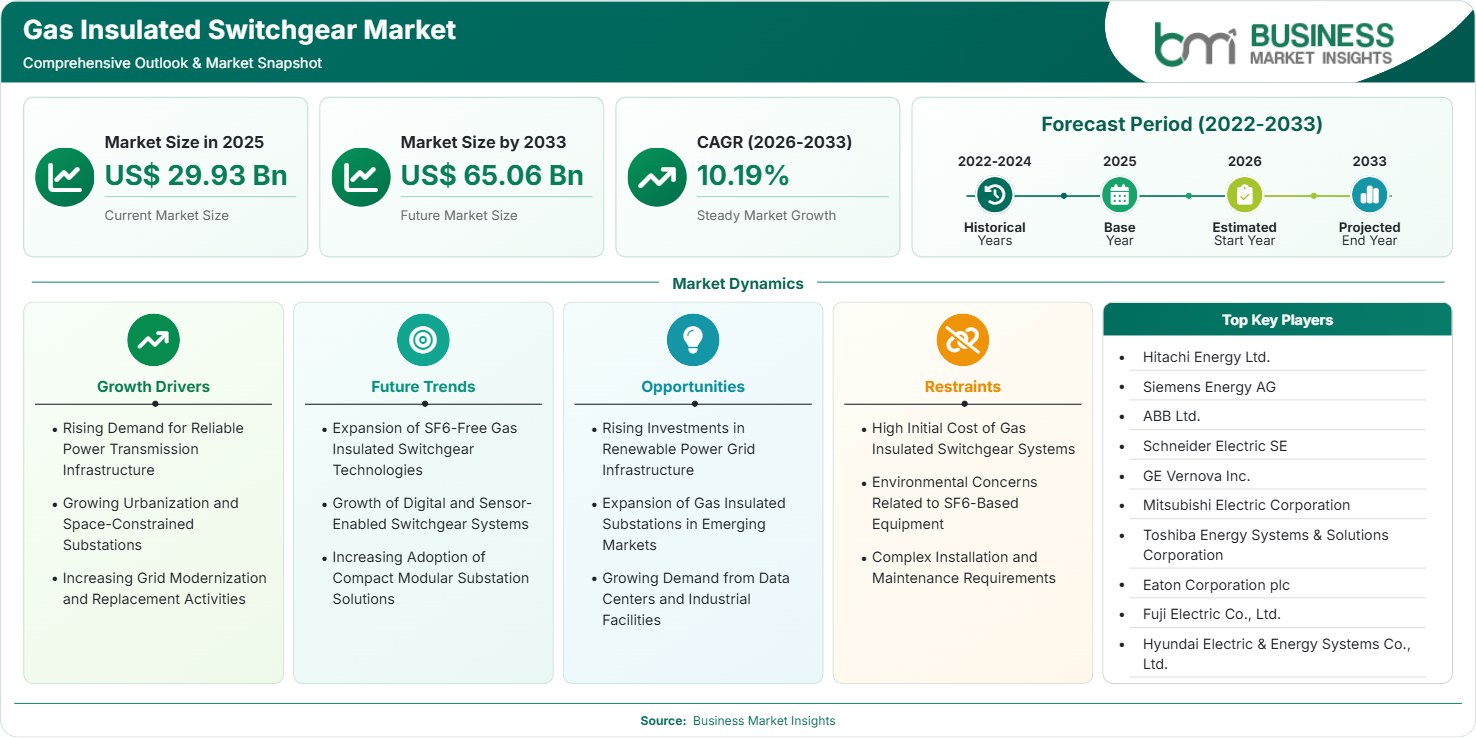
The Gas Insulated Switchgear Market size was valued at US$ 29.93 Billion in 2025 and is projected to reach US$ 65.06 Billion by 2033, growing at a CAGR of 10.19% during 2026–2033, driven by grid modernization, renewable integration, urban substations, data-center electrification, and demand for compact high-voltage infrastructure.

Report Coverage
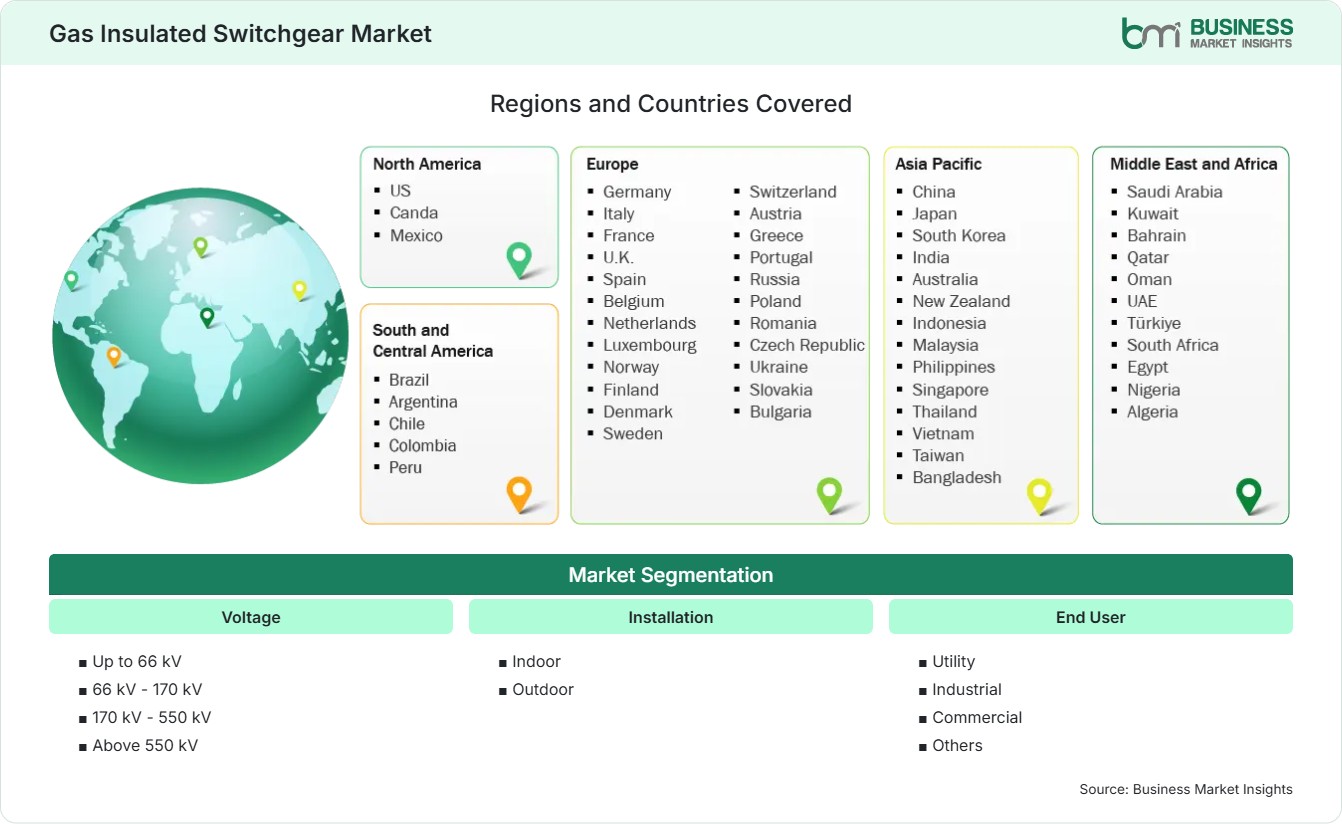
  • Voltage: Up to 66 kV, 66 kV - 170 kV, 170 kV - 550 kV, Above 550 kV
  • Installation: Indoor, Outdoor
  • End User: Utility, Industrial, Commercial, Others
US$ 29.93 Bn Market size in 2025
US$ 65.06 Bn Market Size by 2033
10.19% CAGR, 2026 - 2033
2026-2033 Forecast Period

AI Overview

Gas Insulated Switchgear Market Summary

  • North America Region: North America holds a 24%–27% of the Gas Insulated Switchgear Market share in 2025, growing with a 9.4%–10.0% CAGR during 2026–2033, influenced by aging-grid replacement, data-center electricity demand, transmission reinforcement, renewable interconnections, and resilient substation investments. The US accounts for approximately 72%–76% of North American demand, with a 9.5%–10.1% CAGR, supported by utility modernization, hyperscale data centers, and grid reliability programs.
  • Fastest Growing Region: Asia Pacific holds a 32%–35% share in 2025, growing with a 10.8%–11.5% CAGR during 2026–2033, supported by urban electricity demand, transmission expansion, renewable evacuation, industrialization, compact substations, and accelerating investment across China, India, Japan, and Southeast Asia.
  • Leading Segment: The 170 kV–550 kV voltage segment holds a 42%–45% share in 2025, growing with a 10.0%–10.6% CAGR during 2026–2033, supported by transmission upgrades, renewable power evacuation, long-distance networks, utility substations, and compact high-capacity equipment requirements.
  • High Growth Segment: The Above 550 kV voltage segment holds an 8%–11% share in 2025, growing with a 12.0%–12.8% CAGR during 2026–2033, supported by ultra-high-voltage corridors, renewable integration, interregional transmission, large power projects, and rising electricity transfer requirements.
  • Key Market Opportunity: Expansion of SF₆-free GIS, digital substations, high-voltage renewable evacuation, and compact urban transmission assets creates opportunities for suppliers combining environmental compliance, monitoring, reliability, and lifecycle service capabilities.
  • Major Market Players: Hitachi Energy Ltd.; Siemens Energy AG; ABB Ltd.; Schneider Electric SE; GE Vernova Inc.; Mitsubishi Electric Corporation; Toshiba Energy Systems & Solutions Corporation; Eaton Corporation plc; Fuji Electric Co., Ltd.; Hyundai Electric & Energy Systems Co., Ltd.
Strategic Insights

Gas Insulated Switchgear Market: Strategic Insights

Gas Insulated Switchgear Market Strategic Framework
FREE PDF
Request your free sample
Request free sample
Stakeholder View

Key Takeaways

  • Supply chains are moving toward integrated equipment, engineering, installation, monitoring, and lifecycle-service models. High-voltage GIS projects involve specialized interrupters, enclosures, insulation systems, control equipment, testing, commissioning, and long-term maintenance, increasing the importance of qualified local execution partners.
  • The highest upside lies in transmission-grade equipment above 170 kV, particularly projects connecting renewable generation, large industrial loads, data centers, and interregional grids. The Above 550 kV category offers a smaller installed base but stronger project-value potential.
  • Product innovation is shifting toward SF₆-free insulation, vacuum interruption, digital condition monitoring, low-power instrument transformers, remote diagnostics, and modular substation architectures. Hitachi Energy, Siemens Energy, GE Vernova, ABB, and Schneider Electric are positioning environmental performance alongside reliability and footprint reduction in the Gas Insulated Switchgear Market.
  • India provides a compelling investment case because transmission expansion, renewable generation, industrial electrification, and data-center development are increasing requirements for compact high-voltage substations. GE Vernova's 765 kV GIS order for India's Khavda renewable transmission network illustrates this demand.
  • Investment is increasingly directed toward technology portfolios rather than conventional capacity alone. OEMs are expanding SF₆-free product ranges, local manufacturing, digital services, and high-voltage engineering capabilities to secure utility framework agreements and shorten qualification cycles.
  • Competitive differentiation will increasingly depend on installed-base service, environmental compliance, delivery reliability, and proven operation at higher voltage levels. Suppliers that can combine GIS, transformers, protection, automation, and digital monitoring can capture larger portions of substation expenditure.
Geographic Outlook

Gas Insulated Switchgear Market Regional Highlights

North America Gas Insulated Switchgear Market

North America represented 24%–27% of 2025 demand and is projected to expand at a 9.4%–10.0% CAGR during 2026–2033. The regional opportunity is concentrated in transmission reinforcement, utility replacement programs, renewable interconnections, and data-center infrastructure. The US represents the dominant player in the Gas Insulated Switchgear market, while Canada contributes through transmission expansion and renewable integration. Compact GIS is particularly attractive where urban land costs, reliability requirements, environmental exposure, and outage constraints make conventional substations less suitable for new capacity.

  • Utility modernization is increasing procurement of compact substations capable of replacing aging equipment while limiting outage durations and site requirements.
  • Data-center clusters are creating high-capacity connection requirements, strengthening demand for reliable transmission and substation equipment near major digital infrastructure corridors.
  • Renewable projects require dependable switching and protection infrastructure to connect variable generation to increasingly constrained transmission networks.
  • Canada offers opportunities through grid expansion, hydroelectric integration, urban distribution reinforcement, and infrastructure modernization.

US Gas Insulated Switchgear Market

The Gas Insulated Switchgear market in the US represented 72%–76% of North American demand in 2025 and is expected to expand at a 9.5%–10.1% CAGR during 2026–2033. Demand is increasingly linked to transmission congestion, aging utility assets, renewable generation, manufacturing reshoring, semiconductor facilities, and hyperscale computing. GIS provides utilities and industrial users with compact substation architectures where land availability, reliability, and accelerated project development influence equipment selection. The market favors suppliers with established qualification records and domestic service capabilities.

  • Hyperscale data-center investment is increasing the need for high-reliability substations, reinforcing demand for transmission-grade GIS and associated protection equipment.
  • Utility capital programs increasingly emphasize grid resilience, replacement of aging infrastructure, and faster interconnection of new generation and large loads.
  • Industrial reshoring is expanding electricity requirements around semiconductor, battery, advanced manufacturing, and other energy-intensive facilities.

Europe Gas Insulated Switchgear Market

Europe accounted for 20%–23% of 2025 demand and is projected to grow at a 10.3%–11.0% CAGR during 2026–2033. Germany, France, the United Kingdom, Italy, and the Nordic markets remain important because transmission investment coincides with renewable integration and stringent environmental requirements. France is emerging as a major SF₆-free reference market, while Germany and the UK are advancing sustainable grid modernization. Regulatory requirements are strengthening the business case for alternative insulation technologies across new installations and replacements.

  • France is a leading eco-efficient GIS market, with RTE selecting GE Vernova's SF₆-free technology across high-voltage GIS levels from 72.5 kV to 420 kV.
  • Germany combines transmission expansion with stringent environmental compliance, encouraging suppliers to commercialize lower-emission equipment and digital monitoring solutions.
  • The UK and Nordic countries offer high-growth opportunities through offshore wind connections, transmission reinforcement, and replacement of aging substations.
  • Italy and Spain benefit from renewable generation growth, grid reinforcement, and increasing requirements for reliable connection infrastructure.

Asia Pacific Gas Insulated Switchgear Market

The Gas Insulated Switchgear market in Asia Pacific held 32%–35% of 2025 demand and is projected to grow at a 10.8%–11.5% CAGR during 2026–2033, making it the largest regional market. China, India, Japan, South Korea, and Southeast Asia combine rapid electricity-demand growth with extensive transmission construction. High-voltage GIS is increasingly used for renewable evacuation, urban substations, industrial parks, and densely populated load centers where compact footprints reduce land and civil-work requirements.

  • China remains a major high-voltage deployment market because of large transmission corridors, renewable integration, urbanization, and strong domestic manufacturing capabilities.
  • India combines renewable capacity expansion with transmission investment, including 765 kV infrastructure supporting large renewable-energy zones such as Khavda.
  • Japan is advancing SF₆-free high-voltage adoption, with Hitachi Energy receiving an order for 550 kV equipment from Chubu Electric Power Grid in March 2026.
  • South Korea benefits from export-oriented electrical equipment manufacturing and continued investment in transmission, industrial facilities, and urban networks.

Rest of World Gas Insulated Switchgear Market

The Gas Insulated Switchgear market in Latin America and the Middle East and Africa together represented approximately 15%–18% of 2025 demand and are projected to grow at a 9.8%–10.5% CAGR during 2026–2033. South America is supported by renewable generation, transmission reinforcement, and urban infrastructure. The Gulf states are investing in grid capacity for industrialization, electrification, and large infrastructure programs. Saudi Arabia's first SF₆-free GIS deployment demonstrates that sustainable equipment demand is moving beyond Europe.

Brazil, Mexico, Chile, Saudi Arabia, the UAE, and South Africa provide the strongest commercial opportunities, although project financing and procurement localization remain important constraints.

  • Brazil and Chile offer opportunities from renewable generation expansion, transmission projects, and grid reinforcement associated with geographically dispersed power resources.
  • The industrial growth of Mexico drives substation demands in the manufacturing belt; however, procurement is vulnerable to funding issues.
  • Saudi Arabia and the UAE are considered high-growth economies due to industrial diversification, urban growth, and infrastructure development which require adequate transmission and distribution capacity.
  • South Africa needs modernization of the grid system and incorporation of renewables into the existing power generation and distribution infrastructure.
Global Market Geography
FREE PDF
Request your free sample
Request free sample
Segment Analysis

Gas Insulated Switchgear Market Segmentation

Voltage

Voltage selection determines equipment architecture, insulation requirements, project value, and utility qualification cycles. The 170 kV–550 kV range leads with a 42%–45% share in 2025 and a 10.0%–10.6% CAGR during 2026–2033, supported by transmission expansion. Higher voltage applications offer stronger project values as renewable corridors and interregional grids expand in the Gas Insulated Switchgear Market.

  • Up to 66 kV: Supports distribution substations, industrial facilities, commercial networks, and compact urban applications where footprint and reliability influence equipment selection and replacement decisions.
  • 66 kV–170 kV: Serves sub-transmission, industrial, renewable, and urban utility networks, with demand supported by compact installations and increasing replacement of aging substations.
  • 170 kV–550 kV: Addresses major transmission substations, renewable evacuation corridors, industrial connections, and regional grid reinforcement requiring high reliability and compact high-voltage architectures.
  • Above 550 kV: Targets ultra-high-voltage transmission corridors and large renewable evacuation projects where high transfer capacity, stability, and reduced substation footprint justify advanced equipment.

Installation

Requirements for installation affect land use, environmental considerations, access, scheduling, and cost analysis. Indoor installations continue to see high demand in urban and industrial settings, while outdoor installations still hold importance in transmission settings. Installation requires consideration of factors like availability of land, voltage rating, environmental considerations, size of installation, and substation design, especially for compact substation designs when land availability is an issue or civil works are complex.

  • Indoor: Preferred for urban substations, commercial establishments, and industrial sites, where smaller equipment helps in reducing land space required and protecting sensitive components from external elements.
  • Outdoor: Important for transmission and utility substations due to higher voltage ratings, availability of land, access, and traditional substation layout.

End User

The Utilities continue to dominate the end-user market as they need huge amounts of switching, protection, and substation equipment due to their transmission and distribution network. The Utilities lead with an estimated 50%-53% market share in 2025 with a CAGR of 10.0%-10.6% between 2026-2033. The industries and commercial markets also contribute with their demand in electrification of buildings and facilities, data centers, manufacturing, and infrastructural projects.

  • Utility: Needs large procurement due to transmission upgrade, renewable connections, grid replacement, grid resiliency programs, and dependability of high voltage switchgear infrastructure.
  • Industrial: Utilizes GIS in manufacturing, mining, metals, chemical, oil & gas, semiconductor, and other industries that need uninterrupted operation with compact substations.
  • Commercial: Comprises data centers, hospitals, airports, commercial buildings, and infrastructural projects.
Market Forces

Gas Insulated Switchgear Market Dynamics

Key Market Drivers

Transmission Expansion and Renewable Power Integration

The global electrical grid will demand considerable transmission investments since there will be dispersion of renewable energy sources and also emergence of new electricity loads. According to the IEA projections, transmission and distribution grid lengths must expand by more than 20% until 2030, whereas annual grid investment needs to grow to US$600 billion from US$300 billion. The above investments will drive the market, as there is a need for compact switchgear used in high-voltage substations to provide isolation, switching, control, and protection. According to the Gas Insulated Switchgear Market forecast, the number of connection points will also increase due to the construction of renewable energy projects. Solar and wind corridors often necessitate substations which need to have high capacity to evacuate power.

Urbanization and Space-Constrained Substation Development

There is growing strain on utilities to build additional substations without having to increase their land use because of the urban increase in electricity demand. GIS enables placing of circuit breakers, disconnectors, busbars, and other equipment in enclosed compact enclosures, thus enabling highly dense installation even though traditional installations using air insulation occupy large areas. This particular feature comes into play mainly when there are many dense urban developments, transportation systems, business centers, and industrial parks. Not only is space saved, but also the GIS technology helps to save on the exposure to the outside environment that could result in contamination or weather-related problems.

Grid Reliability and Replacement of Aging Assets

Replacement needs due to aging transmission and distribution networks are generating replacement opportunities in addition to greenfield applications. Lifecycle reliability, diagnostic features, maintenance, and availability are among criteria that utilities employ for assessing switchgear, beyond simply the price of equipment itself. Digital monitoring solutions can provide operational data regarding partial discharge, gas density, operation, condition, etc., which maintenance staff can then use to focus on what requires action. For instance, Siemens Energy notes digital and eco-friendly substation designs, which include SF₆-free GIS, digital transformers, and IEC 61850 process bus solutions. Replacement cycles, in conjunction with digitalization trends, help in the Gas Insulated Switchgear Market growth through increasing the value opportunity per application.

Key Market Opportunities

Commercialization of SF₆-Free High-Voltage GIS

Environmental regulations are giving rise to an opportunity for suppliers who can provide SF₆-free GIS without compromising on their compactness, reliability, or voltage rating capabilities. The EconiQ range from Hitachi Energy proves the move towards the use of alternative gases, whereas the g³ technology used by GE Vernova is using an alternative insulating fluid and focusing on high-voltage ratings. According to Hitachi Energy, its 550 kV EconiQ GIS offers 99% less CO₂-equivalent emission than traditional SF₆ switchgear products. The commercial opportunity exists not only in Europe but in other countries such as Japan, China, Australia, Saudi Arabia, and others where utilities have started adopting low emission products.

Digital Substations and Condition-Based Services

Digital monitoring adds value to the services layer in connection with switchgear. There is growing demand from utilities in the Gas Insulated Switchgear market for remote diagnosis, asset condition information, monitoring, and connection to substation automation systems. Digital monitoring allows suppliers to combine GIS with sensors, low power instrument transformers, digital protection, communication infrastructure, analysis, and maintenance. GE Vernova’s range of GIS products includes digital monitoring, partial discharge monitoring, controlled switching, and low power instrument transformer solutions up to 800 kV. In this way, sales of services may add to the sale of hardware while retaining customers. Vendors with a substantial installed base can use data from operations to find upgrade or replacement opportunities. A good business model would include both hardware and software solutions.

Data Centers and High-Density Industrial Electrification

The rise in energy usage of AI, cloud computing, semiconductor production, and advanced industrial plants is making the load suitable for the deployment of high voltage GIS as developers require reliable and compact substations that will allow them to link up their facilities with the grid. This is exemplified by the collaboration between GE Vernova and Campus AI to deploy a 420 kV SF₆ free GIS facility for the French AI campus with a capacity of 1.4 GW. There is the possibility of similar projects in North America, Europe, Asia, and the Middle East. Providers who can deliver fast engineering, modular systems, and local installation can benefit from accelerated schedules in data center building timelines.

Market Restraints and Challenges

High Initial Capital and Engineering Requirements

Factor: GIS involves custom manufacturing processes, factory testing, excellent enclosure, insulation management, protection, and engineering expertise, thus making GIS relatively expensive compared to conventional substations. Impact: Utilities and industries that are sensitive to cost considerations will keep choosing air insulated substations when enough land is available and lifecycle savings cannot compensate for the extra initial costs. Project owners also have qualification criteria that can lead to longer buying processes especially in case of new high-voltage solutions. Such limitations may impede adoption in developing countries and small industrial plants. The manufacturers must thus have local production capability, common product platforms, finance options, and proof of lifecycle savings.

SF₆ Transition Complexity and Alternative Technology Qualification

Factor: The use of SF₆ has been common due to its excellent dielectric and arc extinguishing properties, whereas the high voltage gas alternatives need a lot of testing under strict electrical and operational conditions. Impact: The transition to other gases or to air insulation would lead to higher cost and time for development, certification, training, and qualification by utilities. According to Hitachi Energy, the global warming impact of SF₆ is 24,300 times higher than that of CO₂, thus making the environmental justification for alternatives stronger but also highlighting the significance of reliable alternatives.

Company Analysis

Competitive Landscape

Positioning in terms of competition has become a mix of voltage coverage, environment technology, manufacturing scale, utility references, digitalization, and lifecycle services. The Gas Insulated Switchgear Market shows that the market is moderately consolidated, with global OEMs competing with regional manufacturers. The top players are heavily investing in SF₆-free technology, digital monitoring, high voltage products, and local manufacturing.

Company Name

Overview

Products and Services relevant to this market

Hitachi Energy Ltd.

Global grid technology supplier with strong high-voltage GIS capabilities and an established utility installed base.

EconiQ SF₆-free GIS, conventional GIS, high-voltage breakers, digital monitoring, substation solutions, and lifecycle services.

Siemens Energy AG

Global energy technology company with extensive transmission and substation engineering capabilities across major power markets.

GIS from medium to high voltage, Blue GIS, digital substations, breakers, transformers, automation, engineering, and services.

ABB Ltd.

Diversified electrification supplier with broad switchgear, automation, and grid technology capabilities across utility and industrial markets.

Gas-insulated switchgear, medium-voltage GIS, breakers, protection, automation, digital services, and grid modernization solutions.

Schneider Electric SE

Global energy-management and automation company focused strongly on compact distribution and digitally connected electrical infrastructure.

GIS, SF₆-free AirSeT platforms, vacuum technology, EcoStruxure digital systems, monitoring, protection, and services.

GE Vernova Inc.

Major grid technology provider with extensive GIS engineering experience and a broad high-voltage product portfolio.

SF₆ and g³ GIS, gas-insulated substations, GIL, breakers, digital monitoring, mobile GIS, and lifecycle services.

Mitsubishi Electric Corporation

Japanese electrical technology supplier with significant transmission, distribution, and power equipment capabilities.

GIS, high-voltage breakers, substation equipment, protection, control systems, and grid automation technologies.

Toshiba Energy Systems & Solutions Corporation

Japanese energy infrastructure supplier serving utilities, industrial customers, and transmission projects.

GIS, switchgear, transformers, protection and control equipment, power systems engineering, and maintenance services.

Eaton Corporation plc

Global power-management company with extensive electrical distribution and industrial infrastructure capabilities.

Medium-voltage switchgear, distribution equipment, protection, power management, monitoring, and integrated electrical solutions.

Fuji Electric Co., Ltd.

Japanese electrical equipment manufacturer serving utilities, industrial facilities, renewable projects, and infrastructure markets.

GIS, breakers, substation equipment, power electronics, monitoring, protection, and energy-management systems.

Hyundai Electric & Energy Systems Co., Ltd.

South Korean electrical equipment supplier with strong high-voltage transmission and export capabilities.

GIS, transformers, breakers, substations, power distribution systems, digital monitoring, and turnkey project services.

Trust & Transparency

Research Methodology

The market analysis combines proprietary research with secondary data from government agencies, company disclosures, regulatory filings, industry databases and expert interviews. Market estimates are validated through data triangulation, cross-market benchmarking and analyst review.

View Full Research Methodology

Questions Answered

Frequently Asked Questions

What capabilities will distinguish GIS suppliers through 2033?

Technology is not everything when it comes to competitiveness. Suppliers who have SF₆-free products that are digitally monitored, locally manufactured, engineered, utility referred to, commissioned, and long-term serviced will be more competent in complex grid projects.

Which voltage range offers the strongest commercial value in the Gas Insulated Switchgear Market?

The voltage range 170 kV to 550 kV includes wide application possibilities for power transmission as well as evacuation of renewable energy. The voltage above 550 kV allows for intensive projects, but procurement volumes are limited.

How are data centers affecting GIS procurement?

Big data centers generate a high electricity load that may require special high voltage substations to be installed. GIS may prove useful for such projects where the development of a compact, reliable, and quickly installable electrical infrastructure is required.

Why is SF₆-free GIS becoming strategically important?

SF₆ has a global warming potential of 24,300 times that of CO₂. Environmental regulation and corporate decarbonization programs are therefore encouraging utilities to evaluate alternative insulation technologies, especially for new high-voltage installations.

What is driving demand for gas-insulated switchgear in urban power networks?

Compact equipment reduces substation footprint, which is particularly valuable where land is expensive or unavailable. Urban utilities also value enclosed equipment because it can improve protection against environmental exposure and support reliable operation within dense infrastructure corridors.

Access the Full Gas Insulated Switchgear Market Report

Get segment-level forecasts, regional estimates, competitive benchmarking, company profiles and downloadable Excel datasets.

Access the full Gas Insulated Switchgear Market Report
350 pages PDF & Excel | 2026-08-31