
Water Test Kits Market Outlook: Size, Share, Trends, Growth Analysis, Competitive Landscape & Forecast, 2026–2033

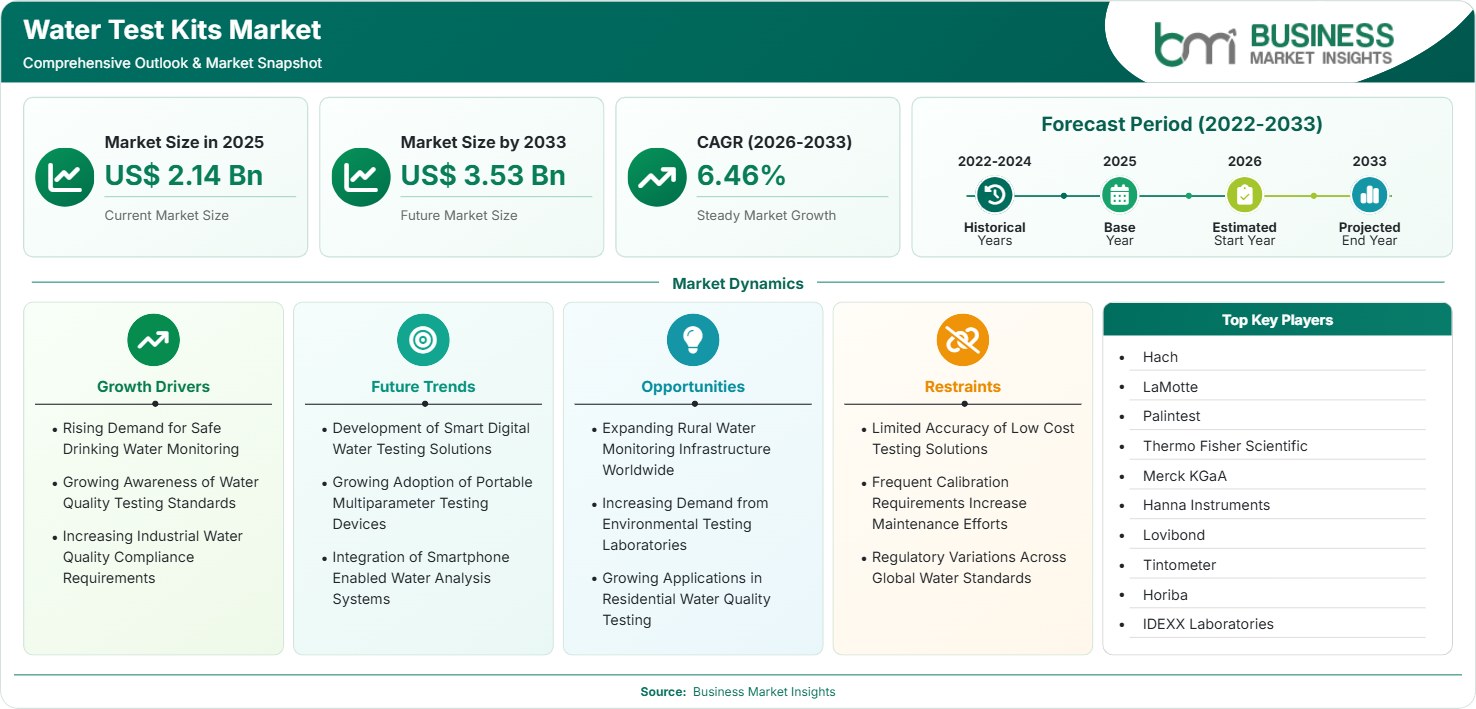
The Water Test Kits Market size was valued at US$ 2.14 billion in 2025 and is projected to reach US$ 3.53 billion by 2033, growing at a CAGR of 6.46% during 2026–2033. Growth is driven by increasing water safety concerns, rising environmental monitoring requirements, industrial compliance needs, and expanding demand for convenient water quality testing solutions.

Report Coverage
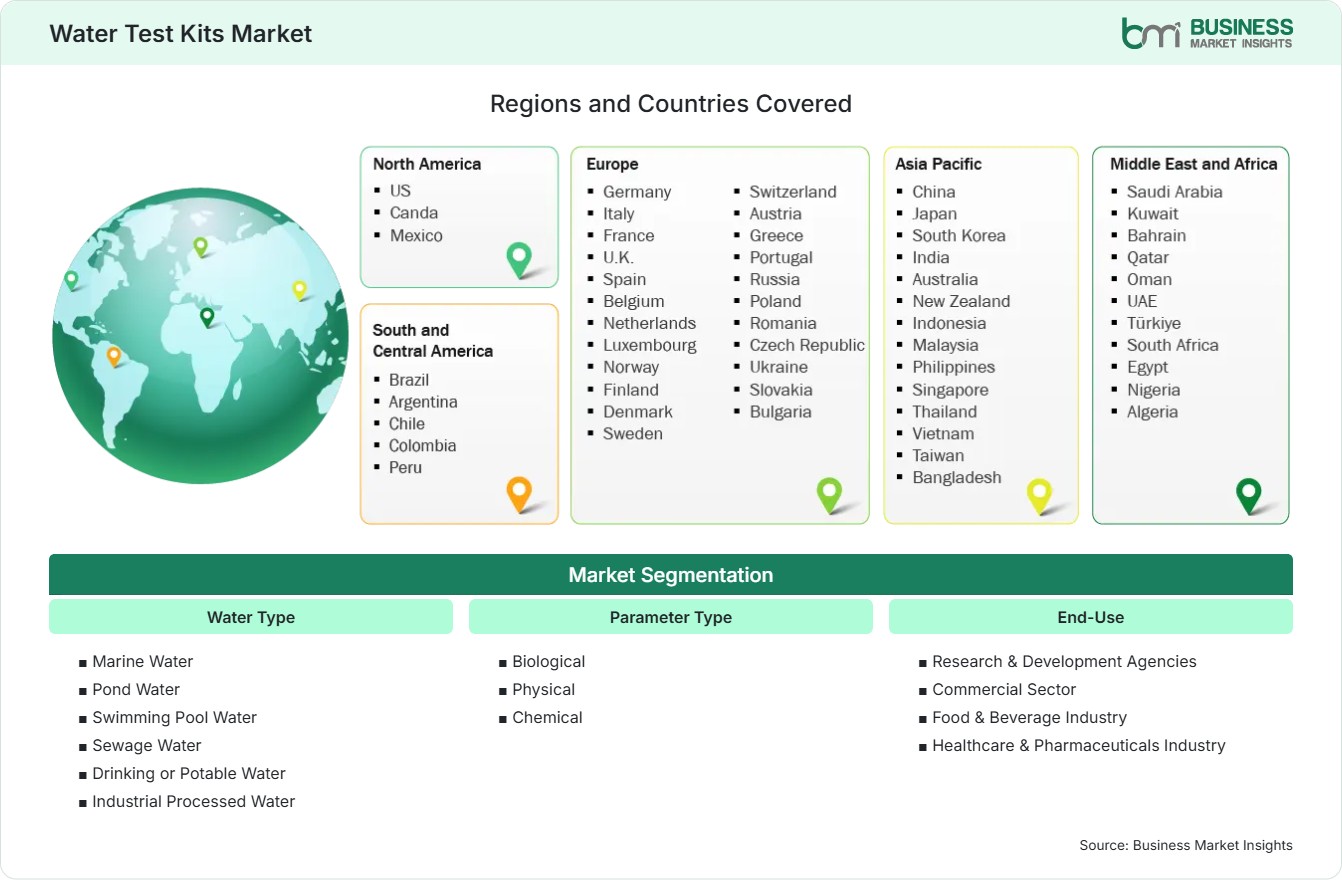
  • Water Type: Marine Water, Pond Water, Swimming Pool Water, Sewage Water, Drinking or Potable Water, Industrial Processed Water
  • Parameter Type: Biological, Physical, Chemical
  • End-Use: Research & Development Agencies, Commercial Sector, Food & Beverage Industry, Healthcare & Pharmaceuticals Industry
US$ 2.14 Bn Market size in 2025
US$ 3.53 Bn Market Size by 2033
6.46% CAGR, 2026 - 2033
2026-2033 Forecast Period

AI Overview

Water Test Kits Market Summary

  • North America Region: North America holds a 32%–36% share in 2025 and is projected to grow at a 6.1%–6.6% CAGR during 2026–2033. Growth is supported by strict water quality regulations, environmental monitoring programs, industrial compliance requirements, and adoption of advanced testing solutions. The U.S. market benefits from established laboratory infrastructure, increasing municipal water monitoring activities, and growing demand for portable testing technologies.
  • Fastest Growing Region: Asia Pacific represents a 30%–34% share in 2025 and is expected to expand at a 7.0%–7.6% CAGR during 2026–2033. Growth is driven by increasing water contamination concerns, expanding urban populations, industrial development, and investments in drinking water quality monitoring infrastructure across emerging economies.
  • Leading Segment: Chemical Parameter Type accounts for a 42%–46% share in 2025 and is projected to grow at a 6.3%–6.8% CAGR during 2026–2033. Adoption is supported by widespread testing requirements for pH, chlorine, hardness, and chemical contaminants across residential, commercial, and industrial applications.
  • High Growth Segment: Drinking or Potable Water Applications represent a 28%–32% share in 2025 and are expected to grow at a 7.1%–7.7% CAGR during 2026–2033. Growth is supported by increasing public health awareness, rural water monitoring initiatives, and demand for accessible testing solutions.
  • Key Market Opportunity: Expanding environmental monitoring programs, residential water testing adoption, rural infrastructure development, and industrial water compliance requirements are creating opportunities for advanced testing kit manufacturers.
  • Major Market Players: Hach, LaMotte, Palintest, Thermo Fisher Scientific, Merck KGaA, Hanna Instruments, Lovibond, Tintometer, Horiba, and IDEXX Laboratories.
Strategic Insights

Water Test Kits Market: Strategic Insights

Water Test Kits Market Strategic Framework
FREE PDF
Request your free sample
Request free sample
Stakeholder View

Key Takeaways

  • The Water Test Kits Market ecosystem includes testing equipment manufacturers, reagent suppliers, environmental laboratories, industrial users, municipal authorities, and healthcare organizations focused on water quality management.
  • Drinking water monitoring and industrial water testing applications provide strong growth opportunities due to increasing regulatory attention and rising awareness of contamination risks.
  • Innovation is focused on digital-enabled testing solutions, portable devices, improved reagent technologies, and user-friendly monitoring platforms for faster water quality assessment.
  • Asia Pacific provides attractive investment opportunities due to expanding water infrastructure projects, urban development, and increasing environmental monitoring requirements.
  • Companies are strengthening market positions through product launches, technology improvements, partnerships, and expansion of testing solution portfolios.
  • Integration of smart monitoring capabilities with traditional testing methods is creating opportunities for improved data collection, analysis, and water management decisions.
Geographic Outlook

Water Test Kits Market Regional Highlights

North America Water Test Kits Market

North America accounted for a 32%–36% share in 2025 and is expected to grow at a 6.1%–6.6% CAGR during 2026–2033. The region benefits from advanced water management infrastructure, established regulatory frameworks, and increasing adoption of portable testing technologies. The Water Test Kits Market share is influenced by municipal monitoring programs, industrial compliance requirements, and growing demand for rapid testing methods across residential and commercial applications.

  • The United States represents the largest regional contributor due to strong environmental regulations and advanced water testing infrastructure.
  • Canada is expanding adoption through municipal water monitoring programs and sustainability-focused initiatives.
  • Industrial facilities are increasing testing frequency to maintain compliance with wastewater and water safety standards.
  • Residential users are adopting convenient testing kits for household water quality assessment.
  • Manufacturers are developing digital and portable solutions to improve accessibility.

US Water Test Kits Market

The United States represented a 80%–84% share of North America in 2025 and is projected to grow at a 6.2%–6.7% CAGR during 2026–2033. Growth is supported by regulatory requirements, environmental monitoring activities, and increasing awareness regarding safe water consumption. Demand is rising across municipalities, households, laboratories, and industrial facilities requiring accurate and efficient testing solutions.

  • Municipal water providers are adopting advanced testing methods to maintain safety standards and monitoring accuracy.
  • Industrial users are increasing water quality testing to meet environmental compliance requirements.
  • Residential adoption is supported by growing awareness of contamination risks.
  • Laboratories are utilizing improved testing kits for faster analytical procedures.

Europe Water Test Kits Market

Europe represented a 25%–29% share in 2025 and is expected to expand at a 6.3%–6.8% CAGR during 2026–2033. The region benefits from strong environmental policies, advanced laboratory networks, and increasing focus on sustainable water management. Germany, the United Kingdom, France, and Italy are key markets due to regulatory enforcement and investments in water quality monitoring technologies.

  • Germany is supporting growth through environmental compliance programs and industrial water testing adoption.
  • The United Kingdom is expanding monitoring activities across municipal and residential applications.
  • France is investing in sustainable water management and contamination prevention initiatives.
  • European industries are increasing testing requirements due to stricter environmental standards.
  • Research organizations are adopting advanced testing solutions for environmental studies.

Asia Pacific Water Test Kits Market

Asia Pacific accounted for a 30%–34% share in 2025 and is projected to grow at a 7.0%–7.6% CAGR during 2026–2033. The region is experiencing rising demand due to population growth, industrial expansion, and increasing concerns regarding water contamination. China, India, Japan, and Southeast Asian countries are creating opportunities through infrastructure development and public health initiatives.

  • China is expanding water monitoring capabilities through environmental protection programs and industrial testing requirements.
  • India is increasing adoption through rural water quality monitoring initiatives.
  • Japan is focusing on advanced testing technologies and environmental sustainability.
  • Southeast Asian countries are developing water infrastructure and quality monitoring systems.
  • Manufacturers are expanding distribution networks across emerging markets.

Rest of World Water Test Kits Market

Rest of World accounted for a 8%–12% share in 2025 and is expected to grow at a 6.7%–7.2% CAGR during 2026–2033. Latin America, Middle East, and Africa are witnessing increasing demand due to water scarcity concerns, infrastructure development, and environmental monitoring requirements. The region offers opportunities through public water initiatives and industrial testing applications.

  • Latin American countries are investing in water quality monitoring systems to improve public health outcomes.
  • Brazil is expanding testing adoption through environmental management programs.
  • Middle Eastern countries are focusing on water conservation and treatment monitoring.
  • African markets are developing rural water testing infrastructure.
  • Regional partnerships are improving access to affordable testing technologies.
Global Market Geography
FREE PDF
Request your free sample
Request free sample
Segment Analysis

Water Test Kits Market Segmentation

Water Type

The Water Type segment represents diverse testing requirements across environmental, residential, and industrial applications. The segment accounted for approximately 44%–48% share in 2025 and is projected to grow at a 6.4%–6.9% CAGR during 2026–2033. Increasing concerns regarding contamination, water safety, and regulatory compliance are driving demand for testing solutions across different water sources and usage environments. The segment growth is supported by expanding monitoring programs and improved accessibility of portable testing products.

  • Marine Water: Marine water testing solutions are used for environmental monitoring, ecosystem assessment, and research activities. Increasing focus on ocean health and pollution monitoring is supporting adoption across laboratories and environmental agencies.
  • Pond Water: Pond water testing is gaining importance for aquaculture, recreational areas, and ecological studies. Users require reliable testing solutions to monitor chemical balance, contaminants, and biological conditions.
  • Swimming Pool Water: Swimming pool water testing solutions support hygiene management and chemical balance monitoring. Increasing recreational facility development is driving demand for convenient testing methods.
  • Sewage Water: Sewage water testing applications are expanding due to wastewater management requirements and environmental regulations. Treatment facilities use testing kits to monitor quality parameters and process effectiveness.
  • Drinking or Potable Water: Drinking water testing represents a major application due to increasing concerns regarding public health, contamination detection, and household water safety monitoring.
  • Industrial Processed Water: Industrial processed water testing is growing due to compliance requirements, process optimization needs, and demand for maintaining operational water quality standards.

Parameter Type

The Parameter Type segment influences adoption based on testing objectives, accuracy requirements, and application conditions. The segment represented approximately 38%–42% share in 2025 and is expected to grow at a 6.3%–6.8% CAGR during 2026–2033. Growing demand for comprehensive water analysis is encouraging adoption of solutions capable of measuring multiple parameters. The Water Test Kits Market trend reflects increasing preference for easy-to-use kits that provide faster testing results across residential, commercial, and industrial environments.

  • Biological: Biological testing solutions help detect microorganisms and biological contaminants. Increasing focus on waterborne disease prevention is supporting adoption across healthcare, environmental, and municipal applications.
  • Physical: Physical parameter testing measures characteristics such as appearance, temperature, and turbidity. These solutions are important for basic water quality evaluation and routine monitoring activities.
  • Chemical: Chemical testing solutions are widely adopted for detecting pH levels, chlorine, hardness, metals, and other chemical properties. Broad application across industries supports segment expansion.

End-Use

The End-Use segment demonstrates strong demand across research, commercial, industrial, and healthcare applications. The segment accounted for approximately 41%–45% share in 2025 and is projected to grow at a 6.6%–7.1% CAGR during 2026–2033. Increasing water quality requirements, regulatory compliance, and environmental awareness are supporting adoption among different user groups. The Water Test Kits Market scope continues expanding as organizations seek efficient monitoring solutions.

  • Research & Development Agencies: Research organizations utilize water test kits for environmental studies, scientific analysis, and monitoring projects requiring reliable measurement capabilities.
  • Commercial Sector: Commercial users adopt testing solutions for facilities such as hotels, recreational centers, and service operations requiring regular water quality monitoring.
  • Food & Beverage Industry: Food and beverage companies use water testing kits to maintain production standards, ensure safety compliance, and monitor processing water quality.
  • Healthcare & Pharmaceuticals Industry: Healthcare and pharmaceutical organizations require water testing solutions to maintain strict quality standards and support contamination prevention practices.
Market Forces

Water Test Kits Market Dynamics

Key Market Drivers

Rising Demand for Safe Drinking Water Monitoring

The growing concern about water quality is driving demand for an efficient way to test water. The dangers associated with water pollution, including chemical contamination, microbial presence, and industrial effluents, are among the factors prompting regular testing. Water test kits have been developed to serve this purpose, providing an efficient solution for testing water quality without the need for large laboratories. The Water Test Kits market growth is driven by awareness of waterborne diseases and the need for faster testing methods. Companies have enhanced their products to improve precision, portability, and ease of use in response to changing needs.

Growing Awareness of Water Quality Testing Standards

Greater awareness of water quality guidelines is making organizations and consumers more receptive to water testing solutions for routine testing. Regulatory authorities and environmental agencies are working to comply with established water safety guidelines, and thus, there is demand for testing tools. Organizations and individuals are taking a proactive approach to identifying contaminants and ensuring compliance with quality guidelines. Improved testing technologies are making it easier for consumers to carry out tests. More and more manufacturers are coming up with solutions that are easy to use and reliable. Environmental awareness and greater availability of information have led to increased use of water testing kits around the world.

Increasing Industrial Water Quality Compliance Requirements

Water quality testing has become increasingly necessary for industries due to environmental regulations and other concerns. Industries such as manufacturing, food processing, pharmaceuticals, and chemicals require testing to meet production standards. Industrial water test kits will help industries assess water quality parameters. The adoption of industrial water testing products by companies helps them to manage compliance and identify any water problems that may arise in the process. The growth of industrial activity in emerging countries is driving demand for water test kits. Companies are focusing on designing effective testing equipment that can operate across various industries.

Key Market Opportunities

Expanding Rural Water Monitoring Infrastructure Worldwide

The emergence of water-monitoring infrastructure in rural areas will create opportunities for providers of water test kits, given efforts by governments and other organizations to improve access to clean water. There is a need for affordable, easy-to-use water-testing methods in such remote locations. Portable water test kits are now considered important for monitoring water sources that lack adequate laboratory facilities. According to the Water Test Kits Market Forecast, there will be increasing opportunities from public health campaigns, rural development projects, and investment in water management in underdeveloped areas.

Increasing Demand from Environmental Testing Laboratories

There has been an increase in the use of water test kits by environmental testing laboratories due to rising monitoring needs associated with pollution control and ecosystem management. There has been a need for efficient means for laboratories to assess water quality from various sources and regions. Environmental research work and monitoring programs have been contributing to the growth in the demand for testing technologies. Water conservation and climate impact assessment have presented new avenues for providers of testing solutions.

Growing Applications in Residential Water Quality Testing

Home water quality testing is turning out to be a lucrative opportunity sector owing to the rising consumer awareness about their home water safety. Consumers are relying on convenient home water testing devices to test contamination levels, chemical composition, and water quality. The growing availability of online purchasing is increasing the availability of these products and aiding consumer adoption. Companies are developing convenient testing kits for non-professional use that provide quick results. The growth of home water filtration systems is aiding in demand for these testing products.

Market Restraints and Challenges

Limited Accuracy of Low Cost Testing Solutions

Factor: Testing water at low cost may prove inaccurate owing to the use of simpler testing procedures, reduced sensitivity, and limited detection of parameters. Impact: Reliability issues may reduce user confidence and adoption in professional users who require high levels of accuracy in their analysis. In response to this problem, manufacturers are working to increase the accuracy of reagents, calibrations, and designs while keeping costs down. The challenge will remain important in cost-conscious environments where affordability takes precedence over testing capabilities. Striking a balance between affordability and performance will be key to ensuring broader implementation of the technology.

Frequent Calibration Requirements Increase Maintenance Efforts

Factor: Certain water testing devices require regular calibration and maintenance to maintain measurement accuracy over time. Impact: Frequent calibration requirements can increase operational effort, maintenance costs, and user inconvenience, particularly for organizations managing multiple testing locations. Companies are developing improved designs with longer stability periods and easier maintenance procedures to reduce operational challenges. Training requirements and proper handling practices also influence performance consistency. Enhancing product durability and simplifying calibration processes will remain important strategies for manufacturers seeking wider acceptance among industrial and professional users.

Company Analysis

Competitive Landscape

The Water Test Kits Market analysis indicates a competitive environment involving laboratory equipment manufacturers, water testing specialists, analytical technology providers, and healthcare-focused testing companies. Companies are focusing on product innovation, digital integration, expanded distribution networks, and improved testing accuracy to strengthen their market position.

Company Name

Overview

Products and Services relevant to this market

Hach

Hach provides water analysis solutions for environmental and industrial applications.

Offers water testing kits, instruments, reagents, and monitoring solutions.

LaMotte

LaMotte specializes in water testing equipment and analytical solutions.

Provides test kits for environmental, pool, and industrial water testing.

Palintest

Palintest develops water analysis technologies for multiple industries.

Offers portable testing kits and digital water analysis solutions.

Thermo Fisher Scientific

Thermo Fisher Scientific provides analytical technologies globally.

Supplies laboratory water testing instruments and analytical products.

Merck KGaA

Merck KGaA develops scientific and testing solutions.

Provides analytical reagents and water quality testing products.

Hanna Instruments

Hanna Instruments manufactures measurement and testing equipment.

Offers water testing meters, kits, and monitoring solutions.

Lovibond

Lovibond specializes in water analysis and measurement systems.

Provides colorimetric testing kits and water analysis equipment.

Tintometer

Tintometer develops testing solutions under Lovibond technologies.

Supplies water testing instruments for industrial and environmental uses.

Horiba

Horiba provides analytical measurement technologies.

Offers water quality monitoring and laboratory testing solutions.

IDEXX Laboratories

IDEXX Laboratories develops diagnostic and testing technologies.

Provides water testing solutions for environmental applications.

Trust & Transparency

Research Methodology

The market analysis combines proprietary research with secondary data from government agencies, company disclosures, regulatory filings, industry databases and expert interviews. Market estimates are validated through data triangulation, cross-market benchmarking and analyst review.

View Full Research Methodology

Questions Answered

Frequently Asked Questions

What does the Water Test Kits Market report indicate about future competition?

The report indicates that competition will focus on testing accuracy, product portability, digital integration, parameter coverage, and distribution expansion. Companies developing reliable, user-friendly, and technologically advanced testing solutions are expected to improve their competitive positioning.

Why are environmental monitoring programs creating new opportunities for water test kits?

Environmental monitoring programs are creating opportunities due to increasing focus on pollution control, ecosystem protection, and sustainable water management. Organizations require efficient testing solutions to evaluate water conditions, monitor contamination levels, and support environmental compliance initiatives across different regions.

How are digital technologies influencing water testing kit adoption?

Digital technologies are influencing adoption by enabling connected monitoring, automated result interpretation, improved data management, and remote reporting capabilities. Manufacturers are integrating smart features into testing solutions to improve usability, accuracy, and decision-making across professional and consumer applications.

Which applications present the strongest opportunity in the market?

Drinking water monitoring, industrial water testing, environmental laboratories, food and beverage processing, and residential testing applications represent strong opportunities. These areas require reliable quality assessment solutions to support safety standards, operational efficiency, and increasing awareness regarding water contamination management.

What factors are improving Water Test Kits Market return on investment?

Increasing demand for water safety monitoring, industrial compliance requirements, environmental testing activities, and portable quality assessment solutions are improving return on investment. Water test kits help users reduce testing time, support regulatory compliance, and enable faster identification of contamination risks across residential, commercial, and industrial applications.

Access the Full Water Test Kits Market Report

Get segment-level forecasts, regional estimates, competitive benchmarking, company profiles and downloadable Excel datasets.

Access the full Water Test Kits Market Report
350 pages PDF & Excel | 2026-08-21