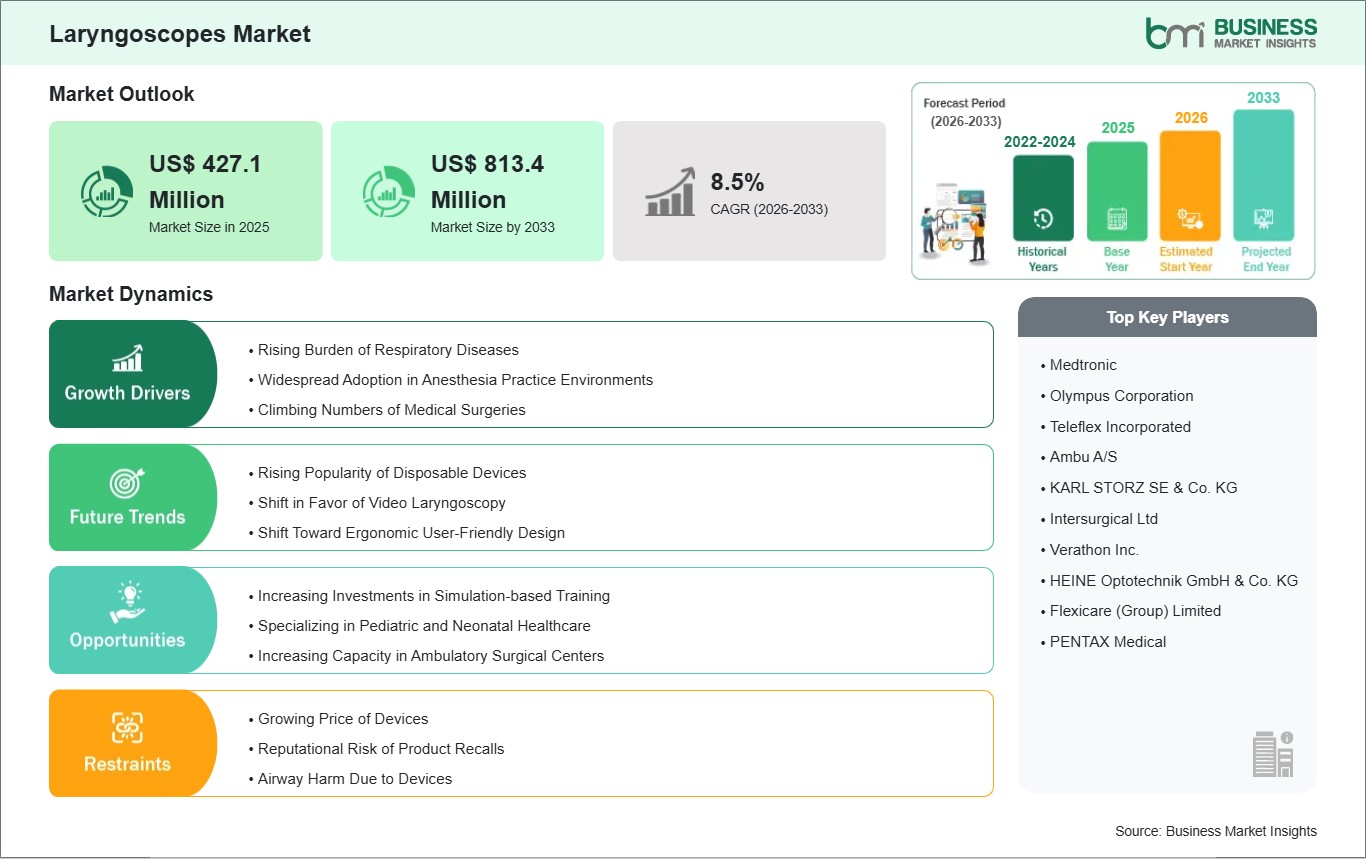
Rising Burden of Respiratory Diseases
The global laryngoscopes market is being shaped by a steady increase in respiratory disorders across both developed and developing regions. Urbanization, declining air quality, and rising smoking rates in parts of Asia, the Middle East, and Latin America have contributed to a higher incidence of conditions such as asthma and chronic obstructive pulmonary disease. At the same time, aging populations in regions like North America, Europe, and Japan are more susceptible to respiratory complications, which often require surgical or emergency airway management interventions.
The prevalence of these respiratory conditions has brought about an increased number of patients who require intubation and ventilation treatment. The use of laryngoscope devices becomes highly necessary when performing these treatments, especially in critical care and emergency departments, where prompt entry into the airway passage is vital. In nations with growing healthcare sectors like India, Brazil, and Indonesia, the expansion of critical care services is leading to a high demand for reliable airway management devices. Consequently, the demand is growing both in matured and developing healthcare sectors.
The severity of these respiratory conditions continues to increase owing to the presence of complications such as obesity, heart problems, and diabetes, among others. These developments have compelled medical practitioners around the world to utilize innovative laryngoscopy procedures that provide superior visualization results and success rates. Moreover, the increased preparedness for respiratory health emergencies, including the pandemic, has contributed to the steady expansion of the laryngoscope market.
Increasing Investments in Simulation-based Training
Simulation-based training is a significant aspect of healthcare globally, with an increasing number of simulation labs being integrated into the training curricula of medical facilities to enable the practicing of intubation procedures. Hands-on experience, even when practiced in simulations, helps build procedural knowledge and confidence among medical practitioners and students while lowering the chances of errors occurring in real-life situations.
Simulation-based training has been adopted widely in North American and Western Europe owing to the availability of state-of-the-art technology, including VR technologies. In contrast, developing nations have gradually been integrating the use of simulation-based training for their students through international organizations and private and public sector collaborations. This is seen in countries from the Asia-Pacific region and the Middle East.
These investments are directly influencing the adoption of modern laryngoscopy devices. As healthcare professionals become trained on advanced equipment during simulation exercises, they are more likely to prefer and advocate for the same technologies in clinical practice. This creates a feedback loop where training drives device familiarity, and familiarity drives procurement. Globally, the alignment between education, technology adoption, and patient safety priorities continues to strengthen the role of simulation-based training as a key factor supporting growth in the laryngoscopes market.