
Rheumatoid Arthritis Testing Market Outlook: Size, Share, Trends, Growth Analysis, Competitive Landscape & Forecast, 2026-2033

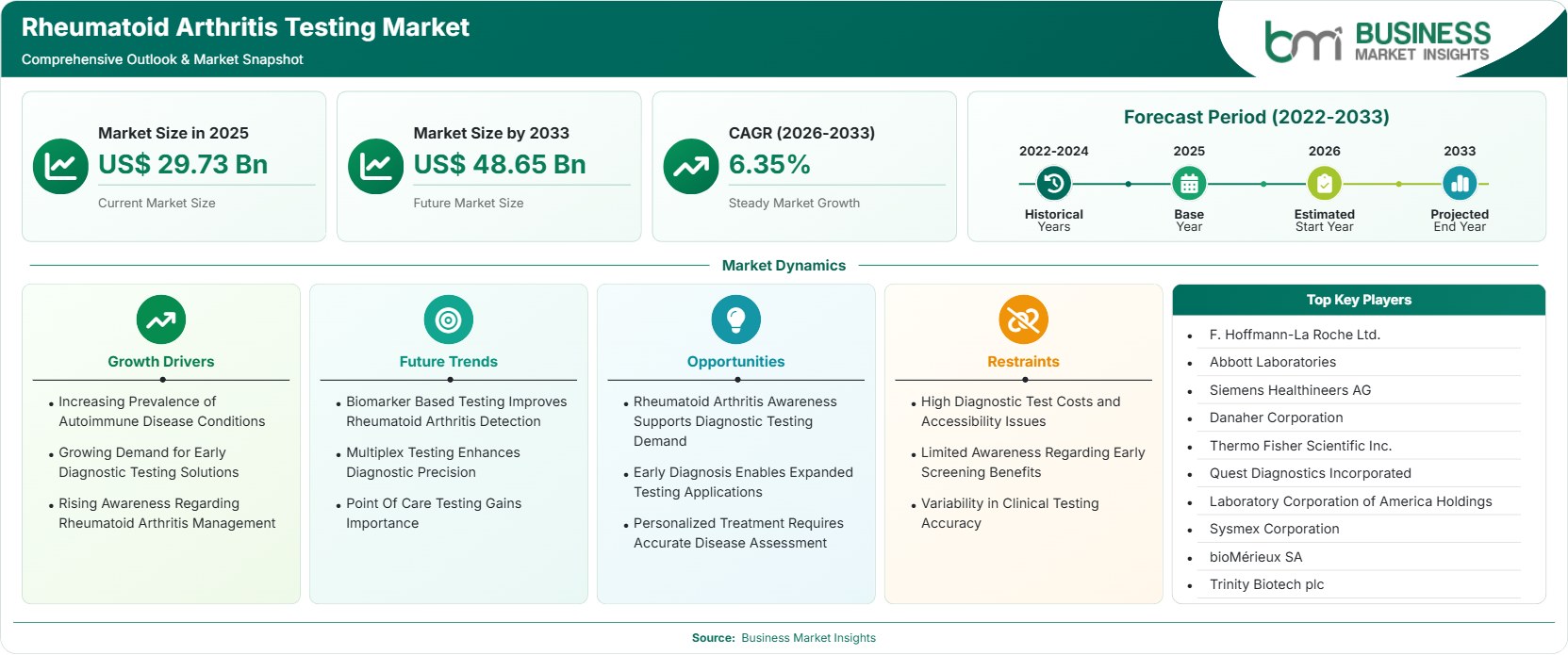
The Rheumatoid Arthritis Testing Market size was valued at US$ 29.73 Billion in 2025 and is projected to reach US$ 48.65 Billion by 2033, growing at a CAGR of 6.35% during 2026–2033. Rising prevalence of autoimmune disease, expanding early-diagnosis programs, biomarker innovation, AI-enabled interpretation, and broader access to specialty diagnostics are creating new revenue opportunities across laboratories, hospitals, and diagnostic networks.

Report Coverage
  • Test Type: Serological Tests, Rheumatoid Arthritis Severity Tests & Medication Monitoring Tests, Imaging Tests
  • End User: Hospitals & Clinics, Diagnostic Centers, Others
US$ 29.73 Bn Market size in 2025
US$ 48.65 Bn Market Size by 2033
6.35% CAGR, 2026 - 2033
2026-2033 Forecast Period

AI Overview

Rheumatoid Arthritis Testing Market Summary

  • North America Region: North America holds a market share of 37%–40% in 2025 and is projected to grow at a CAGR of 5.8%–6.2% during 2026–2033. Growth is supported by advanced diagnostic infrastructure, widespread biomarker adoption, reimbursement availability, integrated healthcare networks, strong rheumatology expertise, digital laboratory modernization, precision medicine expansion, rising autoimmune disease awareness, and proactive screening pathways. The US market benefits from extensive adoption of specialty testing and large laboratory networks, advancing at a 5.9%–6.3% CAGR.
  • Fastest Growing Region: Asia Pacific holds a market share of 24%–27% in 2025, growing with a CAGR of 7.3%–7.8% during 2026–2033. Expansion is driven by investments in healthcare capacity, rising rates of autoimmune disease diagnosis, urban laboratory development, expanding insurance access, digital health integration, physician education programs, rising healthcare expenditure, and broader availability of advanced immunology testing.
  • Leading Segment: Serological Tests hold a market share of 48%–52% in 2025, growing with a CAGR of 6.0%–6.5% during 2026–2033. Demand remains anchored in rheumatoid factor and anti-CCP testing, scalable laboratory workflows, the need for early disease detection, favorable clinical guidelines, cost-efficiency, strong physician familiarity, and broad global availability.
  • High Growth Segment: Diagnostic Centers hold a market share of 28%–32% in 2025, growing with a CAGR of 7.0%–7.5% during 2026–2033. Growth stems from outsourcing trends, high-throughput testing platforms, specialized immunology services, shorter turnaround times, private healthcare expansion, laboratory automation investments, regional network development, and increasing participation in preventive healthcare.
  • Key Market Opportunity: Integration of multi-biomarker panels, AI-supported interpretation, decentralized diagnostics, and longitudinal disease-monitoring platforms can improve diagnostic precision, optimize treatment, reduce clinical uncertainty, enable recurring testing revenue, and support value-based care initiatives.
  • Major Market Players: F. Hoffmann-La Roche Ltd., Abbott Laboratories, Siemens Healthineers AG, Danaher Corporation, Thermo Fisher Scientific Inc., Quest Diagnostics Incorporated, Laboratory Corporation of America Holdings, Sysmex Corporation, bioMérieux SA, Trinity Biotech plc.
Strategic Insights

Rheumatoid Arthritis Testing Market: Strategic Insights

Rheumatoid Arthritis Testing Market Strategic Framework
FREE PDF
Request your free sample
Request free sample
Stakeholder View

Key Takeaways

  • Diagnostic value chains are becoming increasingly integrated, linking assay manufacturers, automated laboratory platforms, hospital systems, specialty clinics, and digital analytics providers into coordinated autoimmune disease management ecosystems.
  • Multi-marker testing and disease-monitoring applications offer greater commercial upside than traditional standalone assays because clinicians increasingly require comprehensive patient stratification and treatment-response information.
  • Innovation is shifting toward algorithm-supported interpretation, highly sensitive immunoassays, biomarker combinations, and predictive disease activity assessment tools that support personalized care pathways.
  • India, China, Indonesia, Saudi Arabia, and Brazil present compelling investment cases due to expanding access to specialty healthcare, laboratory modernization, and improved autoimmune disease detection rates.
  • Strategic collaborations between diagnostic manufacturers and laboratory service providers are increasing, enabling broader test availability, portfolio expansion, and stronger geographic penetration.
  • Recurring medication monitoring and disease severity assessment services are generating higher-value revenue streams than one-time diagnostic testing models.
Geographic Outlook

Rheumatoid Arthritis Testing Market Regional Highlights

North America Rheumatoid Arthritis Testing Market

North America accounted for 37%–40% Rheumatoid Arthritis Testing Market share in 2025 and is projected to expand at a CAGR of 5.8%–6.2% through 2033. Well-established reimbursement policies, extensive specialty lab networks, and physician knowledge make testing utilization possible. Health care professionals have started using full panels of biomarkers to improve accuracy and inform treatment decisions. There is a lot of money being spent on R&D activities and on immunology infrastructure, and automation of diagnostic processes has been achieved in the region.

  • Large reference laboratory networks accelerate access to advanced biomarker testing and support the rapid expansion of autoimmune diagnostic services across community and specialty healthcare settings.
  • Growing utilization of anti-CCP and multi-marker assays improves early diagnosis rates and enhances treatment planning accuracy among rheumatology specialists.
  • Integration of laboratory automation and AI-assisted analytics strengthens productivity, supports quality compliance, and reduces operational variability across high-volume testing facilities.
  • Increasing healthcare expenditure and aging populations continue to expand demand for chronic disease monitoring and recurring laboratory assessments.

US Rheumatoid Arthritis Testing Market

The United States represented approximately 78%–82% of the North American Rheumatoid Arthritis Testing Market revenue in 2025 and advanced at 5.9%–6.3% CAGR. The presence of numerous commercial laboratories, the widespread use of autoimmune testing by clinicians, and patient awareness drive market demand. Precision medicine programs and the increasing adoption of disease activity monitoring affect recurrent test volumes. Further advancements in laboratory digitization and the integration of care pathways help improve accessibility.

  • National laboratory operators continue expanding autoimmune testing portfolios, supporting broader access to advanced disease-monitoring solutions.
  • Rising preference for evidence-based treatment selection strengthens demand for comprehensive biomarker assessment before therapeutic decision-making.
  • Digital pathology integration and automated reporting systems improve turnaround efficiency and clinical workflow management.

Europe Rheumatoid Arthritis Testing Market

Europe held 28%–31% Rheumatoid Arthritis Testing Market share in 2025 and is projected to register a CAGR of 5.9%–6.4% through 2033. Universal health care models favor testing and monitoring initiatives. The most important market region is Germany, whereas Eastern Europe offers the greatest room for development. Upgrading laboratories, regulation alignment, and specialty testing contribute to increasing demand. Increasing emphasis on early intervention approaches and disease burden reduction ensures steady demand among public and private health facilities.

  • Germany leads regional revenue generation, supported by advanced laboratory infrastructure and extensive rheumatology care capacity.
  • Poland and Romania demonstrate faster expansion, supported by healthcare investment and improving diagnostic accessibility.
  • Growing adoption of advanced autoimmune biomarker panels enhances disease stratification and monitoring capabilities.
  • Public health efforts promoting earlier diagnosis support long-term demand across hospital and laboratory settings.

Asia Pacific Rheumatoid Arthritis Testing Market

Asia Pacific accounted for 24%–27% share in 2025 and is anticipated to achieve 7.3%–7.8% CAGR, making it the fastest-growing regional market. Growing investment in healthcare infrastructure, an increase in the number of patients being diagnosed, and higher insurance coverage lead to increased demand. The country generating the maximum regional revenue is China, and the fastest-growing country is India. The use of more automation in laboratories, the availability of more specialists, and the government’s healthcare programs help make autoimmune diagnostics easier.

  • China leads regional adoption through extensive diagnostic infrastructure investments and growing autoimmune disease awareness.
  • India records strongest growth as laboratory networks expand into secondary cities and specialty healthcare capabilities improve.
  • Private healthcare operators increasingly invest in high-throughput immunology testing platforms.
  • Rising healthcare expenditure supports broader integration of advanced testing technologies and disease-management programs.

Rest of World Rheumatoid Arthritis Testing Market

Rest of World represented 8%–11% market share in 2025 and is forecast to expand at 6.4%–6.9% CAGR through 2033. Advantages for South and Central America include greater development of private diagnostic facilities and increased access to specialists. Middle East and African markets benefit from diversification in health care, laboratory modernization, and efforts related to chronic disease management. In Latin America, Brazil is the largest market, whereas Saudi Arabia shows fast development.

  • Brazil benefits from private laboratory expansion and increasing awareness of autoimmune disease diagnostics.
  • Saudi Arabia records robust growth through laboratory investments and healthcare modernization initiatives.
  • Improving healthcare access increases testing volumes in large urban population centers.
  • Strategic partnerships with international diagnostics companies improve assay availability and technical expertise.
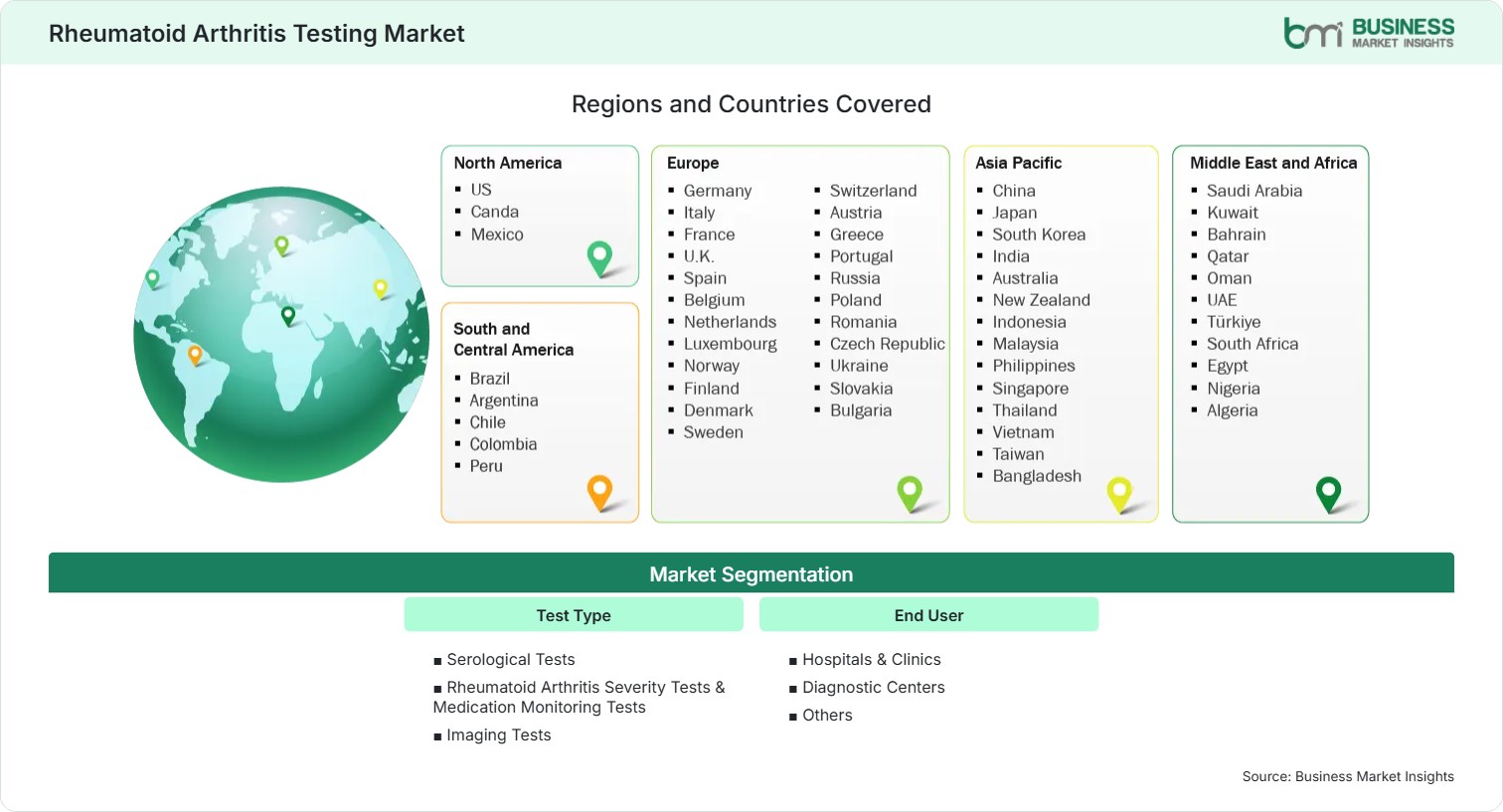
Global Market Geography
FREE PDF
Request your free sample
Request free sample
Segment Analysis

Rheumatoid Arthritis Testing Market Segmentation

Test Type

This segment accounted for approximately 62%–65% share in 2025 and is expected to advance at 6.3%–6.8% CAGR. The Rheumatoid Arthritis Testing Market scope within testing categories continues to broaden through advanced biomarker discovery, disease monitoring requirements, and increased demand for earlier diagnosis. Healthcare providers increasingly adopt integrated testing strategies combining serology, imaging, and treatment monitoring.

  • Serological Tests: Represent the diagnostic foundation for autoimmune assessment, supported by anti-CCP and rheumatoid factor testing, broad laboratory accessibility, standardized workflows, and strong guideline-based clinical utilization.
  • Rheumatoid Arthritis Severity Tests & Medication Monitoring Tests: Increasingly utilized for treatment optimization, disease progression assessment, therapeutic response measurement, and long-term patient management across specialty rheumatology practices.
  • Imaging Tests: Growing adoption of ultrasound and advanced imaging supports earlier structural assessment, improved disease characterization, and enhanced monitoring of treatment outcomes.

End User

End-user demand remains concentrated among institutional healthcare providers, accounting for approximately 35%–38% share in 2025 with a CAGR of 6.1%–6.6%. The Rheumatoid Arthritis Testing Market trends indicate increasing testing decentralization through specialty laboratory networks, while hospitals continue retaining major diagnostic volumes owing to integrated clinical care capabilities.

  • Hospitals & Clinics: Maintain leadership through direct patient access, specialist availability, integrated diagnostics, and comprehensive disease management services supporting diagnosis and monitoring.
  • Diagnostic Centers: Benefit from outsourcing trends, scalable testing infrastructure, laboratory automation, specialized expertise, and efficient turnaround performance for autoimmune diagnostics.
Market Forces

Rheumatoid Arthritis Testing Market Dynamics

Key Market Drivers

Growing Burden of Autoimmune Disorders Worldwide

The rising prevalence of rheumatoid arthritis continues to increase testing demand across healthcare systems. According to the World Health Organization, musculoskeletal disorders are a leading source of disabilities in the world. This prompts the importance of early detection and interventions. Increased physician knowledge of such conditions, patient education, and specialist consultations increases the use of lab tests. In addition, healthcare providers realize that late diagnosis increases the cost of treatment and leads to poor health outcomes for patients. All of these enhance the application of serological tests, imaging tests, and disease monitoring during the forecasted period.

Advancement of Biomarker-Based Diagnostic Technologies

Diagnostic innovation is improving sensitivity, specificity, and clinical utility. The new generation of biomarker panels combines classic biomarkers along with novel disease activity biomarkers, thereby providing a more thorough analysis. Automation helps to decrease variability and increase laboratory efficiency. Companies keep on innovating in terms of test development, software, and reporting systems. As clinicians seek greater clinical certainty, more sophisticated diagnostic tools are used more often. All of these innovations not only help to operate more efficiently, but also enable better disease detection in hard-to-diagnose patient categories.

Shift Toward Early Intervention and Precision Care

Clinical guidelines increasingly emphasize early diagnosis and prompt treatment initiation because earlier intervention can reduce irreversible joint damage. Consequently, the need for precision in diagnostic and monitoring equipment remains important for patients throughout the process. This need is not only for diagnoses but also for treatment responses and monitoring of the disease state. Increased use of biological drugs and targeted therapy has led to increased demands for diagnostic stratification. Personalized treatment modalities, expanded specialty practice, and monitoring needs have contributed to ongoing demand for autoimmunity testing.

Key Market Opportunities

Expansion of Multi-Biomarker and Predictive Testing Platforms

Healthcare providers are looking for more detailed, clinically relevant information beyond what individual biomarkers provide. Combining inflammation markers, serology markers, and markers of disease activity to form multi-biomarker platforms presents a promising growth path. They facilitate early disease detection, patient segmentation, and better treatment decision-making. The development of data integration and algorithms creates new commercial possibilities. Rheumatoid Arthritis Testing Market Forecasts increasingly reflect demand for recurring monitoring programs, creating higher-value service models and stronger long-term customer retention opportunities.

Growth Potential Across Emerging Healthcare Economies

Expansion potential in emerging markets will remain substantial due to lower diagnostic penetration than in developed countries. Investments in the health care infrastructure, lab accreditation, insurance coverage, and specialist training are contributing to improved access to these markets. Urbanization and higher incidence of autoimmune diseases are increasing the number of patients diagnosed. International diagnostic firms will continue to establish collaborations, improve distribution channels, and develop local testing services. Improved access to health care facilitates volume growth and creates opportunities to develop differentiated solutions.

AI-Enabled Interpretation and Digital Laboratory Integration

AI and analytics present opportunities to ensure diagnostic consistency and make the process more efficient. There is an increasing use of digital technology, which can help integrate data generated through different testing methods. Digital technology will enable physicians to make decisions, detect patterns, and improve the quality of reports. It will also make it easier to manage patients longitudinally by allowing them to consolidate previous testing data for each patient.

Market Restraints and Challenges

High Cost of Advanced Testing Technologies

Factor: Sophisticated biomarker panels, automation systems, and advanced imaging solutions require substantial investment from laboratories and healthcare providers. Impact: Increased implementation costs may hinder the use of the method in small-scale facilities and in healthcare facilities with limited resources. In addition, financial limitations may hinder purchasing decisions and access to full testing services. The reimbursement process varies by country and affects the mode of use. While technology is continually improving, cost constraints remain a major hindrance.

Diagnostic Variability and Access Inequality

Factor: Differences in laboratory capabilities, physician expertise, healthcare infrastructure, and testing availability create uneven adoption across regions. Impact: Patients can be exposed to diagnostic delays and inconsistent diagnostic pathways, which reduce the efficiency of the disease management program. Disparities hinder standardization processes and may affect clinical outcomes. Emerging markets often have limited capacity despite significant investment in the healthcare system. It is necessary to bridge these gaps through stronger laboratory networks, training, and access to diagnostics.

Company Analysis

Competitive Landscape

The competitive environment reflects ongoing Rheumatoid Arthritis Testing Market analysis focused on biomarker innovation, laboratory expansion, automation, and autoimmune disease monitoring capabilities.

Company Name

Overview

Products and Services relevant to this market

F. Hoffmann-La Roche Ltd.

Global diagnostics leader with extensive immunodiagnostic portfolio and strong laboratory automation capabilities.

Immunoassay platforms, autoimmune diagnostics, laboratory workflow solutions, digital diagnostics integration.

Abbott Laboratories

Major diagnostics company supporting autoimmune disease testing through broad instrument portfolios.

Anti-CCP assays, rheumatoid factor testing, immunochemistry systems, laboratory automation tools.

Siemens Healthineers AG

Healthcare technology provider with extensive diagnostics and imaging capabilities.

Immunoassays, laboratory diagnostics, imaging systems, digital healthcare solutions.

Danaher Corporation

Diagnostics group operating through multiple life sciences and laboratory businesses.

Clinical diagnostics, laboratory instruments, biomarker testing technologies, workflow automation.

Thermo Fisher Scientific Inc.

Supplier of analytical technologies and laboratory solutions for clinical diagnostics.

Immunoassays, laboratory reagents, specialty diagnostics, clinical testing platforms.

Quest Diagnostics Incorporated

Large diagnostic services provider serving hospitals, physicians, and consumers.

Rheumatoid arthritis diagnostic panels, reference laboratory testing, monitoring services.

Laboratory Corporation of America Holdings

Global laboratory services company with broad autoimmune testing capabilities.

RheumAssure, RA profiles, disease monitoring tests, specialty diagnostics services.

Sysmex Corporation

Diagnostics manufacturer with growing specialty testing presence.

Clinical laboratory systems, diagnostic analyzers, autoimmune testing support solutions.

bioMérieux SA

In vitro diagnostics specialist focused on innovative laboratory technologies.

Diagnostic assays, laboratory instrumentation, clinical testing solutions.

Trinity Biotech plc

Diagnostic testing company active in specialty immunology and laboratory markets.

Autoimmune testing products, immunoassays, laboratory diagnostic reagents.

Trust & Transparency

Research Methodology

The market analysis combines proprietary research with secondary data from government agencies, company disclosures, regulatory filings, industry databases and expert interviews. Market estimates are validated through data triangulation, cross-market benchmarking and analyst review.

View Full Research Methodology

Questions Answered

Frequently Asked Questions

Why is this Rheumatoid Arthritis Testing Market Report important for investors?

It identifies growth segments, technology shifts, regional opportunities, competitive positioning, and long-term demand drivers shaping revenue generation across the diagnostic ecosystem.

How do diagnostic centers strengthen industry demand?

Diagnostic centers provide high-throughput testing capacity, specialized expertise, rapid turnaround times, and outsourced services for hospitals and clinics, supporting increasing test volumes.

What role does AI play in testing workflows?

AI supports result interpretation, pattern recognition, laboratory automation, workflow optimization, and integration of multiple data sources, improving clinical efficiency and consistency.

Why is Asia Pacific growing faster than other regions?

Healthcare infrastructure investments, expanding insurance coverage, increasing diagnosis rates, laboratory modernization, and growing awareness of autoimmune diseases collectively accelerate regional expansion.

Which testing category generates the largest revenue?

Serological tests generate the largest revenue contribution because anti-CCP and rheumatoid factor assays remain central to clinical diagnosis, treatment planning, and screening workflows worldwide.

Access the Full Rheumatoid Arthritis Testing Market Report

Get segment-level forecasts, regional estimates, competitive benchmarking, company profiles and downloadable Excel datasets.

Access the full Rheumatoid Arthritis Testing Market Report
350 pages PDF & Excel | 2026-09-16
Similar Research

Related Market Reports