
Legionella Testing Market Outlook: Size, Share, Trends, Growth Analysis, Competitive Landscape & Forecast, 2026-2033

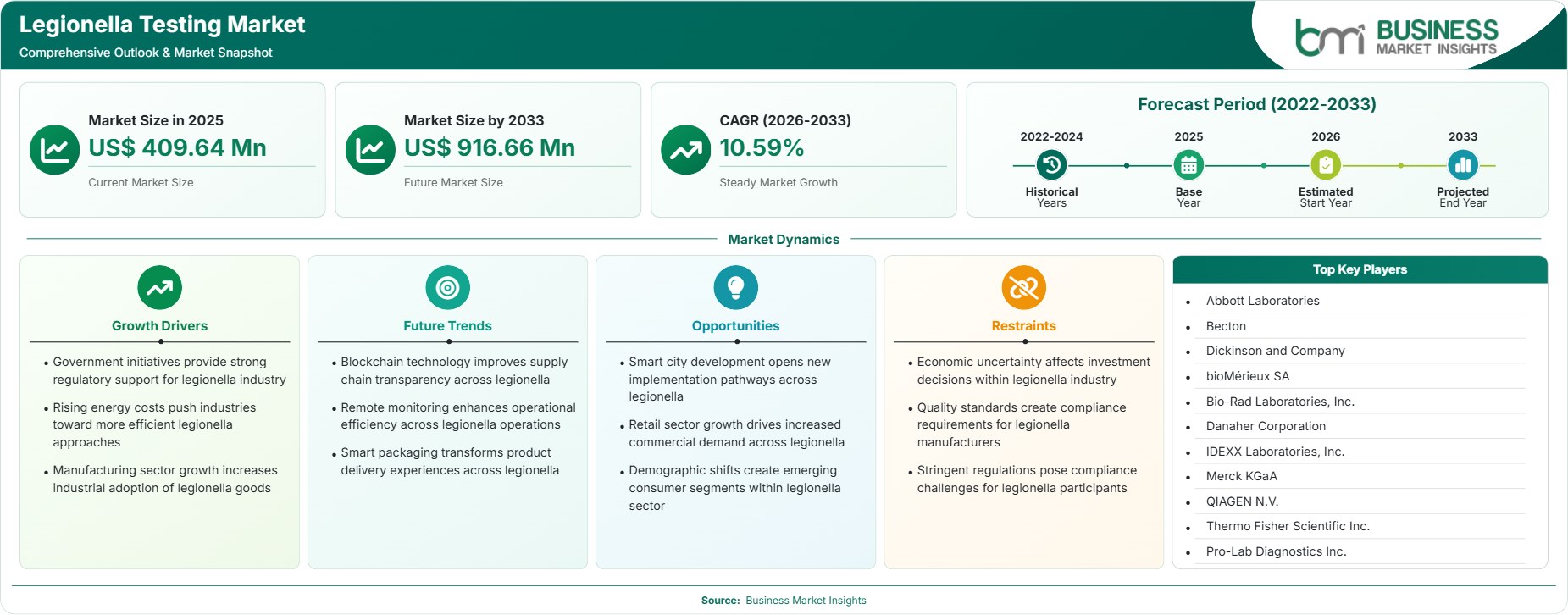
The Legionella Testing Market size was valued at US$ 409.64 Million in 2025 and is projected to reach US$ 916.66 Million by 2033, growing at a CAGR of 10.59% during 2026–2033. Key drivers include stricter water-safety regulations, rising Legionnaires’ disease incidence, expanding molecular diagnostics adoption, and broader surveillance programs. Opportunities arise from rapid PCR deployment, smart water monitoring integration, healthcare infrastructure expansion, and preventive testing mandates.

Report Coverage
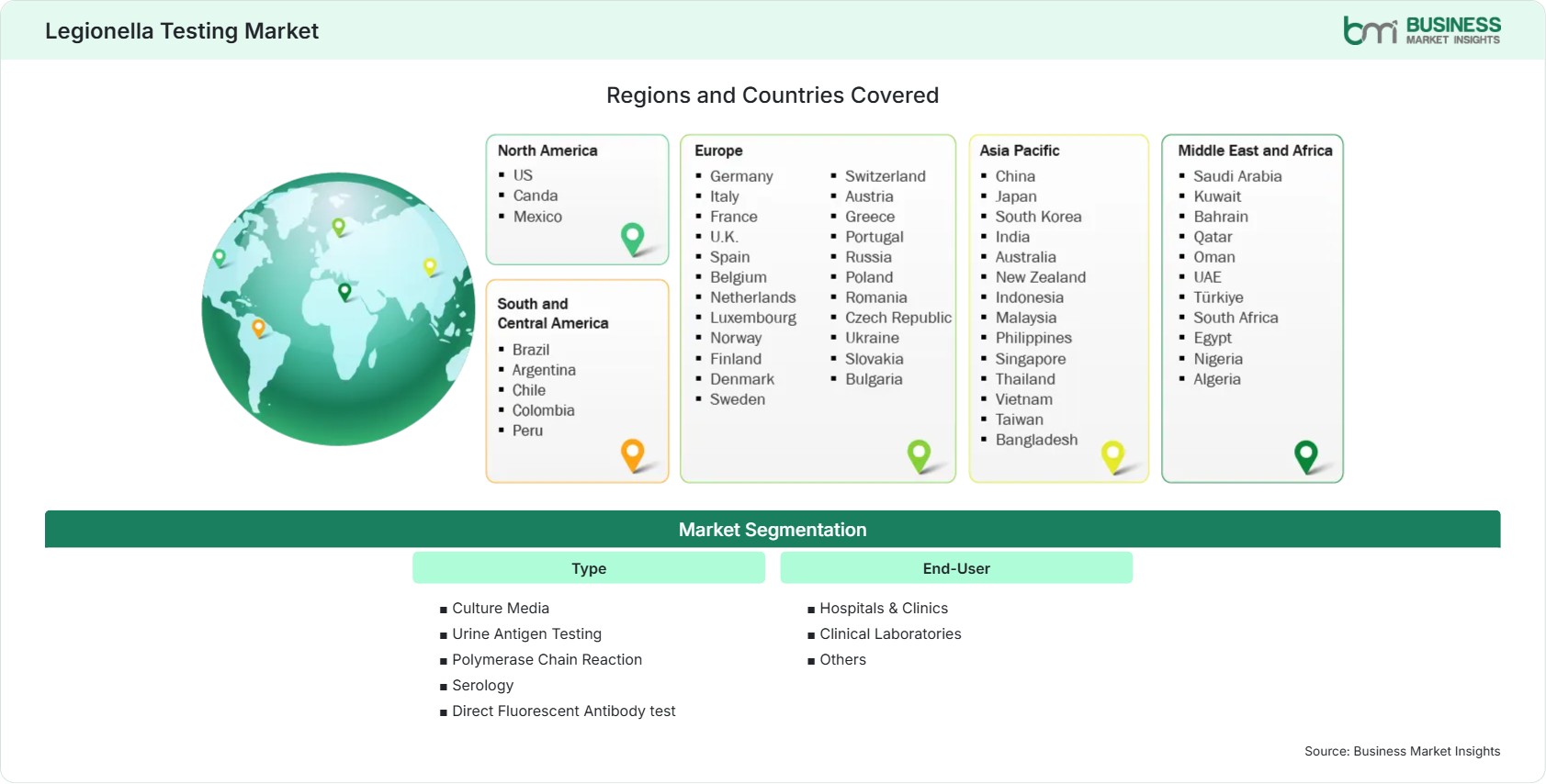
  • Type: Culture Media, Urine Antigen Testing , Polymerase Chain Reaction , Serology, Direct Fluorescent Antibody test
  • End-User: Hospitals & Clinics, Clinical Laboratories, Others
US$ 409.64 Mn Market size in 2025
US$ 916.66 Mn Market Size by 2033
10.59% CAGR, 2026 - 2033
2026-2033 Forecast Period

AI Overview

Legionella Testing Market Summary

  • North America Region: North America holds a Legionella Testing Market share of 39%–43% in 2025, growing with a CAGR of 9.8%–10.4% during 2026–2033. Strong healthcare surveillance, water quality regulations, hospital compliance programs, expanding diagnostic capabilities, outbreak prevention initiatives, and molecular testing investments continue creating sustained demand and innovation opportunities across public and private sectors. Brief U.S. analysis: The U.S. leads regional adoption through healthcare compliance, environmental testing expansion, and PCR deployment, recording 10.0%–10.6% CAGR.
  • Fastest Growing Region: Asia Pacific holds a market share of 22%–26% in 2025 and advances at a CAGR of 11.8%–12.5% during 2026–2033. Urban infrastructure investments, healthcare modernization, growing disease awareness, hospitality-sector monitoring requirements, water treatment upgrades, and increasing laboratory capacity support accelerated regional market expansion.
  • Leading Segment: Polymerase Chain Reaction (PCR) holds a Legionella Testing Market share of 34%–38% in 2025 and expands at a CAGR of 11.2%–11.9%. Faster turnaround times, high sensitivity, automation compatibility, laboratory workflow efficiency, outbreak management needs, and wider clinical adoption continue supporting dominant segment positioning.
  • High Growth Segment: Clinical Laboratories hold a market share of 28%–32% in 2025 and grow at a CAGR of 11.7%–12.4%. Rising outsourced diagnostics demand, testing standardization, laboratory automation, reference laboratory expansion, preventive surveillance programs, and advanced molecular workflows foster strong growth opportunities.
  • Key Market Opportunity: Expanding regulatory monitoring of building water systems is creating sustained demand for routine screening programs, advanced molecular platforms, integrated analytics, outsourced diagnostics services, and preventive public-health management solutions globally.
  • Major Market Players: Abbott Laboratories, Becton, Dickinson and Company, bioMérieux SA, Bio-Rad Laboratories, Inc., Danaher Corporation, IDEXX Laboratories, Inc., Merck KGaA, QIAGEN N.V., Thermo Fisher Scientific Inc., Pro-Lab Diagnostics Inc.
Strategic Insights

Legionella Testing Market: Strategic Insights

Legionella Testing Market Strategic Framework
FREE PDF
Request your free sample
Request free sample
Stakeholder View

Key Takeaways

  • The value chain increasingly integrates diagnostic manufacturers, environmental testing providers, healthcare facilities, water-management consultants, and public authorities, creating a diversified ecosystem with recurring testing demand.
  • Clinical laboratories and PCR-based workflows offer the highest upside as healthcare institutions increasingly outsource specialized testing while pursuing faster and more reliable diagnostic outcomes.
  • Innovation is moving toward automated sample preparation, multiplex assays, digital surveillance platforms, and data-driven outbreak monitoring to strengthen diagnostic accuracy and response time.
  • Asia Pacific presents a compelling investment case due to healthcare infrastructure expansion, urbanization-driven water management requirements, and growing regulatory focus on public-health safety.
  • Strategic acquisitions and portfolio expansion activities among diagnostics companies are enhancing molecular testing capabilities and strengthening geographic reach across emerging economies.
  • Environmental monitoring applications are becoming increasingly important as commercial buildings, hotels, and industrial facilities implement proactive water-risk management programs.
Geographic Outlook

Legionella Testing Market Regional Highlights

North America Legionella Testing Market

North America accounts for 39%–43% share in 2025 and records a CAGR of 9.8%–10.4% through 2033. The region benefits from mature laboratory infrastructure, active public-health surveillance, and broad adoption of molecular diagnostics. The Legionella Testing Market share remains highest in North America due to stringent testing practices across hospitals, long-term care facilities, and commercial buildings. Regulatory frameworks encouraging preventive monitoring and outbreak investigations continue supporting demand across clinical and environmental applications.

  • CMS compliance requirements reinforce routine water-management testing programs across healthcare facilities.
  • High adoption of PCR technologies improves diagnostic accuracy and accelerates outbreak response capabilities.
  • Aging infrastructure creates sustained demand for proactive environmental water-quality monitoring.
  • Strong reimbursement systems support advanced testing utilization across major healthcare networks.

US Legionella Testing Market

The U.S. contributes 78%–82% of regional revenue and advances at a CAGR of 10.0%–10.6%. Extensive healthcare infrastructure, disease surveillance, and water-safety standards support substantial diagnostic volumes. Federal and state-level guidance encourages preventive monitoring in hospitals and large facilities. Continued laboratory investments and technology upgrades reinforce market leadership while supporting faster disease detection and public-health response initiatives.

  • Healthcare-acquired infection prevention programs stimulate routine screening adoption.
  • Molecular assay utilization continues increasing across reference laboratories.
  • Commercial real-estate operators are expanding preventive water-monitoring budgets.
  • Public-health investigations strengthen awareness and testing frequency nationwide.

Europe Legionella Testing Market

The Europe region accounts for 28% to 32% market share in 2025 with a CAGR of 9.6% to 10.2%. Demand in the European region is driven by stringent water safety standards, environmental surveillance requirements, and sophisticated healthcare infrastructure. Germany remains the key revenue contributor in the region, whereas Spain and Italy are known for their high testing volume. Eastern European countries exhibit higher growth momentum as regulatory frameworks and laboratory capacity continue to strengthen across healthcare and infrastructure sectors.

  • Germany remains the leading market with strong laboratory and environmental testing networks.
  • Spain demonstrates high-growth potential with CAGR exceeding regional averages.
  • EU water-safety directives encourage wider preventive testing implementation.
  • Hospitality and tourism infrastructure creates recurring environmental monitoring demand.

Asia Pacific Legionella Testing Market

The Asia Pacific region holds 22%-26% market share by 2025 and grows at a CAGR of 11.8%-12.5%. The factors aiding increased adoption include the modernization of healthcare services, urbanization, and infrastructure investments. Japan emerges as a key market owing to superior diagnostics, while India and Southeast Asian countries offer growth opportunities. Regional laboratory network development and greater public-health awareness continue to strengthen demand for advanced diagnostic solutions.

  • Japan leads regional adoption through established diagnostic infrastructure.
  • India exhibits among the strongest growth rates due to healthcare expansion.
  • Smart-city developments increase focus on water-quality surveillance.
  • Laboratory accreditation initiatives support broader assay adoption.
  • Rising hospitality investments expand environmental monitoring requirements.

Rest of World Legionella Testing Market

The Rest of World segment accounts for 9%-12% of the market in 2025 and records a CAGR of 10.8%-11.5%. South & Central America have been benefiting from improved healthcare and increased knowledge of waterborne diseases. The Middle East and Africa have seen increased investment in infrastructure, tourism, and water management solutions. Regulatory modernization and laboratory development remain key factors supporting gradual market penetration and long-term adoption.

  • Brazil leads Latin American demand through expanding laboratory capabilities.
  • GCC countries strengthen environmental monitoring in hospitality facilities.
  • South Africa demonstrates growing adoption of advanced diagnostic technologies.
  • Infrastructure modernization increases testing opportunities across commercial buildings.
  • Public-health campaigns enhance disease-awareness and surveillance activities.
Global Market Geography
FREE PDF
Request your free sample
Request free sample
Segment Analysis

Legionella Testing Market Segmentation

Type

Type is the main reason for the industrial revenue base. This category encompasses various diagnostic methods for clinical detection and environmental surveillance. The Legionella Testing Market scope continues to grow as healthcare providers emphasize early detection. PCR is the market leader, with 34%-38% market share in 2025 and a CAGR of 11.2%-11.9%, supported by accuracy and rapid turnaround.

  • Culture Media: Traditional reference methodology remains important for confirmatory analysis, epidemiological investigations, and regulatory compliance despite longer processing times and increasing competition from molecular alternatives.
  • Urine Antigen Testing (UAT): Widely used for rapid clinical diagnosis because of ease of administration, quick results, and suitability for frontline healthcare settings.
  • Polymerase Chain Reaction (PCR): The dominant technology due to superior sensitivity, faster detection, automation compatibility, and growing utilization across reference laboratories and outbreak investigations.
  • Serology: Supports retrospective diagnosis and epidemiological assessments, particularly where complementary clinical information is required alongside other testing methodologies.
  • Direct Fluorescent Antibody (DFA) test: Maintains niche clinical relevance in specialized laboratories requiring direct organism visualization and confirmatory diagnostic support.

End-User

End-user demand will come from Hospitals & Clinics, which will account for 46%-50% of the market share in 2025, with a CAGR of 10.1%-10.8%. This demand will come from the necessity to manage patients, control infections, and comply with regulations. According to Legionella Testing Market trends, testing volumes are increasing in centralized laboratories as healthcare providers emphasize diagnostic efficiency and operational scalability.

  • Hospitals & Clinics: Primary testing centers due to patient diagnosis requirements, outbreak response responsibilities, and integrated infection-prevention programs supporting continuous utilization.
  • Clinical Laboratories: Fastest-growing category as outsourcing increases, automation expands, and specialized molecular workflows improve testing throughput and operational efficiency.
Market Forces

Legionella Testing Market Dynamics

Key Market Drivers

Rising Incidence of Legionnaires’ Disease Worldwide

The increased incidence of the disease has raised the need for more diagnostic services in health care facilities. Reports from the WHO and other public health organizations indicate that cases are being continuously reported due to Legionella-related waterborne diseases. Increased surveillance activity has necessitated early testing and environmental studies. In hospitals, testing for Legionella is becoming more common in the diagnosis of pneumonia. This will drive the Legionella Testing Market growth through increased testing and monitoring activities. Increased awareness and improved infection control have accelerated the adoption of rapid diagnostic tests.

Expansion of Water Safety Regulations and Compliance Programs

Government bodies are enacting increasingly stringent regulations to ensure that water management programs follow strict rules. Compliance for health institutions, hotels, and commercial structures is leaning toward preventive monitoring to reduce the risk of outbreaks and liabilities. Institutions are setting aside budgets for surveillance, sampling, and laboratory work. The increased regulatory environment makes a compelling case for diagnostics and recurring revenues from such programs. There is also increased demand for proper testing due to robust auditing procedures and health department monitoring. The combination of compliance pressure and risk mitigation continues to create a durable foundation for demand across developed and emerging markets.

Shift Toward Advanced Molecular Diagnostic Technologies

Molecular testing systems provide faster results than traditional culture methods and offer greater sensitivity. More labs are opting for automation in PCR testing to improve efficiency and reduce diagnostic delays. The use of digital reporting facilitates surveillance and decision-making processes. Assay and laboratory technology development remains active in increasing accessibility to cutting-edge technologies. The current technology shift plays an important role in supporting efficiency and quality improvement programs. Increased use of multiplexing and molecular techniques increases clinical confidence.

Key Market Opportunities

Digital Water Monitoring and Predictive Surveillance

There is an increased need for an integrated system that incorporates test results, sensors, and analytics. Predictive surveillance technology can detect the risk of contamination even before an outbreak occurs, thereby informing intervention strategies. There have been partnerships between water management and diagnostic companies to develop integrated monitoring technologies. This presents the chance for revenue generation through service contracts and more informed decision-making. The Legionella Testing Market Forecasts highlight the growing need to integrate software systems in hospitals and commercial buildings, driven by digital transformation efforts. There is potential to capture future value in vendors that can integrate testing, monitoring, and reporting.

Emerging Healthcare Infrastructure Across Developing Economies

Rapid investments in healthcare across Asia, the Middle East, and Latin America are adding more laboratories. New hospitals, diagnostic clinics, and public health programs need efficient testing methods. Governments are placing greater emphasis on infection control and healthcare quality. With the growing availability of diagnostic tests, the requirement for PCR, antigen, and environmental testing kits will continue to increase. Opportunities can be gained via distribution channels, local support services, and training laboratories. Healthcare upgrades continue to provide an excellent revenue stream outside mature markets due to low penetration levels.

Expansion of Environmental Testing Beyond Healthcare Facilities

Commercial real estate, hospitality sites, educational institutions, and industries are becoming more aggressive in their approaches to water safety. Companies realize that the testing program helps to reduce disruptions and minimize risks to their reputation. The adoption of environmental monitoring is gradually moving away from compliance to asset management. The need for custom-designed sampling tools, outsourced laboratory testing services, and fast detection technologies has increased. This will provide an opening for the diagnostic companies, service providers, and technology platforms that offer solutions beyond clinical applications. This diversification of the end-users reduces dependence on the health care industry and increases the addressable market during the forecast period.

Market Restraints and Challenges

High Testing Costs and Adoption Constraints

Factor: Cost remains a significant barrier for smaller facilities and laboratories. Advanced molecular platforms require capital investment, skilled personnel, and ongoing maintenance expenditures. Environmental monitoring programs also involve recurring sampling and analytical expenses. Impact: Budget limitations can reduce testing frequency, delay technology upgrades, and restrict broader implementation of comprehensive surveillance strategies. Organizations with constrained resources may continue relying on conventional methodologies despite performance limitations. Cost sensitivity is particularly apparent within developing economies where healthcare funding and infrastructure remain uneven. As a result, market participants face challenges in accelerating adoption among price-conscious customer groups.

Variability in Testing Standards and Inconsistent Results

Differences in testing protocols, sample collection practices, and laboratory procedures can affect result comparability. Variability presents challenges for large-scale surveillance programs and cross-regional benchmarking. Impact: Inconsistent outcomes may reduce user confidence, complicate outbreak investigations, and increase verification requirements. Harmonization efforts continue across regulatory authorities and industry organizations, yet implementation remains uneven. Laboratories must invest in quality management systems, accreditation processes, and workforce training to ensure reliable performance. Until standardization improves further, achieving universal consistency across diverse testing environments will remain a persistent operational challenge.

Company Analysis

Competitive Landscape

The competitive environment reflects ongoing Legionella Testing Market analysis focused on molecular diagnostics, assay development, environmental testing solutions, and global laboratory support capabilities.

Company Name

Overview

Products and Services relevant to this market

Abbott Laboratories

Global diagnostics leader with broad infectious disease testing capabilities and extensive healthcare presence.

Immunoassays, laboratory diagnostics, infectious disease detection platforms, clinical testing solutions.

Becton, Dickinson and Company

Major medical technology company serving laboratories and healthcare institutions worldwide.

Diagnostic instruments, specimen collection systems, microbiology and laboratory workflow products.

bioMérieux SA

Specialized in microbiology diagnostics with strong expertise in infectious disease detection.

Culture media, molecular assays, microbial identification, laboratory automation solutions.

Bio-Rad Laboratories, Inc.

Provides life science and clinical diagnostic technologies globally.

PCR platforms, reagents, quality controls, molecular diagnostic solutions.

Danaher Corporation

Diagnostics portfolio includes advanced molecular testing and laboratory technologies.

PCR systems, laboratory instruments, workflow optimization tools through operating subsidiaries.

IDEXX Laboratories, Inc.

Recognized for microbiological and water quality testing capabilities.

Water testing products, microbial detection technologies, laboratory services.

Merck KGaA

Science and technology company supporting laboratory and life science activities.

Culture media, laboratory reagents, analytical testing materials and services.

QIAGEN N.V.

Molecular diagnostics specialist serving research and clinical laboratories.

Nucleic acid extraction, PCR assays, molecular workflow solutions.

Thermo Fisher Scientific Inc.

Global provider of analytical and diagnostic technologies.

PCR instruments, reagents, laboratory consumables, testing services.

Pro-Lab Diagnostics Inc.

Focused provider of microbiology and infectious disease diagnostic products.

Legionella detection kits, microbiology products, laboratory consumables and testing solutions.

Trust & Transparency

Research Methodology

The market analysis combines proprietary research with secondary data from government agencies, company disclosures, regulatory filings, industry databases and expert interviews. Market estimates are validated through data triangulation, cross-market benchmarking and analyst review.

View Full Research Methodology

Questions Answered

Frequently Asked Questions

Why is a Legionella Testing Market Report valuable for stakeholders?

It provides visibility into demand patterns, competitive positioning, technology adoption, regulatory developments, investment opportunities, and strategic growth areas across regions and end-user categories.

What factors influence laboratory selection of diagnostic platforms?

Turnaround time, sensitivity, automation capability, operating costs, regulatory compliance requirements, and integration with existing laboratory information systems are key decision factors.

How does environmental testing differ from clinical testing?

Environmental testing evaluates water systems for contamination risks, while clinical testing focuses on diagnosing infection in patients presenting symptoms associated with Legionnaires’ disease.

What industries beyond healthcare utilize testing services?

Hotels, commercial buildings, universities, manufacturing facilities, and water-management organizations increasingly implement testing programs to reduce contamination risks and comply with safety requirements.

Which testing method is gaining the strongest adoption momentum?

PCR-based diagnostics are gaining the strongest momentum because they deliver faster results, improved sensitivity, and compatibility with automated laboratory workflows, supporting both clinical diagnosis and environmental surveillance.

Access the Full Legionella Testing Market Report

Get segment-level forecasts, regional estimates, competitive benchmarking, company profiles and downloadable Excel datasets.

Access the full Legionella Testing Market Report
350 pages PDF & Excel | 2026-08-31