Market Summary
Executive Summary and Global Market Analysis
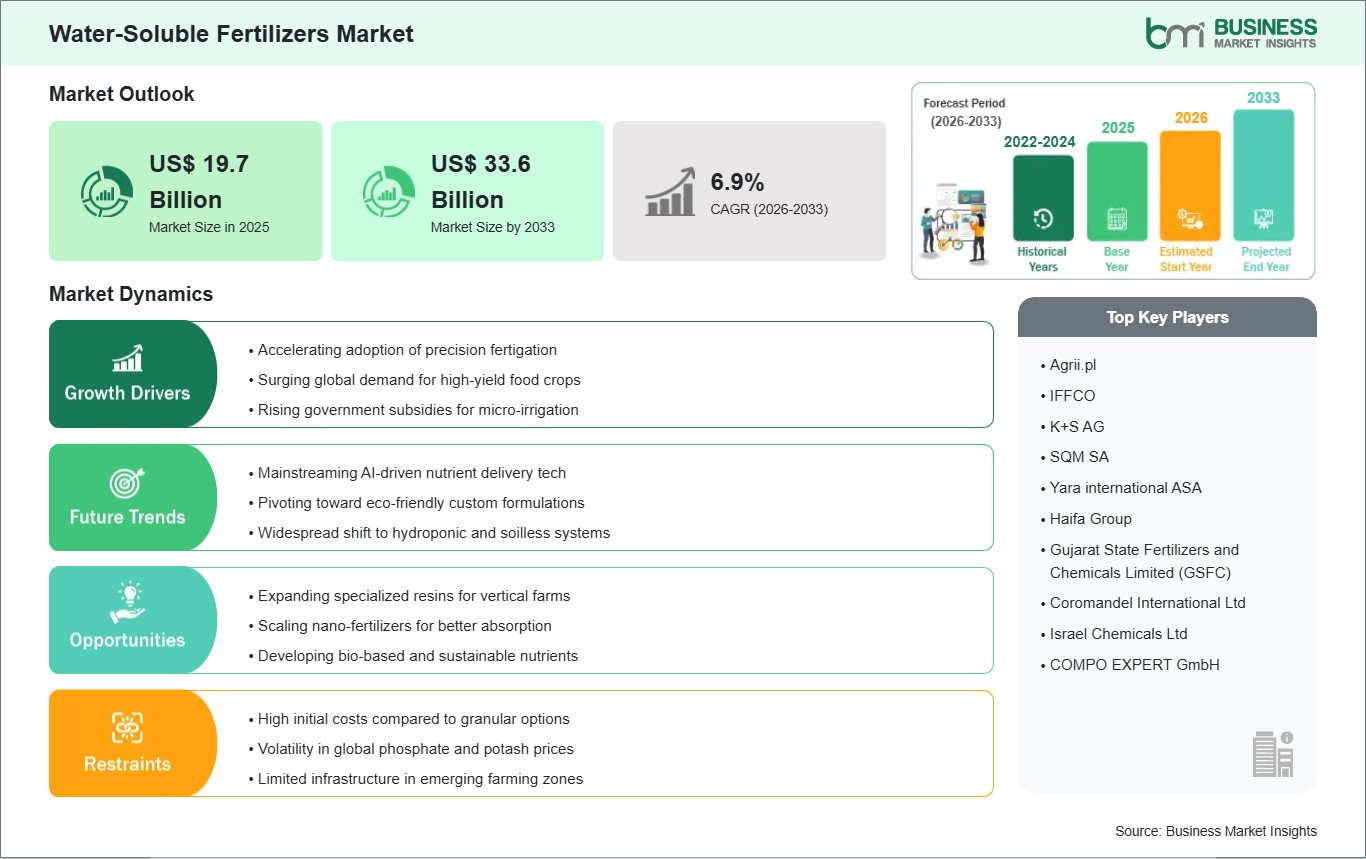
Water-Soluble Fertilizers (WSF) are crucial for modern agriculture, as these help in delivering essential nutrients directly to the plant through irrigation (fertigation) or foliar application. These specialized fertilizers are essential for core farming systems: precision agriculture, greenhouse cultivation, horticulture, and high-value field crops. WSFs offer advantages, including superior nutrient use efficiency (NUE), rapid nutrient absorption by plants, reduced environmental leaching, and precise control over nutrient ratios. The market is fueled by the accelerating global adoption of micro-irrigation systems (drip and sprinkler), the urgent need to increase yields and quality of high-value crops (fruits, vegetables, ornamentals), and the diminishing availability of arable land coupled with water scarcity.
However, several challenges restrain market growth: the initial cost of WSFs is significantly higher than that of conventional granular fertilizers, posing a financial barrier for smallholder farmers. Investment in or lack of suitable micro-irrigation infrastructure is a prerequisite for optimal use, which is missing in many developing regions. Furthermore, the industry faces constraints due to growing competition from the rapidly expanding organic fertilizers market and the need for specialized knowledge and training for farmers to properly formulate and apply the nutrient solutions. Despite these hurdles, opportunities arise driven by the increasing trend toward customized, crop-specific nutrient formulations, the development of advanced chelated micronutrient products, and substantial market dominance and growth in the Asia-Pacific region, where horticulture and greenhouse farming are rapidly expanding. Government subsidies and initiatives promoting sustainable, water-efficient farming are expected to open powerful new avenues for market expansion.
Segment Analysis
Water-Soluble Fertilizers Market Segmentation
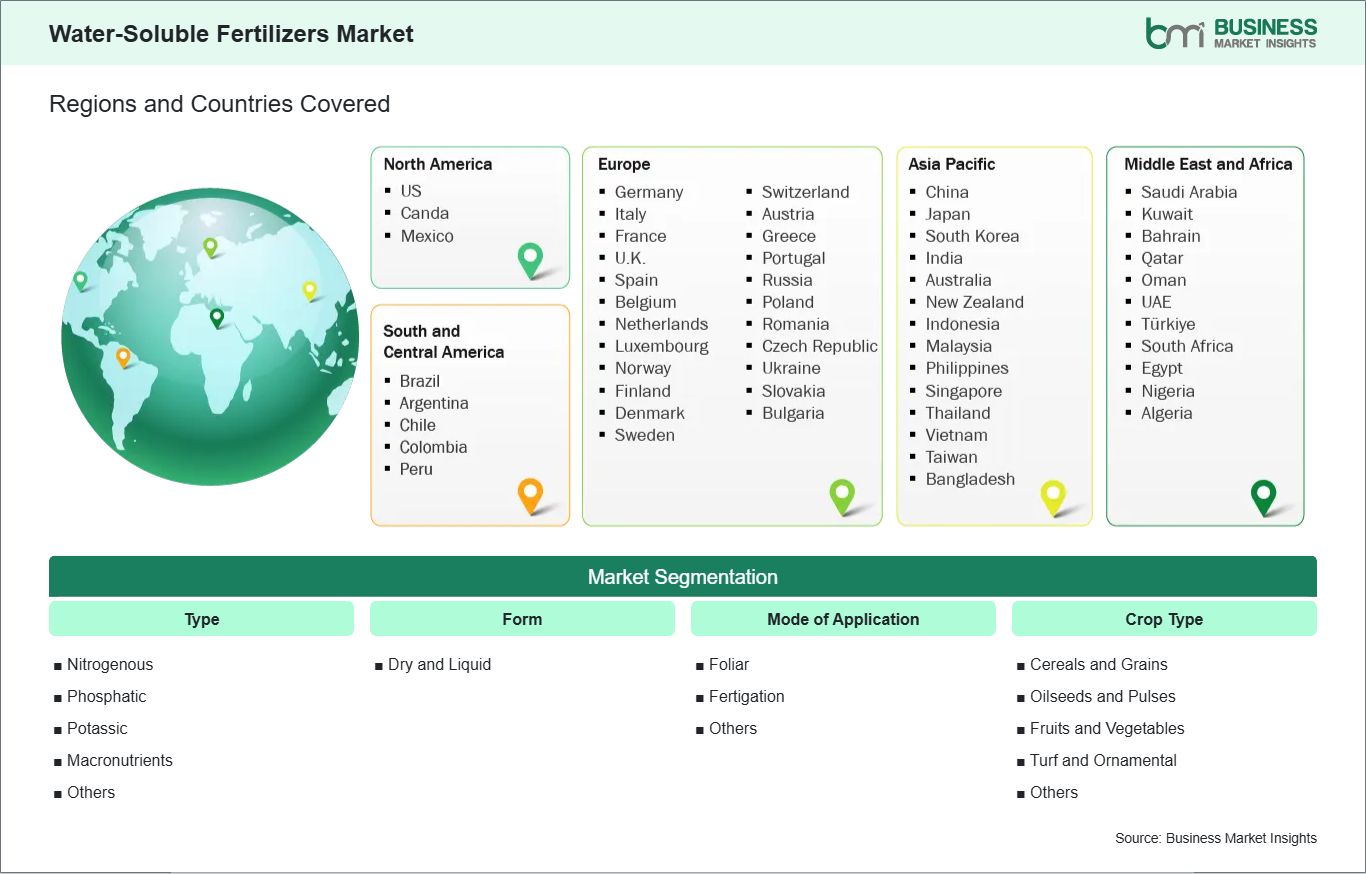
Key segments that contributed to the derivation of the Water-Soluble Fertilizers Market analysis are type, form, mode of application, and crop type.
- By Type, the market is segmented into Nitrogenous, Phosphatic, Potassic, Macronutrients, and Others.
- By Form, the market is segmented into Dry and Liquid.
- By Mode of Application, the market is segmented into Foliar, Fertigation, and Others.
- By Crop Type, the market is segmented into Cereals and Grains, Oilseeds and Pulses, Fruits and Vegetables, Turf and Ornamental, and Others. The Cereals and Grains segment is further divided into Corn, Wheat, Rice, and Others. The Oilseeds and Pulses segment is further categorized into Soybean, Sunflower, and Others. The Fruits and Vegetables segment is further divided into Root and Tuber Vegetables, Leafy Vegetables, Pome Fruits, Berries, Citrus Fruits, and Others.
Market Forces
Water-Soluble Fertilizers Market Drivers and Opportunities
Integration with Precision Irrigation
The core driver for the Water-Soluble Fertilizers (WSF) Market is the synergistic and growing adoption of micro-irrigation systems, drip and sprinkler technology, which makes WSFs a required input. Traditional granular fertilizers cannot be applied efficiently through these modern systems. WSFs are designed to dissolve completely in water, enabling their seamless application via fertigation (the method of applying dissolved fertilizers directly to the plant root zone via the irrigation water). This precision delivery drastically improves Nutrient Use Efficiency (NUE), often increasing it from 30–50% for conventional methods to over 80–90% for fertigation. The dual benefit of water conservation (critical in arid and semi-arid regions) and maximized yield from high-value horticultural crops is driving farmers, often supported by government subsidies for micro-irrigation, to transition from conventional broadcasting to WSF-based fertigation.
Customized Formulations
A significant high-value opportunity lies in the development of complex, crop-specific, and micronutrient-enriched WSF formulations and the rapid expansion of controlled-environment agriculture (CEA). High-value crops such as fruits, vegetables, and ornamentals have specific, changing nutritional needs at different growth stages. Manufacturers are capitalizing on this by creating specialized NPK (Nitrogen-Phosphorus-Potassium) blends fortified with essential micronutrients (iron, zinc, and boron) in highly available chelated forms. Furthermore, the global expansion of greenhouse and vertical farming is a captive market for WSFs. These intensive, soil-less systems (hydroponics, aeroponics) demand 100% water-soluble nutrient solutions for precise, year-round nutrient delivery, creating a high-growth, technology-driven segment that commands premium pricing.
Size and Share Analysis
Water-Soluble Fertilizers Market Size and Share Analysis
The Water-Soluble Fertilizers Market demonstrates steady growth, with size and share analysis revealing evolving trends and competitive positioning among key players. The report further examines subsegments categorized within type, form, mode of application, and crop type, offering insights into their contribution to overall market performance.
For instance, Nitrogenous fertilizers, primarily in Dry granular or powder form, are essential for all crops. This subsegment is driven by nitrogen's critical role in early crop growth and its widespread application globally. The Fertigation technique is a widely used application method, particularly for Fruits and Vegetables. It utilizes potassic and phosphatic fertilizers in both Dry and Liquid forms to maximize Nutrient Use Efficiency and enhance the yield and quality of high-value horticultural crops. These factors aid the Fertigation subsegment in holding a significant share of the market.
Geographic Insights
Water-Soluble Fertilizers Market Geographic Insights
The geographical scope of the Water-Soluble Fertilizers Market report is divided into five regions: North America, Asia Pacific, Europe, the Middle East & Africa, and South & Central America.
The Asia-Pacific Water-Soluble Fertilizers Market is segmented into China, Japan, South Korea, India, Australia, New Zealand, Indonesia, Malaysia, the Philippines, Singapore, Thailand, Vietnam, Taiwan, Bangladesh, and the Rest of Asia. The Asia-Pacific market is driven by rapidly shrinking arable land and the necessity for efficient nutrient delivery to maximize crop yields.
Growth is further propelled by the rising cultivation of high-value commercial crops (particularly fruits and vegetables) alongside increasing emphasis on sustainable farming practices and water-efficient irrigation in response to resource constraints. Additionally, government subsidies and promotional initiatives supporting fertigation technologies reinforce the Asia-Pacific region’s position as the primary global growth engine for water-soluble fertilizer demand.
Industry Activity
Recent Developments
The Water-Soluble Fertilizers Market is evaluated by gathering qualitative and quantitative data post-primary and secondary research, which includes important corporate publications, association data, and databases. A few of the key developments in the Water-Soluble Fertilizers Market are:
- In December 2025, Coromandel International Limited, an agri-solutions provider and a frontrunner in crop nutrition and specialty nutrients, announced the launch of Fertinex, a next-generation water-soluble fertilizer (WSF) specifically developed for fertigation applications. Developed through extensive in-house research and rigorous agronomic trials, Fertinex reflects Coromandel’s continued focus on innovation-led growth and farmer-centric solutions.
- In April 2025, Agrifields DMCC Will Expand To Korea, Introduce New Age Water Soluble Fertilizers In India by FY 26. The company plans to expand its footprint into Korea which is driven by the growing demand for agricultural products and the need for sustainable and efficient farming practices. The company aims to leverage its expertise and experience in the agricultural industry to tap into the new market and increase its global footprint.
- In February 2025, the Haifa Group introduced Haifa Soluble DUO, designed for fertigation to increase calcium input without adding excess nitrogen.
Trust & Transparency
Research Methodology
The market analysis combines proprietary research with secondary data from government agencies, company disclosures, regulatory filings, industry databases and expert interviews. Market estimates are validated through data triangulation, cross-market benchmarking and analyst
review.
View Full Research Methodology
Key Sources Referred:
World Bank - Global Trade IndicatorsWorld Trade Organization (WTO)International Monetary Fund (IMF)International Trade Administration (ITA)Company WebsitesCompany Annual ReportsCompany Investor Presentations