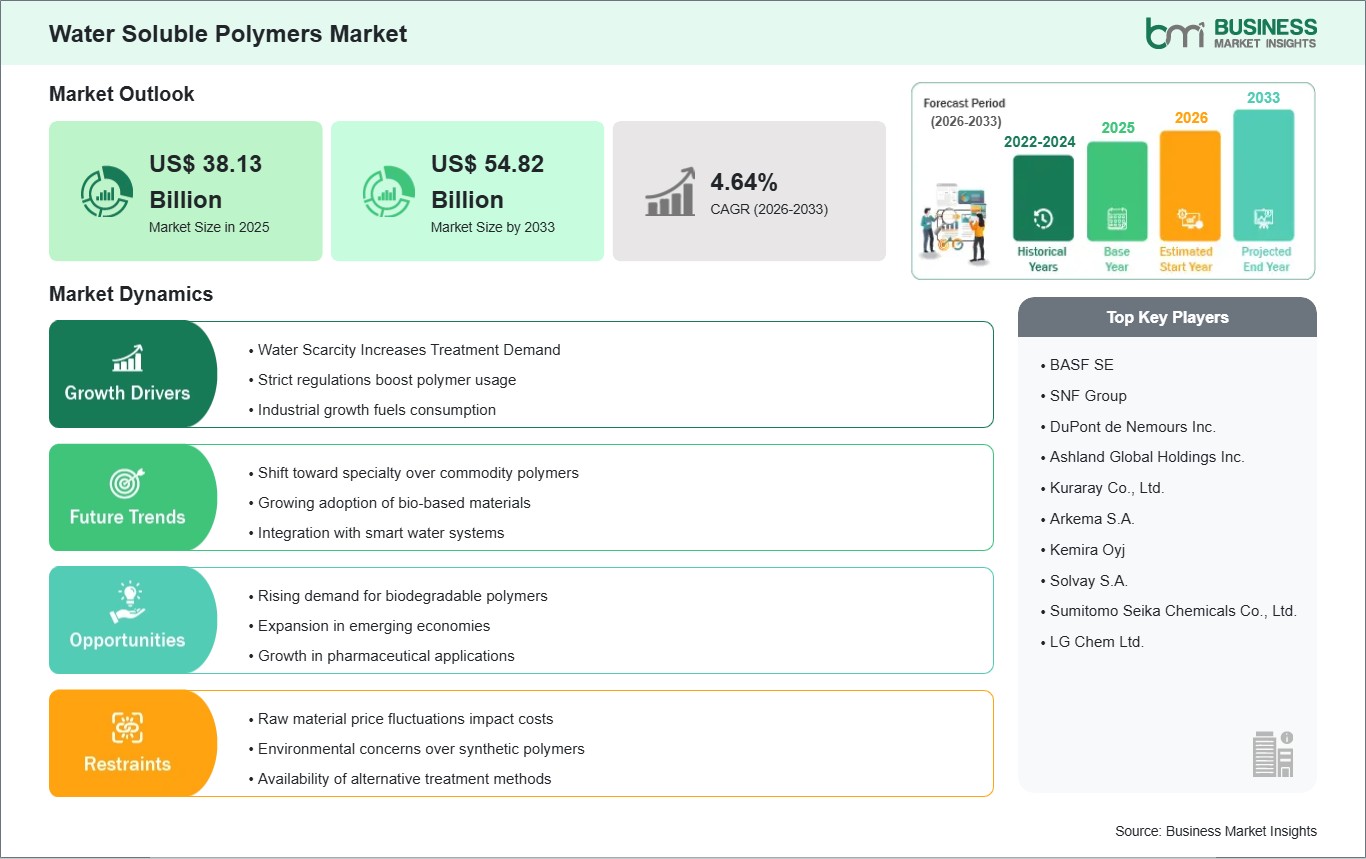
The Water Soluble Polymers Market size is expected to reach US$ 54.82 billion by 2033 from US$ 38.13 billion in 2025. The market is estimated to record a CAGR of 4.64% from 2026 to 2033.
The global water soluble polymers market is evolving as a critical enabler across industries that require efficient fluid management, stabilization, and environmentally responsive materials. These polymers are widely used in water treatment, oil & gas recovery, pharmaceuticals, food processing, and personal care due to their ability to dissolve, thicken, disperse, or bind in aqueous environments. A key driver shaping the global landscape is the growing emphasis on water conservation and wastewater treatment, particularly as governments and industries adopt stricter sustainability frameworks. Additionally, increasing demand from enhanced oil recovery and agricultural applications is strengthening market penetration in both developed and emerging economies.
Another important growth factor is the rising use of bio-based and biodegradable polymers, reflecting a shift toward eco-friendly formulations in response to environmental concerns. However, the market faces restraints such as volatility in raw material availability and pricing, particularly for petrochemical-derived inputs. Regulatory scrutiny over synthetic polymer disposal and potential ecological impact also presents a challenge, prompting manufacturers to invest in innovation and compliance. Overall, the global market is characterized by a balance between performance-driven demand and sustainability-led transformation, with ongoing advancements in polymer chemistry shaping its future trajectory.

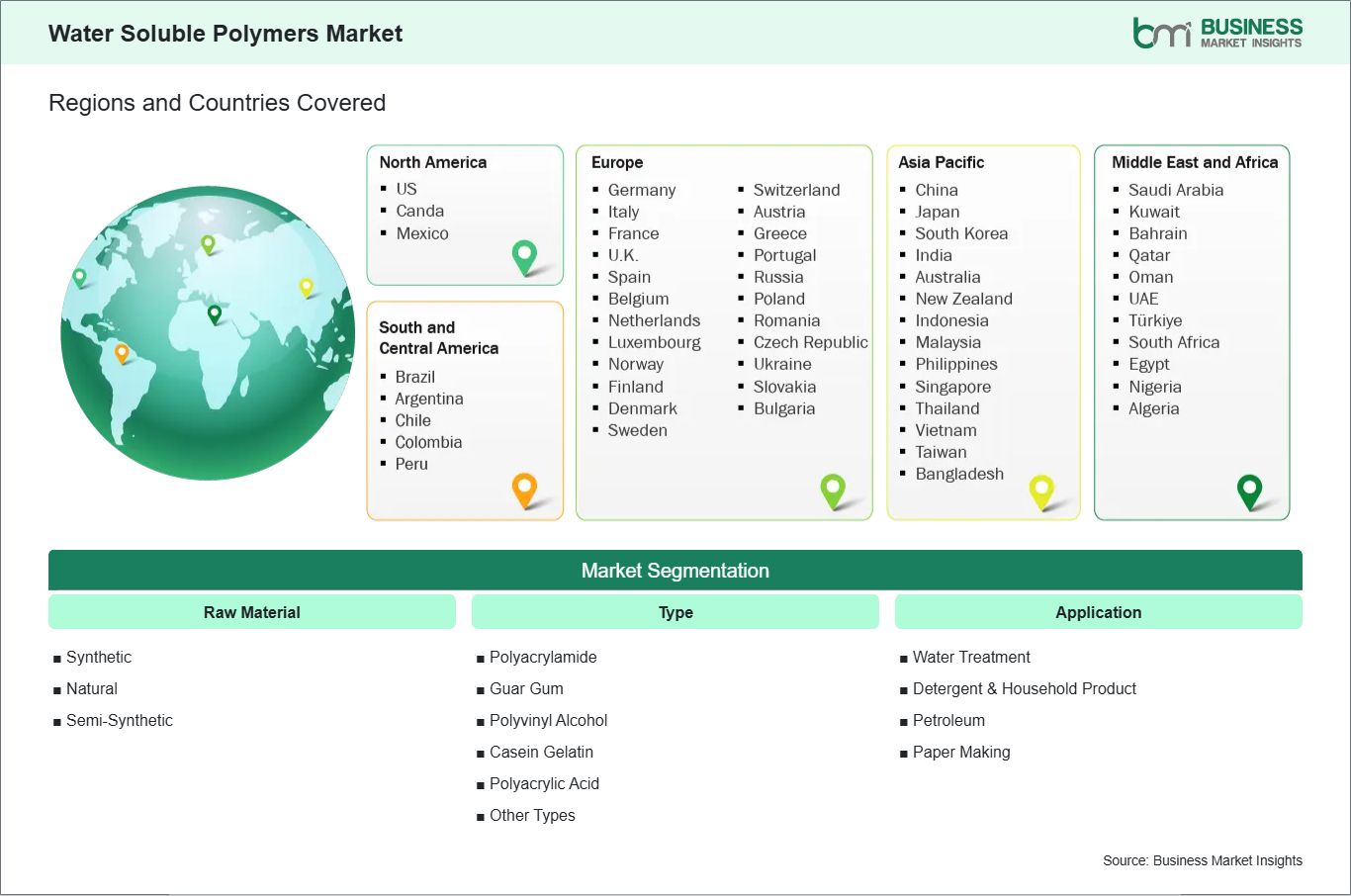
Key segments that contributed to the derivation of the water soluble polymers market analysis are material type, type, and application
Water scarcity is one of the major factors that is contributing to the increasing need for water soluble polymers. This is because many water treatment plants and industries are seeking effective means of conserving water that is increasingly becoming scarce. For instance, areas such as the western states in the US have been experiencing severe water shortages due to droughts. This has caused many water treatment plants to invest in new water treatment technologies that use water soluble polymers for coagulation and flocculation. Areas such as southern Europe and North Africa have been experiencing severe water shortages during the summer season.
Similarly, industrial users are increasing their polymer requirements as water reuse becomes essential for the sustainability of industrial processes. For example, in East Asia, semiconductor and textile industries in Taiwan and South Korea have expanded membrane bioreactors and secondary clarifiers, which utilize water-soluble polymers to treat industrial effluent to more stringent discharge requirements while conserving water resources. Industry sources show that polymer demand for industrial water treatment applications in the Asia Pacific region is increasing at a compound annual growth rate of 9-11% from 2022 to 2025, exceeding the growth rate for the chemical market.
In Latin American countries such as São Paulo and Mexico, the urban centers are facing challenges such as increasing populations and repeated dry seasons, thus increasing the rate of investment in water reuse programs. Water soluble polymers are being used not only in large-scale water treatment plants but also in small-scale water treatment plants. According to forecasts, the water soluble polymers used for water recovery and reuse activities are expected to account for 40-45% of the total water soluble polymers used in the region by the year 2030, compared to 30% in 2023.
Sustainability issues and more rigorous environmental regulations are driving the adoption of biodegradable and bio-based water soluble polymers in a variety of markets. In North America, food and beverage processors are moving away from synthetic polyacrylamide-based polymers and toward more natural alternatives like cellulose-based polymers, starch-based polymers, and guar-based polymers for applications like juice clarification, wash water treatment, and emulsion stabilization. Recent industry surveys have shown that nearly 28% of new polymer sales in the U.S. food industry in 2025 were for biodegradable polymers. This figure is forecasted to increase to more than 35% by 2030.
The markets in Western Europe are also driving the biodegradable and bio-based water soluble polymers market due to more rigorous discharge regulations for wastewater treatment plants in Europe. The Water Framework Directive in the EU has driven the adoption of biodegradable polymers in Europe. In addition, chemical companies in countries like Germany, the Netherlands, and Scandinavia are increasing their manufacturing capacity for bio-based water soluble polymers. Annual capacity increases of more than 15% are forecasted for this region up to 2028.
In addition, emerging markets in South and Southeast Asia have witnessed similar trends in this regard, where incentives and demand for biodegradable polymers are helping to boost growth in this area. In India, for example, the cosmetics and home care industries have started to look towards natural sources such as guar gum and cassava starch, which is now more favored for its sustainable properties. From export statistics for Southeast Asian nations, it is evident that bio-based polymer intermediates have grown by about 22% in 2024, reflecting global interest in sustainable polymer solutions.

The global water soluble polymers market is experiencing steady growth, with market size and share analysis reflecting evolving treatment preferences and competitive dynamics among key players. The report evaluates important subsegments categorized within material type, type, and application highlighting their respective contributions to overall market performance.
By material type, the synthetic subsegment dominated the market in 2025 because they provide consistent quality, customizable properties, and cost-effectiveness. They are suitable for a variety of industrial conditions where natural or semi-synthetic polymers may fail, making them the preferred choice for large-scale water treatment, petroleum, and detergent applications.
By type, the polyacrylamide segment subsegment dominated the market in 2025 due to due to its excellent flocculation, coagulation, and thickening properties. It is highly efficient in water purification, oil recovery, and industrial processes, which makes it the most widely used water-soluble polymer globally.
By application, the water treatment subsegment dominated the market in 2025 because water treatment is the largest application segment because of increasing global water scarcity, stringent environmental regulations, and rising industrial & municipal wastewater management needs.
| Report Attribute | Details |
|---|---|
| Market size in 2025 | US$ 38.13 Billion |
| Market Size by 2033 | US$ 54.82 Billion |
| Global CAGR (2026 - 2033) | 4.64% |
| Historical Data | 2022-2024 |
| Forecast period | 2026-2033 |
| Segments Covered | By Raw Material
|
|
Regions and Countries Covered
| |
| North America | US, Canada, Mexico |
| Europe | Belgium, Austria, Finland, Denmark, Greece, Poland, Romania, Russia, Ukraine, Czech Republic, Slovakia, Bulgaria, Italy, Luxembourg, Germany, Switzerland, France, Netherlands, Norway, Portugal, Spain, Sweden, United Kingdom |
| Asia-Pacific | Australia, China, India, Japan, South Korea, Indonesia, Malaysia, Philippines, Singapore, Thailand, Vietnam, Bangladesh, New Zealand, Taiwan |
| South and Central America | Brazil, Argentina, Peru, Chile, Colombia |
| Middle East and Africa | Bahrain, Kuwait, Oman, Qatar, Saudi Arabia, United Arab Emirates, Turkiye, South Africa, Egypt, Algeria, Nigeria |
| Market leaders and key company profiles |
|
The "Water soluble polymers market Size and Forecast (2022 - 2033)" report provides a detailed analysis of the market covering below areas:
The geographical scope of the Water soluble polymers market report is divided into: North America, Asia Pacific, Europe, Middle East & Africa, and South & Central America. North America held the largest share in 2025.
North America leads the global water soluble polymers market due to its mature industrial base, strong regulatory environment, and high adoption of advanced water treatment technologies. The region benefits from a well-established infrastructure for wastewater management, where water soluble polymers play a crucial role in flocculation, coagulation, and sludge treatment processes. Industrial sectors such as oil & gas, particularly in unconventional extraction methods, continue to drive demand for high-performance polymers that enhance recovery efficiency and operational stability. The United States remains the central contributor, supported by ongoing investments in sustainable industrial practices and a strong focus on environmental compliance. Additionally, the region’s pharmaceutical and personal care industries contribute significantly to polymer demand, as these materials are essential in formulations requiring controlled solubility and viscosity. Innovation is a defining characteristic of the North American market, with companies actively developing bio-based alternatives and multifunctional polymers to meet evolving regulatory and consumer expectations. Canada also plays a supporting role, particularly in resource-driven applications and water infrastructure development. Overall, the region’s dominance is reinforced by technological leadership, regulatory clarity, and consistent demand across diverse end-use sectors.

The water soluble polymers market is evaluated by gathering qualitative and quantitative data post primary and secondary research, which includes important corporate publications, association data, and databases. A few of the key developments in the Water soluble polymers market are:
The Water Soluble Polymers Market is valued at US$ 38.13 Billion in 2025, it is projected to reach US$ 54.82 Billion by 2033.
As per our report Water Soluble Polymers Market, the market size is valued at US$ 38.13 Billion in 2025, projecting it to reach US$ 54.82 Billion by 2033. This translates to a CAGR of approximately 4.64% during the forecast period.
The Water Soluble Polymers Market report typically cover these key segments-
The historic period, base year, and forecast period can vary slightly depending on the specific market research report. However, for the Water Soluble Polymers Market report:
The Water Soluble Polymers Market is populated by several key players, each contributing to its growth and innovation. Some of the major players include:
The Water Soluble Polymers Market report is valuable for diverse stakeholders, including:
Essentially, anyone involved in or considering involvement in the Water Soluble Polymers Market value chain can benefit from the information contained in a comprehensive market report.
Please tell us your area of interest
(Market Segments/ Regions and Countries/ Companies)