Market Summary
Executive Summary and Global Market Analysis
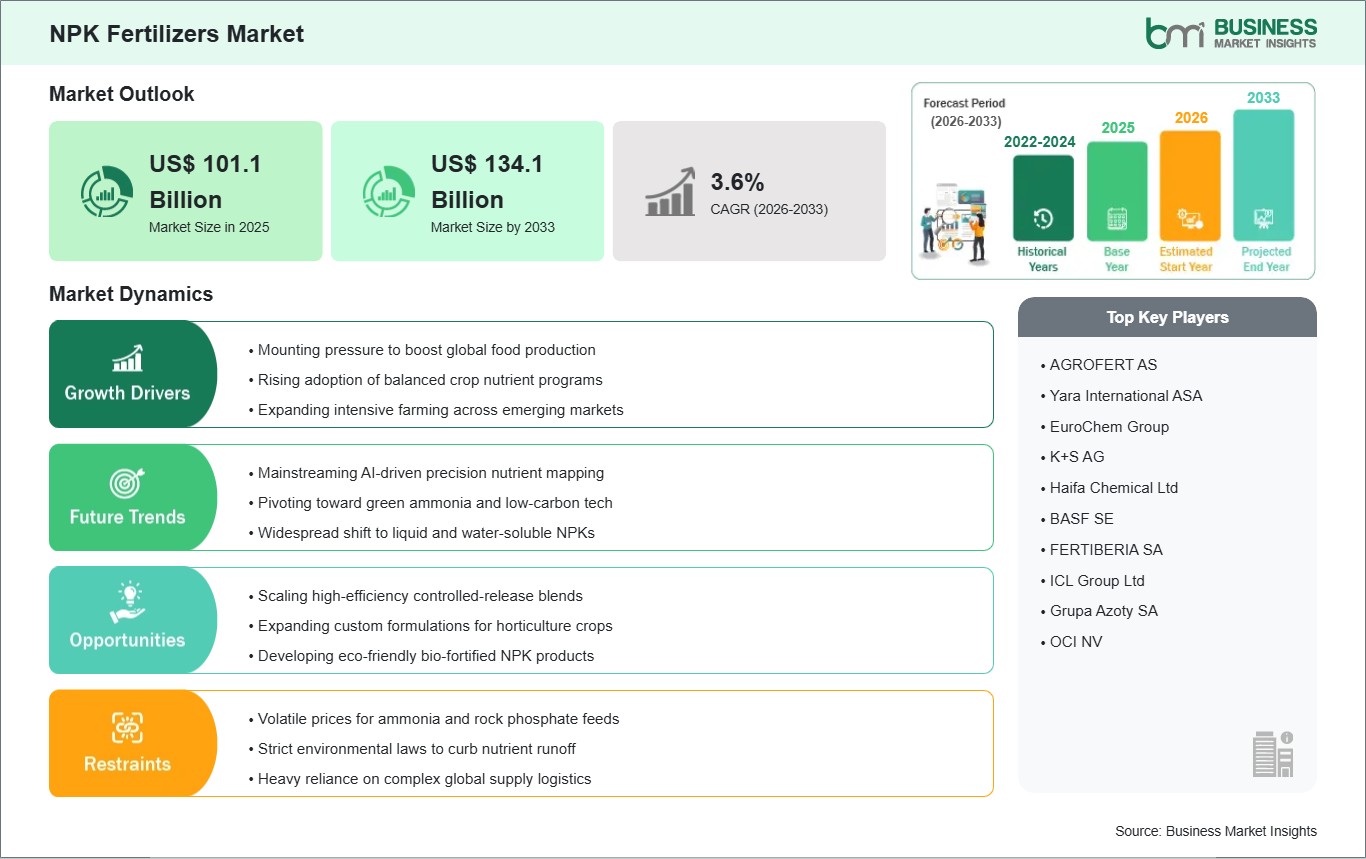
NPK fertilizers play a key role in global food security by supplying the main nutrients plants need: Nitrogen (N), Phosphorus (P), and Potassium (K). They are used in all types of agriculture, from large farms to greenhouses. NPK fertilizers help match nutrients to soil needs, speed up crop growth, and increase harvests. The market is growing due to rising food demand, more use of precision farming, and government efforts to improve soil health with balanced fertilizers instead of single-nutrient products like urea.
However, several challenges restrain market growth, such as farmers being sensitive to price changes and the costs of raw materials, such as ammonia and potash, making long-term planning difficult. Environmental concerns about nutrient runoff are leading to stricter rules in many areas. There is also more competition from biological and organic soil products. Despite these hurdles, there are lucrative opportunities, such as move to specialty liquid and water-soluble NPK blends, and use of smart soil sensors to improve fertilizer use. New low-carbon and climate-friendly NPK products are also expected to help the market grow.
Segment Analysis
NPK Fertilizers Market Segmentation
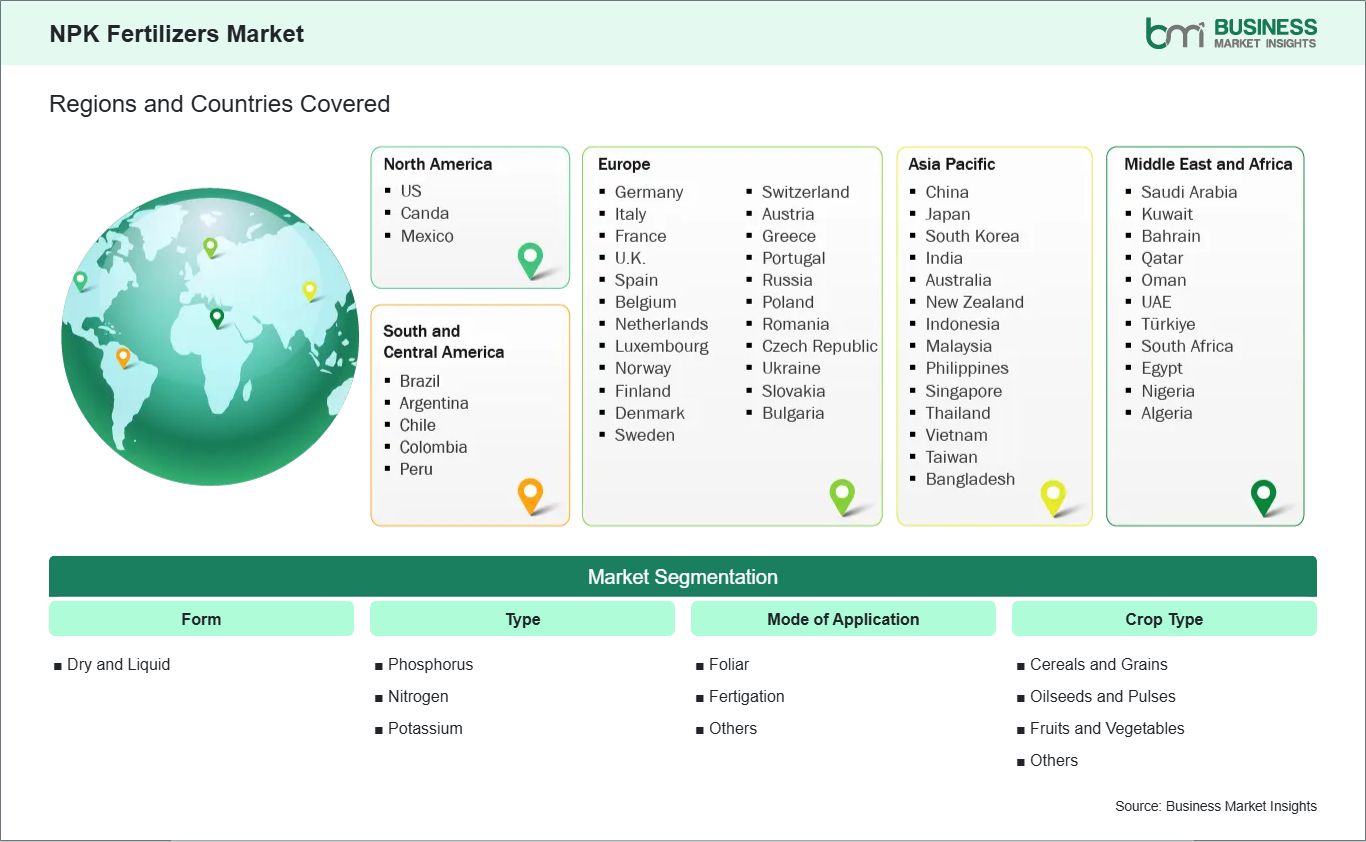
Key segments that contributed to the derivation of the NPK Fertilizers Market analysis are form, type, mode of application, and crop type.
- By Form, the market is segmented into Dry and Liquid.
- By Type, the market is segmented into Phosphorus, Nitrogen, and Potassium.
- By Mode of Application, the market is segmented into Foliar, Fertigation, and Others.
- By Crop Type, the market is segmented into Cereals and Grains, Oilseeds and Pulses, Fruits and Vegetables, and Others. The Cereals and Grains segment is further divided into Corn, Wheat, Rice, and Others. The Oilseeds and Pulses segment is further categorized into Soybean, Sunflower, and Others. The Fruits and Vegetables segment is further divided into Root and Tuber Vegetables, Leafy Vegetables, Pome Fruits, Berries, Citrus Fruits, and Others.
Market Forces
NPK Fertilizers Market Drivers and Opportunities
Global Food Security and Crop Intensification
The most powerful driver for the NPK (Nitrogen, Phosphorus, and Potassium) market is the urgent global imperative to maximize food production on a shrinking per-capita base of arable land. As the world population trends toward 9.7 billion by 2050, agricultural systems are shifting from extensive to intensive farming. NPK fertilizers are the fundamental tools for this intensification, providing the "big three" macronutrients required for healthy plant development: Nitrogen for vegetative growth, Phosphorus for root and flower strength, and Potassium for overall disease resistance. As modern high-yield crop varieties (especially cereals and oilseeds) are heavy "nutrient feeders," they rapidly deplete natural soil fertility. This creates a non-negotiable, recurring demand for balanced NPK applications to prevent yield gaps and meet the escalating global caloric and protein requirements.
Precision Nutrients and Specialty Formulations
A major opportunity exists in the transition from bulk "one-size-fits-all" fertilizers to customized, specialty NPK formulations integrated with precision agriculture. Traditional broad-spectrum application often leads to nutrient runoff and economic waste. The market is rapidly moving toward Controlled-Release Fertilizers (CRFs) and water-soluble NPKs designed for fertigation. These high-value products allow for "spoon-feeding" nutrients to the plant exactly when they are needed, drastically improving Nutrient Use Efficiency (NUE). Additionally, there is a burgeoning niche for micronutrient-fortified NPKs (adding Zinc, Boron, or Manganese) and bio-augmented blends that combine chemical nutrients with beneficial microbes to improve soil health. These advanced products allow manufacturers to command premium prices while helping farmers comply with tightening environmental regulations regarding nutrient leaching.
Size and Share Analysis
NPK Fertilizers Market Size and Share Analysis
The NPK Fertilizers Market demonstrates steady growth, with size and share analysis revealing evolving trends and competitive positioning among key players. The report further examines subsegments categorized within form, type, mode of application, and crop type, offering insights into their contribution to overall market performance.
For instance, the Foliar mode of application is the leading method for rapid nutrient delivery, frequently utilizing liquid NPK blends. This approach is highly effective for addressing immediate nutrient deficiencies and is increasingly used in the cultivation of high-value fruits and vegetables to improve crop quality and yield. Therefore, the Foliar subsegment is likely to hold significant share of the overall market in the upcoming years.
Report Coverage
NPK Fertilizers Market Report Coverage and Deliverables
The "NPK Fertilizers Market Size and Forecast (2022 - 2033)" report provides a detailed analysis of the market covering below areas:
- NPK Fertilizers Market size and forecast at global, regional, and country levels for all the key market segments covered under the scope
- NPK Fertilizers Market trends, as well as market dynamics such as drivers, restraints, and key opportunities
- NPK Fertilizers Market analysis covering key market trends, global and regional framework, major players, regulations, and recent market developments
- Industry landscape and competition analysis covering market concentration, heat map analysis, prominent players, and recent developments for the NPK Fertilizers Market
- Detailed company profiles, including SWOT analysis
Geographic Insights
NPK Fertilizers Market Geographic Insights
The geographical scope of the NPK Fertilizers Market report is divided into five regions: North America, Asia Pacific, Europe, the Middle East & Africa, and South & Central America.
The Asia-Pacific NPK Fertilizers Market is segmented into China, Japan, South Korea, India, Australia, New Zealand, Indonesia, Malaysia, the Philippines, Singapore, Thailand, Vietnam, Taiwan, Bangladesh, and the Rest of Asia. The Asia-Pacific market is primarily driven by the region’s massive agricultural sector and the urgent need for food security to support an expanding population.
Growth is further bolstered by the increasing adoption of precision farming and fertigation technologies, particularly in the production of high-value horticultural crops such as fruits and vegetables. The presence of major manufacturing hubs and the push for soil health restoration through customized nutrient ratios solidify Asia-Pacific as the global engine for NPK fertilizer demand and innovation.
Industry Activity
Recent Developments
The NPK Fertilizers Market is evaluated by gathering qualitative and quantitative data post-primary and secondary research, which includes important corporate publications, association data, and databases. A few of the key developments in the NPK Fertilizers Market are:
- In February 2025, Haifa North West Europe (NWE) introduced Haifa Soluble DUO, an innovative water-soluble fertilizer that enables growers to increase calcium input without adding extra nitrogen, chlorides, or sulphates, or reduce nitrogen without compromising the supply of essential nutrients such as potassium and calcium. This groundbreaking product is specifically designed for fertigation, offering growers an efficient and sustainable solution to optimize their cultivation strategies.
- In April 2025, Yara’s technology has transformed a granular product into a water-soluble fertilizer, making it the first of its kind and more affordable than other water-soluble fertilizers on the market. YaraRega™ is a competitive alternative to traditional fertigation fertilizers and has been designed for field crops irrigated with drippers or spray units.
Trust & Transparency
Research Methodology
The market analysis combines proprietary research with secondary data from government agencies, company disclosures, regulatory filings, industry databases and expert interviews. Market estimates are validated through data triangulation, cross-market benchmarking and analyst
review.
View Full Research Methodology
Key Sources Referred:
World Bank - Global Trade IndicatorsWorld Trade Organization (WTO)International Monetary Fund (IMF)International Trade Administration (ITA)Company WebsitesCompany Annual ReportsCompany Investor Presentations