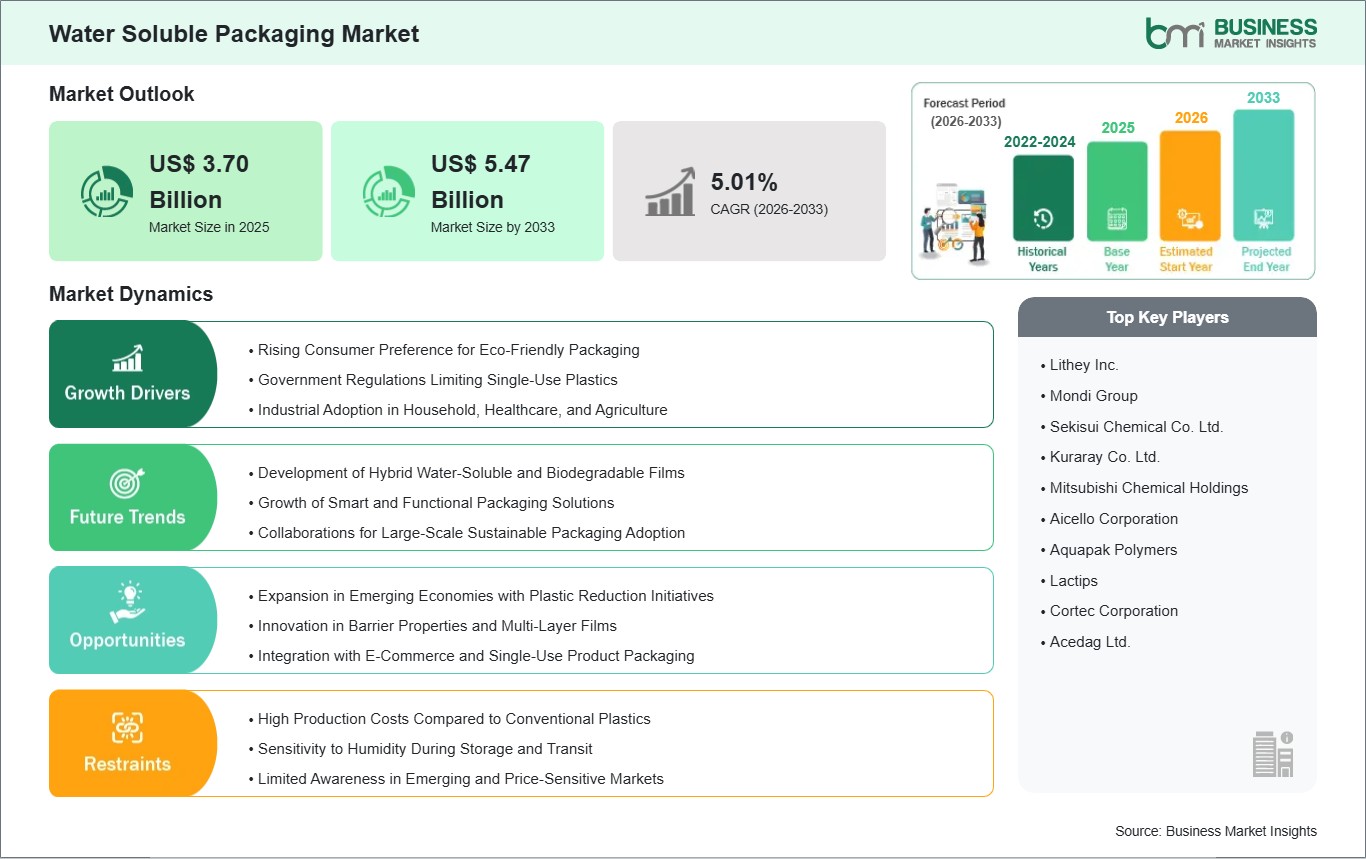
The Water Soluble Packaging Market size is expected to reach US$ 5.47 billion by 2033 from US$ 3.7 billion in 2025. The market is estimated to record a CAGR of 5.01% from 2026 to 2033.
The global water-soluble packaging market is currently undergoing rapid transformation because businesses and policymakers, together with consumers, now view sustainability, waste reduction and circular economy principles as essential goals. Water-soluble packaging encompasses packages and films that dissolve in water through polymers, which include polyvinyl alcohol (PVOH) and other biodegradable polymers that dissolve when exposed to water. These solutions become especially valuable for single‑use packaging applications, which include laundry and dish detergent pods, agricultural sachets and industrial chemical packaging, because their primary goal is to eliminate plastic waste while reducing environmental damage. Water-soluble packaging presents an effective waste solution because it enables complete material dissolution, which prevents microplastic contamination of soil and waterways. The main market driver exists because regulations now demand reduced single-use plastic usage, while they promote the development of sustainable packaging solutions through regulatory pressure.
North American and European governments enforce bans and taxes and extended producer responsibility regulations to promote the adoption of water-soluble materials. Consumer preferences are now shifting toward eco‑friendly products because sustainability certifications and green branding have become key factors in purchasing decisions. The household care, personal care, healthcare and agriculture industries now choose water-soluble packaging because it offers two advantages: easy use and reduced environmental impact. Water-soluble films serve the healthcare industry through their application in single-dose drug delivery systems and diagnostic test strips, which require both sterilization and ecological protection. The market shows strong potential yet encounters specific limitations that restrict its growth.
Water-soluble packaging materials generally produce higher manufacturing expenses than traditional plastic films, which results in decreased market access for price-sensitive customers and emerging market territories. Performance concerns require strict testing standards and testing standards because products need to show they can handle humidity and water contact during both storage and transportation. Organizations face difficulty in maintaining product performance while managing storage requirements and expenses. Water-soluble packaging solutions now exist as a sustainable packaging option that multiple global industries can use because ongoing material research has developed better barrier materials and hybrid product designs.

Key segments that contributed to the derivation of the water soluble packaging market analysis are raw material, end use, solubility type, and packaging type.
The global water-soluble packaging market experiences its strongest growth because consumers now understand environmental sustainability better than before. The current shopping behavior of consumers enables them to understand plastic pollution better than before, which has led all brands, from household products to personal care items and food products, to change their packaging methods. Water-soluble packaging functions because it uses polyvinyl alcohol and other water-soluble polymers to create packaging that makes laundry pods, detergent sachets and single-dose agricultural chemicals fully dissolve in water, thus eliminating plastic waste while promoting a sustainable product lifecycle. North American and European consumers who value environmental protection show a strong preference for this benefit, which has made green purchasing patterns become important for companies, who have changed their brand approaches and product selection.
In developed markets, brands are highlighting their eco-credentials through water-soluble films, which they use to showcase their dedication to sustainability, as part of their product value proposition. Consumer packaged goods makers use these materials to create products that they can market as "zero-waste" because customers will find them easier to use. Water-soluble packaging is becoming more popular in the healthcare and pharmaceutical industries because it provides safe unit-dose packaging that protects the environment while making it easier for patients to handle their medications.
Emerging markets are experiencing this trend because environmental awareness campaigns from NGOs and governments expose the ecological damage caused by plastic waste. People in regions where price competition exists choose to pay extra for products that use sustainable packaging materials that match their environmental values. The worldwide increase in awareness, together with rising expectations, has created a consumer demand for sustainable packaging. This demand drives the adoption of water-soluble packaging in multiple product categories across different regions.
Emerging economies are driving new growth trajectories for the global water soluble packaging market, largely due to increasing governmental emphasis on reducing plastic waste and building more sustainable industrial ecosystems. Countries across Asia Pacific, Latin America, and parts of Africa are implementing policies that discourage single‑use plastics, aligning with global commitments under frameworks like the UN Environment Programme. India’s Plastic Waste Management Rules and Indonesia’s commitments to cut ocean plastic are examples of regulatory environments that are motivating both local manufacturers and multinational brands to explore water soluble alternatives, particularly in fast‑moving consumer goods and agricultural sectors.
In Asia Pacific, rapidly growing consumer markets and expanding middle classes are creating high demand for packaged goods — from detergents to food and personal care items with sustainability positioned as a key purchasing criterion. Water soluble packaging solutions fit well into initiatives that seek to transition away from traditional plastics without compromising functionality or consumer convenience.
Governments are supporting adoption through incentives, pilot programs, and partnerships with private sector stakeholders, particularly for products distributed through modern retail and e‑commerce channels, where packaging waste can be highly visible.South & Central American countries are also exploring plastic reduction strategies, often in collaboration with industry coalitions and international agencies that promote circular economy models. In these regions, water soluble packaging is gaining ground in agricultural inputs such as fertilizer and pesticide sachets, where precise dosing and reduced packaging waste deliver both environmental and operational benefits. As emerging economies balance rapid industrial growth with sustainability mandates, water soluble packaging is increasingly seen not just as an environmental solution but as a strategic component of national plastic reduction initiatives worldwide.
The water soluble packaging market demonstrates steady growth, with size and share analysis highlighting evolving trends and competitive dynamics among key players. The report examines subsegments categorized within raw material, end use, solubility type, and packaging type, offering insights into their contribution to overall market performance.
By raw material, the polymers subsegment dominated the market in 2025, driven by their excellent film-forming properties, biodegradability, and wide applicability in water-soluble packaging.
In terms of end use, the industrial subsegment dominated the market in 2025, driven by the high demand from chemicals, food & beverage, and agricultural industries.
Based on solubility type, the cold water soluble subsegment dominated the market in 2025, driven by its extensive use in detergents and cleaning applications requiring quick dissolution.
By packaging type, the pouches subsegment dominated the market in 2025, driven by their convenience, ease of handling, and widespread adoption in packaging applications.
| Report Attribute | Details |
|---|---|
| Market size in 2025 | US$ 3.70 Billion |
| Market Size by 2033 | US$ 5.47 Billion |
| Global CAGR (2026 - 2033) | 5.01% |
| Historical Data | 2022-2024 |
| Forecast period | 2026-2033 |
| Segments Covered | By Raw Material
|
|
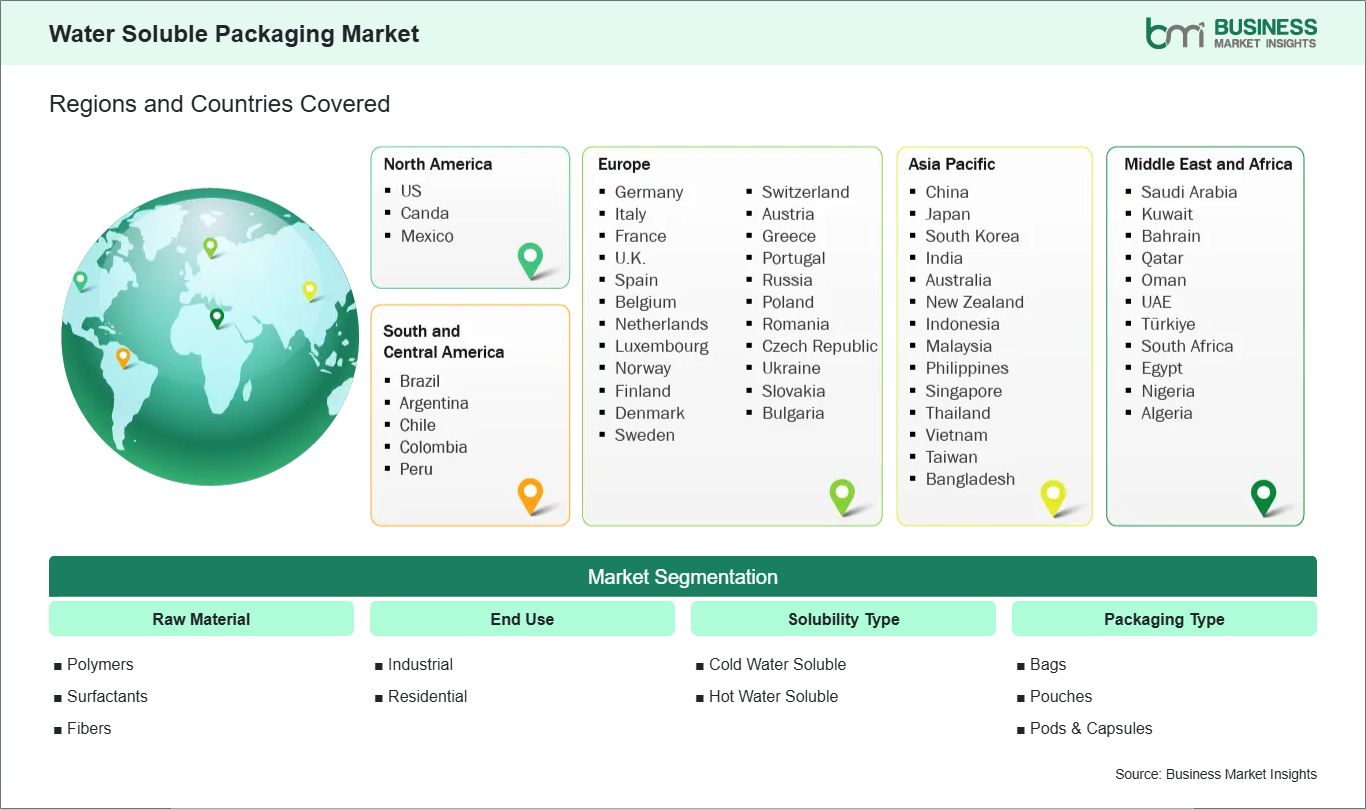
Regions and Countries Covered
| |
| North America | US, Canada, Mexico |
| Europe | Belgium, Austria, Finland, Denmark, Greece, Poland, Romania, Russia, Ukraine, Czech Republic, Slovakia, Bulgaria, Italy, Luxembourg, Germany, Switzerland, France, Netherlands, Norway, Portugal, Spain, Sweden, United Kingdom |
| Asia-Pacific | Australia, China, India, Japan, South Korea, Indonesia, Malaysia, Philippines, Singapore, Thailand, Vietnam, Bangladesh, New Zealand, Taiwan |
| South and Central America | Brazil, Argentina, Peru, Chile, Colombia |
| Middle East and Africa | Bahrain, Kuwait, Oman, Qatar, Saudi Arabia, United Arab Emirates, Turkiye, South Africa, Egypt, Algeria, Nigeria |
| Market leaders and key company profiles |
|
The "Water Soluble Packaging Market Size and Forecast (2022 - 2033)" report provides a detailed analysis of the market covering below areas:
The geographical scope of the Water Soluble Packaging Market report is divided into North America, Asia Pacific, Europe, Middle East & Africa, and South & Central America. North America held the largest share in 2025.
North America holds the top position in the worldwide water-soluble packaging market because of its strict regulations against single-use plastics and its high public awareness of environmental sustainability, combined with its extensive use of water-soluble packaging by multiple industries, including household care, healthcare and agriculture. The United States and Canada have seen strong integration of water-soluble films in laundry and dishwasher pods, unit-dose pharmaceuticals, and agricultural sachets, which advanced research and development efforts between manufacturers and research institutions proved through their development of improved barrier properties and moisture resistance.
Europe follows closely with Germany, France and the Netherlands, implementing policy measures and incentives which drive major FMCG companies to switch from traditional plastics to water-soluble materials for their consumer goods and industrial chemical packaging needs.
In the Asia Pacific region, countries such as Japan, China and India experience growth because of rising environmental concerns and government campaigns to reduce plastic waste and increasing industrialization, while water-soluble packaging becomes popular in both household products and agricultural applications despite challenges from cost sensitivity and supply chain issues.
The Middle East and Africa region is experiencing gradual improvement as governmental entities and industrial sectors work on developing sustainable waste management solutions, which also help to solve water scarcity problems; the agricultural and industrial applications of these solutions depend on local climate conditions and available infrastructure.
The South and Central American region demonstrates growing demand, which primarily exists between Brazil and Argentina because agritech companies in these countries test water-soluble sachets for fertilizers and agrochemicals while urban consumers develop higher understanding of eco-friendly packaging. Across all regions, the key drivers include regulatory pressure, corporate sustainability goals, and increasing consumer preference for environmentally responsible products, while challenges such as higher material costs and sensitivity to humidity remain consistent considerations.
The North American region maintains its position as the leading market, while other markets develop their adoption rates through worldwide advancements in technology, public knowledge and infrastructure development.

The Water Soluble Packaging Market is evaluated by gathering qualitative and quantitative data post primary and secondary research, which includes important corporate publications, association data, and databases. A few of the key developments in the water soluble packaging market are:
The Water Soluble Packaging Market is valued at US$ 3.70 Billion in 2025, it is projected to reach US$ 5.47 Billion by 2033.
As per our report Water Soluble Packaging Market, the market size is valued at US$ 3.70 Billion in 2025, projecting it to reach US$ 5.47 Billion by 2033. This translates to a CAGR of approximately 5.01% during the forecast period.
The Water Soluble Packaging Market report typically cover these key segments-
The historic period, base year, and forecast period can vary slightly depending on the specific market research report. However, for the Water Soluble Packaging Market report:
The Water Soluble Packaging Market is populated by several key players, each contributing to its growth and innovation. Some of the major players include:
The Water Soluble Packaging Market report is valuable for diverse stakeholders, including:
Essentially, anyone involved in or considering involvement in the Water Soluble Packaging Market value chain can benefit from the information contained in a comprehensive market report.
Please tell us your area of interest
(Market Segments/ Regions and Countries/ Companies)